Introduction to Design Patterns (original) (raw)
Last Updated : 5 May, 2026
Design patterns are reusable solutions to common software design problems that help create structured and well-organized systems. They provide proven approaches that make code easier to understand and extend.
- Improve code structure and maintainability by organizing solutions in a clear and consistent way.
- Enhance scalability, flexibility, and reusability while promoting standardized design practices.
**Example: A common example is the _Singleton Pattern, which ensures that a class has only one instance and provides a global point of access to it (e.g., a database connection manager).
Types of Design Patterns
Creational, Structural, and Behavioral Design Patterns -three categories that define how objects are created, organized, and how they interact.
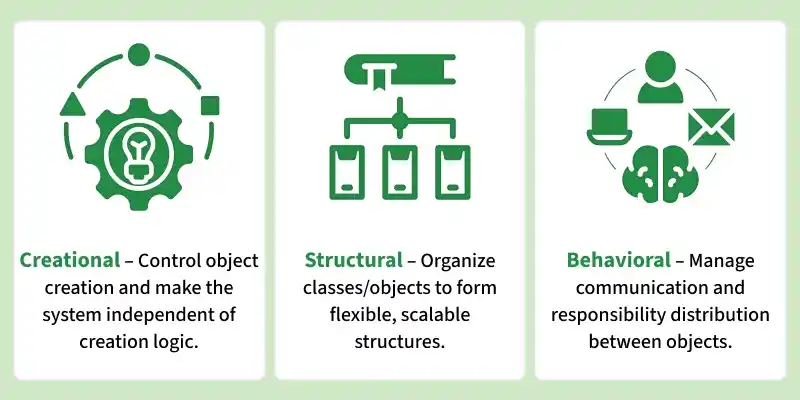
Types
Basically, there are several types of design patterns that are commonly used in software development.
Use cases
Design patterns offer several important benefits in software development:
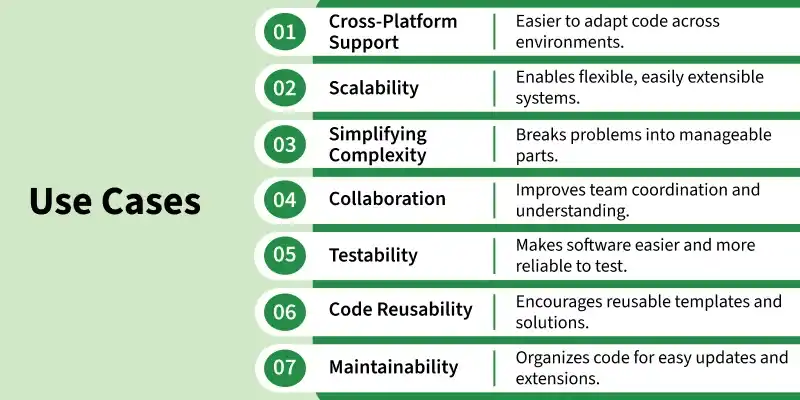
Use Cases
Design patterns are a valuable tool in software development, and they offer various benefits and uses, some of them are explained below :
- **Cross-Platform Support : Design patterns are not tied to a specific programming language or platform. They are general guidelines that can be applied across different technologies, making it easier to adapt your code to different environments.
- **Improving Scalability: Design patterns, particularly structural patterns, allow us to create a flexible and extensible architecture, making it easier to add new features or components.
- **Simplifying Complex Problems: Complex software problems can be broken down into smaller, more manageable components using design patterns. This simplifies development by addressing one problem at a time and, in turn, makes the code more maintainable.
- **Enhancing Collaboration: Design patterns provide a common language and a shared understanding among team members. They enable developers to communicate effectively and collaborate on software projects by referring to well-known design solutions.
- **Improving Testability: Code designed with patterns in mind is often more modular and easier to test. we can write unit tests for individual components or classes, leading to more reliable and robust software.
- **Promoting Code Reusability: Design patterns encapsulate solutions to recurring design problems. By using these patterns, we can create reusable templates for solving specific problems in different parts of your application.
- **Enhancing Maintainability: Design patterns help organize code in a structured and consistent way. This makes it easier to maintain, update, and extend the codebase. Developers familiar with the patterns can quickly understand and work on the code.
Applications
Basically, design patterns should be used when they provide a clear and effective solution to a recurring problem in our software design. Here are some situations where we can use the design patterns.
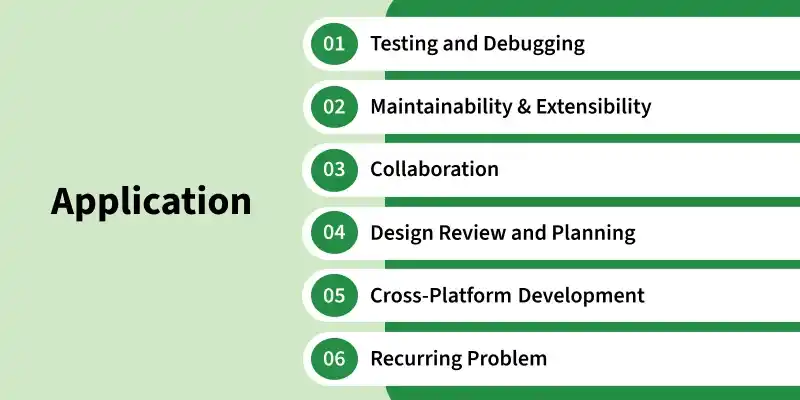
Applications
- **Testing and Debugging: Design patterns can make our code more modular and testable, leading to improved testing and debugging processes.
- **Maintainability and Extensibility: When we wants to create code that is easy to maintain, extend, and modify over time, design patterns can help by providing a structured approach to problem-solving.
- **Collaboration: Suppose if we are working in a team or on a project with multiple developers, so there design patterns can facilitate collaboration by providing a common language and shared understanding of how to address specific design challenges.
- **Design Review and Planning: During the design and planning phase of a project, we can proactively consider the use of design patterns to solve anticipated design challenges.
- **Cross-Platform Development: When we need to create code that works on different platforms or with various technologies, design patterns provide a platform-agnostic way to solve common problems.
- **Recurring Problem: Suppose if we encounter a design problem that we have seen in different forms in multiple projects or if it's a well-known and documented problem in software development, it's a good indicator that a design pattern might be useful.
Limitations
There are situations where it's best to avoid or be cautious about the use of design patterns . Here are some cases when we have to avoid the use of design patterns:
- **Over-engineering: Don't use design patterns just for the sake of using them. If a simpler and more straightforward solution can solve the problem effectively, choosing a design pattern can introduce unnecessary complexity.
- **Lack of Relevance: If a design pattern doesn't directly address the problem there we have try to solve, it's better not to force-fit it into our code. Instead, consider other, more suitable solutions.
- **Tight Deadlines: When we have tight project deadlines, spending extra time implementing design patterns might not be practical. Prioritize meeting project milestones over applying design patterns that might not be immediately necessary.
- **Misapplication: Applying design patterns incorrectly can lead to code that is harder to understand and maintain. It's crucial to understand the patterns thoroughly and apply them in the right context.
- **Resource Constraints: In resource-constrained environments, such as embedded systems or performance-critical applications, design patterns might introduce overhead that affects system efficiency. In these cases, consider more lightweight solutions.
Best Practices for Learning Design Patterns
Learning design patterns is a valuable skill for software developers and architects. Here are some key points where we can focus to learn Design Pattern.
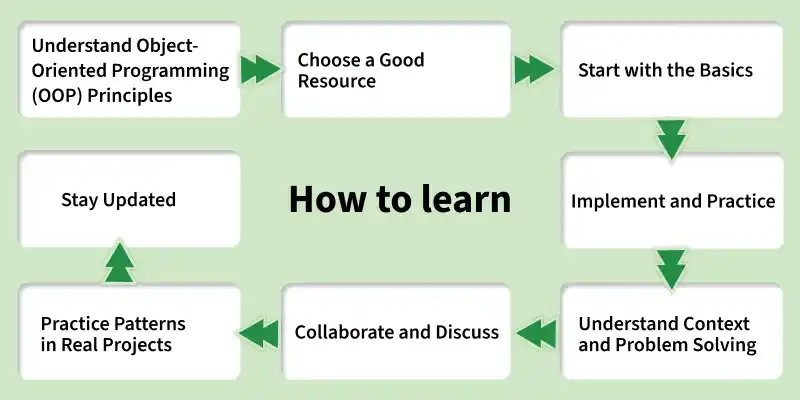
Learning Design pattern
- **Understand Object-Oriented Programming (OOP) Principles: Before diving into design patterns, ensure we have a solid understanding of OOP principles like encapsulation, inheritance, polymorphism, and abstraction, as design patterns often build upon these concepts.
- **Choose a Good Resource: Select a reputable book, online course, or tutorial that focuses on design patterns. Some well-regarded resources include "Design Patterns: Elements of Reusable Object-Oriented Software" by the Gang of Four (GoF), and online courses on platforms like Coursera, edX, or Pluralsight.
- **Start with the Basics: Begin with the fundamental design patterns. The Gang of Four book, for instance, covers 23 classic design patterns categorized into creational, structural, and behavioral patterns. Start with creational patterns like Singleton, Factory Method, and Abstract Factory.
- **Implement and Practice: Don't just read about design patterns; implement them in our own code. Create small projects or code examples to apply the patterns that we learn. Practical experience is crucial for understanding how and when to use them.
- **Understand Context and Problem Solving: Focus on understanding the problem context that each design pattern addresses. Why was the pattern created, and in what situations is it most useful? Recognize the problems that each pattern aims to solve.
- **Collaborate and Discuss: Join programming forums, communities, or meetups where you can discuss design patterns with fellow developers. Peer discussions can provide different perspectives and insights.
- **Practice Patterns in Real Projects: Apply design patterns in real-world projects whenever we have the opportunity. This hands-on experience will help you gain a deeper understanding of their practical benefits and challenges.
- **Stay Updated: Keep up with the latest developments and trends in design patterns, as new patterns may emerge over time. The software development field is constantly evolving.
Advantages
Design patterns provide proven and reusable solutions that improve overall software design and development efficiency.
- Promote code reusability and maintainability
- Improve scalability and flexibility of applications
- Provide a standard approach to solving common problems
Disadvantages
While useful, design patterns can introduce complexity if not used appropriately.
- Can lead to over-engineering for simple problems
- Misuse may result in poor or complicated design
- Requires learning curve and proper understanding
Real-World Examples
Design patterns are widely used in real-world applications to solve common design problems efficiently.
- **Singleton Pattern: Ensures a single instance of a class (e.g., database connection manager)
- **Factory Pattern: Handles object creation logic (e.g., creating UI components based on input)
- **Observer Pattern: Used in event-driven systems (e.g., notifications, event listeners)
- **Decorator Pattern: Adds functionality dynamically (e.g., middleware in web applications)