Types of Software Design Patterns (original) (raw)
Last Updated : 5 May, 2026
Design patterns are reusable solutions to common software design problems. They help create clean, scalable, and maintainable code by providing proven design templates.
- Provide a common vocabulary for developers and reduce development time by using well-tested solutions.
- Make large codebases easier to understand, maintain, and refactor.
**Example: The Observer Pattern is used in event-driven systems where multiple objects need to be notified about changes, such as notification systems or UI event handling.
There are three types of Design Patterns
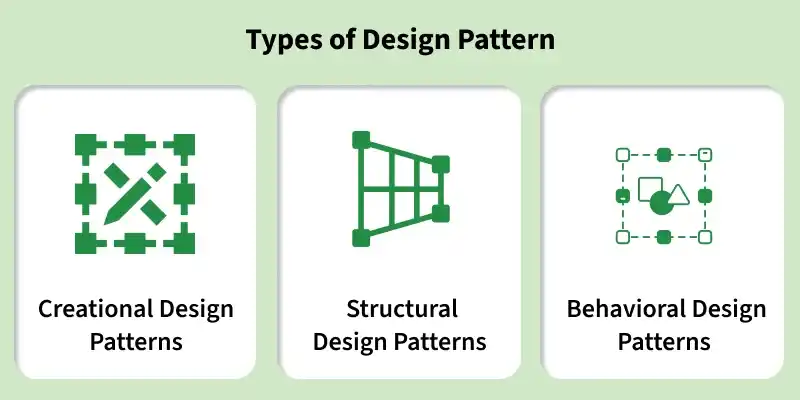
Types
1. Creational Design Pattern
Creational Design Pattern abstract the instantiation process. They help in making a system independent of how its objects are created, composed and represented.
**Example: A database connection is created only once and shared across the application. This avoids multiple instances and ensures efficient resource usage.
Importance
Creational patterns play a key role in making object creation flexible, reusable, and easier to manage.
- Class creational patterns use inheritance for object creation, while object creational patterns delegate creation to other objects for better runtime flexibility.
- Modern systems favor object composition over inheritance, enabling reusable components to be combined into complex behaviors.
- Creational patterns simplify complex object creation by managing construction logic cleanly and consistently.
Applications
Creational patterns are widely used in scenarios where object creation needs to be controlled, flexible, or standardized.
- Creational patterns help manage complex object creation that involves multiple steps or detailed configuration.
- They promote reusability and modularity by providing a standardized way to create objects across the system.
- By hiding instantiation details, they reduce coupling between client code and concrete classes.
- Specific needs are addressed by patterns like Singleton (single instance control) and Builder (step-by-step construction of complex objects).
Advantages
Using creational patterns provides several benefits in terms of flexibility, maintainability, and design quality.
- **Flexibility and Adaptability: Creational patterns make it easy to change or add new object types without touching existing code.
- **Centralized Control: These patterns control object creation from a single place.
- **Scalability: Creational patterns support system growth without breaking existing code.
- **Promotion of Good Design Practices: Creational patterns encourage clean and well-structured design.
Disadvantages
There are some trade-offs when using creational patterns, particularly in terms of complexity and readability.
- **Increased Complexity: Introducing creational patterns can add complexity, especially with many classes, interfaces, and relationships.
- **Overhead: Patterns like Abstract Factory or Prototype may introduce overhead due to extra classes and interfaces.
- **Dependency on Patterns: Over-reliance can make the codebase dependent on a specific pattern, making adaptation or switching harder.
- **Readability and Understanding: Some creational patterns may make code harder to read and understand for developers unfamiliar with them.
2. Structural Design Patterns
Structural patterns are concerned with how classes and objects are composed to form larger structures. Structural class patterns use inheritance to compose interfaces or implementations.
**Example: A mobile charger adapter allows different plug types to work together. It converts one interface into another so incompatible devices can connect.
Importance
Structural patterns help organize and compose objects effectively, making it easier to integrate and extend systems.
- This pattern is particularly useful for making independently developed class libraries work together.
- Structural object patterns describe ways to compose objects to realize new functionality.
- It added flexibility of object composition comes from the ability to change the composition at runtime, which is impossible with static class composition.
Applications
Structural patterns are applied to improve object composition, simplify integration, and manage complex systems.
- Use the Adapter pattern to connect existing classes without changing their code, ideal for legacy systems or third-party libraries.
- The Decorator pattern adds new functionality by composing objects, providing flexibility without subclassing.
- The Facade pattern simplifies complex subsystems by offering a unified and easy-to-use interface.
- The Proxy pattern manages object access, creation timing, or lifecycle control efficiently.
Advantages
Structural patterns provide benefits in flexibility, reusability, and maintainability of code.
- **Code Reusability: These patterns provide a standardized way to compose objects, so components can be reused in different contexts and reduce redundancy.
- **Improved Scalability: Structural patterns organize relationships between classes and objects, supporting system growth without increasing complexity.
- **Simplified Integration: Patterns like Adapter make it easier to integrate existing or third-party components by providing a standard interface.
- **Easier Maintenance: Modular and encapsulated designs reduce the impact of changes, lowering the risk of unintended consequences.
Disadvantages
Structural patterns also introduce some trade-offs in terms of complexity, overhead, and applicability.
- **Complexity: Using structural patterns can increase code complexity, especially when multiple patterns or many classes and interfaces are involved.
- **Overhead: Patterns like Composite may add extra layers, creating additional overhead to manage object hierarchies.
- **Maintenance Challenges: Modifying class structures or relationships can be harder when structural patterns are heavily used, requiring updates across multiple components.
- **Limited Applicability: Not every structural pattern fits every situation; using the wrong pattern may add unnecessary complexity.
3. Behavioral Design Pattern
Behavioral patterns are concerned with algorithms and the assignment of responsibilities between objects. Behavioral patterns describe not just patterns of objects or classes but also the patterns of communication between them.
**Example: In social media apps, followers get notified when a user posts content. This enables one-to-many communication between objects.
Importance
Behavioral patterns help manage complex object interactions and control flow, making systems easier to understand and maintain.
- These patterns characterize complex control flow that's difficult to follow at runtime.
- They shift focus away from flow of control to let you concentrate just on the way objects are interconnected.
- Behavioral class patterns use inheritance to distribute behavior between classes.
Applications
Behavioral patterns are applied to improve object collaboration, flexibility, and dynamic behavior in a system.
- Allows objects to communicate and collaborate in a flexible, reusable way, improving overall system interaction.
- Encapsulates algorithms, strategies, or behaviors, enabling reuse and independent modification without affecting other parts of the code.
- Supports dynamic changes in an object's behavior at runtime, providing flexibility without altering its core implementation.
- Manages state-dependent behavior, letting objects change actions based on internal state while keeping interactions clear and modular.
Advantages
Behavioral patterns enhance flexibility, modularity, and maintainability in software systems.
- **Flexibility and Adaptability: Behavioral patterns allow objects to interact dynamically, making it easier to modify or extend system behavior without changing existing code.
- **Separation of Concerns: Responsibilities are divided among classes, improving modularity and making the code easier to understand.
- **Encapsulation of Algorithms: Behaviors are isolated in standalone objects, allowing modification or extension without affecting client code.
- **Ease of Maintenance: Clear roles and responsibilities help localize changes, reducing the impact on the rest of the system.
Disadvantages
Behavioral patterns also have trade-offs in terms of complexity, applicability, and scalability.
- **Increased Complexity: Using behavioral patterns can make the codebase more complex, especially when multiple patterns are applied together.
- **Over-Engineering: Applying patterns where simpler solutions would work may lead to unnecessary complexity.
- **Limited Applicability: Not all behavioral patterns fit every situation; using the wrong pattern can add needless complications.
- **Code Readability: Some patterns may reduce readability, making it harder for developers unfamiliar with them to understand the code.
- **Scalability Concerns: Certain patterns, like Observer, may face efficiency issues as the number of objects or interactions grows.