Consistency vs. Availability in System Design (original) (raw)
Last Updated : 30 Dec, 2025
When it comes to the field of system design there are two fundamental Concepts often analyzed, they are Consistency and Availability.
- It is essential to comprehend these ideas to ensure the construction of dependable, inexpensive, and optimal systems.
- These two concepts are explained in detail in this article where a comparison of the two has also been made with a highlight on the benefits and categories of each of them.
Consistency
As far as phase and domain synchronous are concerned, they guarantee that different nodes of the distributed system make use of the simultaneous copy of the data. When a system is said to be consistent, every time there is a write then a read, the returned value will always be the most recent written value. This ensures that the data is consistent from one node to another in the distributed environment.
- **Strong Consistency: Ensures that if a write is totally done, from that point on any reads will result to the write. This is somewhat similar to the ACID properties that are found in the traditional database systems where any transaction, or set of operations, is required to be affirmed as whole and correct before other transactions can begin.
- **Eventual Consistency: Guarantees always that if any two nodes are allowed enough time to make computations, they will in the long run have the same value, although in the short run, they can have dissimilar values. This is normally used in systems where accuracy is not as important compared to the availability and performance of the system.
- **Causal Consistency: Makes sure that all nodes get to view operations that are related in terms of cause and effect at the same time. This is weaker than strong consistency but stronger than eventual consistency.
Availability
In a distributed system, availability gives every request a response even if it is a failed one. This is because, in an available system, all the working nodes have to be able to respond to queries and answer even if it is with wrong or old data. Some of the importance of availability include; The importance of availability cannot be over-emphasized when it comes to IT service delivery since some systems will require to be up and responsive always. Some types of availability include:
- **High Availability: Makes sure that the system is up and running for most of the time needs. High availability systems are those systems, which are intended to work even if they fail and usually work at this level through redundancy and fail-over techniques.
- **Partial Availability: It is not correct to consider that this system is either available or unavailable because some sections may be available while others are not depending on the failure situation. This can be observed in systems that support a degraded mode of operation.
Differences Between Consistency and Availability
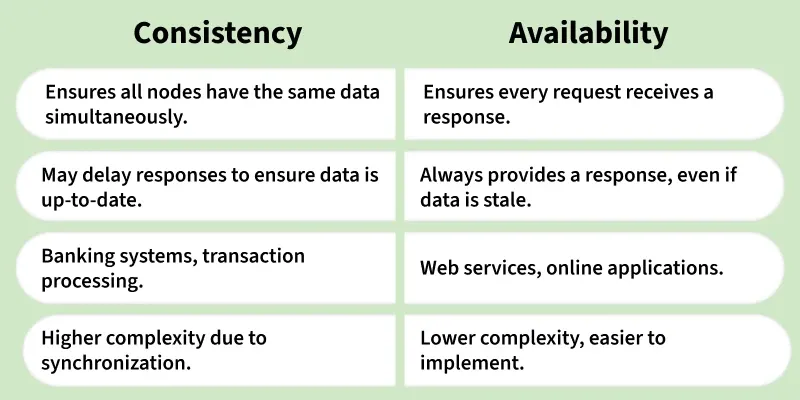
Here’s a comparison of Consistency and Availability in tabular format:
| Feature | Consistency | Availability |
|---|---|---|
| Definition | Ensures all nodes have the same data simultaneously. | Ensures every request receives a response. |
| Primary Goal | Data accuracy and integrity. | Service continuity and responsiveness. |
| Response Behavior | May delay responses to ensure data is up-to-date. | Always provides a response, even if data is stale. |
| Trade-offs | May sacrifice availability for data correctness. | May sacrifice consistency for higher uptime. |
| Typical Use Cases | Banking systems, transaction processing. | Web services, online applications. |
| CAP Theorem Focus | Consistency and Partition Tolerance. | Availability and Partition Tolerance. |
| Complexity | Higher complexity due to synchronization. | Lower complexity, easier to implement. |
| Failure Handling | May reject requests to ensure data consistency. | Always responds to requests, even during failures. |
Benefits of Consistency
- **Data Integrity: Checks the integrity of data in all the nodes that has been sent to it by other nodes. This is essential especially in an environment where the presence of wrong data, or outdated data may cause severe problems, for instance, in banking and or in medical records.
- **Reliability: Avoids having irregularities in the data set. More so where data accuracy is critical, having the entire system in a consistent state all the nodes are guaranteed that the behaviour of the system will be as expected.
- **Predictability: Ensures that all read and write operations are easily determinable by a user. End users may always be assured of acquiring the latest data, thereby easing the computational concepts pertaining to data in an application.
Use Cases of Consistency
- **Banking Systems: Where transaction processing is important. It is necessary to maintain proper records and intact security measures that address the problems such as double-spend or undesired balance.
- **Inventory Management: To make certain that inventory is correctly recorded in other premises. For businesses that use multiple warehouses or Stores when it comes to inventory management consistency helps them maintain accurate stock status to evade such problems as overselling.
- **Distributed Databases: When data correctness and entry standardization are critical. In systems where data is stored and retrieved at any of the nodes in the network, consistency means that all nodes mirror each other’s state and important to prevent data inconsistencies and anomalies.
Benefits of Availability
- **Service Continuity: Maintains the system to function well at all times as expected. High availability is required for applications that have to be always available in the application space to the users regardless of failures or high loads.
- **User Experience: Works within the framework of user demands requirement, and assurance of timely feedback to users thereby improving the user satisfaction. Availability-oriented systems guarantee that the client is constantly able to use the application with no disruptions of any sort.
- **Resilience: Can work with one or more nodes of a cluster being unavailable or the communication between nodes being severed without affecting service. Making the system fault tolerant enhances the availability aspect of the software and makes the internet application more reliable.
Use Cases of Availability
- **E-commerce Websites: Where continuity as well as response time is an essential factor that determines the use of the application. As for the online retailing, availability directly affects a range of user activities such as, products and services’ viewing, order placing or even payments making, thus influencing the sales and customers’ satisfaction.
- **Social Media Platforms: That users can always upload and download material. Consumers of content shared via the social media do expect constant availability of this content, high availability is central in the sustaining of interest and overall satisfaction.
- **Content Delivery Networks (CDNs): Offering maximum access of information to the world population. CDNs provide the content in multiple servers globally to enable quick and accurate delivery to the user no matter the region as they rely on high availability to provide performance and reliability.