Behavioral Design Patterns (original) (raw)
Last Updated : 27 Apr, 2026
Behavioral design patterns focus on how objects communicate and collaborate to manage responsibilities effectively. They improve flexibility and simplify complex control flows within a system.
- Facilitate clear communication and responsibility sharing between objects, helping manage complex workflows and control structures.
- Promote loose coupling between components, improving system flexibility and maintainability.
Types of Behavioral Design Patterns
There are mainly 10 types of Behavioral design patterns:
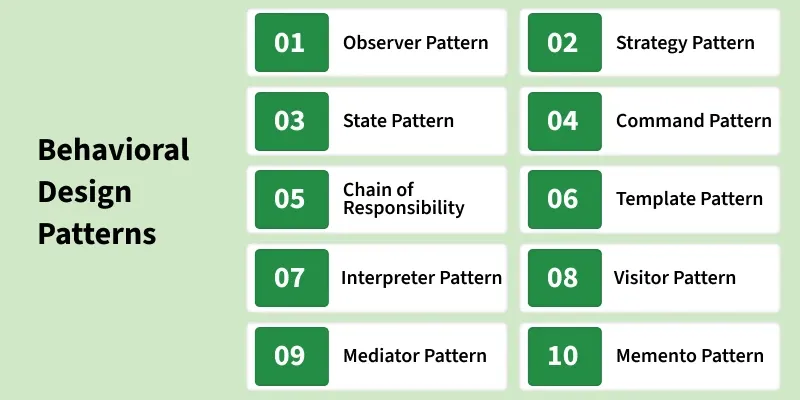
Types
1. Observer Method Design Pattern
Observer method or Observer design pattern also known as dependents and publish-subscribe. It defines a one-to-many dependency between objects, where a change in one object automatically notifies and updates all its dependents.
When to use
Use this pattern when multiple objects need to stay updated with changes in another object without tight coupling.
- When a change in one object requires updates in multiple other objects, and the number of dependents is unknown.
- When an object needs to notify others without knowing their concrete implementations.
Uses of Observer Design Pattern
It is mainly used to handle automatic updates and maintain consistency across related objects.
- Automatically updates multiple objects when the state of a subject changes.
- Commonly used in publish-subscribe systems like GUI event handling.
- Helps achieve loose coupling between subjects and observers
2. Strategy Method Design Pattern
Strategy method or Strategy Design Pattern also known as Policy, it define a family of algorithm, encapsulate each one, and make them interchangeable. Strategy lets the algorithm vary independently from clients that use it.
When to use
Use this pattern when multiple algorithms can be selected or switched dynamically based on different conditions.
- When you have multiple algorithms (e.g., sorting, searching, compression) that can be used interchangeably.
- When you need to choose or switch algorithms at runtime based on user input, configuration, or system state.
Uses of Strategy Design Pattern
It helps in organizing and managing different behaviors in a flexible and reusable way.
- Allows switching between algorithms without modifying client code.
- Supports implementing interchangeable behaviors like sorting, searching, or payment methods.
- Reduces the need for complex conditional statements for selecting algorithms.
3. State Method Design Pattern
State method or State Design Pattern also known as objects for states, it allow an object to alter its behaviour when its internal state changes.
When to use
Use this pattern when an object’s behavior depends on its state and changes frequently.
- When conditional logic (if-else or switch-case) becomes complex and hard to manage.
- When an object frequently transitions between different states with different behaviors.
Uses of State Design Pattern:
It helps in organizing state-specific behavior in a structured and maintainable way.
- Enables changing behavior dynamically based on internal state.
- Simplifies complex conditional logic by replacing it with state classes.
- Encapsulates state-specific behavior into separate classes for better maintainability.
4. Command Method Design Pattern
Command Design Pattern converts a request into a standalone object that contains the method, its parameters, and the receiver, enabling flexible request handling.
When to use
Use this pattern when you need to decouple the sender of a request from the object that executes it.
- When you want to separate the requester (sender) from the executor (receiver).
- When your application requires support for undo and redo operations.
Uses of Command Design Pattern
It helps in encapsulating requests and managing them efficiently.
- Decouples the sender and receiver of a request.
- Supports undo/redo functionality.
- Allows queuing, logging, or scheduling requests for later execution.
5. Chain Of Responsibility Method Design Pattern
Chain of Responsibility design pattern allows a request to pass through a chain of handlers, where each handler decides whether to process it or pass it to the next handler.
When to use
Use this pattern when multiple objects can handle a request, and the handler is not known in advance.
- When you want to pass requests dynamically without specifying the exact receiver.
- When you need flexible and extensible processing of requests.
Uses of Chain of Responsibility Design Pattern
It helps in building flexible and decoupled request-processing systems.
- Allows multiple objects to handle a request sequentially.
- Creates processing pipelines for handling operations.
- Reduces coupling between sender and receiver of a request.
6. Template Method Design Pattern
Template method or Template Design Pattern, define the skeleton of an algorithm in a method, allowing subclasses to redefine certain steps without changing the overall structure.
When to use
Use this pattern when you want to maintain a fixed algorithm structure but allow flexibility in specific steps.
- When similar processes need to be performed in different contexts.
- When you want to enforce a sequence of steps while allowing customization in parts of the algorithm.
Uses of Template Method Design Pattern
It helps in reusing common logic while allowing controlled customization.
- Enforces a consistent sequence of steps in an algorithm.
- Reduces code duplication by sharing common structure.
- Provides a base class with extensible steps for subclasses.
7. Interpreter Method Design Pattern
Interpreter design pattern defines a way to represent and evaluate language grammar or expressions by modeling them as a set of classes.
When to use
Use this pattern when your application needs to interpret structured expressions or commands.
- When working with domain-specific languages (DSLs).
- When new operations or grammar rules need to be added frequently.
Uses of Interpreter Design Pattern
It helps in building systems that can process and evaluate custom languages or expressions.
- Enables interpretation and evaluation of expressions at runtime.
- Useful for implementing DSLs.
- Allows easy extension by adding new grammar rules.
8. Visitor Method Design Pattern
Visitor design pattern allows adding new operations to related classes without modifying their structure. It is useful when classes are stable but operations need to be extended easily.
When to use
Use this pattern when the object structure is stable but new operations need to be added frequently.
- When you have related classes and need to perform different operations on them.
- When you want to extend functionality without modifying existing classes.
Uses of Visitor Design Pattern
It helps in separating operations from object structures for better maintainability.
- Performs operations across a set of objects without changing their classes.
- Keeps algorithms separate from the object structure.
- Allows adding new functionality without altering existing code.
9. Mediator Method Design Pattern
Mediator Design Pattern defines an object that controls and manages interactions between multiple objects, promoting loose coupling.
When to use
Use this pattern when multiple objects interact in complex ways and need centralized coordination.
- When objects need to communicate in a complex manner.
- When you want a single point to manage and organize interactions.
Uses of Mediator Design Pattern
It helps in simplifying communication and reducing dependencies between objects.
- Centralizes complex interactions between objects.
- Reduces direct dependencies, promoting loose coupling.
- Improves maintainability by handling interaction logic in one place.
10. Memento Method Design Patterns
Memento design pattern captures and restores an object’s internal state without breaking encapsulation. It enables undo or rollback by saving and restoring previous states of an object.
When to use
Use this pattern when you need to save and restore an object’s state at different points in time.
- When implementing features like versioning or checkpoints.
- When rollback is required in case of errors or exceptions.
Uses of Memento Design Pattern
It helps in managing object state safely and efficiently.
- Supports undo or rollback functionality.
- Maintains history through versioning or checkpoints.
- Restores previous states without exposing internal details.
Importance of Behavioral Design Patterns
Behavioral design patterns help manage object interactions and responsibilities in a system, making it easier to maintain and extend.
- Defines clear communication between objects, improving maintainability.
- Promotes code reusability by encapsulating behavior in separate classes.
- Helps manage complex control flows and interactions efficiently.
- Improves flexibility by allowing dynamic changes to object behavior.
Challenges of Behavioral Design Patterns
While useful, behavioral patterns can also introduce complexity that developers must manage carefully.
- Can increase system complexity, making code harder to understand.
- Overuse may lead to a high number of small classes and objects.
- Debugging can be difficult due to multiple layers of indirection.
- Misuse may reduce performance or make behavior tracking harder