Content Delivery Network(CDN) in System Design (original) (raw)
Last Updated : 14 Apr, 2026
A CDN (Content Delivery Network) is a distributed network of servers that deliver content to users from the nearest location. It improves website speed and user experience by caching content closer to users and reducing latency. Edge servers are placed across different regions to enhance performance and efficiency.
- A distributed network of servers that work together to deliver content (like images, videos, and static files) to users faster and more efficiently.
- These servers, called edge servers, are strategically positioned across various geographical locations.
- Helps improve the performance, reliability, and scalability of websites and applications by caching content closer to users, reducing latency, and offloading traffic from origin servers.
**Example: When a user in India visits a website hosted in the US, a CDN serves the content from a nearby server in India, making the website load much faster.
1. Without CDN
When a user requests content from a website without a CDN****,** the request is sent directly to the origin server where the website is hosted. The origin server processes the request and sends back the requested content to the user's device.
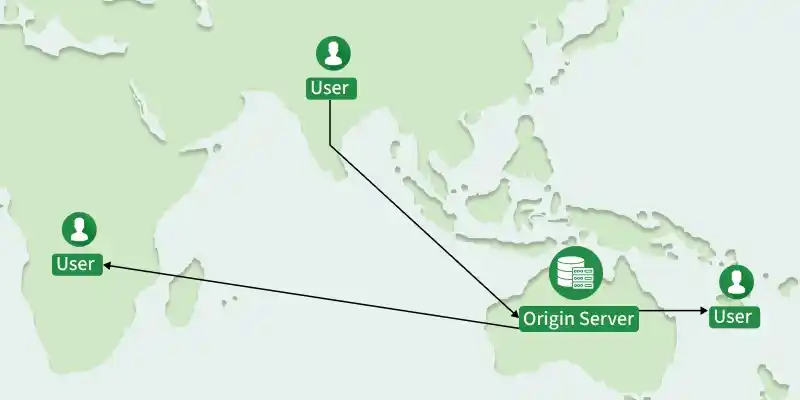
Without CDN
- If the origin server is located far away from the user, it may result in longer loading times due to increased latency.
- High traffic volumes or server overload can lead to slower response times and even server downtime, negatively impacting user experience.
2. With CDN
When a user requests content from a website with a CDN, the CDN identifies the user's location and routes the request to the nearest edge server. Edge servers are distributed across different regions and store cached content closer to users, enabling faster delivery.
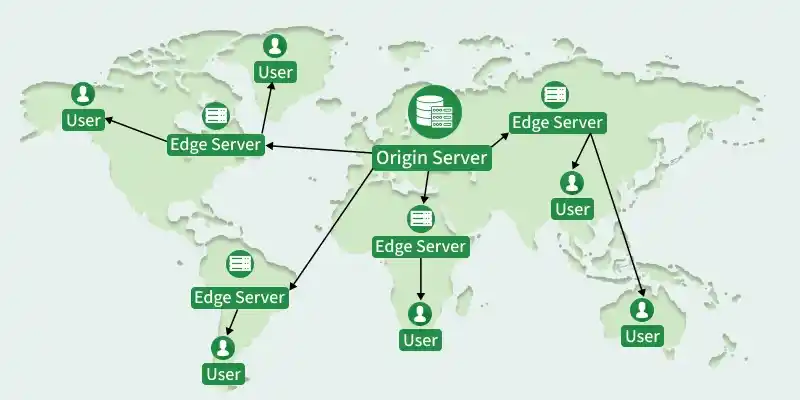
With CDN
- Since edge servers are distributed globally, content delivery is faster, resulting in reduced latency and faster load times.
- The CDN also helps to offload traffic from the origin server, reducing the risk of server overload and ensuring consistent performance even during traffic spikes.
Real-World Applications
Content Delivery Networks (CDNs) are widely used by large-scale platforms to deliver content quickly and efficiently to users across the globe.
- **Streaming Media Delivery (e.g., Netflix, YouTube): CDNs help stream video and audio content smoothly by delivering it from nearby servers. This reduces buffering and ensures high-quality playback even during heavy traffic.
- **E-commerce (e.g., Amazon): CDNs enable fast loading of product images, pages, and other content. This improves user experience and handles high traffic efficiently, especially during sales.
- **Software Distribution: CDNs are used to distribute software updates, patches, and applications quickly across different regions. This ensures faster and more reliable downloads for users worldwide.
- **Gaming: CDNs reduce latency by delivering game data from servers closer to users. This results in smoother gameplay and better real-time interaction in online gaming platforms.
- **API Delivery: CDNs enhance the performance of APIs used in mobile and web applications. They reduce response time and efficiently handle large volumes of requests.
Types of CDN
CDNs can be classified into several types based on their architecture and functionality:
**1. Public CDNs
Any CDN that is accessible to everybody online is referred to as a public CDN. These CDNs are used to swiftly and effectively provide content, including pictures, movies, and other static files, to users. They usually consist of a vast global network of servers.
**Example: Cloudflare, Akamai, and Amazon CloudFront.
**2. Private CDNs
A CDN that is only utilized by one firm or organization is known as a private CDN. These CDNs are used to distribute content to internal users or clients, and they are frequently set up on a private cloud or within an organization's own infrastructure. More control over content distribution is possible with private CDNs, which may be customized to satisfy particular performance and security needs.
**Example: Google Cloud CDN, Netflix Open Connect.
**3. Peer-to-Peer (P2P) CDNs
These CDNs utilize peer-to-peer networking technology to distribute content directly between users, reducing reliance on centralized servers.
**Example: BitTorrent, webTorrent.
**4. Hybrid CDNs
A hybrid CDN combines elements of both public and private CDNs. In a hybrid CDN, some content is delivered using a public CDN, while other content is delivered using a private CDN. This approach allows organizations to optimize content delivery based on factors such as cost, performance, and security requirements.
**Example: Microsoft Azure CDN
**5. Push CDNs
In a push CDN, content is uploaded or "pushed" to the CDN's servers in advance of when it is needed. This can help improve performance by ensuring that content is available closer to end users when they request it. Push CDNs are often used for caching large files or content that is not frequently updated.
**Example: KeyCDN, CDN77
**6. Pull CDNs
Pull CDNs fetch content from the origin server when requested and are mainly used for caching static or frequently accessed content. Dynamic content may be delivered but is usually cached selectively or for shorter durations.
**Example: Amazon CloudFront, Cloudflare
Components
A typical CDN consists of the following key elements
- **Edge Servers: Distributed servers that are close to end users are in control of rapidly delivering and caching content.
- **Origin Server: It serves as the primary source for content distribution and the main location for managing and storing original content.
- **Content Distribution Nodes: Network nodes responsible for routing and optimizing content delivery within the CDN, ensuring efficient traffic management.
- **Control Plane: Content caching, routing, load balancing, and other CDN functions are managed and coordinated by these software or services.
Working
Step-by-step working of a CDN:
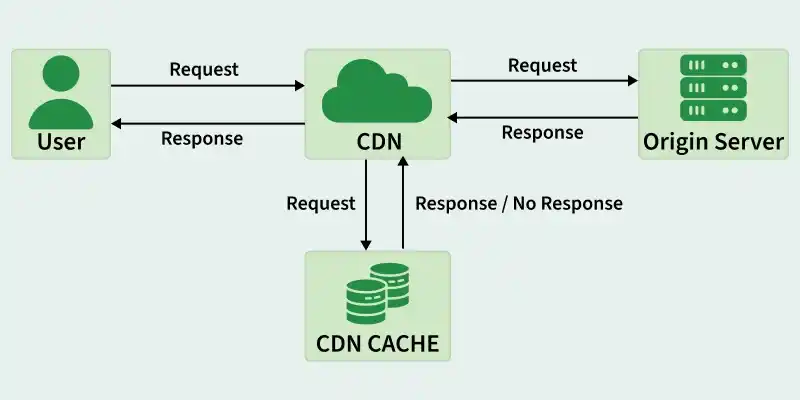
Working
- User sends a request for content (e.g., an image) from a website.
- CDN identifies the user's location and routes the request to the nearest edge server.
- If the content is cached at the edge server, it is delivered directly to the user.
- If the content is not cached, the edge server retrieves it from the origin server, caches it locally, and delivers it to the user.
- Cached content is stored at the edge server for future requests, optimizing performance and reducing latency.
Types of Content Delivered by CDN
A CDN can deliver different types of content based on how frequently the data changes and how it is generated.
1. Static Content
Content that remains the same for all users and does not change frequently.
- Examples: images, logos, CSS, JavaScript files
- Easy to cache and deliver quickly from edge servers
- Improves performance as no processing is required
2. Dynamic Content
Content that changes based on user interaction, location, or preferences.
- Examples: social media feeds, login data, weather updates
- Generated in real-time by the server
- Cached selectively or for shorter duration
Importance
CDNs offer several key benefits that make them important for delivering content over the internet:
- **Faster Content Delivery: CDNs improve load times and lower latency by reducing the physical distance that data must travel by caching content on servers that are closer to end users.
- **Improved Website Performance: Improved website performance, including longer visit durations, higher user engagement, and higher conversion rates, is an immediate result of faster load times.
- **Scalability: CDNs help websites handle traffic spikes and high loads by distributing the load across multiple servers. This scalability is especially crucial for websites with global audiences or those experiencing sudden surges in traffic.
- **Redundancy and Reliability: CDNs offer redundancy by storing copies of content across multiple servers. If one server fails, another server can seamlessly take over, ensuring continuous availability of the content.
- **Cost Savings: By reducing the load on origin servers and optimizing content delivery, CDNs can help lower bandwidth costs and infrastructure expenses for website owners.
- **Security: CDNs provide additional security features, such as DDoS protection, SSL/TLS encryption, and web application firewalls, helping to protect websites from various online threats.
Challenges
The challenges of using CDN are:
- **Cost: Implementing and maintaining a CDN can incur additional costs compared to relying solely on the origin server.
- **Complexity: Managing and optimizing a CDN requires technical expertise and ongoing maintenance.
- **Security considerations: Ensuring data security while using a CDN requires careful configuration and adherence to security best practices.