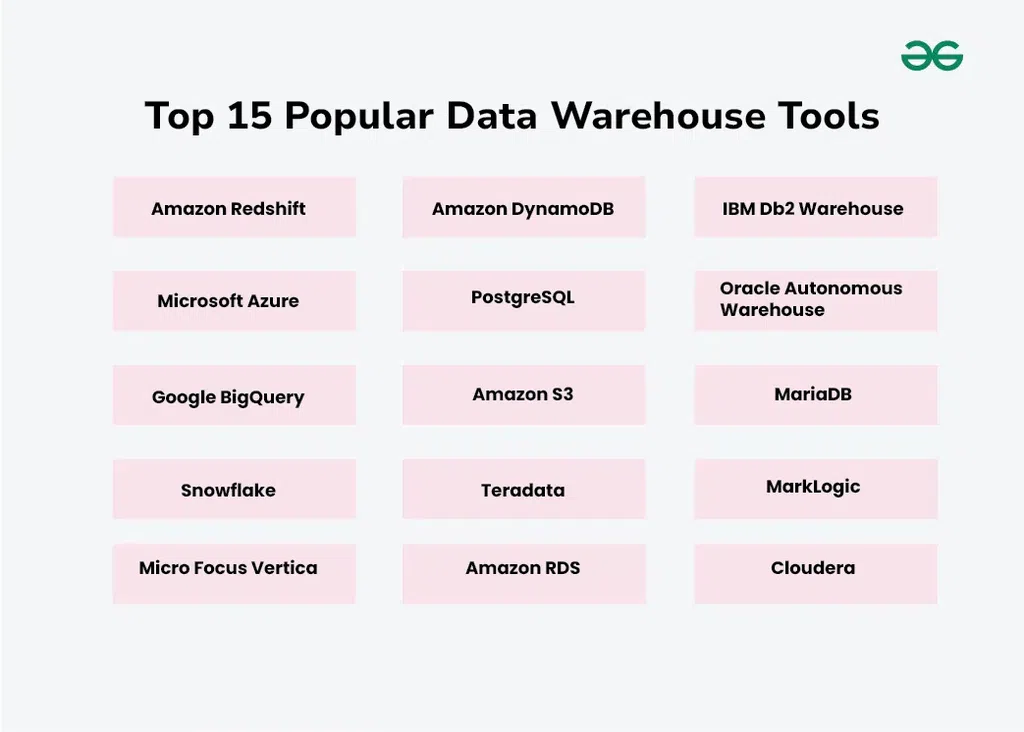
Top 15 Popular Data Warehouse Tools (original) (raw)
Last Updated : 8 Dec, 2025
A data warehouse is a centralized system used for storing, reporting, and analyzing large volumes of structured and semi-structured data. It is a core component of Business Intelligence (BI) that helps organizations make data-driven decisions.
Modern data warehouses have moved from on-premise infrastructure to cloud-based platforms, reducing setup cost, improving scalability, and simplifying maintenance.
Cloud-Based Data Warehouses
1. Amazon Redshift
A data warehouse service that can be optimized for a specific use-case and fully managed by AWS, when it comes to analyzing huge volumes of data. It has a column storage model to facilitate the query of structured information.
**Key Features:
- Columnar storage for fast analytical queries
- MPP (Massively Parallel Processing) architecture
- Auto-scaling and pay-as-you-use pricing
- Native integration with AWS ecosystem (S3, Glue, Athena)
2. Microsoft Azure Synapse Analytics
A suite of data warehouse programs such as Azure Synapse Analytics that takes a cloud computing system approach. It helps to build, deploy and manage data warehousing solutions with machine learning capabilities within its architecture.
**Key Features:
- Distributed query processing
- Built-in security with Azure Active Directory
- Tight integration with Power BI
- Supports real-time and batch analytics
3. Google BigQuery
A tool for analyzing Big Data that is specifically for data warehouses without having to manage the servers. It is pay-as-you-go and boasts faster query operations with the inclusion of SQL support.
**Key Features:
- BigQuery is an intelligent database that facilitates processing of large dataset for insights. It reduces the need for human intervention in the server and can automatically increase resources if the queries requested are beyond the limit of available resources and can facilitate large-scale data warehousing for big data analytics.
- BigQuery is a Google’s pay-per-use Cloud Storage solution that charges you only when you use their services. This makes it the most cost-effective for testing different volumes of data.
- Google Cloud services provide additional features like Cloud AI Platform for BigQuery when using the BigQuery service to perform some statistical analysis or to use advanced analytics capabilities to derive new insights from data.
**4. Snowflake
A leading cloud-based data warehouse known for its independent scaling of storage and compute resources. This allows for flexible cost management and simplifies data management.
**Key Features:
- Supports structured and semi-structured data (JSON, Parquet, Avro)
- Separation of storage and compute
- Secure data sharing
- Multi-cloud deployment (AWS, Azure, GCP)
5. Micro Focus Vertica
A data warehouse with the architecture needed for extreme performance for large numbers of data records. It is designed on the principle of MPP (Massively Parallel Processing) that makes it possible for fast processing of queries and comes as a strong analytics tool.
**Key Features:
- MPP architecture
- Real-time ingestion and analytics
- In-memory query acceleration
- Advanced workload management
NoSQL Data Stores
Amazon DynamoDB
A fully managed NoSQL database service for high-performance data access. It excels in handling large volumes of key-value and document data with high availability and scalability.
**Key Features:
- Millisecond-level latency
- Automatic scaling
- High availability with multi-region replication
- Pay-per-request pricing
Relational Databases Used in Warehousing
PostgreSQL
A powerful, open-source relational database management system (RDBMS) known for its reliability and feature richness. It supports complex queries and integrates well with various BI tools.
Key Features of **PostgreSQL
- PostgreSQL is a powerful, open-source RDBMS known for its reliability and feature richness. It supports complex SQL queries.
- Ensures data consistency and integrity through support for ACID (Atomicity, Consistency, Isolation, Durability) transactions.
- Includes features like triggers, stored procedures and user-defined functions for advanced data manipulation.
- Integrates well with various BI tools and analytics platforms for data visualization and reporting.
Object Storage (Used in Modern Data Warehousing)
Amazon S3
A scalable and cost-effective object storage service for storing large amounts of unstructured data like images, videos and log files. It offers high durability, security and easy access to data.
Key Features:
- S3 offers a scalable and cost-effective solution for storing large amounts of unstructured data like images, videos, logs and backups.
- Maintains historical versions of objects, allowing you to revert to previous versions if needed.
- Automates data lifecycle management by defining rules for archiving or deleting data based on specific criteria.
Enterprise Data Warehouse
Teradata
A robust data warehouse platform known for its MPP architecture and ability to handle massive data volumes. It excels in real-time data processing and complex analytics tasks for large enterprises.
**Key Features:
- MPP architecture
- Optimized for complex queries
- Built-in workload management
- Enterprise-level security and governance
Managed Relational Cloud Services
Amazon RDS
Managed relational databases for scalable backend data storage.
**Key Features:
- Automated backups and patching
- High availability with Multi-AZ
- Auto-scaling
- Supports MySQL, PostgreSQL, Oracle, SQL Server
IBM Db2 Warehouse
An elastic cloud data warehouse offering independent scaling of compute and storage. It provides robust functionalities for data management, analytics and integration.
Key Feature of IBM Db2 Warehouse
- Independent scaling of compute and storage
- Advanced security controls
- Integrated analytics and ML capabilities
Oracle Autonomous Warehouse
A self-driving cloud data warehouse service by Oracle. It automates administration tasks like provisioning, scaling and security, simplifying data warehouse management.
**Key Features:
- Automated provisioning and tuning
- Auto-patching and backup
- High concurrency query execution
- Integrated Oracle analytics services
Open-Source Relational Databases
**MariaDB: A popular open-source relational database management system known for its compatibility with MySQL and its focus on performance and ease of use.
**Key Features:
- MySQL compatibility
- High availability clustering
- Strong community support
- Optimized query execution engine
NoSQL Document Databases
**MarkLogic: A multi-model NoSQL database that excels at storing and managing large volumes of XML and JSON documents. It offers powerful querying capabilities for complex data structures.
**Key Features:
- Native XML and JSON storage
- Full-text search
- ACID-compliant transactions
- Flexible schema support
Enterprise Data Cloud Platform
**Cloudera: A platform designed for building and managing data warehouses and data lakes in a hybrid or multi-cloud environment. It provides tools and security features for data governance and analytics at scale.
**Key Features:
- Hadoop and Spark ecosystem support
- Centralized governance and security
- Scalable distributed storage
- Real-time and batch analytics support