Off the Kuff | Knowledge Is Good (original) (raw)
Abbott threatens to take over Corpus Christi
Gov. Greg Abbott criticized Corpus Christi leadership Tuesday over its looming water crisis and warned that if local leaders do not take immediate action, the state may need to intervene to ensure residents and businesses have enough.
“Corpus Christi is a victim not because of lack of water. They’re a victim because of a lack of ability to make a decision,” Abbott said at a press conference after a reporter asked him to comment on an Inside Climate News story quoting former regional and city officials who said the potential shortage is a result of years of delayed and poor decisions by city leaders.
“We can only give them a little time more before the state of Texas has to take over and micromanage that city and run that city to make sure that every resident who goes to the water tap and turns it on, they’re going to be getting water out of their faucet, not because of what local leaders are doing, but because of what the state of Texas will do,” Abbott said.
The city’s water supply could drop below expected demand as soon as June 2027, according to one model, said Elisa Olsen, the city’s communications director. The city currently has $1 billion worth of projects in the works to increase its supply — but many of them won’t come online until later this year or next year.
“We are not out of water, but our water supply is declining,” she said.
[…]
The city’s water troubles are partly due to low reservoir levels, drought and rapidly increasing demand driven by industry. Over the last decade the region has seen a huge industrial boom, especially in petrochemical and energy projects near the bay. Those industries require massive amounts of water, putting pressure on the city’s water supply.
However, this is only part of the problem. Former city employees and residents in the area say the crisis has been fueled by a long list of political fights locally over the “right” solutions, poor long-term planning despite repeated warnings and several delayed or canceled water solutions, including the large seawater desalination project that was abandoned after years of planning and spending.
At the press conference, Abbott said the state has been actively involved, giving the city $750 million to address the growing water problem.
“You know what they did? They squandered it,” he said.
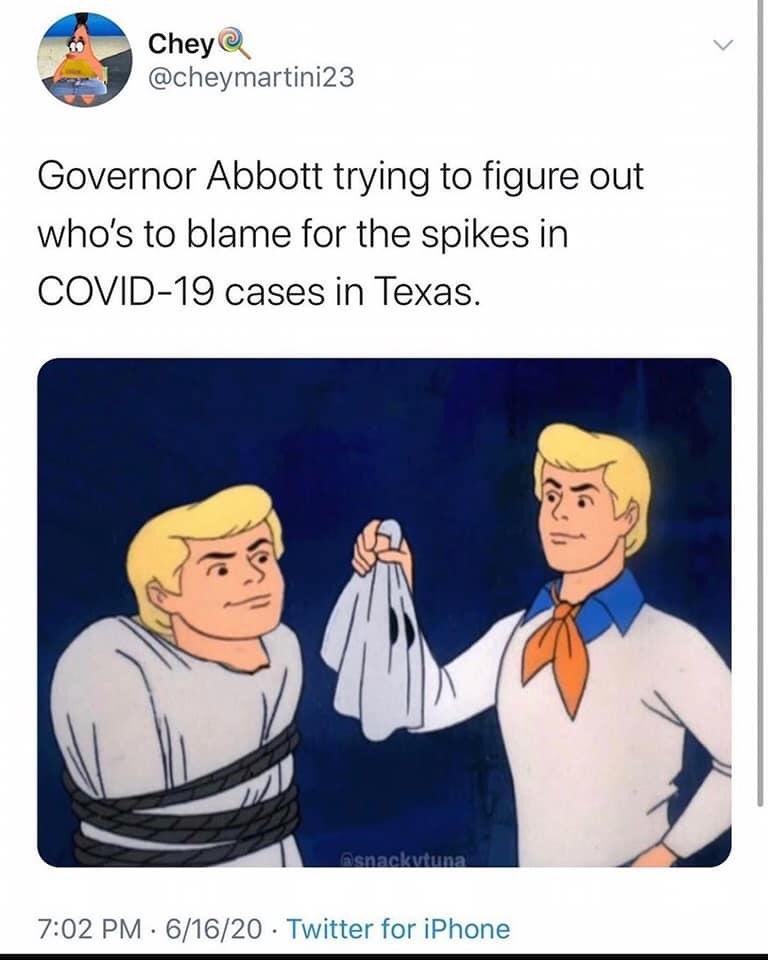
See here for the background. So, like, is there some kind of city takeover law on the books that would allow Abbott to appoint a puppet Mayor and City Council, or would he step in as Mayor himself? And if there is a puppet-Mayor law, I have two words for you, Greg: Mike Miles. I’m sure he could use a change of scenery and a new challenge. Think about it.
My guess is that Abbott is mostly saber-rattling because he spends too much time on Twitter and gets all full of himself. But I also expect that he would like to cover his ass, because however poorly Corpus Christi has handled this situation, if refineries that supply a huge amount of jet fuel get knocked offline as a result, a lot of the blowback will be on him. I’m pretty sure he would like to be seen as Doing Something about it in advance of that possibility, even if all he can do is talk shit about it. But hey, there are no bad ideas in a brainstorming session, so if Abbott has anything constructive to toss out there, go for it. That at least might have some value.
UPDATE: The Chron addresses my question.
A full state takeover would be unprecedented, and it is unclear exactly how it would work. But Abbott would appear to have the authority to at least temporarily take control under a disaster declaration, said Brandon Rottinghaus, a political scientist at the University of Houston who has studied the governor’s office.
Abbott has used that power before, including issuing a years-long border disaster under which the state took over a public park in Eagle Pass without the approval of the city and strung miles of razor wire along the Rio Grande, even on some private ranches.
But Rottinghaus said he could not find an instance where a city was “lock, stock and barrel taken over by the state of Texas,” even as the GOP-led Legislature has increasingly set rules around what cities can and cannot do on issues like police funding and environmental regulations.
“This is beyond unusual,” he said. “It would be a dramatic escalation of the war between city and state governments.”
I dunno, man, I’d really like to have a state government that didn’t want to go to war against me. Is that so much to ask for?
Ivermectin 4Ever
MaryJo Perry raises animals on her property outside of Jackson, Miss., and uses ivermectin to treat her cattle. To her, the drug is as familiar, safe, cheap and effective as vitamins: “We’ve been using it on the farm for 40 years.”
Perry, who studied animal science and at one time wanted to be a vet, also uses it to treat mange in stray dogs she rescues near her home. It works without side effects, she says: “I’ve never seen issues with it.”
In humans, ivermectin fights parasitic infections from roundworm, lice and scabies; it’s effective against certain tropical diseases, and may have benefits in fighting malaria.
Its reputation as a miracle drug for animal and human disease began with its discovery in the 1970s. It has driven down cases of river blindness around the world. And scientists initially hoped it might treat COVID-19, too, prompting many people to embrace it, though dozens of studies later confirmed the drug is not an effective treatment.
Despite the disappointing research results, ivermectin took off during the pandemic, fueled by misinformation. Perry, speaking at a political event on medical freedom she organized in September, says she doesn’t believe the research finding it ineffective. “I believe that it prevents COVID; I know that firsthand,” she claims. “I’ve taken care of my family with it. Since I started taking it, I’ve not gotten it again.”
Ivermectin is now making a comeback, after its use receded in the waning years of the pandemic. Now, especially in conservative political circles, its reputation keeps growing as a kind of cure-all for various ailments, and even for cancer — despite a lack of evidence it works.
So far, five state legislatures — in Tennessee, Arkansas, Idaho, Louisiana and Texas — have voted to make the drug available over-the-counter, causing concern among doctors who say people might overuse or misuse it, or worse — substitute ivermectin for proven treatments.
[…]
Last month, Trump’s appointed head of the National Cancer Institute, Anthony Letai, said the agency was conducting preclinical studies on ivermectin’s ability to kill cancer cells — though doctors say it holds little promise. And Florida’s First Lady Casey DeSantis, a breast cancer survivor, touted it in announcing $60 million in cancer research funding, including use of ivermectin.
There’s currently no good evidence that ivermectin is an effective cancer treatment in humans.
“Most promising drugs in test tubes and mice don’t pan out in humans,” Mafi says. “That’s just a statistical reality.”
And there is already a lot of other cancer research and treatments in the form of targeted immunotherapies that are far more advanced and promising than ivermectin, he says.
Yet that hasn’t stopped it from taking off among patients influenced by disinformation.

See here for some background. Trump’s war on funding for cancer research probably won’t help with that, but at least you’ll be able to get ivermectin over the counter.
You should read the rest, there’s grifting and Joe Rogan and general COVID weirdness. I don’t have anything to add to the story, but I do have this to add to this post.
Attorney General Ken Paxton’s office made “numerous inaccurate statements” in court filings and statements when it sided with a Houston doctor in her legal battle against the Texas Medical Board, state regulators said.
The medical board’s response came one week after Paxton’s office announced it would not defend the state agency in a lawsuit filed by Dr. Mary Talley Bowden, an ear, nose and throat specialist who has garnered national attention for her opposition to COVID-19 vaccine mandates and support for using ivermectin, an anti-parasite medication, to treat the virus.
Paxton’s office accused the medical board of “acting on nothing more than personal animosity and spite” when it issued a public reprimand to Bowden over her treatment of a COVID-19 patient.
“I will not stand by as Dr. Bowden has her Constitutional rights trampled and ability to serve her patients impeded with an illegal reprimand,” Paxton said in a statement.
The Texas Medical Board said some of Paxton’s claims were erroneous, though a spokesman for the agency declined to specify which statements in the court filing were inaccurate.
“(The board) has provided ample justification for disciplining Dr. Bowden for attempting to treat a patient at a hospital in which she did not have privileges,” the board said in a statement last week. “(The board) intends to vigorously contest these claims and will stand firm to ensure hospitalized Texans receive care from doctors who are authorized to be on hospital premises.”
The medical board is still evaluating its options for legal representation in the case now that Paxton’s office is not defending the agency, the spokesman said.
Honestly, they’d be better off with a first-year law student. And may Ken Paxton be given nothing but ivermectin for every medical issue he may have for the rest of his life.
Posted in Technology, science, and math | Tagged cancer, coronavirus, Donald Trump, Houston, ivermectin, Ken Paxton, Mary Talley Bowden, National Cancer Institute, RFK Jr, Texas, Texas Medical Board, The Lege |
Texas blog roundup for the week of March 9
The Texas Progressive Alliance can’t believe we’re in another stupid war started by another stupid Republican president as it brings you this week’s roundup.
Off the Kuff did his initial analyses of the 2026 primaries.
SocraticGadfly had a roundup of coverage, reaction and issues with the first week of war in Iran, including callouts both of most mainstream media coverage and of actions and reactions by much of both duopoly political parties.
Neil at the Houston Democracy Project said with the primary over, we can get back to the more essential business of organizing ourselves.
===================
And here are some posts of interest from other Texas blogs.
Audubon Texas is urging everyone to turn off all non-essential nighttime lighting on buildings and other structures from 11:00 p.m. to 6:00 a.m. each night, to help migratory birds get where they’re going.
Bay Area Houston hopes you weren’t fooled by phony endorsement slates.
Pete von der Haar has seen this movie before.
Evil MoPac reran his 2025 Q&A with Democratic Senate nominee James Talarico.
Houstonia examines what it takes to be a Houston food influencer.
The Lone Star Project reminds us that John Cornyn is in a bad position no matter what happens with the possible Trump endorsement.
The Barbed Wire investigated the election day problems in Dallas County.
The “number of primary votes by Congressional district” metric
Noting this for the record.
With the possible exception of U.S. Senate nominee James Talarico, the most relieved Democrats after Tuesday’s primary might be U.S. Reps. Henry Cuellar and Vicente Gonzalez of South Texas.
Their relief has less to do with the fact that each easily secured renomination against lesser-known challengers. What matters more is the raw vote totals: in both districts, Democratic turnout matched or exceeded the total number of Republican votes cast in the GOP primaries.
That’s significant because both districts were redrawn last year by the Republican-controlled state Legislature at the urging of President Donald Trump, who wanted as many as five additional winnable Texas seats for the GOP in November’s midterm elections.
Consider Cuellar’s 28th Congressional District, anchored by his home base in Laredo but stretching into rural Southwest Texas where Republicans showed surprising strength in the 2024 presidential election. That display of newfound muscle convinced Republican map drawers that they might finally be able to unseat Cuellar, even though he’s been racking up votes in the region since the 1990s, when he was first elected to the Texas House.
Tuesday’s results told a different story.
Cuellar drew just over 39,000 votes, about 58% total in a three-way race. In all, 67,401 votes were cast in the district’s Democratic primary, according to the Texas Secretary of State’s Office. On the Republican side, Webb County Judge Tano Tijerina captured nearly 75% of the vote against a single rival. But his raw total was just 12,487 votes out of 16,792 ballots cast.
Put simply, Democrats outvoted Republicans by more than a 4-to-1 margin in a district designed to give the GOP the edge.
A similar pattern emerged farther south the Rio Grande in Brownsville, the anchor city of the 34th Congressional District.
Gonzalez received 35,249 votes against his only challenger, good for 63% of the 56,198 ballots cast in the Democratic primary.
The GOP certainly treated the race that way: eight Republicans entered the newly drawn District 34 primary.
Combined, those eight Republican candidates received 36,520 votes — slightly more than Gonzalez himself, but nearly 20,000 fewer than the total number of Democratic votes cast in the district.
None of this guarantees that Cuellar or Gonzalez will win in November. But it also doesn’t point to the kind of Republican landslide that some political strategists and GOP leaders predicted after South Texas shifted toward Trump in 2024.

I’ve yammered on at length about how the newly-drawn districts depend heavily on what happened in 2024, and that the more things change from there, especially in a direction back towards how they were before, the better off Dems will be and the more foolish the whole exercise will look for the GOP. The most high-profile of those targets are the two incumbent Dems who are running again in their current districts, and columnist John Moritz updates us on them here. Which I appreciate, but I will also note that if the number of votes cast in the primary is the metric we’re going to use, we could use it more broadly than that. I spent a few minutes on the SOS election returns page, and this is what I found:
Dist GOP Dem
CD02 65,839 48,595* CD03 79,134 48,612* CD08 62,597 42,317 CD09 31,544 34,673 CD10 74,947 53,602 CD12 54,814* 51,524 CD15 30,003* 54,518 CD21 95,128 65,947 CD22 63,020 47,981 CD23 55,062 58,950 CD24 71,351* 60,212 CD26 73,416 56,940 CD28 16,792 67,401 CD31 77,355 55,307 CD32 69,062 57,388 CD34 36,520 56,198 CD35 46,989 54,558 CD38 61,238 52,286
The asterisks denote uncontested primaries, where one might see a larger number of undervotes and thus a smaller total than might be representative. Redistricted CDs 09 and 35 also saw greater Democratic activity, and so did Republican-held CDs 15 and 23, which has been in the news quite a bit these days, as the mostly normal but scandal-plagued Rep. Tony Gonzales is stepping down and Brandon “I am not a Nazi, I just really like reading Mein Kampf” Herrera replaces him on the November ballot. CD15 was won by Beto by a fairly wide margin in 2018, while CD23 has at best been a purple-hued white whale for Dems, and here they are again in the conversation whether invited to be or not.
I want to be clear, I am presenting this data for amusement purposes only. Like Moritz, I am not claiming that any of these numbers Mean Something, just that I looked out of curiosity and I was interested in what I found. I can’t do a comparison with a previous year because (duh) the districts were different then. All I can do is present these numbers, with no extra context. Caveat emptor, your mileage may vary, product may settle during shipping, all sales are final.
Posted in Election 2026 | Tagged Brandon Herrera, CD02, CD03, CD08, CD09, CD10, CD12, CD15, CD21, CD22, CD23, CD24, CD26, CD28, CD31, CD32, CD34, CD35, CD38, Congress, Democratic primary, Election 2024, Election 2026, Henry Cuellar, primaries, redistricting, Texas, Tony Gonzales, turnout, Vicente Gonzalez |
What happens if Corpus Christi runs out of water?
We may be on the verge of finding out.
The imminent depletion of water supplies in Corpus Christi threatens to cut off the flow of jet fuel to Texas airports and other oil exports from one of the nation’s largest petroleum ports, triggering potential shockwaves through energy markets in Texas and beyond.
Without significant rainfall, Corpus Christi is headed for a “water emergency” within months and total depletion of the system next year, according to the city’s website.
“The impacts are going to be felt tremendously through the state, if not internationally,” said Sean Strawbridge, former CEO of the Port of Corpus Christi Authority, the nation’s top port for crude oil exports, in a 40-minute interview Thursday. “This should be no surprise to anybody. We were talking about this over a decade ago.”
Other current and former officials, alarmed at what they call a lack of preparations, have suggested the potential for an economic crisis involving mass layoffs, disruption of fuel supplies and billions of dollars in emergency spending to avoid an evacuation of the city.
Strawbridge, who now lives in Houston, laid the blame on city leaders, citing “their lack of experience, their lack of knowledge, their lack of recognizing the risks” in a bumbling, decade-long endeavor to build a large seawater desalination plant that would veer the region off its clear course towards calamity.
“They’ve found themselves in quite a dire predicament as a result of those poor decisions,” Strawbridge said. “Time is up.”
A spokesperson for Corpus Christi Mayor Paulette Guajardo declined interview requests, citing “prior commitments,” and did not respond to follow-up questions. City manager Peter Zanoni also did not respond to questions. Instead, Corpus Christi public information manager Robert Gonzales provided an emailed statement.
“The water shortage in the Coastal Bend is the result of a historic five-year drought,” it said. “Currently, the City of Corpus Christi has $1 billion in City Council-approved and funded water projects underway to address our water needs. The City remains committed to ensuring water security for the more than 500,000 residents and our commercial and industrial customers.”
Depletion of this region’s reservoirs would lead to “controlled depression” for the local economy, “mass unemployment” and “industrial total shutdown,” according to a two-page report by Don Roach, former assistant general manager of the San Patricio Municipal Water District, which supplies many of the region’s large industrial water users.
That includes refineries operated by Flint Hills Resources, Valero and Citgo that provide jet fuel to Texas airports and meet much of the state’s daily demand for gasoline.
“This waiting disaster is under the radar for the rest of the state,” said Roach, who worked 20 years at the water district and retired in 2014. “We hear nothing from the Texas politicians about the seriousness of the situation or any state plan to mitigate it.”
He no longer had access to current water data and contracts, he stressed, but produced the report based on his own knowledge. It said the costs of trucking in emergency water “would bankrupt many local small businesses and low-income households” while state emergency managers would need billions of dollars to “build emergency temporary pipelines or subsidize desalination barge rentals to prevent a total evacuation of the city.”
Strawbridge, a former director of the Port of Long Beach, said Roach’s assessment was “spot on.”
Zanoni, the city manager who has overseen Corpus Christi’s descent toward water depletion since 2019 and receives a $400,000 salary, rejected notions of imminent disaster during a press conference Thursday, when Lake Corpus Christi, one of the city’s main reservoirs, dropped below 10 percent. The press conference took place three days after Inside Climate News asked the city for comment about the impending water crisis.
“I think we are going to get through this,” he told TV cameras as he stood before the dwindling remnants of the lake. “We have confidence in what we’re doing. This is no time to panic.”
Zanoni, who holds a master’s of public administration from Florida State University, said the city had “worked tirelessly over the past months to bring everything that we humanly and possibly could to forego what could be this supply and demand issue.”
“Now we’re going to focus, with the City Council and the region, on being prepared in case supply doesn’t meet demand,” he said.
“The best-case scenario, that assumes some level of rain, has this lake here going to about the early fall,” said Zanoni, who indicated that the summer months would give the city enough time to boot up its portfolio of new groundwater water projects..”
James Dodson, a former director of Corpus Christi’s water department who retired this year as a private consultant and was involved in several of those projects, disagreed. He said residents and officials “are crazy not to be panicking.”
“It’s the very worst scenario that I’ve ever seen,” said Dodson, who oversaw a historic expansion of Corpus Christi’s water supply in the 1990s. “It’s going to be an economic disaster.”
For years, he said, the city dismissed repeated opportunities to develop groundwater import projects as it maintained a singular and fruitless focus on desalination. That includes projects that the city only recently scrambled to get started. Dodson doubted any will materialize in time.
“They’ve been kicking the can down the road for a long time and they’ve finally run out of road,” said a current regional water official who requested anonymity to preserve a working relationship with the city. “They’re looking at projects to do that they should have done five, six, seven years ago.”
The last hope to avert disaster, the official said, was a 20- to 30-inch rainfall.
“It would basically have to be a hurricane,” he said.

Emphasis mine.This is a long story and you should read the whole thing, and then wonder what you would do if your city’s water got turned off because there wasn’t any. A big part of the problem in Corpus Christi is that there are many refineries that use the city’s water, and they can’t easily be shut down or ratcheted back. There had been a push for desalinization plants a few years ago to help with the supply, but for a variety of reasons (discussed in the story) they didn’t happen; a recent update on that situation is in this post. What happens next, barring that hurricane they seem to be hoping for, I have no idea. But we’ll find out.
Chron overview of District C special election
It’s almost time to vote again, for you lucky duckies in District C.
Abbie Kamin
Residents in Houston’s Montrose, Meyerland, the Heights and surrounding neighborhoods will soon head to the polls to elect a new city council member.
Abbie Kamin, District C representative since 2020, resigned her position to run for Harris County attorney, but will hold the seat until voters choose her replacement. Kamin won the Democratic primary and will face Republican Jacqueline Lucci Smith in November.
Seven candidates have lined up for a chance to take Kamin’s place. Should no candidate secure 51% of the vote, the race will head to a runoff between the two top finishers.
Election Day is April 4, with early voting beginning March 18. Check the map below to see if you live in the district.
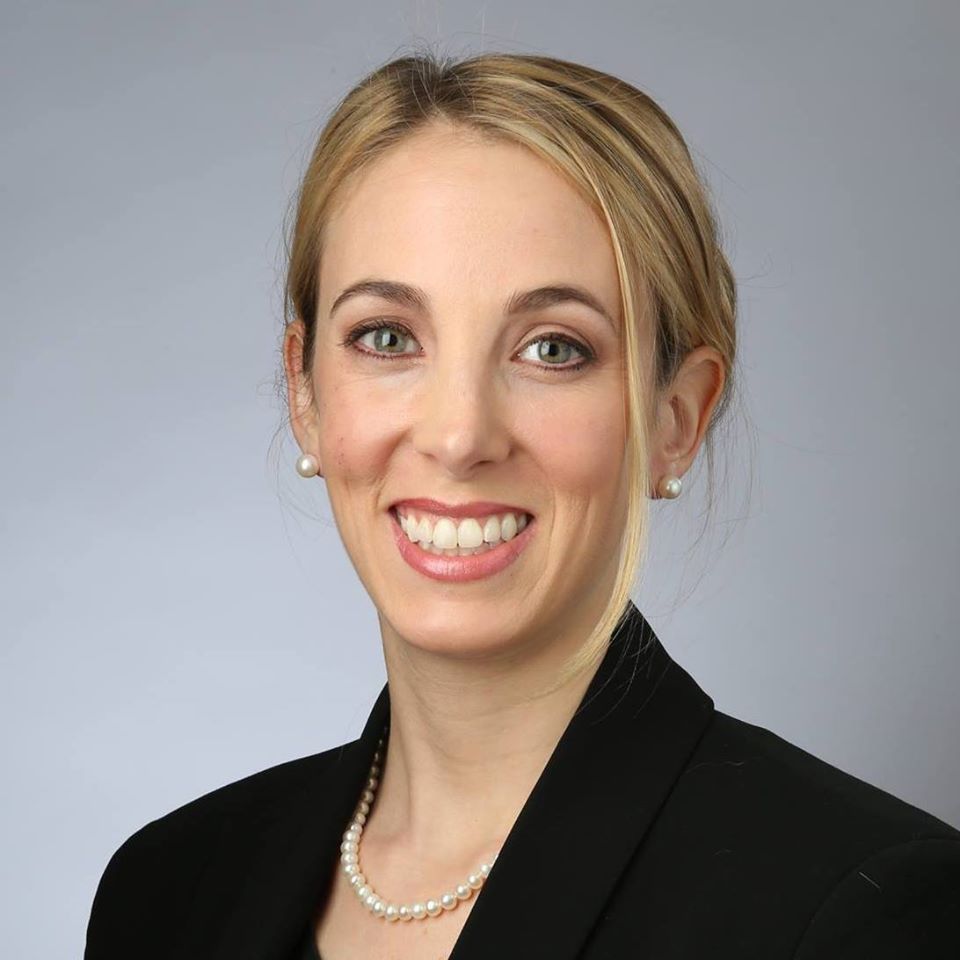
You can click over (gift link) to see the candidates’ info. You can also listen to my candidate interviews, which will begin running tomorrow. And you can also attend the District C candidate forum, presented by A Tale of Two Bridges and several other urbanist groups, on March 21 at the historic Heights Fire Station on Yale at 12th. The event will begin with a candidate meet and greet at 10 AM, with the forum beginning at 10:45. And it will be moderated by me, which I’m looking forward to. Come on out and meet the candidates and hear what they have to say, at this forum in person and on the blog via my interviews. This is certain to go to a runoff, so get to know them all now.
Posted in Election 2026 | Tagged Abbie Kamin, Angelica Luna Kaufman, Audrey Nath, District C, Election 2026, Houston, Houston City Council, Joseph Panzarella, Laura Gallier, Nick Hellyar, Patrick Oathout, Sophia Campos, special election |
First post-primary poll
Rep. James Talarico
A PPP poll commissioned by Senate Majority PAC found “no meaningful difference in electability” between Sen. John Cornyn (R-Texas) and Texas Attorney General Ken Paxton in a general election matchup against Democratic state Rep. James Talarico.
It’s notable to us that Senate Democrats are pushing this narrative, given Democrats have spent much of this year praying for Paxton to advance to the general. Conventional wisdom was that the attorney general’s scandals — Paxton was impeached in 2023 and his ex-wife has accused him of adultery — would make him more vulnerable than Cornyn to an upset.
The polling found Talarico leading Cornyn 44%-43% and Talarico leading Paxton 47%-45%. We’ll note these results are within the 4.1% margin of error and there’s a relatively small sample size of 576 Texas voters. The poll was conducted immediately after Tuesday’s primary from March 4-5.
Talarico has consistently said he views Paxton and Cornyn as equally vulnerable to a general election upset.
We don’t normally run polls like this. But PPP, to its credit, was accurate in its polling of the Texas Senate Democratic primary. The last PPP poll before the primary had Talarico leading Rep. Jasmine Crockett (D-Texas) 48%-42%. Talarico ended up winning the election 52%-46%.
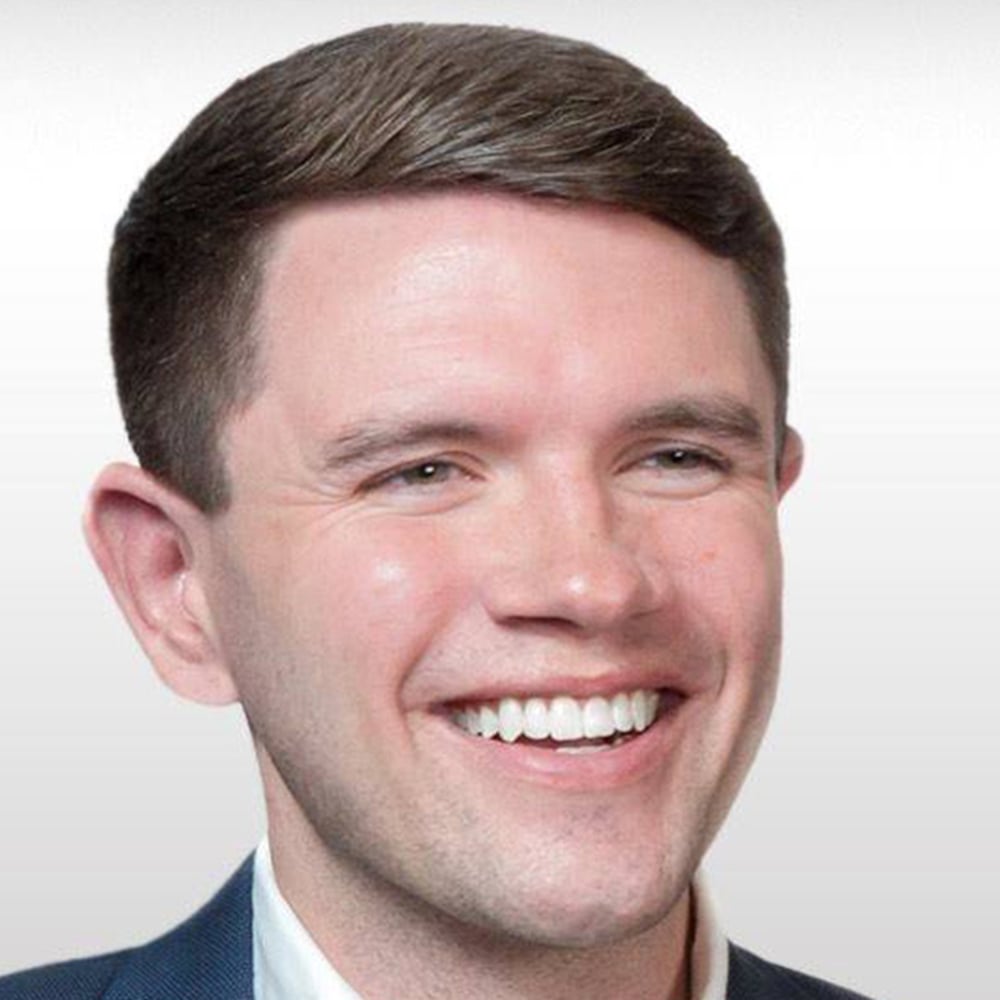
You can see the polling memo here but it doesn’t tell you much that the story didn’t say. We talked a lot about how the limited polling data we had during the primary showed James Talarico and Jasmine Crockett doing about as well against any of the Republicans; in other words, that neither Dem could claim to be “more electable” based on the data we had so far. They also trailed against all three of the Republicans that were included, and while the margins were small they were always there. This is the first poll I’ve seen that had a Democrat in the lead. That’s a big deal for obvious reasons, not the least of which being that Beto only led Cruz in one poll that I tracked back in 2018. We’ve already equaled that mark.
Now, in addition to this being just one result, it’s one that comes at a favorable time for Talarico, who’s still flush from his win last week, while Cornyn and Paxton are not only still fighting but also now engaged in Trump-endorsement-gate, which is the cause of more discourse. Republicans haven’t hit Talarico with anything substantive yet, and the fact that their primary is still contested almost certainly shaves a point or two off of each of their guys’ totals. Plus, you know, it’s just one result, and we don’t take any one result too seriously. I feel confident saying this will be a frequently-polled race, so we will see plenty more data points. I am hopeful we will soon see polling for other races, specifically Gina Hinojosa versus Greg Abbott, which may help us tell if Talarico is separating from the pack or if the wave we hope we’re getting is lifting other boats as well. For now, this is what we have. I doubt we’ll have to wait long for there to be more.
UPDATE: Later in the day, we got this:
Texas Public Opinion Research (TPOR) today released a new poll of Republican primary runoff voters ahead of the May 2026 Senate runoff between John Cornyn and Ken Paxton.
The survey of 781 likely Republican primary voters was conducted from March 7 to March 8, 2026 and has a margin of error of ±3.9 percentage points. The full topline is available here, and crosstabs are available upon request.
Key Findings
- Paxton leads Cornyn 49% to 41% in the runoff — an eight-point advantage — with 11% undecided.
- If Trump were to endorse Cornyn, Paxton would still lead 44% to 43%. A Trump endorsement of Paxton would widen his lead to 58% to 32%.
- Wesley Hunt’s primary voters are breaking for Paxton. Among voters who supported Hunt in the primary, 48% now back Paxton, compared to 31% for Cornyn.
- Paxton leads across key demographics, including men (53% to 39%), non-college-educated voters (52% to 36%), and voters under 65.
The takeaway: Ken Paxton enters the race with a clear advantage among the Republican primary runoff electorate. Hunt’s voters are breaking Paxton’s way, and even a Trump endorsement of Cornyn is not enough to put the incumbent in the lead over Paxton.
There’s more, so click over and see what else they have. Hard to see a path to victory for Cornyn if the Trump endorsement – which he still hasn’t made and may never make – isn’t enough to push him over the line. But who knows, maybe there’s room for Paxton to screw up some more.
Posted in Election 2026 | Tagged Donald Trump, Election 2026, endorsements, Gina Hinojosa, Governor, Greg Abbott, James Talarico, Jasmine Crockett, John Cornyn, Ken Paxton, polls, primaries, runoff, Senate, Texas |
No last minute reprieve for KP George
Judge KP George
A Houston appeals court on Monday rejected Fort Bend County Judge KP George’s last-ditch attempt to remove the county’s top prosecutor from his money laundering case, clearing the way for his trial to begin Tuesday.
George’s trial on felony money laundering charges will move forward as scheduled before Fort Bend County Judge Maggie Jaramillo.
Special prosecutor Brian Wice described the effort as a “desperate 11th-hour Hail Mary.”
“We’re gratified but not at all surprised by how quickly the court of appeals rejected this defendant’s 11th-hour ploy to avoid answering to a Fort Bend County jury,” Wice said.
George filed the emergency requests Friday after the trial judge refused to remove Fort Bend County District Attorney Brian Middleton and his office from prosecuting the case.
The appeals court denied both petitions Monday, stating in brief rulings that George had not shown he was entitled to the extraordinary action he requested.
George had previously asked the court to step in and order the trial judge to hold a hearing on his claims that Middleton and his office should be removed from the case.
Fort Bend prosecutors opposed the request and argued George was trying to stall the trial.
Wice said in an interview Sunday that the appeal would not stop the case from moving forward.
Prosecutors also argued George could challenge the ruling through a normal appeal if he is convicted.

See here for the previous update, and here for the early morning story in the Chron about the appeal. The story doesn’t say which appeals court had this matter, but a little searching confirmed that it’s the 14th Court of Appeals. Their order was not published when I went looking, but you can find the relevant appellate documents, along with the order when it is published, here. And yes, that is the same Brian Wice who special-prosecuted Ken Paxton. Dude knows his way around cases like this. All this after KP finished last in his primary race. Tough stuff. I look forward to the start of the trial and will keep an eye on it.
Posted in Crime and Punishment | Tagged 14th Court of Appeals, Brian Middleton, Brian Wice, campaign finance reports, County Judge, Election 2026, Fort Bend County, Jared Woodfill, KP George, money laundering, Taral Patel, Texas |
The school district that didn’t get taken over
Texas declined Thursday to take over the Wichita Falls school district, which had been at risk of receiving the state’s most severe form of intervention over years of academic underperformance.
Kirby Middle School triggered the potential of a takeover. Under the state’s school accountability system, five consecutive years of unacceptable ratings at a single school allows the Texas Education Agency to replace a district’s locally elected school board with a state-selected board of managers or order the closure of the struggling campus.
The district near the Texas-Oklahoma border had already informally closed Kirby Middle School in 2024 and moved its students to Hirschi Middle School to provide them with better facilities. Facing continued pressure from the state to improve academic performance, the district adopted state math materials and outsourced operations at Hirschi to Third Future Schools, a charter school network that focuses on turning around struggling schools.
After TEA Commissioner Mike Morath visited the districtlast month, he and Wichita Falls ISD agreed to formally close the obsolete Kirby campus and permit Hirschi to continue its partnership with Third Future Schools. The TEA will appoint a conservator to monitor the district’s progress and advise the superintendent and school board.
“TEA will continue to tightly monitor the district’s progress through the appointment of a conservator and the other conditions that the district agreed to,” said Jake Kobersky, a spokesperson for the agency. “The district must continue to improve academic outcomes for students to prevent a campus closure or Board of Managers appointment in the future.”
The district went from 11 academically unacceptable campuses in the 2022-23 school year to five in 2024-25. Donny Lee, the superintendent of Wichita Falls, said he expects there to be no failing campuses when accountability ratings are released later this year.
With Third Future Schools in charge, students experience stricter learning environments with longer school days. They are lined up and walked to their next class, and if there’s a disruption, students are removed from the classroom, Lee said.

See here for a brief mention of WFISD’s fate as of December. Good for WFISD avoiding the takeover, even if they had to get into bed with Mike Miles’ charter school outfit to do so. Boy, having actual elected officials represent you and your views on your schools board – *fans self* – I miss that.
I do have questions about this arrangement. How long are they obligated to be yoked to Third Future? Like, if in a couple of years that school is still doing fine, do they have the option of saying “okay, we got this from here, thanks and here’s a nice parting gift”? At least under the takeover law, you know there’s an endpoint. Will they have any way to seek redress if Third Future turns out to be unable to deliver on their promise? What control, if any, do they have over how Third Future handles business at that school? Can they at some point say “let the kids get to class on their own”, or “loosen up on the discipline”, or whatever? What if Third Future is asking for above-and-beyond expenditures, or wants to go their own way on curriculum? How much of this is a true partnership, and how much of it is a takeover that’s just limited to that one school? I’m just curious.
On a side note, Fort Worth ISD’s generally well-regarded Superintendent Karen Molinar was given her walking papers by Mike Morath in advance of the formal takeover. She had a lot of political support, and for a minute or two it looked like there might be a chance she’d stay on; the Supers of the other taken-over districts have all been replaced by now. Whether that was ever a serious consideration or a fig leaf I couldn’t say. I will say again, good luck to you, Fort Worth ISD. I’m still waiting to see if the TEA has more than one model in mind for how to handle these takeovers or if it’s going to be Mike Miles clones all the way down.
A followup on turnout and early voting preference
Just a couple of followup items for things we discussed during early voting, now that we have more complete data. The first was about how much of the vote would be cast early, and whether Republicans were waiting until Election Day to really show up. Here’s what the numbers look like:
Statewide
Early E-Day Total Early%============================================ GOP 1,370,502 795,242 2,165,744 63.3% Dem 1,528,892 782,934 2,311,826 66.1%
Harris County
Early E-Day Total Early%============================================ GOP 126,512 70,877 197,389 64.1% Dem 222,352 141,471 363,826 61.1%
There were in fact more Republican primary votes cast on Election Day statewide than there were Democratic primary votes, but not by a lot. Democrats still cast about 150K more votes total than Republicans did. Because fewer Republicans voted early, their share of Election Day votes was higher than it was for Democrats, but in both cases a significant majority of the vote was cast before Election Day. This is consistent with the overall trend towards more early voting. I have a lightly-held theory that in elections like this one where there’s a lot of contested races and interest in at least one of those races, which is contributing to a higher level of turnout in early voting, a greater share of the vote will be cast early than for lower-interest elections. Basically, when people are more excited about voting they tend to do it as soon as they can. I may try to quantify that someday, or I may suggest it to a professional type, but that’s my subjective observation. It’s also something to keep in mind in the future, to avoid wildly overestimating total turnout based on an enthusiastic early showing.
Here now is a final look at each parties’ turnout in a number of interesting counties, based on this earlier look when we didn’t yet have complete early voting data.
County 2026 D 2026 R 2022 D 2022 R
Bexar 191,097 94,199 50,516 47,167 Brazoria 29,828 31,518 11,480 31,122 Caldwell 3,505 3,527 1,439 3,601 Chambers 1,680 7,570 637 7,385 Collin 95,523 102,289 36,895 81,141 Comal 11,961 28,969 4,917 24,249 Dallas 277,363 102,269 129,584 88,210 Denton 82,491 87,005 27,516 68,442 El Paso 66,292 24,050 37,624 18,290 Ellis 18,649 24,735 5,496 18,811 Fort Bend 85,094 54,831 41,109 46,480 Galveston 24,425 33,103 11,341 31,309 Guadalupe 13,320 17,895 4,805 20,734 Hays 33,742 18,427 13,154 15,691 Hidalgo 61,480 18,809 43,059 15,306 Johnson 8,418 20,293 2,513 17,263 Kaufman 12,223 14,380 3,079 11,960 Liberty 2,778 10,038 988 8,255 Lubbock 15,520 29,818 5,663 28,014 McLennan 14,936 23,074 6,009 22,809 Medina 2,863 6,720 1,266 7,002 Midland 3,965 14,297 1,531 15,016 Montgomery 31,322 78,880 10,758 72,606 Rockwall 7,880 17,147 2,547 13,561 Tarrant 188,476 145,329 75,125 132,848 Travis 216,231 55,697 109,646 46,679 Waller 3,997 5,960 1,245 4,759 Williamson 64,725 52,100 26,335 48,156
The same observations as before apply here. Democratic turnout was up by a lot pretty much everywhere, even in places with minimal local Democratic presence. I don’t know which of these counties impressed me the most, but Comal, Ellis, Guadalupe, Johnson, Montgomery, and Rockwall all had me smiling and nodding my head. Obviously Tarrant and Bexar are superb, but they did have high-profile lower-tier races – for Congress, the Lege, and county offices – that pushed people to the polls beyond what Talarico and Crockett were doing. Big kudos also to Collin and Denton, which maybe we can credibly dream on as true swing counties this cycle. It’s a lot easier to imagine close statewide races if that is the case. And I included a number of high-growth, dark red counties in this roundup precisely because those places are where Republicans have run up the score in the past. Cutting down those margins is a must have.
On the flip side, Republicans did do very well in a couple of places – Bexar again, where there were three very busy Congressional races in addition to State House and local contests – they more or less kept up with population growth in some others, and they lost ground in absolute (Caldwell, Guadalupe, Medina, Midland) or population-adjusted (Brazoria for sure, likely Montgomery and Williamson) in others. Some of those hot Congressional races from Bexar spilled over into Medina (CD23) and Guadalupe (CD35), and I’d think Republicans are looking at some of these numbers and feeling a bit anxious about them. Fine by me.
Anyway. I don’t want to overreach. November will be different than March was. The runoffs won’t tell us much, either – barring a Paxton payoff scenario I expect Republicans to outdo Dems in the runoff because they’re the only ones that will have a hot statewide race on the ballot. I’ll be looking for the April and July finance reports to give some more signals about what’s happening. Do people like Katy Padilla Stout and Maureen Galindo raise more money? Do any of the lesser-heralded candidates from longer-shot districts raise more money, as we saw in 2018? That will tell me something. What do you think?
Posted in Election 2026 | Tagged Bexar County, Brazoria County, Caldwell County, CD21, CD23, CD35, Chambers County, Collin County, Comal County, Congress, Dallas County, Democratic primary, Denton County, Donald Trump, early voting, El Paso, Election 2018, Election 2022, Election 2026, Fort Bend County, Galveston, Guadalupe County, Harris County, Hays County, Hidalgo County, James Talarico, Jasmine Crockett, John Cornyn, Johnson County, Katy Padilla Stout, Kaufman County, Ken Paxton, Liberty County, Lubbock, Maureen Galindo, McLennan County, Medina County, Midland County, Montgomery County, primaries, Rockwall County, Senate, Tarrant County, Texas, Travis County, turnout, Waller County, Williamson County |
Mayor Whitmire finally says something about HPD and ICE
Mayor John Whitmire
A day after a Chronicle report found Houston police officers in at least two instances arrested drivers and personally transported them to immigration agents, Mayor John Whitmire told Univision Houston the arrests violated department policies.
Whitmire, who hasn’t responded to requests from the Chronicle since Aug. 17, told Univision: “I’m disappointed. It was a violation of Houston Police Department policy, and it will be corrected.”
Representatives for the mayor’s office did not immediately respond to a request for comment from the Chronicle as of Friday afternoon. Officials with the Houston Police Department referred questions to the mayor’s office.
The mayor’s statement comes after legal experts said the two arrests, in July and August of last year, could risk violating the U.S. Constitution and internal department policies.
Details from police reports obtained by the Chronicle show a new level of cooperation with federal officials. Houston officers called federal authorities in more than 154 cases in 2025, an increase of more than 1,000% from prior years.
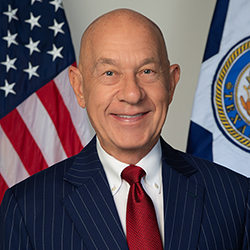
See here, here, and here for some background. Other cities have a clear policy about how their police can and cannot interact with ICE, while we have mostly lived in the murkiness of Mayor Whitmire’s reluctance to say anything on the issue. What he’s saying here is correct and good and I’m glad he’s saying it, but I’m also deeply annoyed it took him this long to do so. It’s just an abdication of leadership at the worst possible time. Maybe now he can say something about this, or about any of the vast array of atrocities ICE has been committing in this city and everywhere else. The best time would have been before they happened, but the second best time is right now.
On deepfakes and accountability
I’ll be keeping an eye on this.
A class action lawsuit accusing X.AI of enabling the mass creation of sexualized deepfakes marks a new stage of liability in cases involving artificial intelligence.
Now, plaintiff lawyers are focusing on technology platforms themselves—not just users—which could put AI companies at risk for large-scale lawsuits.
And as lawsuits and regulatory actions mount, attorneys are watching who courts will hold accountable for AI-driven wrongdoings.
In the latest case, litigant Jane Doe from South Carolina filed a class action lawsuit against X.AI, claiming its AI chatbot Grok created and shared non-consensual sexualized deepfake images of women.
Attorney Sophia M. Rios of Berger Montague filed the case in the U.S. District Court for the Northern District of California, San Jose Division.
“X.AI’s conduct is despicable and has harmed thousands of women and children who were digitally stripped and forced into sexual situations that they never consented to,” Rios claimed in an emailed statement. “This class action seeks relief for those harmed by X.AI’s monetization of image-based abuse and harassment.”
[…]
The lawsuit asserts products liability arising from design and manufacturing defects, negligence for failing to use standard safety measures, violations of California’s right-of-publicity laws, defamation, intentional infliction of emotional distress, privacy violations under California law, and unfair business practices.
This legal approach is similar to a recent case in which Ashley St. Clair, the mother of one of Elon Musk’s children, filed a lawsuit in federal court in New York. She claims the Grok chatbot is “unreasonably dangerous as designed.”
“As deepfake litigation continues to grow, I see clear parallels to earlier accountability battles,” Mick S. Grewal, who represented 111 of Gymnastic Coach Larry Nassar’s survivors and secured a $500 million settlement with Michigan State University, said in a statement.
“These days, plaintiffs are shifting their focus from bad-acting individuals to AI systems themselves, as illustrated by recent lawsuits targeting the platforms used to cause harm,” Grewal said. “This marks a meaningful evolution in how courts could make AI-driven technology responsible for the harmful actions of humans.”
For many years, Section 230 of the Communications Decency Act of 1996 provided a nearly impenetrable defense for tech firms: They argued they were merely hosting content from users, not generating it, David Himelfarb, managing partner at Toronto-based Himelfarb Proszanski, said in an email.
“That defense is falling apart,” Himelfarb said.
When plaintiffs claim AI systems are “unreasonably dangerous as designed,” they are using products liability principles in a manner that courts have not encountered previously, Himelfarb said.

I for one welcome this development and will be rooting for the plaintiffs. There are other avenues that could be taken to impose some controls on these things and their owners, but there’s no reason why it has to be a one-or-the-other approach. Let’s try them all and see what works best.
Posted in Legal matters, Technology, science, and math | Tagged artificial intelligence, California, class action, deepfakes, Elon Musk, Grok, lawsuit, South Carolina, Twitter, X.AI |
Weekend link dump for March 8
“Poppycock. She’s doing none of those things. She’s writing science fiction which will be used by a mathematical equation to alter the statistical likelihood of a computer program choosing some tokens rather than other tokens as its output. Saying that any of this is teaching a chatbot philosophy is like calling yourself a psychiatrist because you thought about Oedipus while jacking off.”
“Trump’s War on National Park Signs Is Even Dumber Than You Think”.
“Looksmaxxing Is Just Mar-a-Lago Face For Men“.
“Pretty consistently for the last few rounds of the dietary guidelines updates, Americans have been a little short on calcium, potassium, fiber and vitamin D. Protein was not and has never been in that list of things that we’re short of.”
“The place on Earth from which you can, in theory, see further than any other is between an unnamed Himalayan ridge near the Indian-Chinese border and Pik Dankova in Kyrgyzstan. It is just over 530km.” You can see all the views in the world here.
“I think it’s worth operating from the premise that we are seeing a step-change in what [AI] tools can be used for. But it does mean we should keep in mind that the experience of early adopters — the people who are most enthused by coding agents — is probably dissimilar to the normies. This thing can be revolutionary for coders and entrepreneurs, while still being nothing like the social revolution they imagine is in the offing. It feels very much like Neal Stephenson overestimating the social contagion of the Linux revolution circa 1999. It can be a lightning bolt within one sector of the economy, but still limited to people with a very specific set of tastes and preferences.”
“Bills introduced in recent weeks in the legislatures of at least four Democratic-led states would impose long-term consequences on new ICE employees by rendering them ineligible for jobs in law enforcement, public education, and, in their most expansive form, the entire state civil service.”
“In addition to its human horrors, the Trump administration’s assault on immigrants living in the U.S. is having a chilling effect on people traveling here from outside the country. International travel to the U.S. is in a certifiable freefall, with nine straight months of decline in foreign visitors versus the year before.”
A long list of reasons why Dr. Phil sucked, and still sucks.
“Idaho considers an ‘apocalyptic’ choice for disabled people and families”. Spoiler alert, it’s all about the Big Beautiful Medicaid cuts.
“Surprise, You Might Be Canadian And Not Even Know It!”
“That we are discussing the ins-and-outs of which random gamblers get paid out during an illegal war in which already hundreds of school children have been bombed to death feels like the type of grotesque sideshow that is only possible because the U.S. government is only interested in regulating its perceived political enemies, and which only feels possible because much of the American economy feels held together by cope and the gobs of money being thrown into AI, data centers, and gambling.”
“Let’s be clear here: Meta Glasses are awful, both for our right to privacy and for our species’ ability to separate itself from a cycle of corporate media monopolies that have made us addicted to their toxic algorithms.”
“When FBI Director Kash Patel fired a dozen FBI agents and staff last week for their role in the classified documents investigation of Donald Trump, he targeted an elite counter espionage unit that investigates threats from foreign adversaries and specializes in Iran, according to more than a half dozen sources with knowledge of the firings.”
RIP, Len Garry, guitarist who was Paul McCartney and John Lennon’s bandmate in The Quarrymen.
“But less than 24 hours later, the DOJ changed its mind, filing what can only be described as a “whoopsie, we take it back” motion. Is there any explanation or legal justification for this? Of course not.”
RIP, Lou Holtz, Hall of Fame college football coach who won a national championship at Notre Dame.
“Speaker Mike Johnson already faces an almost daily attendance problem with his slim House majority, and the Texas elections on Tuesday might have made that dynamic worse.
“Ukraine is prepared to send military experts to the Middle East to help the U.S. and its partners counter Iranian drones, the country’s president said this week.”
Would you like to buy a lightly used triceratops skeleton? Reasonably priced, as far as these things go.
Might The Bride! cause Oscar problems for Jessie Buckley as Norbit is supposed to have done for Eddie Murphy?
RIP, Bernard LaFayette, civil rights activist who did the risky groundwork for the voter registration campaign in Selma, Alabama, that culminated in the passage of the Voting Rights Act of 1965.
Posted in Blog stuff | Tagged linkdump |
When hand counts go wrong
There are supposed to be consequences for this. But will there be?
Calhoun County finished submitting its primary election results to the state Friday morning after county Republicans, who hand counted their primary ballots, missed a deadline in state law requiring them to submit early-voting and Election Day results to the county no later than 24 hours after polls closed, a county election official said.
Mary Ann Orta, the elections administrator in the South Texas county, which includes Victoria and Port Lavaca, and the Texas Secretary of State’s Office both confirmed the county GOP missed the deadline and its results were submitted to the state Friday morning. The results for county Democrats, who used electronic voting equipment to tabulate ballots, were submitted to the state not long after the polls closed on Tuesday night, Orta said.
In Texas, political parties decide at the county level how their primaries will be administered, and Calhoun Republicans chose to hand count ballots this year, including those cast early and at 11 Republican precincts on Election Day, a labor-intensive process.
In a text message responding to questions from Votebeat, Calhoun County GOP Chair Russell Cain said the party “would like to thank the Calhoun County Elections Office and the Texas Secretary of State for their continual support and guidance during the Republican Primary Handcount. We had about a hundred people devoted to this endeavor and appreciate their dedication and resilience throughout the counting process.”
He did not immediately respond to questions about exactly when workers completed counting, or about the missed deadline to report results. There were 3,153 ballots cast in the county’s GOP primary, according to data posted on the Texas secretary of state’s website Friday.
Failure to provide results by the 24-hour deadline is a class B misdemeanor, which carries fines of up to $2,000 and the potential for jail time. The Texas Secretary of State’s Office declined to comment on how the law is enforced, or the potential legal implications of the party’s failure to meet the deadline. But Alicia Pierce, a spokesperson for the agency, referred Votebeat to a section of the Texas election code that says the canvassing authority — in this case, the county party chair and the party’s executive committee — can seek a court order to force the delivery of records and supervision of the counting process. However, local prosecutors generally have the authority to investigate and prosecute any election crimes or violations, according to the election code.
Orta did not have many answers Friday morning. She and her staff have been sleep-deprived since Tuesday, as they waited for all the information necessary to report results to the state.
“I’m exhausted and still trying to make heads or tails of everything we’ve got,” Orta said.

I did not have Calhoun County on my list of hand–counting miscreants. All of the others either managed to get their counts done in a sufficiently timely manner (how error-ridden they will prove to be remains unreported on) or had to abandon the effort. They still caused chaos and damage that may reverbate for some time, but no one in those counties is in legal jeopardy at this time. One must count that as a win, I suppose.
As to what may happen in Calhoun County, I have no idea. I haven’t gone looking for the hand count law, so I don’t know what its specifics are, or even who might be at risk of arrest and prosecution. One hopes it would be the party officials and not the local elections admins, since primaries are run by the parties, but give the state of elections law in Texas I’m not confident of that. The Calhoun County DA may well conclude that there’s nothing for them to do, and I feel even more confident that Ken Paxton is not going to try and bigfoot this one, since there are no Democrats for him to harass. So maybe no harm, no foul? I would not be surprised if everyone involved just decides to pretend this never happened.
Whitmire “pay for play” accusation against Hollins goes nowhere
We’re just now hearing about it.
Chris Hollins
An investigation Mayor John Whitmire initiated into Controller Chris Hollins’ decision to solicit sponsorships for a city event was “not sustained” by the city’s Office of Inspector General, city records show.
Whitmire in October 2024 called a news conference to announce that he was asking investigators to probe the “unacceptable” sponsorships Hollins was inviting for his office’s annual investor conference, saying it was “the appearance of pay to play.”
A conference pamphlet listed sponsorships from 10,000upto10,000 up to 10,000upto100,000, with increasing perks, including a “private dinner with the controller” for top donors. Whitmire said at the time that he had gotten calls from banks who were concerned about being able to work with the city if they didn’t fork over money to sponsor the event.
A list of OIG cases and their outcomes the Houston Chronicle obtained through a public records request shows the mayor’s office referred the program for investigation the day after Whitmire’s news conference.
The case was quietly closed Oct. 16, the file shows, and listed as “not sustained.” Neither the mayor’s nor controller’s office has publicly noted it.
Whitmire’s office did not return a request for comment on the investigation’s results. His office and spokesperson have not returned any written requests or phone calls for comment from the Chronicle since Aug. 17.
Hollins, who had reacted to the mayor’s press conference by calling the issue “a huge nothing burger that is meant to distract from the mayor’s failed leadership,” said the OIG ruling was a “pretty obvious outcome.”
“The allegation was unserious at the onset, and it remained unserious throughout,” Hollins said Thursday.
[…]
“That is the nature of scandal these days,” [UH poli sci professor Brandon] Rottinghaus said. “People forget these corruption and scandal allegations fairly quickly, and the herd moves on.”
Hollins said he didn’t address the case’s closure publicly because his office was busy with more important matters.
“I said from the beginning this was a joke and an embarrassment, and so that’s how we thought about it,” Hollins said. “We never wanted to breathe any life into it because we knew it was dumb.”

See here for the background. I had forgotten this was a thing, which validates Hollins’ decision to let the sleeping dog lie. Hollins made his own request to the OIG to include the Mayor’s sponsorship requests for the State of the City address in its investigation, claiming the only difference between the two was where the funds were going. The story doesn’t say anything about that, so my guess is that the OIG never took it up. Which, also fair. I called this “the opening of the 2027 Mayoral race” at the time, but it seems clear that Hollins is running for re-election as Controller at this time. So in every way this ended up a total nothingburger.
Posted in Local politics | Tagged Bank On Houston, Chris Hollins, Election 2027, ethics, Houston, Houston City Controller, Houston Forward, Inspector General, John Whitmire, Mayor, Robin Curtis |
The 1940 Air Terminal Museum has closed
This is a major bummer.
The 1940 Air Terminal Museum, a longstanding tribute to Houston’s aviation history, has closed because it was no longer economically sustainable, according to its president.
The museum is adjacent to Houston’s Hobby Airport. Karen Nicolaou, president and director of The Houston Aeronautical Heritage Society, the nonprofit that operates the museum, said she hopes the closure is temporary as a workable financial solution is sought.
“The museum has ceased operations at this time,” according a Facebook post. “Thank you to everyone who has contributed.”
[…]
The Houston Aeronautical Heritage Society nonprofit leases space in the old terminal building for the museum. She said the building is owned by Houston Airport System which reports to the city of Houston and the mayor’s office and it is governed by federal aviation regulations.
On March 6, 2019, the Houston Municipal Terminal Building was added to the National Register of Historic Places and is a recognized piece of history by the city of Houston.
As a nonprofit that leases the building, she said they face restrictions on where they can get their funding and how they use the space.
The final blow, Nicolaou said, was Facebook’s refusal to let the group pay to promote their raffle fundraiser on the platform because the company considered it gambling. The board of the nonprofit hosted a raffle for a 1928 Ford Model A in December 2025 and had held a raffle the previous year as well. The group also tried raising money through GoFundMe pages and other methods before the closure.
She said the raffle makes up over 50% of their budget and they’ve been doing the raffle for 10 years. The museum’s website lists major benefactors for the museum which include United Airlines, Southwest Airlines, National Trust for Historic Preservation, Texas Preservation Trust, The Strake Foundation, The Houston Endowment and others.

The general economic malaise didn’t help either. I’m annoyed that goddamn Facebook refused to promote their big fundraiser, for such a flimsy reason. I don’t know what can be done about that. There are still some possible ways forward, because this situation as it is now is unacceptable.
While the museum is closed for now, Nicolaou says its board has been in contact with the Texas Historical Commission about taking over operations. One issue is that the commission would want to take ownership of the building from Houston Airports, according to Nicolaou.
“That’s going to take coordination between the city, the airport system, and the Texas State Senate. There’s a lot of politics involved,” Nicolaou says.
Of course, she has a simple proposal for Houston Mayor John Whitmire that would move the process along.
“Mr. Mayor, sell the historical commission the building for a dollar and be done with it,” she says with a laugh.
In response to CultureMap’s request for comment, Mayor John Whitmire provided the following statement: “I’ve spoken with the Chair of the Texas Historical Commission about opportunities to support the museum’s operations in ways that enhance the public experience. We’re making progress, but discussions are in the early stages.”
Whether it’s operated by the City of Houston, the Texas Historical Commission, a university, or some other entity, Nicolaou hopes the public will be able to visit the museum again soon and for many years to come.
“We want a permanent solution. We’ve tried for one for years,” she says. “It belongs to the city. It belongs to the residents of the city of Houston. They should have it to go to for years.”
Yes they should, and one way or another some person or organization needs to step in and save the day. We have the capacity, we just need a volunteer. I really hope that happens, and soon.
Trib analysis of how Talarico beat Crockett
Rep. Jasmine Crockett
When U.S. Rep. Jasmine Crockett jumped into the Democratic primary for U.S. Senate in Texas, she was the immediate frontrunner.
Widely known and beloved by Democratic voters, Crockett had a record of strong fundraising in the U.S. House and a knack for going viral with her brassy quips aimed at Republican foes. Her lead opponent, state Rep. James Talarico of Austin, was on the rise but lesser known among voters outside of Central Texas. Former congressman and 2024 Senate Democratic nominee Colin Allred was a rerun, who dropped out of the race in the hours before she launched.
Early Wednesday, Crockett lost the nomination to Talarico by a decisive margin — the result of a fiercely competitive primary that overwhelmed the Dallas congresswoman’s starting assets and tested the power of political celebrity among Texas Democrats. Her loss reflected both the strength of Talarico’s campaign and her own team’s inability to scale in time for such an expensive and hotly contested statewide race.
From the start, four people familiar with her campaign said, Crockett’s team deprioritized the primary race, confident that her name recognition and reputation as a fighter in Congress would be impossible for Talarico to catch up with, and would carry her to the general election. So she embarked on a primary battle with a makeshift operation that lacked a campaign manager, a developed fundraising strategy and comprehensive infrastructure for a ground game.
“What happened with Jasmine was that name ID can only take you so far,” said Monique Alcala, the former executive director of the Texas Democratic Party. “You actually have to have a real campaign operation, and actually engage in measurable campaign tactics. I don’t think that we ever saw that come together throughout the entire time that she was running.”
Crockett still put up a strong showing at the ballot box, winning over a million votes — 46% of ballots cast — and ginning up enthusiasm among the Democratic base, particularly Black voters.
But she was unable to run up the score where she needed to in Texas’ biggest and most diverse cities. At the same time, Talarico trounced in his political home base in Central Texas, and with voters in heavily Latino counties — a crucial, swingy voting bloc in the general electorate.
Crockett’s relative lack of an apparatus made a difference, especially against a candidate who entered the race three months before she did and built up significant media, fundraising, volunteer and events operations, and whose political persona cultivated its own kind of gravitational pull.
“This was a close race, and so I don’t want to sound like she ran a bad campaign,” Democratic strategist Matt Angle said. “She just ran into a guy who ran a really good campaign. And it’s a really good sign for Democrats that James wasn’t just a personality that caught fire — he had a plan, and he carried it out.”
[…]
Though she barnstormed the state and met voters at the polls during the 11-day early voting period, her campaign up until that point had largely been made up of appearances at churches, local businesses and events hosted by other groups, like unions and Black sororities.
The Crockett team member said the congresswoman wanted to meet Texans where they were outside of political settings, instead of bringing them to her events.
Crockett planned to get around the state more after she secured the nomination and while Republicans were duking it out in a runoff election, said a Democratic strategist who spoke to her directly about the matter.
“To her own admittance, Congresswoman Crockett wanted to launch and run a campaign that was different,” said [Democratic strategist Dallas] Jones, noting her emphasis on in-person politicking at smaller venues like bars and churches over standard campaign rallies and events. “It was a very untraditional campaign in how it was ran and in many ways experimental.”
“If that is the case,” he added, “then we would now say the experiment did not work.”
Crockett’s ground game also paled in comparison to Talarico’s, who has said he saw his bid as the “underdog” campaign.
Crockett largely relied on organizations that endorsed her, such as Jolt Action and Texas Organizing Project, for get-out-the-vote tactics like door-to-door canvassing, in place of a robust in-house operation to turn out her voters.
The Crockett team member said that her campaign invested in Black voter turnout through blockwalking, virtual town halls, robocalls, Black radio stations and efforts on digital platforms to target infrequent Black Democratic voters.
In contrast, Talarico brought tens of thousands of Texans out to rallies and events his campaign put on around the state after he launched his bid in September. His campaign recruited 28,000 volunteers, contacted voters in all 254 counties in Texas and hosted more than 560 voter mobilization in 75 cities throughout the race, according to a Saturday news release. In the four days before election day, his campaign and its volunteers blitzed 40 cities with 130 events.
He also had a clear-cut plan to win Latino voters in particular, running ads and social media content in Spanish, campaigning with Tejano music star Bobby Pulido in South Texas and closing his campaign with an ad featuring Latino influencer Carlos Eduardo Espina.
“He won because he showed up in communities, he ran advertising in those communities, he had an amazing field team,” Rocha said on social media Wednesday. “It’s grassroots organizing combined with paid advertising in digital, TV, radio around sporting events, and a robust Latino advertising campaign.”
Further into the campaign, Crockett suffered from relatively lackluster fundraising. She raised 8.6millionoverthecourseofherbid,morethanhalfofwhichshetransferredfromherHousecommittee—atotalhauldwarfedbyTalarico’smorethan8.6 million over the course of her bid, more than half of which she transferred from her House committee — a total haul dwarfed by Talarico’s more than 8.6millionoverthecourseofherbid,morethanhalfofwhichshetransferredfromherHousecommittee—atotalhauldwarfedbyTalarico’smorethan20 million take.
That drove a major spending deficit on advertising. Crockett spent $4.8 million on advertising, which would have been an impressive spend for a Democratic primary candidate in Texas, if not for Talarico.
Starting in January, Talarico’s campaign and his super PAC collectively unleashed 25.9milliononadsthroughelectionday,outspendingCrockettandhersuperPACnearlyfive−to−one.TalaricoandhissuperPACtogetherraisedmorethan25.9 million on ads through election day, outspending Crockett and her super PAC nearly five-to-one. Talarico and his super PAC together raised more than 25.9milliononadsthroughelectionday,outspendingCrockettandhersuperPACnearlyfive−to−one.TalaricoandhissuperPACtogetherraisedmorethan27.2 million through the start of the year.
Crockett’s team member recalled wondering how long Talarico could maintain his spending momentum. But as he continued to flood the airwaves, Crockett’s internal polling began to show Talarico narrowing the name recognition gap and winning some of her supporters, particularly white women, to his side.
“The fact that he did stay up at that level every week — you see the buy come in at a million dollars a week — all of a sudden, you’re like, ‘Okay, this is gonna make a big difference,’” the team member said.
Meanwhile, Crockett’s only broadcast spot, the biggest avenue for campaigns to get their message out, came five days into early voting, according to media tracking firm AdImpact. The super PAC in her corner fizzled, dropping just under $600,000 on ads supporting her and opposing Talarico.
Over the course of his campaign, Talarico invested $5.7 million in digital fundraising, hiring Aisle 518, a firm whose clients have included California Gov. Gavin Newsom and Sens. Bernie Sanders of Vermont, Jon Ossoff of Georgia and Ruben Gallego of Arizona, to build out the operation.

There’s more, so read the rest. There was also this Politico story that was more focused on Rep. Crockett and her choices in the campaign, which is fine as far as it goes but is somewhat less interesting to me because any losing campaign can be picked apart afterwards. The main thing I took out of this article was how strong a campaign Talarico apparently ran. He contacted a huge swath of voters everywhere in the state, with an emphasis on reaching out to Latino voters, he raised a ton of money and ran effective ads on TV and online, he worked with firms that have worked with some of the more successful national Democrats around – I mean, what’s not to love? Running in a general election is different, and he will be the focus of a ferocious and well-funded attack network, which he didn’t face in the primary – we’ll see how he responds when one of those attacks slithers over from the wingnut fever swamps to the mainstream press – but if the primary was a test of how he campaigns, he passed with flying colors. I don’t know what more you could have asked of him.
Lawsuit filed over Comptroller’s anti-minority business program shenanigans
Good.
Four business owners and a trade association sued the state of Texas on Monday, seeking to reverse acting Comptroller Kelly Hancock’s emergency rules altering a state program intended to give additional exposure to economically disadvantaged groups in government contracting.
During an afternoon news conference in Austin, the business owners said they are suing because they all lost out on government contracts after Hancock stripped their Historically Underutilized Business Program certification in December.
“In this country, the legislature passes the laws, not the comptroller, and Texas is no different,” Alphonso David, president & CEO of the Global Black Economic Forum, and lead counsel for the plaintiffs, wrote in a statement. “The HUB case highlights a fundamental American principle — members of the executive branch cannot rewrite laws passed by the state legislature. They cannot deny citizens of their legal rights without a court order, legislative approval, or due process.
“Acting Comptroller Hancock took a program created by statute and rewrote it without any legal authority. His actions are baseless and unlawful and must be reversed.”
The plaintiffs are seeking a temporary injunction to block Hancock’s emergency rules, as well as reinstatement to the HUB program while the lawsuit plays out in a Travis County district court.
They are ultimately seeking a court order to restore the program to its original form, arguing that Hancock overstepped his statutory authority, deprived them of state contracts without due process and violated the Texas Constitution.
[…]
The program was created through bipartisan legislation during the 1990s, intended to give minority- and women-owned businesses a leg up when seeking state contracts. The program does not set quotas for the contracting of HUB-certified businesses, but sets goals that state agencies generally strive to meet.
HUB businesses received 3,634 contracts totaling more than $4 billion in 2024, according to the Comptroller’s Office.
Republicans filed several bills aimed at killing the HUB program entirely last year in the Legislature. They all died without making progress in either chamber.
In October, Hancock announced that his office would not issue new or renewed certifications under the program while it was reviewed, pushing the program into the national battle over government initiatives perceived to be “diversity, equity and inclusion.” The Comptroller’s Office then cited emergency powers to restructure the program in December, removing all women and minority business and limiting eligibility to only service-disabled veteran business owners.
“Businesses deserve a level playing field where government contracts are earned by performance and best value — not race or sex quotas,” Hancock, who is running in a competitive GOP primary for comptroller, wrote on social media at the time.
That change shrank the program from more than 15,000 participants to just under 500. HUB certified business owners said at the time that the change risked undercutting their business strategy and would hurt their bottom line.
State Sen. Royce West, a Dallas Democrat who co-authored the 1999 bill that codified the program into state law, said the Legislature, not the comptroller, is empowered to change the program.
“The Legislature voted. The answer was no,” West said. “The Comptroller doesn’t get to override that decision because he disagrees with it — that’s not his role under the Texas Constitution, and these business owners deserve to have that principle upheld in court.”
This is the first lawsuit challenging Hancock’s changes to the program.
I don’t think I had written about this change before, because honestly it’s hard to keep up with all the BS. I’m trying to come up with something to say other than “this sure seems clear-cut”, because what Sen. West says makes total sense, but it’s hard. This is how it’s supposed to work, right? Even in Texas, in the Year of Our Lord 2026? I guess we’ll find out.
Posted in Legal matters | Tagged Comptroller, HHSC, Historically Underutilized Business Program, Kelly Hancock, lawsuit, Marc Williams, National Association of Minority Contractors, Royce West, Stephanie Muth, Texas, Texas Facilities Commission, The Lege, Travis County, TxDOT, Will McKerall |
Camp Mystic ordered to not touch flood-damaged cabins
Basically, an order to preserve evidence while litigation proceeds.
Camp Mystic cannot alter its property by the Guadalupe River where 27 girls and the camp’s executive director died last summer, so that evidence can be preserved while a lawsuit proceeds, a judge in Austin ruled Wednesday.
The camp cannot demolish, repair or reconstruct a number of cabins where campers slept when a massive flood struck on July 4, Travis County District Court Judge Maya Guerra Gamble said.
The camp also cannot modify its grounds or its office building, recreation hall or commissary — all points of interest in the wrongful death case filed by the parents of camper Cile Steward, whose body still has not been found.
But the court order, which will be finalized in the coming days, doesn’t block Camp Mystic from reopening its neighboring Cypress Lake camp site, where cabins didn’t flood, this summer. The judge asked attorneys to bring back a map showing a clear line drawn between the Guadalupe portion where children died and the Cypress Lake portion, which the camp is seeking to reopen.
“For us, it’s incredibly vindicating to have this order ruled in our favor as it relates to maintaining the evidence and trying to really get down to the bottom of what happened to our children,” said CiCi Steward, Cile’s mother.
Mikal Watts, the lawyer representing Camp Mystic and its owners and directors, the Eastland family, also praised the judge’s decision.
“She did the right thing: She agreed that the evidence at the Guadalupe River should be preserved,” he said.
See here for some background. This was the first hearing in any of the lawsuits against Camp Mystic, and that was one reason why I wanted to note this. Seems like this particular motion was not really contested, but as these plaintiffs want to shut the camp down until the litigation is resolved, I don’t imagine it will continue like that.
The Trump-Cornyn-Paxton endorsement psychodrama
First, there was this.
Big John Cornyn
President Donald Trump on Wednesday said he will soon make an endorsement in the heated Texas Senate Republican primary, as Sen. John Cornyn and Texas Attorney General Ken Paxton head toward a runoff election in May.
Trump also expressed his desire for the non-endorsed candidate to concede.
“The Republican Primary Race for the United States Senate in the Great State of Texas, a State I LOVE and won 3 times in Record Numbers (the HIGHEST vote ever recorded, by far!!!), cannot, for the good of the Party, and our Country, itself, be allowed to go on any longer. IT MUST STOP NOW!” Trump wrote on his social media platform.
“I will be making my Endorsement soon, and will be asking the candidate that I don’t Endorse to immediately DROP OUT OF THE RACE! Is that fair? We must win in November!!!” Trump wrote.
The president’s post came hours after Senate Republican leadership urged Trump to back Cornyn, a four-term Republican senator, over Paxton, a conservative firebrand who has become popular among Trump’s MAGA base despite being involved in several scandals.

They are, perhaps, a little worried about this race, and for sure worried about all the money that will be incinerated in the runoff. It’s a little hard to imagine Ken Paxton just rolling over, however, and as such we next got this.
Attorney General Ken Paxton on Wednesday said not even President Donald Trump could push him out of the Texas Senate contest, telling a right-wing cable news show that he still plans to stay in the GOP primary runoff against Sen. John Cornyn even if he does not earn Trump’s endorsement.
“I’m staying in this race,” Paxton told Real America’s Voice. “I owe it to the people of Texas. I’ve spent a year of my life campaigning against John Cornyn because John has not represented the people of Texas well. He’s been against Trump in both of his elections, said he shouldn’t run last time. The people of Texas, at least the Republicans, would like something different.”
[…]
But even the hint of suggestion that Trump would force out Paxton—a MAGA darling who has litigated right-wing culture war issues and helped aid in Trump’s failed quest to overturn the 2020 election—enraged some of Trump’s biggest supporters, who said it was wrong for Trump to deny GOP voters the chance to choose their own candidates.
“This is wrong and the people of Texas should be able to vote for WHOEVER THEY WANT!!! NOT the candidate Trump demands,” former Rep. Marjorie Taylor Greene wrote Wednesday in a post on X. “People are furious over this and if Trump does this, it could actually be the real reason Texas Senate seat flips blue. Stealing people’s opportunity to elect their leaders by force will definitely piss off voters and will lead to even more sitting it out.”
Objectively and separating this all from the Trump stuff, it is weird to ask someone who got over 40% of the vote and trailed the leader by one point to drop out of the runoff. You can argue that Paxton underperformed, but you can also argue that nearly sixty percent of voters wanted not-John Cornyn. Seems like having the runoff is the way to settle it at this point. (*)
And then we settled on this.
Attorney General Ken Paxton said Thursday he would consider dropping out of the U.S. Senate race if Senate GOP leaders agreed to abolish the filibuster and pass a priority piece of legislation for President Donald Trump.
Paxton made the statement in a social media post that also criticized his opponent in Texas’ Senate Republican primary, incumbent John Cornyn, for being against scrapping the filibuster to pass the bill, known as the SAVE America ACT. It would require people to provide proof of citizenship — such as a birth certificate or passport — when they register to vote and present photo identification at the polls, among other new election-related rules.
Cornyn is a supporter of the legislation, though he and other Senate Republicans have long bristled at talk of abolishing the filibuster, a parliamentary tool that, in practice, requires support from 60 senators in the 100-member chamber to bring a bill up for a vote. CNN reported last month that Cornyn would not say whether he backed ending the filibuster to pass the proposal, which the Senate’s 53 Republicans cannot pass amid unified opposition from Democrats.
“I repeat what I have consistently said: I support the bill and have encouraged Senate Republicans to get it done,” Cornyn said in response to Paxton’s post, without addressing his position on the filibuster.
Paxton’s offer to drop out appears designed to make a political point, more than anything else, by drawing attention to Cornyn’s reluctance to get rid of the filibuster. But it marks the first time he has raised the prospect of leaving the race amid intense lobbying by Senate GOP leaders for Trump to endorse Cornyn.
It could mean Paxton is feeling some pressure, or it could mean he’s just being a troll. He’s good at that. By the time this runs in the morning there could have been another two or three twists in the story, much like the Tony Gonzales saga. They’re all gonna do what they’re gonna do, we just have to do our thing and roll with it.
(*) Yes, yes, instant runoff voting, but that isn’t a thing here.
Posted in Election 2026 | Tagged Donald Trump, Election 2026, endorsements, filibuster, John Cornyn, Ken Paxton, primaries, runoff, Senate, Texas, voter suppression |
House ethics panel investigating Rep. Gonzales (who ended up dropping his re-election bid)
Yes, they waited till after the primary.
Rep. Tony Gonzales
The House Ethics Committee opened an investigation into U.S. Rep. Tony Gonzales to investigate affair allegations with his former aide.
The committee announced a panel Wednesday, a day after Gonzales advanced to a May primary runoff, that will determine whether Gonzales “engaged in sexual misconduct towards an individual employed in his congressional office” and “discriminated unfairly by dispensing special favors or privileges.”
Gonzales’ former aide, Regina Santos-Aviles, died by suicide last year after setting herself on fire. Rumors of an affair between the representative and Santos-Aviles circulated since September, but in November, Gonzales addressed the allegations at The Texas Tribune Festival saying they were “completely untruthful.” The story drew renewed attention on Feb. 17, the eve of early voting, when the San Antonio Express-News reported that Santos-Aviles had acknowledged the affair to another staffer in a text message.
Texts later shared by Santos-Aviles’ widower showed Gonzales begging the staffer for a “sexy pic” and asking her to share her “favorite position,” despite Santos-Aviles’ refusal and assertion that Gonzales’ messages were “going too far.”
Reports also found that Santos-Aviles received a raise and bonus the same year she allegedly had an affair with Gonzales, and ended the year with thousands more in earnings than her colleagues in similar roles.
[…]
The timing of the ethics review is another blow to Gonzales who is still fighting for a tough reelection battle against gun rights activist Brandon Herrera, who came within 400 votes of beating him during the last election.
The Office of Congressional Conduct, an independent, nonpartisan body overseeing the House of Representatives, has also been investigating Gonzales for months, the San Antonio Express-News reported.
Gonzales has repeatedly denied wrongdoing and told CNN on Feb. 24 he wouldn’t resign from his term, which ends January 2027, and continued pushing forward with his campaign.

See here and here for some background. It sure sounds like there’s plenty for the panel to investigate, so I look forward to seeing what they find. I don’t know how he wins the runoff with all this hanging over his head, but he is still Trump’s candidate, and it’s not like Brandon Herrera is anyone of any merit. Weirder things have happened. But yeah, this investigation – these two investigations – will do Rep. Gonzales no favors. TPR has more.
UPDATE: Confession is good for the soul.
U.S. Rep. Tony Gonzales, R-San Antonio, admitted Wednesday to having an affair with a staffer who later died by suicide, after initially denying the allegation.
Speaking on conservative talk show host Joe Pags’ show the day after he was forced into a runoff in his primary, Gonzales called the affair a “mistake” and a “lapse in judgment.”
“I take full responsibility for those actions,” Gonzales said. “Since then, I have reconciled with my wife, Angel. I’ve asked God to forgive me, which he has. And my faith is as strong as ever.”
Gonzales is now subject to an investigation from the House Ethics Committee, announced Wednesday, to look into whether he “engaged in sexual misconduct towards an individual employed in his congressional office” and “discriminated unfairly by dispensing special favors or privileges.”
The third-term representative said he looks forward to the committee’s probe.
“I appreciate the opportunity to provide all the facts and all the details that lead to exactly what occurred in the entire situation,” he said.
And timing is everything. Good luck with that. Talking Points Memo has more.
UPDATE: When it rains, it pours.
U.S. House Speaker Mike Johnson and the chamber’s Republican leadership on Thursday asked Rep. Tony Gonzales of San Antonio to drop his reelection bid which is headed for a May 26 runoff against gun activist Brandon Herrera.
The call from the GOP leaders comes a day after Gonzales admitted to having an affair with an aide who later died by setting herself on fire — despite having previously denied the relationship months earlier.
In a statement, GOP leadership said they had urged the House Ethics Committee , a congressional watchdog, to “act expeditiously” and that Gonzales “said he will fully cooperate with the investigation.” House rules prohibit members from having a sexual relationship or engaging in unwelcome sexual advances with their staffers.
“We have encouraged him to address these very serious allegations directly with his constituents and his colleagues,” the statement said. “In the meantime, Leadership has asked Congressman Gonzales to withdraw from his race for re-election.”
[…]
Johnson’s call for Gonzales to end his campaign came after days of skirting questions about the scandal, often telling reporters he wanted the investigative process to run its course.
Notably, he did not ask the congressman to step down from his seat. The GOP is holding onto a razor thin lead in the U.S. House — a majority that could be imperiled in November’s midterm elections.
Notably but unsurprisingly. I mean, principles are nice and all, but let’s not go crazy here.
UPDATE: And in the end, once the ball got rolling, this was where it was going.
Rep. Tony Gonzales, R-San Antonio, dropped out of his primary runoff Thursday, heeding calls from House Speaker Mike Johnson and other GOP members to end his reelection bid amid revelations that he had an affair with an aide who died by suicide.
“After deep reflection and with the support of my loving family, I have decided not to seek re-election while serving out the rest of this Congress with the same commitment I’ve always had to my district,” Gonzales said in a statement posted on social media. “Through the rest of my term, I will continue fighting for my constituents, for whom I am eternally grateful.”
[…]
The situation has a recent analogue in Texas political history. In 2022, then-Rep. Van Taylor, R-Plano, was headed to a runoff after finishing with 49% of the vote in his primary. But the next day, he withdrew from the race, admitting to an affair that had been revealed in Breitbart News the day before the primary. Second-place finisher Keith Self became the nominee and has represented the district since 2023.
Democrats have been eyeing the 23rd District, which is majority-Hispanic and voted for Trump by a 15-point margin in 2024, especially as the scandal around Gonzales has intensified. But they see an opportunity to pick up the seat regardless, as signs abound of Latino voters souring on Trump and the Republican Party after shifting dramatically to the right in 2024.
Herrera, backed by the hard-right House Freedom Caucus’ political arm, has a history of controversial behavior and edgy humor. In 2024, Jewish Insider reported that he had included Nazi imagery, songs and jokes on his YouTube channel. And the outlet also reported he was a member of the Sons of Confederate Veterans, which promotes Lost Cause ideology.
Good riddance, but Brandon Herrera really sucks, so this is no victory. At least, not yet. Give a few bucks to Katy Padilla Stout, who really needs to be named in all of these stories, and maybe we can do something about that.
Posted in Scandalized!, Show Business for Ugly People | Tagged Brandon Herrera, CD23, Congress, Donald Trump, Election 2026, ethics, Katy Padilla Stout, Office of Congressional Ethics, primaries, Regina Santos-Aviles, runoff, Texas, Tony Gonzales, Van Taylor |
Fifth Circuit allows drag ban enforcement
Obviously a pervert
Texas can enforce a 2023 law that restricts some public drag shows, a federal appeals court reaffirmed in a new ruling on Wednesday.
Senate Bill 12 prohibits drag performers from dancing suggestively or wearing certain prosthetics on public property or in front of children. The law would fine business owners $10,000 for hosting such performances, while those who violate the law could be hit with a Class A misdemeanor.
In September 2023, U.S. District Judge David Hittner declared the law unconstitutional, saying that it “impermissibly infringes on the First Amendment” and that it is “not unreasonable” to think it could affect activities like live theater or dancing. More than two years later in November, a three-judge panel in the 5th U.S. Circuit Court of Appeals unblocked the law and returned the case to the district court.
On Wednesday, the appeals court withdrew its November opinion and reissued a largely identical ruling, denying the plaintiff’s request for a rehearing in the process. SB 12 will now take effect on March 18, according to the American Civil Liberties Union of Texas, who represented several of the plaintiffs.
As part of the ruling, the panel found that most of the plaintiffs — a drag performer, a drag production company and pride groups — failed to show that they intended to conduct a “sexually oriented performance,” and therefore, could not be harmed by the law. The ruling suggests that the federal judges don’t believe all drag shows are sexually explicit.
Critics of the ban have previously raised concerns that Republican lawmakers were portraying all drag performances as inherently sexual or obscene.
And while the law doesn’t have language explicitly referencing drag performances, SB 12’s original version specifically included them. Republican leaders have also made it clear that drag shows are the target.
[…]
The plaintiffs and the ACLU of Texas, which represents them, underscored that Wednesday’s rehearing denial maintained that family-friendly drag shows would still be legal, and said they intend to continue fighting the law.
“The law’s vague and sweeping provisions still create a harmful chilling effect for drag artists and those who support them, while also threatening many types of performing arts cherished here in Texas, from theater to ballet to professional wrestling,” ACLU Texas attorney Brian Klosterboer said in a statement. “Because this law remains unconstitutional, we look forward to continuing this case before the district court and encourage anyone who is impacted by the law to reach out to us. Drag in Texas is here to stay.”

See here for the previous update. My interpretation from then, that this should in theory limit enforcement, still stands. The case is back in district court (I think; that was what happened with the November ruling), so there could still be a favorable ruling for the remaining plaintiffs – the Fifth Circuit removed most of the plaintiffs on the grounds that the law didn’t apply to them. I guess where the rubber would meet the road is when a drag show or performer is busted under this law, if that happens before this lands up at SCOTUS. I will also renew my call for the next Democratic President to do to the lawless and corrupt Fifth Circuit what they will no doubt pledge to do to SCOTUS.
Posted in Legal matters | Tagged Abilene, ACLU of Texas, Attorney General, Bexar County, drag shows, Fifth Circuit Court of Appeals, gay rights, Ken Paxton, lawsuit, Montgomery County, Senate, Taylor County, Texas, The Lege, The Woodlands, transgender rights, Travis County |
Initial thoughts on the 2026 primaries
We don’t have full turnout numbers yet, but as of Wednesday some 363,826 votes were cast in the Democratic primary for Senate in Harris County, while there were 197,389 votes cast on the Republican side. About 140K votes were cast on Tuesday for Dems, and about 70K for Republicans – so much for the thesis that they prefer to turn up on Election Day, at least in Harris County. This easily makes 2026 the second highest turnout for a Dem primary, trailing only 2008 and its 411K votes.
Statewide, it depends on your source, the Texas Tribune tracker or the SOS Election Night page. Dems tallied 2,311,826 votes in the Senate so far in the former, and 2,311,564 in the latter, in both cases with still a few more votes to count, mostly provisionals at this point. On the Republican side the numbers are 2,163,582 and 2,165,744. I’m not sure why the gap is larger there.
Remember Greg Abbott’s threat to spend a ton of money to turn Harris County “dark red” this year? Well, he might want to shore up his support in the Republican Party first, as the candidates he endorsed had at best a mixed bag of results. In addition to Kelly Hancock getting squashed in the Comptroller’s race, Briscoe Cain trailed Alex Mealer in CD09, and John Lujan, for whom CD35 was drawn, underperformed against the Trump-backed Carlos de la Cruz, whose main qualification appears to be that he’s the brother of Rep. Monica de la Cruz. And my favorite result of the night, Abbott-backed Marty Lancton lost his hold on second place in the primary for Harris County Judge and fell behind Warren Howell to finish out of the runoff. Great job, Greg! Keep bringing that energy to these races!
Rep. Hubert Vo not only faces a runoff against challenger (and Chron-endorsed) Darlene Breaux in HD149, he fell behind her in total votes, albeit by a tiny margin, 3,743-3,734. That doesn’t bode well for him in May.
Abbie Kamin’s victory over Audrie Lawton Evans for Harris County Attorney was by just over one percentage point, 50.55% to 49.45%, which translates to just over three thousand votes out of over 310K cast in that race. Two strong candidates, only one could win. Congrats to Abbie Kamin, condolences and best wishes to Audrie Lawton Evans.
Darrell Jordan finished just ahead of Alex Maldonado for District Clerk by an even smaller margin, 18.93% to 18.81%, a mere 365 votes out of almost 316K cast. Latino candidates overall did better on Tuesday than in early voting – County Judge third-place candidate Matt Salazar went from 14% in early voting to 16% overall. I still don’t understand that, but there it is.
As noted yesterday, one incumbent Democratic judge lost their primary (Jim Kovach), but I forgot to mention that one other (Brian Warren) is in a runoff. Justic of the Peace Sharon Burney is also in a runoff; she trailed Melanie Miles on Tuesday. Other incumbent judges all won, and one former judge (Ramona Franklin, sigh) made a successful comeback.
As the Trib notes and as I mentioned yesterday, Rep. Dan Crenshaw lost badly to the terrible Steve Toth in CD02. Rep. Tony Gonzales is in a runoff with Brandon Herrera in CD23. Two incumbent Dems – Reps. Al Green in CD18 and Julie Johnson in CD33, both running in new districts because of redistricting – are in runoffs and were trailing on Tuesday, so a total of as many as four current members of Congress could be ousted before November. Add the new member (Frederick Haynes) in CD30, who will succeed Jasmine Crockett, and that’s a lot of turnover already.
Kamala Harris made a late endorsement of Rep. Jasmine Crockett in the Senate primary. She has now endorsed Rep. James Talarico, and sent a fundraising email for him as well.
Oh, and it looks like Donald Trump may be getting ready to endorse Sen. Cornyn in the runoff. Maybe, who knows with that guy. I’m sure Team Paxton will be magnanimous about it if that happens.
Congratulations to Emerson College for nailing the Dem Senate race in their most recent poll:
The polling in this Texas Senate race has been wack. Maybe the highest ever standard deviation I’ve seen for a contest, even higher than NY Mayor last year. Someone is gonna be really wrong https://fiftyplusone.news/polls/senate/democratic-primary/texas
— G. Elliott Morris (@gelliottmorris) 8:10 AM – 3 March 2026
On the other hand, UT-Tyler, what in the world were you doing?
I’ll have more when I get my hands on a fuller data set. In the meantime, here are various takeaways and roundups from TPM, the Trib, Daily Kos, The Downballot, the Texas Observer, Mother Jones, Lone Star Left, and Marc Campos.
Posted in Election 2026 | Tagged Abbie Kamin, Al Green, Alex Maldonado, Audrie Lawton, Brandon Herrera, Briscoe Cain, CD02, CD09, CD18, CD23, CD30, CD33, CD35, Christian Menefee, Colin Allred, Comptroller, Congress, Dan Crenshaw, Darlene Breaux, Darrell Jordan, Democratic primary, District Clerk, Don Huffines, Election 2026, endorsements, Frederick Haynes, Greg Abbott, Harris County, Harris County Attorney, Harris County Judge, HD149, Hubert Vo, James Talarico, Jasmine Crockett, John Lujan, judicial races, Julie Johnson, Justice of the Peace, Kelly Hancock, Marty Lancton, Melanie Miles, polls, primaries, runoff, Senate, Sharon Burney, Steve Toth, Texas, The Lege, Tony Gonzales, turnout |
A few followup items from Tuesday
This is officially my favorite story from the primaries.
One tough Grandma
Texas congressional candidate Vince Shlomi, known as the “ShamWow guy,” is suing the Republican Party of Texas, accusing it of “rigging” the primary after he says the party removed his nickname from the ballot.
Shlomi announced the lawsuit Tuesday on X, alleging the party was helping incumbent U.S. Rep. John Carter by omitting his recognizable moniker from the GOP ticket.
“Rigged election by these rhinos,” Shlomi wrote on X, attaching the court filing to his social media post.
The filing also names RPT chairman Abraham George as a respondent in the case.
“It’s a product name, people know it, I thought, why not—a couple weeks before, they pull it, I would’ve said, ‘Vote, Shlomi,’ I have to re-do it, I am going to have to rebrand myself now,” Shlomi told the American-Statesman. “I am definitely going to have a difficult time now.”
Shlomi claims George approved his application to appear on the ballot under the nickname “ShamWow,” certifying its use in the March 3 Republican primary.
However, in response to what Shlomi describes as “a challenge” by the National Republican Congressional Committee — which he alleges was sent in coordination with Carter — the party reversed its decision and disallowed the nickname.
Shlomi argues the party violated Texas election code by making the change.
In the filing, Shlomi also asserts that the RPT is not “uniformly and fairly” enforcing its position against other candidates who were not “challenged by the NRCC.” He cites gubernatorial candidate Pete “Doc” Chambers as an example.
The lawsuit references a Jan. 9 letter from RPT general counsel Rachel Hooper notifying of the nickname’s removal.
Shlomi claims the letter was not addressed to him but instead to the NRCC. He says he did not see the correspondence and would not have had an opportunity to challenge the decision even if he had.

Yes, being listed as “ShamWow” on the ballot would definitely have been the difference-maker. Congratulations, Vince Shlomi, you are the Grandma Strayhorn of 2026.
Here’s a headline that will grab your attention: Six data-driven reasons Texas could actually go blue in 2026.
Democrats haven’t won a statewide race in Texas since 1994. But every cycle, we are inundated with pieces asking if this will be the year Texas turns blue. The answer, for 32 years, has been no. I wrote my own version for The Economist back in 2019, calling the state Democrats’ “white whale” for 2020. From 2020 to 2024, the state only drifted further toward Republicans, who win the state on average by 12 percentage points.
But this year, Democrats might have a real shot at winning a statewide election in the Lone Star State.
On Tuesday, March 3, Democratic primary voters picked state House Rep. James Talarico over U.S. Rep. Jasmine Crockett to become their party’s nominee for the November election to the U.S. Senate. On the Republican side, no candidate won above 50%, so incumbent John Cornyn and Ken Paxton are headed to a May 26th runoff election.
I have compiled six data-driven reasons Texas could actually go blue in 2026. They have to do with concerns over Ken Paxton’s electability, Talarico’s support among independent voters, Democratic enthusiasm, and a few other factors. Add them up, and it’s easy to see how Talarico could pull off a win (though it would not be easy to do).
Here are six data-driven reasons Texas could actually go blue in 2026.
Read on for the rest, it’s worth your time. And in the interests of keeping it real, we have this:
I guess the one comfort for Democrats is that he might be. A D+6 WAR puts you in the territory of Blake Masters.
Paxton doesn’t quite *look* like Blake Masters, but he does have a lot more scandal behind him.
— Lakshya Jain (@lxeagle17) 8:07 PM – 3 March 2026
We’ll see how everyone feels after May 26.
There were a couple of big upsets in Dallas and Tarrant Counties that I didn’t see at first but want to note here. In Tarrant County, veteran State Rep. Chris Turner was defeated.
Incumbent Chris Turner has lost his bid for reelection in House District 101 to challenger Junior Ezeonu, a member of the Grand Prairie City Council.
With 100% of the precincts reporting, Ezeonu had 52.67% vote to Turner’s 47.33%. Ezeonu declared victory Wednesday morning.
“We did it, guys! We won!” he said in a post on X. “Thank you to everyone who believed in our campaign, volunteered your time, donated your money, voted, and told a friend to vote as well. This victory is your victory, and I thank you for your support. God bless you all.”
[…]
Ezeonu, 26, is a political consultant who has been on the Grand Prairie City Council since 2021. He told the Star-Telegram that his top three priorities if elected would be to raise the minimum wage to $15 an hour, fund public schools, and make homeownership affordable.
In a Wednesday morning statement, Turner said the outcome was not what he and his supporters had hoped for.
“Sometimes you leave it all out on the field and still come up short,” he said. “The voters have spoken and I respect what they said. I congratulate Rep.-elect Junior Ezeonu on his victory and wish him well as he prepares to take on the responsibility of representing 200,000 of our neighbors in Southeast Tarrant County.”
Rep. Turner has been a member of the Democratic caucus leadership, and as far as I know was one of the good guys. I interviewed him in 2020 about the redistricting process that was to come and what Dems would be doing about it. Here’s his full statement and concession. Congratulations to Rep.-elect Ezeonu, and thanks and best wishes to Rep. Turner.
A more shocking result came in Dallas.
Dallas County District Attorney John Creuzot conceded Wednesday in the Democratic primary to former felony court judge Amber Givens, a shocking upset for the two-term chief prosecutor.
In a statement, Creuzot thanked supporters, voters and his family, and congratulated Givens on her victory.
“While the outcome was not what we had hoped for, I am proud of the work my team accomplished and the important conversations we advanced about justice, accountability, and public safety in Dallas County,” he said.
Givens, who resigned from the 282nd District Court in December to challenge Creuzot, had been widely viewed as the underdog in the race.
Creuzot raised far more campaign money, collecting about 420,000incontributionscomparedwithroughly420,000 in contributions compared with roughly 420,000incontributionscomparedwithroughly20,000 for Givens. And he had the backing of Democrats locally and across the state.
Givens also faced scrutiny last year after the State Commission on Judicial Conduct issued two sanctions, which she is appealing. A trial on the charges was held last week before a Special Court of Review at the state Supreme Court, but it could be several weeks before the three-judge panel issues a decision.
Big primary turnout full of voters who have little or no Democratic primary voting history can have unpredictable results, that’s just the nature of the thing. Creuzot was well respected, and DA-elect Givens (Republicans did not field a candidate) has some baggage. I don’t know enough to comment beyond what I’ve read in the two links presented here. I hope for the best.
One more thing for this post, and I’ll have some other observations and number stuff in a different post, and it has to do with the Dem primary for CD35, a seat I firmly believe we can win, in which a candidate I had not heard of before came out in the lead.
Democrats originally wrote off this district, which under new boundaries would have supported Trump by more than 10 percentage points in 2024.
One of their largest PACs published a report saying it’s out of reach for this election cycle, and efforts to recruit a high-profile candidate fell short.
But House Democrats’ campaign arm has since named the race a top battleground for 2026, and national party leaders are excited about longtime Bexar County Sheriff’s Deputy Johnny Garcia, who got to attend a recent Democratic National Committee fundraiser as a guest of DNC Chair Ken Martin.When the final votes were counted, however, Garcia was headed to a runoff in May.
Maureen Galindo, a family, marriage and sex therapist who ran unsuccessfully for a San Antonio City Council seat in 2025, was in first place with 29.2% of the vote. Garcia had 27.02%.
Despite raising little money, Galindo waged a spirited campaign after developers planned to raze her apartment complex to build a Minor League Baseball stadium.
“This runoff is simple,” she said in a statement Tuesday night. “Do we send a Democrat to Congress who understands and responds to the needs of the people of District 35? Or one who was bought to puppet a corporate-owned America?”
Leading up to Tuesday, a number of local Democratic groups had rallied behind Marine Corps veteran and former federal employee John Lira, who was taking 20.76% in a four-way race.
In an interview at his watch party at the Deco Ballroom, Lira credited Galindo for getting her message out in an overall low-information election.
“She’s basically been a one-person show with a social media following, and seems to be surging,” Lira said as the early results were coming in. “We’ll see where the final dust settles. But she’s over-performed so far. So that’s significant.”
Leaders at the Blue Dog Action PAC, which is helping Garcia, have already said they plan to keep spending to get him through the runoff.
Congratulations to Maureen Galindo, whom I did not include in the January campaign finance report roundup because she had raised a grand total of $4K. She’ll be in the April roundup, and we’ll see if she has more money raised by then. I still think Johnny Garcia is likely to be the stronger competitor – stories like this add more than a little credence to that belief – but you have to respect someone who can do what she did with so little in resources.
Posted in Election 2026 | Tagged Amber Givens, Carole Keeton Strayhorn, CD23, CD35, Chris Turner, Congress, Dallas County, Democratic primary, District Attorney, Election 2026, Harris County, HD101, James Talarico, Jasmine Crockett, John Cornyn, John Creuzot, John Lira, Johnny Garcia, Junior Ezeonu, Ken Paxton, lawsuit, Maureen Galindo, polls, primaries, Republican Party, runoff, Senate, Texas, The Lege, Vince Shlomi |
Lawsuit filed over Muslim schools’ exclusion from voucher program
Yet another seemingly clear-cut First Amendment violation. It’s like it’s a habit around here.
A Houston-area parent is suing state officials, accusing them of religious discrimination for barring Islamic schools from participating in Texas’ private school voucher program.
The plaintiff, Mehdi Cherkaoui, alleges the state has “systematically targeted Islamic schools for exclusion” from the $1 billion tuition support program, preventing Muslim families from applying and using the state money at a school of their choice.
His suit appears to be the first legal challenge to the voucher program that Republican lawmakers pitched last year as a way to help families afford private education, including at religious schools.
Hearst Newspapers reported in early February that no Islamic institutions had been approved for the program even as families began applying to the program. Three Islamic schools had previously been approved but were later removed from the state’s map of approved campuses.
The continued freeze on at least two dozen Islamic schools started in December, when acting Comptroller Kelly Hancock, whose office oversees the program, sought legal approval to block what he says are foreign terrorism-linked schools from accessing the program.
Program leaders have confirmed an ongoing “due-diligence review” of some schools but have not provided details on how the review is being conducted or evidence for why specific schools have been blocked. Hancock confirmed at an event over the weekend that the review remains ongoing.
As the story notes, all this is happening in the wake of some aggressively anti-Mulsim rhetoric and activity from Republicans, so it’s hard to see this as anything but an extension of that. Comptroller Hancock is welcome to testify why it’s not under oath if he wishes. This seems obvious to me, but you know what can happen when this eventually and inevitably makes contact with the Fifth Circuit. So keep your expectations modest.
I note also that Mr. Cherkaoui is seeking to get voucher funds for his two children who are already enrolled in a Muslim private school. He is allowed to do that, as I am sure many parents of children now attending Christian and other fancy private schools. I just wanted to note that this was one of the many arguments people like me made against this whole wasteful scheme in the first place, that the biggest beneficiaries of it will be people who already had their kids in private schools and/or always intended to send them there. I can’t wait to see what that data looks like when we have it. That has nothing to do with the merit of this suit, just with the merit of this dumb law. The Trib has more.
Posted in Legal matters | Tagged Comptroller, Greg Abbott, Houston, Kelly Hancock, Ken Paxton, lawsuit, Mehdi Cherkaoui, Mike Morath, Texas, Texas Education Agency, vouchers |
Texas blog roundup for the week of March 3
The Texas Progressive Alliance congratulates the winners of the primary elections and is ready for November as it brings you this week’s roundup.
Off the Kuff looked at the most recent pre-primary polls of the Democratic race for US Senate.
SocraticGadfly asked rhetorically what HAVE Texas Republicans accomplished in the past 25 years?
Neil at the Houston Democracy Project said Republican Houston Councilmember Julian Ramirez left his Republican Party & himself off his list of top election security threats in Harris County.
=======================
Saraí Bejarano explains why they are fighting to protect Hispanic Serving Institutions in Texas.
The Texas Observer talks to Sen. Sarah Eckhardt about how to put the Comptroller’s office back on a good path.
Tom Palladino and Linda Mais urge better support for caregivers.
Deceleration has a kickass “Smash Fascism” playlist for you.
The TSTA Blog wonders how the State Board of Education would handle the social studies curriculum standards post-Trump.
The Barbed Wire analyzed 300 Texas accounts on a white supremacist dating site.
2026 primary results: Statewide
We have to start with this:
The Texas Supreme Court suspended a district court’s decision Tuesday to extend voting by two hours in Dallas County and ordered that any votes cast by people who got in line after 7 p.m. be separated.
Voting was extended until 9 p.m. in Dallas County after the Dallas County Democratic Party asked for an extension on Tuesday due to confusion over precinct-specific voting locations and issues with the county’s elections website.
Kardal Coleman, Dallas County Democratic Party Chair, filed an emergency petition Tuesday, saying voter confusion was so severe that the county election department’s website crashed. Coleman asked that polls be kept open until 9 p.m. to allow voters time to get to their assigned precinct location.
After the district court judge’s decision, voters were allowed to get in line until 9 p.m., but those who got in line after 7 p.m. were going to be casting provisional ballots, according to former U.S. Rep. Colin Allred.
The Texas Supreme Court issued a statement Tuesday night saying voting should occur only as permitted by the Texas Election Code and that votes cast by voters who were not in line at 7 p.m. should be separated.
U.S. Rep. Jasmine Crockett’s camp issued a statement Tuesday afternoon saying Dallas County Republicans and the Williamson County GOP implemented precinct-specific voting locations on Election Day that were an “effort to suppress the vote” and that state law forced Democrats to “follow suit against our will.”
“This effort to suppress the vote, to confuse and inconvenience voters, is having its intended effect as people are being turned away from the polls,” Crockett said. “We are monitoring the situation and working with our local county party to explore all solutions, including an extension of election day voting hours.”
During a news conference Tuesday afternoon, Crockett said there were issues with the Dallas County Elections website staying online and providing accurate data, which made it difficult for voters to verify their precinct location.
Texas Rep. James Talarico, who is running in the primary race against Crockett, issued a statement saying he was “deeply concerned about the reports of voters being turned away from the polls” and also called for an extension of voting hours.
Crockett said voters in the counties are accustomed to countywide voting, which allows them to cast ballots at any voting location in the county during early voting and on Election Day, not just at their assigned precinct.
[…]
Kendall Scudder, chairman of the Texas Democratic Party, said Republicans in Dallas and Williamson counties refused to agree to a joint primary, which he said led to confusion and voters showing up at the wrong voting locations on Election Day.
“Let’s be clear about what happened here. Both counties have spent a million dollars trying to get the word out about this change — a million dollars of taxpayer money that didn’t need to be spent. Democrats pushed for a joint election,” Scudder said. “As it has been for eight years, it would have been cheaper, simpler, and more accessible for every voter in the county. Republicans said no.”
This is of course related to the stupid hand-counting scheme that the Dallas County Republicans are embarking on. It’s dumb dumbness all the way down. Most likely, the total number of votes cast in the extended period will be fairly small, and most of them will probably get cured, so the net effect of the SCOTx ruling will probably be minimal. Note all of the qualifiers in that sentence, and note that all of this could have been avoided. Voting in El Paso was also extended by an hour due to some technical difficulties.
On to the results. The Trib has an excellent statewide ballot tracker, which I will use to sum things up:
– As of about 10:30 PM, James Talarico led Jasmine Crockett 52-47, a margin of about 70K votes. At the time of this writing, only early results were in from Dallas (where Crockett led 61-38) and Harris (where she led 53.5-45.5). I’ll update this in the morning, but this is too close to call. (Update: Talarico has been declared the winner, though it doesn’t appear that Crockett has conceded yet. Talarico was up by about 160K votes, with more still to be counted.)
– On the Republican side, John Cornyn had a slight lead on Ken Paxton, but with Wesley Hunt and a bunch of no-names collecting almost 17% of the vote, those two are headed for a runoff. Good, let them beat each other up and set a bunch of money on fire for three more months. I’m actually impressed Cornyn was leading Paxton in early votes, but that could change by morning.
– Gina Hinojosa and Sarah Eckhardt (Comptroller) were cruising to easy wins. Vikki Goodwin and Nathan Johnson were right around 49% in their races for Lite Guv and AG, so maybe they’re in a runoff and maybe they squeak by. Benjamin Flores was up 55-45 for Land Commissioner. Maggie Ellis and Kristen Hawkins won their primaries for State Supreme Court. (Update: Flores won, Goodwin and Johnson are in runoffs with Marcos Vélez and Joe Jaworski, respectively.)
– Don Huffines is a turd, but him wiping the floor with Greg Abbott’s hand-picked Comptroller Kelly Hancock is grimly funny. All that and Taylor Rehmet is now the Senator in SD09. Someone give Abbott one of those Magic Erasers to get the “L” off of his forehead. Sid Miller may have finally worn out his welcome as Ag Commissioner, but he was only trailing by seven points as I write this, so he’s not fully dead yet. Mayes Middleton and Chip Roy will fight it out for AG in May.
– I could save this for the Harris County results, but Steve Toth, who is also a turd, is kicking Dan Crenshaw’s behind in CD02. Remember when Crenshaw became a national name who got to go be chummy on “Saturday Night Live” because Pete Davidson made a dumb joke about his eye? Those were the days. Everyone, get to know Shaun Finnie. Dan, you know you don’t have to be gracious about this, especially not after Ted Cruz stabbed you in the back, right? Just think about it, that’s all I’m saying.
– Bobby Pulido easily won in CD15, while Colin Allred and Julie Johnson will go to overtime in CD33.
– The other Congressional race of interest is of course in CD23, where scandal-ridden Rep. Tony Gonzales had a slight lead over gun nut Brandon Herrera. The two will face off in May; Gonzales barely beat Herrera in a primary runoff in 2024. Katy Padilla Stout was on track to face the winner.
– One local result of interest, former San Antonio Mayor Ron Nirenberg easily won the Dem primary for Bexar County Judge, ousting incumbent Peter Sakai. I expect he’ll win easily in November as well. Nirenberg briefly flirted with running for Governor. Maybe another cycle.
– And finally, a result from outside Texas of interest:
Democrat Alex Holladay won a Republican-held seat in the Arkansas state House on Tuesday night, marking the ninth time Democrats have flipped a district from red to blue in a special election since the start of Donald Trump’s second term.
Holladay, a healthcare administrator, defeated businessman Bo Renshaw to capture the 70th District outside of Little Rock, a swingy constituency he had come close to winning in 2024.
In that race, state Rep. Carlton Wing held off Holladay by a slender 51-49 margin, just the latest in a series of difficult elections for the incumbent. With the possibility of another tough battle looming, Wing accepted an appointment to become head of Arkansas PBS last September, triggering a race to replace him.
Republican Gov. Sarah Huckabee Sanders, however, wasn’t eager to hold a special election and originally scheduled it for June 9—more than eight months after Wing’s departure, and, notably, after the legislature’s annual session is set to conclude.
But Arkansas Democrats sued, saying that Sanders’ long delay violated state law. A judge agreed and ordered the election be moved up to March 3, the same day as the state’s regularly scheduled primary.
If Sanders was worried about the GOP’s chances of holding Wing’s seat, she was right to be. The 70th District was the rare constituency that moved to the left in 2024.
Trump carried it 51-47 in 2020, according to data uploaded to Dave’s Redistricting App by the Voting and Election Science Team, but calculations from The Downballot show that Kamala Harris won it 50-48 four years later.
Alex Holladay becomes the second Dem to flip a Republican-held legislative seat in 2026, following Taylor Rehmet. Congratulations to him.
UPDATE: Jasmine Crockett has conceded in the Senate race. I’m glad we have that wrapped up, and I wish her all the best with whatever comes next.
Posted in Election 2026 | Tagged Ag Commissioner, Alex Holladay, Arkansas, Attorney General, Bexar County, Bobby Pulido, Brandon Herrera, CD02, CD15, CD23, CD33, Chip Roy, Colin Allred, Comptroller, Congress, County Judge, Dallas County, Dan Crenshaw, Democratic primary, Don Huffines, El Paso, Election 2026, Gina Hinojosa, Governor, hand counting, James Talarico, Jasmine Crockett, Joe Jaworski, John Cornyn, Julie Johnson, Katy Padilla Stout, Kelly Hancock, Ken Paxton, Kristen Hawkins, Land Commissioner, Lite Gov, Maggie Ellis, Marcos Vélez, Mayes Middleton, Nathan Johnson, Nathan Sheets, Peter Sakai, primaries, Ron Nirenberg, runoff, Sarah Eckhardt, SD09, Senate, Sid Miller, Steve Toth, Supreme Court, Taylor Rehmet, Texas, Tony Gonzales, Vikki Goodwin, Wesley Hunt, Williamson County |
2026 primary results: Harris County
Going to bullet point this one, with updates to come later, as most Election Day votes are still out as I write this:
– Christian Menefee and Al Green appear headed to a runoff in CD18. Menefee had a sizeable lead in Harris County, but CD18 now extends into Fort Bend, and Green led there by enough to hold Menefee under 50% as of early voting. Amanda Edwards still took in about seven percent of the vote, despite suspending her campaign. Rep. Sylvia Garcia was over 56% in CD29, Leticia Gutierrez was at almost 52% in CD09, and Melissa McDonough was on her way to a second try in CD38.
– Alex Mealer and Briscoe Cain will run it off for CD09 on the Republican side. Mealer, like Don Huffines, was the Trump-endorsed candidate while Cain, like Kelly Hancock, was Abbott-endorsed. Make of that what you will. Someone named Jon Bonck fell just short of 50% for the Republican nomination in CD38, and will be in the runoff with someone named Shelly DeZavallos. And Dan Crenshaw, we already discussed.
– Annise Parker was just under 50% for County Judge; she may pull it out, or she may have to run it off against Letitia Plummer, who was at 37%. How it is that 14% of early voters supported Matt Salazar is a mystery to me. Orlando Sanchez (26%) and Marty Lancton (22%) were early leaders on the Republican side, but the third and fourth place candidates were right at 20%, so who knows. No consensus there, that’s for sure. (Update: Parker and Plummer will run it off.)
– Abbie Kamin had a tiny lead over Audrie Lawton Evans for Harris County Attorney – I’m talking 50.08% to 49.92%, a difference of about 300 votes. That will go down to the wire. (Update: Kamin won Election Day and was at just over 51%. There are still some votes out so I don’t want to call this yet, but Kamin is in strong position to win a real squeaker.)
– Former county court judge Darrell Jordan was leading the pack for District Clerk. Jose “Alex” Maldonado and Pernell Davis were the next two in line, so I expect two of those three to be in the runoff. (Update: It’s Jordan and Maldonado in May.)
– Far as I could tell, only one incumbent judge was losing their primary, Jim Kovach for County Civil Court at Law #2. Leah Shapiro of the 315th Juvenile Court was at 53.6%, the rest all looked to be in strong position to win. Sarah Beth Landau looked to be headed to a win for Chief Justice of the 14th Court of Appeals, while William Demond and Michael Adams-Hurta appeared headed to a runoff for the other 14th Court slot.
– Rep. Hubert Vo in HD149 is headed for a runoff with Darlene Breaux. Reps. Mary Ann Perez (HD144) and Charlene Ward Johnson (HD139) were winning their races. Staci Childs and Lawrence Allen were headed to a runoff in HD131. And sigh, unless he falters in Election Day voting, Rep. Harold Dutton appears to have won again in HD142, with a not-awe-inspiring-but-still-enough 52% of the vote.
– The biggest surprise of the night was Traci Gibson walloping Mike Doyle in the race for HCDP Chair. Some people I greatly respect were at best ambivalent about this race. Gibson will be sworn in at the June CEC meeing. I wish her all the best and I hope she has a transition team already in place. I voted for Mike Doyle and I thank him for his service.
– And the biggest LOL of the night is turncoat Fort Bend County Judge KP George coming in last in the Republican primary for that office. You have to have been torpedoed real good to sink that quickly and efficiently.
– I will take this opportunity to toot my own horn: I was re-elected as Precinct Chair in Precinct 0003. I’ve been Precinct Chair since 2008, this was the first time I had an opponent. I did some actual campaigning, and I will say since the voters in this tiny little race are literally my neighbors, it was immensely gratifying to have people cheerfully say they would vote for me. More than one who I didn’t get to talk to either told me in person or texted my wife after voting that they voted for me. Gotta say, it was a nice feeling. Thank you to everyone who voted in that last race on your ballot for me.
I will post updates as I can in the morning.
UPDATE: Warren Howell, whoever he is, appears to have snuck past Marty Lancton into the runoff for Harris County Judge. Lancton was endorsed by Greg Abbott. That sound you hear is me giggling like a little girl.
Posted in Election 2026 | Tagged 14th Court of Appeals, Abbie Kamin, Al Green, Alex Maldonado, Amanda Edwards, Annise Parker, Audrie Lawton, CD09, CD18, CD29, CD38, Charlene Ward Johnson, Christian Menefee, Congress, County Judge, Darlene Breaux, Darrell Jordan, Democratic primary, District Clerk, Election 2026, Fort Bend County, Harold Dutton, Harris County, Harris County Attorney, Harris County Judge, HCDP, HD131, HD139, HD142, HD144, HD149, Hubert Vo, Jim Kovach, Jon Bonck, judicial races, KP George, Lawrence Allen, Leticia Gutierrez, Letitia Plummer, Marty Lancton, Mary Ann Perez, Matt Salazar, Melissa McDonough, Michael Adams-Hurta, Mike Doyle, Orlando Sanchez, Pernell Davis, primaries, runoff, Sarah Beth Landau, Shelly DeZavallos, Staci Childs, Sylvia Garcia, Texas, The Lege, Traci Gibson, Warren Howell, William Demond |
On Republican meddling in the Democratic Senate primary
I have three things to say about this.
Rep. Jasmine Crockett
The Democratic primary for U.S. Senate is closing with a fierce debate that has animated it from the start: Who would Republicans rather face in November?
The leading candidates, U.S. Rep. Jasmine Crockett of Dallas and state Rep. James Talarico of Austin, have each pitched voters on the idea that they are a better bet for November. Crockett has vowed to turn out new voters to finally flip the state, while Talarico has advocated a broader strategy that includes reaching out to Republicans.
Some Republicans have signaled they would rather face Crockett — and Talarico’s side wants voters to know it.
A pro-Talarico super PAC is running ads online in the final days of Tuesday’s primary warning that Republicans are “boosting” Crockett and “spending thousands of dollars to make sure that Jasmine Crockett gets elected.” The ads link to a report about how a conservative group has sent out texts highlighting Crockett’s hard line against ICE and how Gov. Greg Abbott has featured her prominently in ads.
Crockett has scoffed at the GOP meddling narrative, questioning why Republicans would be so clear about a preference, and has urged Democrats to tune out the GOP messaging.
“They love to kind of stir us up and have us decide to play off their rhetoric,” she told CNN last week, drawing a parallel to Republicans who egged on Democrats in the 2024 election to abandon President Joe Biden. “Democrats need to focus on the prize.”
Rep. James Talarico
Talarico has denounced the GOP interference in the Democratic primary.
“I would tell every Republican elected official to stay out of our business and stay out of our primary,” Talarico told a Dallas TV reporter last week when asked about Abbott’s ads featuring Crockett.
The back and forth over GOP meddling gets at a broader debate in the primary about who is better positioned to win a Senate election for Texas Democrats for the first time since 1988. The party is optimistic given the national political environment and the potential that Attorney General Ken Paxton, who has a history of scandals, could emerge as the GOP nominee as he takes on longtime incumbent John Cornyn.
Cornyn has called Crockett’s candidacy a “gift” and warned that Talarico could be “dangerous” as his party’s nominee.
Paxton said Monday he does not have a preference between Crockett and Talarico. “They’re both so liberal,” Paxton told Dallas radio host Mark Davis.
Independent polling has painted an inconclusive picture about which Democratic candidate would be more competitive in November. A University of Houston survey in late January tested an array of potential general election matchups between Crockett or Talarico and GOP candidates — and showed no one had a decisive advantage.
1. That last point above is key. We don’t have much general election polling, but what we do have has not shown any difference in how either Dem candidate performs against any of the possible Republicans. Now, none of this is remotely conclusive – there just aren’t enough data points so far. It may be that over time there could be an effect. That’s the same as saying that over the course of the rest of the election season, a sustained multi-million dollar attack on one candidate or the other could affect their standing in the race. Both candidates can interpret the Republican rhetoric and ad buys in whatever way they think will be favorable to themselves. In the short term, which is to say the outcome of this primary, I don’t think it adds up to much.
2. If the goal was to drive Republican voters over to the Democratic primary to help tilt the scales for Crockett, again at this time there’s little evidence to suggest there’s much to it. As of the waning days of early voting, the percentage of Dem primary voters with an all-Republican primary voting history remains low, similar to what we normally see in ordinary primary years. Given the number of Democrats voting, it would take an enormous Republican crossover surge to move the needle. That might be a hard sell when they have their own Senate race to sort out, not to mention a bunch of Congressional and other contested primaries.
3. Whatever happens, and for whatever the reason it happens, once we know who the candidate is it’s our job to support them 100%, regardless of whether they were our first choice or not. We do not have the luxury of marinating in post-primary grievances. Fight to win in November or GTFO.
From the “FAFO: South Texas” files
Not one but two articles from Politico, on back-to-back days, about some Republicans getting all nervous about Trump and his anti-immigrant rampage. First up:
Home builders are warning President Donald Trump that his aggressive immigration enforcement efforts are hurting their industry. They’re cautioning that Republican candidates could soon be hurt, too.
Construction executives have held multiple meetings over the last month with the White House and Congress to discuss how immigration busts on job sites and in communities are scaring away employees, making it more expensive to build homes in a market desperate for new supply. Beyond the affordability issue, the executives made an electability argument, raising concerns to GOP leaders that support among Hispanic voters is eroding, particularly in regions that swung to Trump in 2024.
Hill Republicans have held separate meetings with White House officials to share their own electoral concerns.
This story is based on eight interviews with home builders, lawmakers and others familiar with the meetings.
“I told [lawmakers] straight up: South Texas will never be red again,” said Mario Guerrero, the CEO of the South Texas Builders Association, a Trump voter who traveled to Washington last week.
He urged the administration and lawmakers to ease up on enforcement at construction sites, warning that employees are afraid to go to work.
The construction industry is one of the latest and clearest examples of how the president’s mass deportation agenda continues to clash with his economic goals of bringing down prices and political aims of keeping control of Congress. Even the president’s allies fear disruptions to labor-heavy industries will undermine the gains with Latino voters Republicans have made in recent years, in large part because of Trump’s economic agenda.
And here’s the followup:
Backlash to President Donald Trump’s immigration crackdown is putting vulnerable Republicans in a tough spot, forcing them to shift their tone to appease frustrated Hispanic voters — or risk losing key battleground seats.
It’s a delicate pivot for Republicans in South Texas, who spent years taking a hardline approach on immigration and flipped historically blue districts in the process.
Republican Rep. Monica De La Cruz, representing a majority-Hispanic district, has gone from calling for mass deportations to focusing on the “worst of the worst.” In lieu of expediting removals, she wants to create new visa categories for undocumented workers to fill jobs in construction and agriculture. And instead of slamming the Biden White House for its “border failure,” she’s setting up private meetings at the Trump White House to plead for temperance in immigration enforcement.
Rep. Tony Gonzales, whose district shares hundreds of miles with Mexico, wants his party to talk more about the border, and said he plans to “continue to advocate that the Republican Party needs to focus on convicted criminal illegal aliens” amid broad outrage over deportations of undocumented people with no proven risk to public safety.
Like other Republicans, they are trying to slowly distance themselves from the massive immigration crackdown that has quickly become political kryptonite for the GOP — but without being seen as disloyal to the president or undercutting their previous positions.
“President Trump made a promise, and he’s kept that promise by securing the border. That was stage one,” De La Cruz said in an interview. “Now we’re at stage two, which is having a conversation of true immigration reform.”
[…]
The immigration crackdown has wreaked havoc for the area’s business community. Greg LaMantia, who runs a major beer wholesaler in the region, said his company’s sales are down as a result of the raids. “You have people that are legal that are scared to death to get caught up in this fiasco and deported,” said LaMantia, who voted for Trump and has donated recently to both Republican and Democratic lawmakers. “It’s caused sales to go down, no doubt about it. It’s chaos.”
Daniel Guerrero, CEO of the McAllen-based South Texas Builders Association, said rampant ICE activity has sent a shiver through the construction industry, leading to massive delays. He said ICE is notorious for following concrete trucks to job sites, then apprehending workers as they begin pouring a foundation, leaving half-poured concrete slabs.
“The sentiment is pretty clear across the table, that nobody really expected this magnitude of enforcement,” said Guerrero, who voted for Trump and De La Cruz in 2024.
[…]
But De La Cruz’s shift in messaging has simultaneously earned skepticism from some industry leaders and frustration with the base, underscoring the political tightrope she must walk until November.
Guerrero, the construction nonprofit leader, said he sensed political opportunism in De La Cruz’s newfound interest in helping his industry.
“People feel abandoned because you never showed face, and now that there’s an actual crisis, you want to show face?” Guerrero said. “It’s like, dude, it’s a little too late, man.”
The MAGA base, meanwhile, doesn’t love the shift, either. Patricio County GOP Chair Rex Warner thinks De La Cruz has become too soft on deportations. “I align with some of it, but very little,” he said.
Some of us were less gullible about how trustworthy Donald Trump was than you were, Daniel. And good luck squaring that circle, Monica. I try to maintain some level of skepticism about these stories, for the simple reason that I don’t want to get overinvested and miss the bigger picture. I do know I’d rather be us than them at this point, and I see no reason to believe that Trump will do anything substantive to address these concerns. He’ll make some rhetorical gestures, and do some quiet backing down, but this is who he is.
Posted in Show Business for Ugly People | Tagged CD15, construction, Donald Trump, economy, Election 2024, Election 2026, immigration, Latino voting, Monica de la Cruz-Hernandez, South Texas Builders Association, Texas |
Today is Primary Day
Today is Election Day for the March 3, 2026, Primary Elections, when Texas voters will decide which Republican and Democratic candidates advance to the November general election. Texas is an open primary state, so voters do not have to register with a political party; however, each voter can only participate in one party’s primary.
“Voters have one final opportunity to participate in the primary election process, unless a primary runoff is required,” said Harris County Clerk Teneshia Hudspeth. “What voters decide at the ballot box will determine this election and the future of Texas.”
Approximately 47% of Harris County voters are in new congressional districts following the Texas Legislature’s 2025 redistricting. Voters can visit the Harris County Voter Registrar’s website to view their voter registration certificate and the federal, state, and county offices associated with their address.
On Election Day, voters may cast their ballot at any of the more than 270 vote centers open from 7 a.m. to 7 p.m. For personalized sample ballots and vote centers, visit HarrisVotes.com.
What to Expect at the Polls
When you arrive at a vote center, you will be asked which party’s primary you want to vote in. Poll workers will then guide you to the correct voting area, Republican or Democratic, and give you an access code for the voting machines.
Voters should verify their access code and confirm they are in the correct primary before voting. Voters may bring a personalized sample ballot and any written notes to assist them while voting. You can find sample ballots and nearby vote centers at HarrisVotes.com.
Texas Required Photo IDs
- TX Driver’s License
- TX Personal ID
- TX Handgun License
- TX Election ID Certificate
- U.S. Military ID (with photo)
- U.S. Citizenship Certificate (with photo)
- U.S. Passport (book or card)
Texas law prohibits the use of wireless communication devices in voting areas. However, voters may bring written notes or sample ballots to the vote centers.
Mail Ballot Drop-Off
- Voters can hand-deliver their mail ballot on Election Day at 1019 Congress St. in downtown Houston between 7 a.m. and 7 p.m. A valid photo ID is required.
- Voters who choose to vote in person instead must surrender their mail ballot at a vote center. If the voter does not have their mail ballot, they may still vote in person, but must vote a provisional ballot per the Texas Election Code.
For more information and real-time updates, follow @HarrisVotes or visit HarrisVotes.com**.**
The interactive map to find a convenient vote center is here and a PSD listing of each location is here. I don’t know how busy it’s going to get, but you have plenty of options for where to go. I will have results for you in the morning. Happy voting, y’all.
A statewide comparison
I mentioned this yesterday, so here it is. I decided to look at the most recent early voting turnout numbers I could find for the counties, and then compare them to the final turnout numbers from the 2022 election. I’ll get into the reasons for that and some notes about the data on the other side, but let’s see the numbers first.
County Dem GOP 2022 D 2022 R
Bexar 123,730 59,547 50,516 47,167 Brazoria 13,974 18,106 11,480 31,122 Caldwell 1,383 1,332 1,439 3,601 Chambers 650 3,650 637 7,385 Collin 49,176 53,091 36,895 81,141 Comal 4,712 10,497 4,917 24,249 Dallas 149,332 51,778 129,584 88,210 Denton 43,901 47,414 27,516 68,442 El Paso 31,830 11,054 37,624 18,290 Ellis 9,939 13,575 5,496 18,811 Fort Bend 42,865 30,822 41,109 46,480 Galveston 13,219 18,809 11,341 31,309 Guadalupe 5,007 8,049 4,805 20,734 Hays 17,224 7,988 13,154 15,691 Hidalgo 40,077 7,771 43,059 15,306 Johnson 4,371 7,119 2,513 17,263 Kaufman 3,640 4,055 3,079 11,960 Liberty 1,048 5,078 988 8,255 Lubbock 8,786 14,730 5,663 28,014 McLennan 6,829 10,905 6,009 22,809 Medina 1,222 2,024 1,266 7,002 Midland 1,508 4,824 1,531 15,016 Montgomery 15,407 42,614 10,758 72,606 Rockwall 3,674 8,288 2,547 13,561 Tarrant 122,184 91,684 75,125 132,848 Travis 103,309 27,138 109,646 46,679 Waller 1,755 2,340 1,245 4,759 Williamson 38,221 29,229 26,335 48,156
For the most part, the EV data comes from the Day Ten county-by-county data provided by Derek Ryan – here’s the Republican report, here’s the Democratic report. I used this data because I started working on this post on Saturday, and that’s what was available at the time. There are two exceptions, and in both cases I have the final EV data: Bexar County, which I found in a news story that came up as I was googling their elections department, and Tarrant County, which I got from Chris Tackett. You should read his analysis of the Tarrant County data, he has a lot of good details there.
I picked counties that were of interest to me, including suburban and exurban ones around the big urban counties, the big urbans themselves, and a few others. I did this in part because I wanted to see what turnout for both parties looked like in counties where there likely were few to no local Democratic primaries of interest, where the Senate race and all things Trump were almost certainly the big drivers. I did not include Harris County because I’ve already covered this for Harris. I included all of the counties that border Harris instead.
I googled “[insert] County Elections” to get the 2022 data. Ideally, I wanted to get the total number of ballots cast for each primary in each county, because the EV totals we have reflect total ballots cast and not votes in a particular race. That wasn’t always possible. Some counties just didn’t have that data, including Travis County as well as some of the smaller counties. Where I couldn’t find it, I used the Contest Details for the Governor’s race in 2022, which gave county-by-county numbers. But those are votes cast, not ballots cast, so it’s a slight undercount. Similarly, some counties that use the Clarity reporting system only gave total turnout as a combination of the two primaries, so again I went by votes cast in the Governor’s race for that county’s turnout number. The difference is likely to be small, but if you have the actual total-ballots-cast figures, you’ll know they’re not the same.
I did this for two reasons. One was to see what the Democratic energy looked like outside of Harris County. That was easy enough, as in every county here the Democratic vote with two days of voting to go has either already surpassed the final total from 2022 or is trivially close to it. In some cases, the Democratic total is far and away higher than in 2022, with more voting still to come. Look at Bexar and Tarrant (the two counties where I have the final EV totals, not the Thursday EV totals), but also look at Ellis and Johnson and Rockwall and Lubbock. The first three are fairly high-growth suburban/exurban counties that have helped boost GOP margins, and the latter is one of my white whales as the most Republican urban area. Just getting more people to vote in a Democratic primary in places like those should help grow the presence of the local Democratic Party and encourage more Democrats to run for lower offices – school boards, City Council, and so on – which in turn will help build a bench.
One year is far from a trend, and Dems have done fine in years where the primary participation rate was low – 2012 and 2018 come to mind for that. But I’m often reminded of some work former Republican consultant Royal Masset did over the years for the Quorum Report, in which he tracked the rise of the Republican Party in Texas by noting the growth in Republican primary turnout, overall and in some key counties. Fort Bend and Williamson used to be seen as Republican juggernauts, as were Collin and Denton and Tarrant. If we can plant some seeds in the next wave of places that people are moving to, we will be much better off down the line.
The other reason to do this is the flip side of the first reason, to see what is happening to Republicans. It’s important to note that in part to their own big money and high profile Senate race, Republican turnout overall for this primary has been pretty good. Harris County Republicans are doing well, and Bexar County, which also features some slugfests at the Congressional and legislative level, has overperformed from 2022. Some other counties seem to be on track to at least match, if not exceed their 2022 turnout when all the votes are counted. But in some of these counties, you have to wonder what’s going on. In some counties, the two-days-to-go tally is less than half of the 2022 final total. Look at Caldwell, Chambers, Comal, Guadalupe, Johnson, Kaufman, Medina, McLennan, Midland – either they’re all committed to Election Day turnout, or there’s some kind of problem for them to worry about. Republicans have won in the past in part because they have run up the score in counties like these – the cumulative effect of them has more than compensated for the blue shifts in the I-35 corridor and Harris County. As good as the excess of Democratic energy is for us, a lack of energy on the Republican side would be disastrous for them. I’ll be very interested to see what the final totals look like.
So there you have it. What will you be looking for in tomorrow’s results?
Posted in Election 2026 | Tagged Bexar County, Brazoria County, Caldwell County, Chambers County, Collin County, Comal County, Dallas County, Democratic primary, Denton County, Donald Trump, early voting, El Paso, Election 2012, Election 2018, Election 2020, Election 2022, Election 2024, Election 2026, Fort Bend County, Galveston, Guadalupe County, Harris County, Hays County, Hidalgo County, James Talarico, Jasmine Crockett, John Cornyn, Johnson County, Kaufman County, Ken Paxton, Liberty County, Lubbock, McLennan County, Medina County, Midland County, Montgomery County, primaries, Rockwall County, Senate, Tarrant County, Texas, Travis County, turnout, Waller County, Williamson County |
Measles in El Paso
Great. Just great.
Seventeen measles cases have been reported in El Paso, including 13 at the Camp East Montana Immigration and Customs Enforcement detention center, health officials said Thursday.
The four community cases in El Paso aren’t connected to the cases at Camp East Montana, city spokesperson Laura Cruz-Acosta said.
The cases at the ICE detention center are outside the city’s jurisdiction and reported through federal authorities, the El Paso Department of Public Health said in a news release. City health officials are coordinating with federal partners and have provided testing support and vaccines for prevention efforts, the release states.
U.S. Rep. Veronica Escobar, D-El Paso, said the measles outbreak at ICE’s largest detention facility is no surprise.
“This public health crisis is a direct result of the manner in which Acquisition Logistics operates the facility: an explicit effort to maximize profits at the expense of federal standards for services such as medical attention,” she said. “Such an inexperienced, incompetent private prison corporation does not share our community’s interests or those of the detainees. For these reasons and more, I continue my calls for Camp East Montana to be shut down and Acquisition Logistics to be investigated.”
Earlier this month, two cases of tuberculosis and 18 cases of COVID-19 were identified at the ICE detention facility, which is located on Fort Bliss.
The ICE Health Services Corps quarantined all people suspected of having contact with people with measles, and ceased all movement within Camp East Montana to control further spread of the disease, Lauren Bis, deputy assistant secretary of the Department of Homeland Security, said in a statement to El Paso Matters.
“Medical staff is continuing to monitor the detainees’ conditions and will take appropriate and active steps to prevent further infection. All detainees are being provided with proper medical care,” the statement said.
There is of course no reason to believe a word of that statement. The best I’d hope for is that the spread can be contained. We haven’t done a good job of that lately.
The U.S. has officially surpassed 1,000 cases of measles in 2026. The Centers for Disease Control and Prevention’s latest disease tally reveals that, as of February 26, 1,136 people have confirmed measles infections. What that means is that, in just two months, the national total is already nearing half of all the 2,281 confirmed cases reported in 2025.
Measles is a vaccine-preventable viral disease that is both extremely contagious and potentially deadly. The U.S. was declared measles-free in 2000, but experts say that achievement is all but certain to be reversed. The rate of infections this year is accelerating at a much faster pace than even during the outbreak that began in West Texas in 2025. The spike has alarmed public health experts, many of whom blame the disease’s resurgence on declining rates of vaccination against measles.
“Hitting 1,000 [cases] in February is unprecedented, but it’s not because there’s something new about the virus or disease like when there’s new strains of flu. It’s unprecedented because of how preventable it is,” says Amy Winter, a demographer and epidemiologist at the College of Public Health at the University of Georgia. “This is 100 percent a reflection of the recent declines in vaccination rates.”
The CDC’s numbers are likely an undercount, and there are likely many more cases in the U.S. going undetected or unreported. Most of the confirmed cases—90 percent—are linked to upsurges across more than a dozen states, with a relentless outbreak in South Carolina fueling the majority of infections this year. On February 27 South Carolina’s public health department reported 985 total cases since the fall of 2025; 919 of those cases were in people who did not receive the measles, mumps and rubella (MMR) vaccine.
Last year 11 percent of people who caught measles were hospitalized.
And adding to the challenge is that because we had done such a good job up until recently of preventing measles, we don’t have much experience in treating it.
As U.S. hospitals face an increasing risk of encountering measles, and pressure to immediately spot it, health care workers face an unusual barrier: Many don’t know what it looks like.
“There’s a word, ‘morbilliform’ — it means measles-like, and there are lots of viruses that can cause a rash that looks like a measles rash in children,” said Theresa Flynn, a pediatrician in Raleigh and the president of the North Carolina Pediatric Society. In 30 years in health care, she’s never seen a measles case, she said.
[…]
Infectious disease experts and doctors said federal policies have left health care workers to lean on their own experience or guidance from their state public health systems to fight a disease that many are preparing to see for the first time and that initially may behave like the common cold.
“As measles becomes more common, all of us are leveling up in our ability to recognize and immediately respond to suspected measles,” Flynn said.
[…]
Most U.S. clinics and hospitals have never experienced measles cases, said Patsy Stinchfield, a former president of the National Foundation for Infectious Diseases and a nurse practitioner. She called CMS’ Immediate Jeopardy penalty for Mission “extreme,” given the virus can be so difficult to identify.
“In the middle of winter right now, measles looks like every other viral respiratory infection that kids come in with,” Stinchfield said.
The CDC has been less communicative in the past year with clinics about their response to outbreaks, said health workers and infectious disease experts. This disconnect began soon after Trump took office, according to a KFF Health News investigation finding that health officials in West Texas were unable to talk with CDC scientists as measles surged last February and March.
“We certainly do not feel the support or guidance from the CDC right now,” said Brigette Fogleman, a pediatrician at Asheville Children’s Medical Center, where staff members have come up with their own method of staving off the virus: screening patients over the phone and in their cars before a visit.
In response to questions about how the CDC is supporting health care organizations during the measles resurgence, spokesperson Andrew Nixon said that “state and local health departments have the lead in investigating measles cases and outbreaks” and that the CDC provides support “as requested.” He pointed to numerous guides and simulation tools the agency has developed as the virus has spread.
Jennifer Nuzzo, an epidemiologist and director of the Pandemic Center at Brown University, acknowledged that diagnosing measles is a major challenge, emphasizing that coordination among public health agencies is critical in overcoming that challenge.
Stinchfield attributed the spread of measles to CDC leaders’ lack of communication to clinics and to the public — no ads on buses, no social media campaigns, no sense of urgency. “When you are at the highest level of measles cases in 30 years, we should be seeing lots more from our federal government,” Stinchfield said. “And I think it’s harming kids and causing an inordinate amount of work and expense that really doesn’t belong in health care right now.”
I’m sure the CDC under the brain worm guy will handle this as well as DHS under the puppy murderer lady will handle the outbreak at Camp East Montana. And on that happy note, I’m going to lie down on the couch and watch some mindless television.
Posted in The great state of Texas | Tagged Camp East Montana, Centers for Disease Control, coronavirus, Donald Trump, El Paso, ICE, measles, National Foundation for Infectious Diseases, RFK Jr, South Carolina, Texas, tuberculosis, vaccinations |
Commissioners Court moves to abolish Treasurer’s office
Wow.
Carla Wyatt
Harris County commissioners unanimously voted Thursday to strip County Treasurer Carla Wyatt’s office of a key responsibility and pursue abolishing the office entirely during the next legislative session.
It’s the first step in a long process that could require approval from a majority of voters both statewide and within Harris County. Commissioners voted 4-0 to add abolishing the office to the county’s legislative agenda, the items the county will ask lawmakers to support during the next legislative session in January 2027.
The move came after treasurer’s office staff approved for payment two fraudulent checks totaling nearly 53,000,accordingtoacountydocumentobtainedbytheHoustonChronicle.Fraudstersinterceptedandalteredtwochecks,onefor53,000, according to a county document obtained by the Houston Chronicle. Fraudsters intercepted and altered two checks, one for 53,000,accordingtoacountydocumentobtainedbytheHoustonChronicle.Fraudstersinterceptedandalteredtwochecks,onefor24,328 and another for $27,530, intended for county vendors. A county financial system that alerts officials of potential problems flagged the payments, but the treasurer’s office approved them anyway, the document shows.
Commissioners unanimously approved transferring that alert system and the employees tasked with overseeing it from the treasurer’s office to the Office of Management and Budget.
While the funds have since been recovered, it’s the latest in a series of mistakes that have shaken commissioners’ faith in Wyatt, who did not immediately respond to a request for comment about the fraud incident late Thursday.
[…]
Wyatt, who is running for re-election in 2026 and is unopposed in Tuesday’s Democratic primary, also is the only candidate in the race for treasurer who has not submitted her Jan. 15 campaign finance report. Wyatt did not respond to a request for comment earlier this week regarding the missing report.
The treasurer’s office also has not uploaded monthly distribution or treasurer’s reports to its website since early 2025. Although not required by law, reports were published on the office’s website each month from 2017 through 2024. The treasurer’s office did not respond to questions about the reports.
Some officials consider the treasurer’s office obsolete, and it has been abolished in 10 counties, including Galveston County, which shuttered the office in 2023. Critics of the county treasurer, such as Republican Galveston County Judge Mark Henry, argue the office is an antiquated position that has long outlived its usefulness.
“In the 1830s, people were trading with gold, silver and probably even Confederate money for that matter. They did not have the systems we have today,” Henry previously told the Chronicle. “It’s generally an unnecessary office because we don’t do things the way we did 250 years ago.”
Henry said the office’s responsibilities were easily assigned to other Galveston County officials, such as the county clerk.
The amendment that abolished Galveston County’s treasurer required approval from a majority of voters within the county and statewide to pass. Nine other counties, including Bexar County, have abolished their treasurers, but only some included language requiring majority approval from county voters and statewide.


See here, here, and here for the background. Politically speaking, I doubt this happens – at least at this time – if Carla Wyatt had drawn a primary challenger. With there being no good outcome in November, at least from a Democratic perspective, I imagine this was an easy call.
There have long been debates about the need for a Treasurer’s office. The state used to have such an office – Ann Richards was State Treasurer before she was Governor – but it was abolished in 1996 by Democrat Martha Whitehead, who campaigned on a promise to do exactly that if elected. Harris County Democratic candidate Richard Garcia campaigned on abolishing the office when he ran in 2006. This is an unusual set of circumstances that led to where we are today.
It’s not that a Treasurer was never useful, it’s mostly that its purpose, like that of a county surveyor, has come and gone. Simply put, there was more for a Treasurer to do in a financially analog world, since one of their duties is writing and depositing checks. The office of Harris County Treasurer had some of its other duties removed by Commissioners Court in the 90s thanks in part to bad blood between then-Treasurer (and always-doofus) Don Sumners and then-Commissioner Steve Radack. I wrote in that post about how longtime Treasurer Jack Cato, who ousted Sumners in a primary, never made the news; that became a running gag about Orlando Sanchez while he was Treasurer (that and his magazine subscription budget). I suppose Carla Wyatt has provided evidence for the thesis that the less one knows about what the Treasurer is up to, the better. We’ll see how this proceeds and whether Judge Hidalgo, who was not there for this vote, opposes the action. Houston Public Media has more.
Posted in Local politics | Tagged Ann Richards, Carla Wyatt, Commissioners Court, Constitution, constitutional amendments, Don Sumners, Election 2006, Election 2026, Galveston, Harris County, Harris County Treasurer, Jack Cato, Lina Hidalgo, Mark Henry, Martha Whitehead, Orlando Sanchez, Richard Garcia |