How To Perform a SWOT Analysis for Your Enterprise (original) (raw)
Sometimes enterprise strategy mistakes start with a poorly diagnosed situation. The leadership teams that overestimated their competitive position, an emerging threat, or moved fast on an assumption nobody challenged.
A SWOT analysis is how you avoid that. This is not a theoretical exercise. It should be a disciplined diagnostic that surfaces what's real before your organization commits resources to a direction.
Used well, a SWOT analysis is one of the most powerful inputs to strategic planning. Used poorly, it produces a list of obvious observations that nobody acts on and a strategy that reflects what leadership hoped was true rather than what the data showed.
Here's how to make it work for an enterprise.
What is a SWOT analysis?
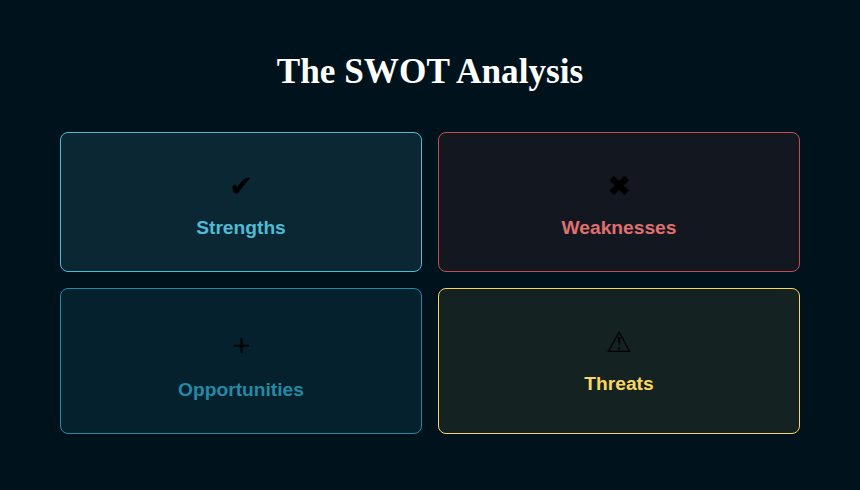
A SWOT analysis is a structured framework for evaluating the internal and external factors that shape your organization's strategic position. Four dimensions:
- Strengths: Internal capabilities that give you a competitive advantage such as proprietary technology, distribution reach, brand equity, talent depth, operating efficiency.
- Weaknesses: Internal factors that limit performance or create vulnerability such as capability gaps, organizational debt, underinvestment in key areas, slow decision-making.
- Opportunities: External conditions that create potential for growth like market shifts, regulatory changes that favor your position, emerging customer needs, competitor missteps.
- Threats: External forces that could erode your position, for example, new market entrants, economic and geopolitical headwinds, technological disruption, changing customer expectations.
The internal factors (strengths and weaknesses) are within your control. The external factors (opportunities and threats) aren't. What you control is how you respond to them.
When a SWOT analysis belongs in your strategic process
A SWOT analysis is most valuable at moments of strategic inflection when the situation demands clarity before commitment.
Use it when you're developing or refreshing company strategy and need a grounded view of your current position before setting the direction for the next horizon.
Use it when you're entering a new market or launching a significant initiative and need to stress-test assumptions before resources are allocated.
Use it when you're responding to a material change in the competitive landscape like a new entrant, a regulatory shift, an acquisition, and need to reassess your position quickly.
What it isn't: a one-time activity that lives in a slide deck. The organizations that extract the most value from SWOT analysis treat it as a living input to strategy. They revisit it when conditions change, update it when new data arrives, and connect it directly to the OKRs driving execution.
The mistakes that turn a SWOT analysis into a waste of time
Enterprise leaders who've sat through too many SWOT sessions know the red flags.
1. No clear scope
A SWOT analysis without a defined strategic question produces a list of observations without strategic relevance. Start with the decision the analysis needs to inform. Everything else follows from that.
2. Opinions dressed as data
"Our culture is a strength" and "competitor pricing is a threat" are claims, not analysis. Every factor needs to be grounded in evidence with market data, customer feedback, performance benchmarks, competitive intelligence. Assumptions are fine if they're labeled as assumptions and treated as hypotheses to validate.
3. Internal bias dominating external reality
Leadership teams consistently overweight factors they control and underweight the external environment. The best SWOT analyses spend equal time on what's happening outside the organization as inside it. Pair your SWOT with competitive analysis, customer research, and market data, not just internal perspective.
4. Static analysis in a dynamic environment
A SWOT analysis completed in January is partially outdated by March. Build review cycles into your operating cadence. The factors that shape your strategic position change, so should your analysis.
5. No connection to execution
The most common mistake: a thorough SWOT analysis that produces insights nobody acts on. The output of a SWOT should connect directly to strategic priorities, OKRs, and the operating commitments that drive execution. Insights without accountability are just observations that are 'nice-to-know'.
From SWOT insights to strategic execution with WorkBoardAI
A SWOT analysis tells you where you stand. WorkBoardAI is what converts that clarity into execution.
Once your strategic direction is set, the challenge shifts to execution and strategy implementation. Translating strategic intent into measurable quarterly outcomes, keeping every team aligned to those outcomes, and adapting when the environment changes faster than the plan anticipated.
The AI Chief of Staff agent connects your SWOT-informed strategy directly to OKRs (your measurable goals), cascading priorities from leadership down to the teams accountable for delivering them. It surfaces execution risk in real time, before a missed key result becomes a missed strategic initiative. It automates the operating cadence that keeps strategy alive between planning sessions: daily focus briefings, weekly status updates, MBR and QBR pre-reads built from actual performance data.
The AI Leadership Coach agent ensures the people side of execution stays sharp. It helps preparing managers for the 1:1 conversations that reinforce strategic priorities, surfacing team dynamics that signal execution risk, and building the coaching habits that compound across an organization over time.
Both agents operate from your system of record: your strategy, your team's commitments, your operating patterns. That's what connects a SWOT analysis to the sustained execution that strategic intent actually requires.
"WorkBoard transformed the way we operate. Now, our strategy isn't buried in PowerPoints or spreadsheets. It's a dynamic, real-time system that keeps the whole team accountable and driving results every single week." — Bharath Oruganti, Former Executive Vice President, Q2