DERIV - Derivative (original) (raw)
Scilab 5.3.3
- Scilab help
- Xcos
- palettes
- Continuous time systems palette
- Continuous_pal
- CLINDUMMY_f
- CLR
- CLSS
- DERIV
- INTEGRAL_f
- INTEGRAL_m
- PID
- TCLSS
- TIME_DELAY
- VARIABLE_DELAY
Please note that the recommended version of Scilab is 2026.0.1. This page might be outdated.
See the recommended documentation of this function
Scilab help >> Xcos > palettes > Continuous time systems palette > DERIV
Block Screenshot

Contents
Description
The Derivative block approximates the instantaneous derivative of its input with respect to time t.
It is a measure of how a output changes as its input changes Δu. The derivative is given by:

The derivative block has no setting and the initial output for the block is zero.
Default properties
- always active: no
- direct-feedthrough: yes
- zero-crossing: no
- mode: no
- regular inputs:
- port 1 : size [-1,1] / type 1 - regular outputs:
- port 1 : size [-1,1] / type 1 - number/sizes of activation inputs: 0
- number/sizes of activation outputs: 0
- continuous-time state: no
- discrete-time state: no
- object discrete-time state: no
- name of computational function: deriv
DERIVATIVE Example
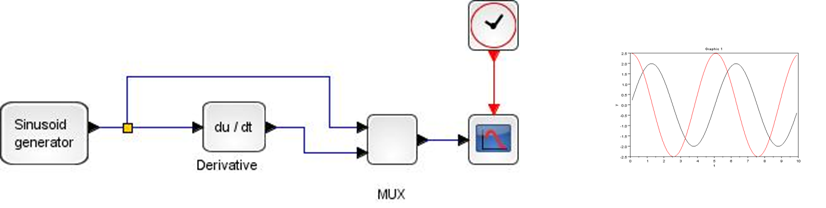
In this example, we compute and display the derivative waveform of a sinusoidal input signal, with amplitude 2 and frequency 1.25 Hz.
The input and output waveforms of the DERIVATIVE block are shown below:
Interfacing function
- SCI/modules/scicos_blocks/macros/Linear/DERIV.sci
Computational function
- SCI/modules/scicos_blocks/src/c/deriv.c (Type 4)
Authors
Ramine Nikoukhah - INRIA
Zhour MADINI-ZOUINE - DIGITEO