Xerces-C++: DOMNode Class Reference (original) (raw)
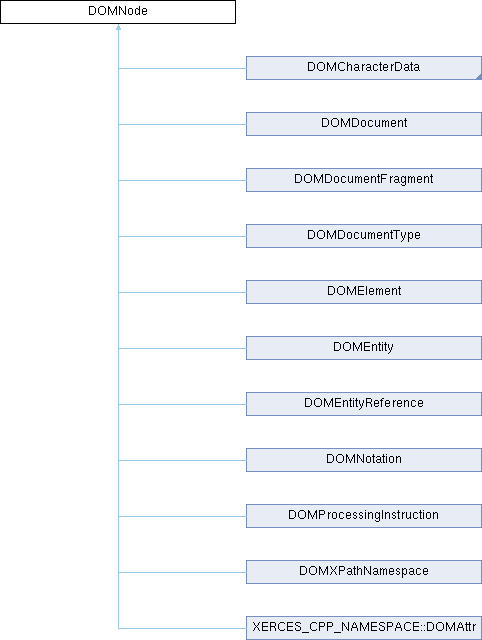
The [DOMNode](classDOMNode.html "The DOMNode interface is the primary datatype for the entire Document Object Model.") interface is the primary datatype for the entire Document Object Model. More...
#include <[xercesc/dom/DOMNode.hpp](DOMNode%5F8hpp%5Fsource.html)>
| Public Types | |
|---|---|
| Public Constants | |
| enum | NodeType { ELEMENT_NODE = 1 , ATTRIBUTE_NODE = 2 , TEXT_NODE = 3 , CDATA_SECTION_NODE = 4 , ENTITY_REFERENCE_NODE = 5 , ENTITY_NODE = 6 , PROCESSING_INSTRUCTION_NODE = 7 , COMMENT_NODE = 8 , DOCUMENT_NODE = 9 , DOCUMENT_TYPE_NODE = 10 , DOCUMENT_FRAGMENT_NODE = 11 , NOTATION_NODE = 12 } |
| NodeType. More... | |
| enum | DocumentPosition { DOCUMENT_POSITION_DISCONNECTED = 0x01 , DOCUMENT_POSITION_PRECEDING = 0x02 , DOCUMENT_POSITION_FOLLOWING = 0x04 , DOCUMENT_POSITION_CONTAINS = 0x08 , DOCUMENT_POSITION_CONTAINED_BY = 0x10 , DOCUMENT_POSITION_IMPLEMENTATION_SPECIFIC = 0x20 } |
| DocumentPosition: More... | |
| Public Member Functions | |
|---|---|
| Destructor | |
| virtual | ~DOMNode () |
| Destructor. | |
| Functions introduced in DOM Level 1 | |
| virtual const XMLCh * | getNodeName () const =0 |
| The name of this node, depending on its type; see the table above. | |
| virtual const XMLCh * | getNodeValue () const =0 |
| Gets the value of this node, depending on its type. | |
| virtual NodeType | getNodeType () const =0 |
| An enum value representing the type of the underlying object. | |
| virtual DOMNode * | getParentNode () const =0 |
| Gets the parent of this node. | |
| virtual DOMNodeList * | getChildNodes () const =0 |
| Gets a DOMNodeList that contains all children of this node. | |
| virtual DOMNode * | getFirstChild () const =0 |
| Gets the first child of this node. | |
| virtual DOMNode * | getLastChild () const =0 |
| Gets the last child of this node. | |
| virtual DOMNode * | getPreviousSibling () const =0 |
| Gets the node immediately preceding this node. | |
| virtual DOMNode * | getNextSibling () const =0 |
| Gets the node immediately following this node. | |
| virtual DOMNamedNodeMap * | getAttributes () const =0 |
| Gets a DOMNamedNodeMap containing the attributes of this node (if it is an DOMElement) or null otherwise. | |
| virtual DOMDocument * | getOwnerDocument () const =0 |
| Gets the DOMDocument object associated with this node. | |
| virtual DOMNode * | cloneNode (bool deep) const =0 |
| Returns a duplicate of this node. | |
| virtual DOMNode * | insertBefore (DOMNode *newChild, DOMNode *refChild)=0 |
| Inserts the node newChild before the existing child node refChild. | |
| virtual DOMNode * | replaceChild (DOMNode *newChild, DOMNode *oldChild)=0 |
| Replaces the child node oldChild with newChild in the list of children, and returns the oldChild node. | |
| virtual DOMNode * | removeChild (DOMNode *oldChild)=0 |
| Removes the child node indicated by oldChild from the list of children, and returns it. | |
| virtual DOMNode * | appendChild (DOMNode *newChild)=0 |
| Adds the node newChild to the end of the list of children of this node. | |
| virtual bool | hasChildNodes () const =0 |
| This is a convenience method to allow easy determination of whether a node has any children. | |
| virtual void | setNodeValue (const XMLCh *nodeValue)=0 |
| Sets the value of the node. | |
| Functions introduced in DOM Level 2. | |
| virtual void | normalize ()=0 |
| Puts all DOMText nodes in the full depth of the sub-tree underneath this DOMNode, including attribute nodes, into a "normal" form where only markup (e.g., tags, comments, processing instructions, CDATA sections, and entity references) separates DOMText nodes, i.e., there are neither adjacent DOMText nodes nor empty DOMText nodes. | |
| virtual bool | isSupported (const XMLCh *feature, const XMLCh *version) const =0 |
| Tests whether the DOM implementation implements a specific feature and that feature is supported by this node. | |
| virtual const XMLCh * | getNamespaceURI () const =0 |
| Get the namespace URI of this node, or null if it is unspecified. | |
| virtual const XMLCh * | getPrefix () const =0 |
| Get the namespace prefix of this node, or null if it is unspecified. | |
| virtual const XMLCh * | getLocalName () const =0 |
| Returns the local part of the qualified name of this node. | |
| virtual void | setPrefix (const XMLCh *prefix)=0 |
| Set the namespace prefix of this node. | |
| virtual bool | hasAttributes () const =0 |
| Returns whether this node (if it is an element) has any attributes. | |
| Functions introduced in DOM Level 3. | |
| virtual bool | isSameNode (const DOMNode *other) const =0 |
| Returns whether this node is the same node as the given one. | |
| virtual bool | isEqualNode (const DOMNode *arg) const =0 |
| Tests whether two nodes are equal. | |
| virtual void * | setUserData (const XMLCh *key, void *data, DOMUserDataHandler *handler)=0 |
| Associate an object to a key on this node. | |
| virtual void * | getUserData (const XMLCh *key) const =0 |
| Retrieves the object associated to a key on a this node. | |
| virtual const XMLCh * | getBaseURI () const =0 |
| The absolute base URI of this node or null if undefined. | |
| virtual short | compareDocumentPosition (const DOMNode *other) const =0 |
| Compares the reference node, i.e. | |
| virtual const XMLCh * | getTextContent () const =0 |
| WARNING: This method is known to be buggy and does not produce accurate results under a variety of conditions. | |
| virtual void | setTextContent (const XMLCh *textContent)=0 |
| This attribute removes any possible children this node may have and, if the new string is not empty or null, replaced by a single DOMText node containing the string this attribute is set to. | |
| virtual const XMLCh * | lookupPrefix (const XMLCh *namespaceURI) const =0 |
| Look up the prefix associated to the given namespace URI, starting from this node. | |
| virtual bool | isDefaultNamespace (const XMLCh *namespaceURI) const =0 |
| This method checks if the specified namespaceURI is the default namespace or not. | |
| virtual const XMLCh * | lookupNamespaceURI (const XMLCh *prefix) const =0 |
| Look up the namespace URI associated to the given prefix, starting from this node. | |
| virtual void * | getFeature (const XMLCh *feature, const XMLCh *version) const =0 |
| This method makes available a DOMNode's specialized interface. | |
| Non-standard Extension | |
| virtual void | release ()=0 |
| Called to indicate that this Node (and its associated children) is no longer in use and that the implementation may relinquish any resources associated with it and its associated children. | |
| Protected Member Functions |
|---|
| Hidden constructors |
The [DOMNode](classDOMNode.html "The DOMNode interface is the primary datatype for the entire Document Object Model.") interface is the primary datatype for the entire Document Object Model.
It represents a single node in the document tree. While all objects implementing the [DOMNode](classDOMNode.html "The DOMNode interface is the primary datatype for the entire Document Object Model.") interface expose methods for dealing with children, not all objects implementing the [DOMNode](classDOMNode.html "The DOMNode interface is the primary datatype for the entire Document Object Model.") interface may have children. For example, [DOMText](classDOMText.html "The DOMText interface inherits from DOMCharacterData and represents the textual content (termed chara...") nodes may not have children, and adding children to such nodes results in a [DOMException](classDOMException.html) being raised.
The attributes nodeName, nodeValue and attributes are included as a mechanism to get at node information without casting down to the specific derived interface. In cases where there is no obvious mapping of these attributes for a specific nodeType (e.g., nodeValue for an [DOMElement](classDOMElement.html "By far the vast majority of objects (apart from text) that authors encounter when traversing a docume...") or attributes for a [DOMComment](classDOMComment.html "This interface inherits from CharacterData and represents the content of a comment,...") ), this returns null. Note that the specialized interfaces may contain additional and more convenient mechanisms to get and set the relevant information.
The values of nodeName, nodeValue, and attributes vary according to the node type as follows:
| Interface | nodeName | nodeValue | attributes |
|---|---|---|---|
| DOMAttr | name of attribute | value of attribute | null |
| DOMCDATASection | "#cdata-section" | content of the CDATA Section | null |
| DOMComment | "#comment" | content of the comment | null |
| DOMDocument | "#document" | null | null |
| [DOMDocumentFragment](classDOMDocumentFragment.html "DOMDocumentFragment is a "lightweight" or "minimal" DOMDocument object.") | "#document-fragment" | null | null |
| DOMDocumentType | document type name | null | null |
| DOMElement | tag name | null | NamedNodeMap |
| DOMEntity | entity name | null | null |
| DOMEntityReference | name of entity referenced | null | null |
| DOMNotation | notation name | null | null |
| [DOMProcessingInstruction](classDOMProcessingInstruction.html "The DOMProcessingInstruction interface represents a "processinginstruction", used in XML as a way to ...") | target | entire content excluding the target | null |
| DOMText | "#text" | content of the text node | null |
See also the Document Object Model (DOM) Level 2 Core Specification.
Since
DOM Level 1
◆ DocumentPosition
DocumentPosition:
DOCUMENT_POSITION_CONTAINED_BY: The node is contained by the reference node. A node which is contained is always following, too.
DOCUMENT_POSITION_CONTAINS: The node contains the reference node. A node which contains is always preceding, too.
DOCUMENT_POSITION_DISCONNECTED: The two nodes are disconnected. Order between disconnected nodes is always implementation-specific.
DOCUMENT_POSITION_FOLLOWING: The node follows the reference node.
DOCUMENT_POSITION_IMPLEMENTATION_SPECIFIC: The determination of preceding versus following is implementation-specific.
DOCUMENT_POSITION_PRECEDING: The second node precedes the reference node.
Since
DOM Level 3
| Enumerator |
|---|
| DOCUMENT_POSITION_DISCONNECTED |
| DOCUMENT_POSITION_PRECEDING |
| DOCUMENT_POSITION_FOLLOWING |
| DOCUMENT_POSITION_CONTAINS |
| DOCUMENT_POSITION_CONTAINED_BY |
| DOCUMENT_POSITION_IMPLEMENTATION_SPECIFIC |
◆ NodeType
NodeType.
Since
DOM Level 1
| Enumerator |
|---|
| ELEMENT_NODE |
| ATTRIBUTE_NODE |
| TEXT_NODE |
| CDATA_SECTION_NODE |
| ENTITY_REFERENCE_NODE |
| ENTITY_NODE |
| PROCESSING_INSTRUCTION_NODE |
| COMMENT_NODE |
| DOCUMENT_NODE |
| DOCUMENT_TYPE_NODE |
| DOCUMENT_FRAGMENT_NODE |
| NOTATION_NODE |
◆ DOMNode() [1/2]
| DOMNode::DOMNode ( ) | protected |
|---|
◆ DOMNode() [2/2]
| DOMNode::DOMNode ( const DOMNode & ) | protected |
|---|
| virtual DOMNode::~DOMNode ( ) | virtual |
|---|
Destructor.
◆ appendChild()
| virtual DOMNode * DOMNode::appendChild ( DOMNode * newChild) | pure virtual |
|---|
Adds the node newChild to the end of the list of children of this node.
If the newChild is already in the tree, it is first removed.
Parameters
| newChild | The node to add.If it is a [DOMDocumentFragment](classDOMDocumentFragment.html "DOMDocumentFragment is a "lightweight" or "minimal" DOMDocument object.") object, the entire contents of the document fragment are moved into the child list of this node |
|---|
Returns
The node added.
Exceptions
| DOMException | HIERARCHY_REQUEST_ERR: Raised if this node is of a type that does not allow children of the type of the newChild node, or if the node to append is one of this node's ancestors. WRONG_DOCUMENT_ERR: Raised if newChild was created from a different document than the one that created this node. NO_MODIFICATION_ALLOWED_ERR: Raised if this node or the node being appended is readonly. |
|---|
Since
DOM Level 1
◆ cloneNode()
| virtual DOMNode * DOMNode::cloneNode ( bool deep) const | pure virtual |
|---|
Returns a duplicate of this node.
This function serves as a generic copy constructor for nodes.
The duplicate node has no parent ( parentNode returns null.).
Cloning an [DOMElement](classDOMElement.html "By far the vast majority of objects (apart from text) that authors encounter when traversing a docume...") copies all attributes and their values, including those generated by the XML processor to represent defaulted attributes, but this method does not copy any text it contains unless it is a deep clone, since the text is contained in a child [DOMText](classDOMText.html "The DOMText interface inherits from DOMCharacterData and represents the textual content (termed chara...") node. Cloning any other type of node simply returns a copy of this node.
Parameters
| deep | If true, recursively clone the subtree under the specified node; if false, clone only the node itself (and its attributes, if it is an DOMElement). |
|---|
Returns
The duplicate node.
Since
DOM Level 1
◆ compareDocumentPosition()
| virtual short DOMNode::compareDocumentPosition ( const DOMNode * other) const | pure virtual |
|---|
Compares the reference node, i.e.
the node on which this method is being called, with a node, i.e. the one passed as a parameter, with regard to their position in the document and according to the document order.
Parameters
| other | The node to compare against this node. |
|---|
Returns
Returns how the given node is positioned relatively to this node.
Since
DOM Level 3
◆ getAttributes()
◆ getBaseURI()
| virtual const XMLCh * DOMNode::getBaseURI ( ) const | pure virtual |
|---|
The absolute base URI of this node or null if undefined.
This value is computed according to . However, when the [DOMDocument](classDOMDocument.html "The DOMDocument interface represents the entire XML document.") supports the feature "HTML" , the base URI is computed using first the value of the href attribute of the HTML BASE element if any, and the value of the documentURI attribute from the [DOMDocument](classDOMDocument.html "The DOMDocument interface represents the entire XML document.") interface otherwise.
When the node is an [DOMElement](classDOMElement.html "By far the vast majority of objects (apart from text) that authors encounter when traversing a docume..."), a [DOMDocument](classDOMDocument.html "The DOMDocument interface represents the entire XML document.") or a a [DOMProcessingInstruction](classDOMProcessingInstruction.html "The DOMProcessingInstruction interface represents a "processinginstruction", used in XML as a way to ..."), this attribute represents the properties [base URI] defined in . When the node is a [DOMNotation](classDOMNotation.html "This interface represents a notation declared in the DTD."), an [DOMEntity](classDOMEntity.html "This interface represents an entity, either parsed or unparsed, in an XML document."), or an [DOMEntityReference](classDOMEntityReference.html "DOMEntityReference objects may be inserted into the structure model when an entity reference is in th..."), this attribute represents the properties [declaration base URI].
Since
DOM Level 3
◆ getChildNodes()
| virtual DOMNodeList * DOMNode::getChildNodes ( ) const | pure virtual |
|---|
Gets a [DOMNodeList](classDOMNodeList.html "The DOMNodeList interface provides the abstraction of an ordered collection of nodes.") that contains all children of this node.
If there are no children, this is a [DOMNodeList](classDOMNodeList.html "The DOMNodeList interface provides the abstraction of an ordered collection of nodes.") containing no nodes. The content of the returned [DOMNodeList](classDOMNodeList.html "The DOMNodeList interface provides the abstraction of an ordered collection of nodes.") is "live" in the sense that, for instance, changes to the children of the node object that it was created from are immediately reflected in the nodes returned by the [DOMNodeList](classDOMNodeList.html "The DOMNodeList interface provides the abstraction of an ordered collection of nodes.") accessors; it is not a static snapshot of the content of the node. This is true for every [DOMNodeList](classDOMNodeList.html "The DOMNodeList interface provides the abstraction of an ordered collection of nodes."), including the ones returned by the getElementsByTagName method.
Since
DOM Level 1
◆ getFeature()
| virtual void * DOMNode::getFeature ( const XMLCh * feature, const XMLCh * version ) const | pure virtual |
|---|
This method makes available a [DOMNode](classDOMNode.html "The DOMNode interface is the primary datatype for the entire Document Object Model.")'s specialized interface.
Parameters
| feature | The name of the feature requested (case-insensitive). |
|---|---|
| version | The version of the feature requested. |
Returns
Returns an alternate [DOMNode](classDOMNode.html "The DOMNode interface is the primary datatype for the entire Document Object Model.") which implements the specialized APIs of the specified feature, if any, or null if there is no alternate [DOMNode](classDOMNode.html "The DOMNode interface is the primary datatype for the entire Document Object Model.") which implements interfaces associated with that feature. Any alternate [DOMNode](classDOMNode.html "The DOMNode interface is the primary datatype for the entire Document Object Model.") returned by this method must delegate to the primary core [DOMNode](classDOMNode.html "The DOMNode interface is the primary datatype for the entire Document Object Model.") and not return results inconsistent with the primary core [DOMNode](classDOMNode.html "The DOMNode interface is the primary datatype for the entire Document Object Model.") such as key, attributes, childNodes, etc.
Since
DOM Level 3
◆ getFirstChild()
| virtual DOMNode * DOMNode::getFirstChild ( ) const | pure virtual |
|---|
Gets the first child of this node.
If there is no such node, this returns null.
Since
DOM Level 1
◆ getLastChild()
| virtual DOMNode * DOMNode::getLastChild ( ) const | pure virtual |
|---|
Gets the last child of this node.
If there is no such node, this returns null.
Since
DOM Level 1
◆ getLocalName()
| virtual const XMLCh * DOMNode::getLocalName ( ) const | pure virtual |
|---|
Returns the local part of the qualified name of this node.
For nodes created with a DOM Level 1 method, such as createElement from the [DOMDocument](classDOMDocument.html "The DOMDocument interface represents the entire XML document.") interface, it is null.
Since
DOM Level 2
◆ getNamespaceURI()
| virtual const XMLCh * DOMNode::getNamespaceURI ( ) const | pure virtual |
|---|
Get the namespace URI of this node, or null if it is unspecified.
This is not a computed value that is the result of a namespace lookup based on an examination of the namespace declarations in scope. It is merely the namespace URI given at creation time.
For nodes of any type other than ELEMENT_NODE and ATTRIBUTE_NODE and nodes created with a DOM Level 1 method, such as createElement from the [DOMDocument](classDOMDocument.html "The DOMDocument interface represents the entire XML document.") interface, this is always null.
Since
DOM Level 2
◆ getNextSibling()
| virtual DOMNode * DOMNode::getNextSibling ( ) const | pure virtual |
|---|
Gets the node immediately following this node.
If there is no such node, this returns null.
Since
DOM Level 1
◆ getNodeName()
| virtual const XMLCh * DOMNode::getNodeName ( ) const | pure virtual |
|---|
The name of this node, depending on its type; see the table above.
Since
DOM Level 1
◆ getNodeType()
| virtual NodeType DOMNode::getNodeType ( ) const | pure virtual |
|---|
An enum value representing the type of the underlying object.
Since
DOM Level 1
◆ getNodeValue()
| virtual const XMLCh * DOMNode::getNodeValue ( ) const | pure virtual |
|---|
Gets the value of this node, depending on its type.
Exceptions
| DOMException | NO_MODIFICATION_ALLOWED_ERR: Raised when the node is readonly. |
|---|
Since
DOM Level 1
◆ getOwnerDocument()
| virtual DOMDocument * DOMNode::getOwnerDocument ( ) const | pure virtual |
|---|
◆ getParentNode()
| virtual DOMNode * DOMNode::getParentNode ( ) const | pure virtual |
|---|
Gets the parent of this node.
All nodes, except [DOMDocument](classDOMDocument.html "The DOMDocument interface represents the entire XML document."), [DOMDocumentFragment](classDOMDocumentFragment.html "DOMDocumentFragment is a "lightweight" or "minimal" DOMDocument object."), and DOMAttr may have a parent. However, if a node has just been created and not yet added to the tree, or if it has been removed from the tree, a null DOMNode is returned.
Since
DOM Level 1
◆ getPrefix()
| virtual const XMLCh * DOMNode::getPrefix ( ) const | pure virtual |
|---|
Get the namespace prefix of this node, or null if it is unspecified.
Since
DOM Level 2
◆ getPreviousSibling()
| virtual DOMNode * DOMNode::getPreviousSibling ( ) const | pure virtual |
|---|
Gets the node immediately preceding this node.
If there is no such node, this returns null.
Since
DOM Level 1
◆ getTextContent()
| virtual const XMLCh * DOMNode::getTextContent ( ) const | pure virtual |
|---|
WARNING: This method is known to be buggy and does not produce accurate results under a variety of conditions.
This attribute returns the text content of this node and its descendants. No serialization is performed, the returned string does not contain any markup. No whitespace normalization is performed and the returned string does not contain the white spaces in element content.
The string returned is made of the text content of this node depending on its type, as defined below:
| Node type | Content |
|---|---|
| ELEMENT_NODE, ENTITY_NODE, ENTITY_REFERENCE_NODE, DOCUMENT_FRAGMENT_NODE | concatenation of the textContent attribute value of every child node, excluding COMMENT_NODE and PROCESSING_INSTRUCTION_NODE nodes |
| ATTRIBUTE_NODE, TEXT_NODE, CDATA_SECTION_NODE, COMMENT_NODE, PROCESSING_INSTRUCTION_NODE | nodeValue |
| DOCUMENT_NODE, DOCUMENT_TYPE_NODE, NOTATION_NODE | null |
Exceptions
| DOMException | DOMSTRING_SIZE_ERR: Raised when it would return more characters than fit in a DOMString variable on the implementation platform. |
|---|
See also
Since
DOM Level 3
◆ getUserData()
| virtual void * DOMNode::getUserData ( const XMLCh * key) const | pure virtual |
|---|
Retrieves the object associated to a key on a this node.
The object must first have been set to this node by calling setUserData with the same key.
Parameters
| key | The key the object is associated to. |
|---|
Returns
Returns the void* associated to the given key on this node, or null if there was none.
See also
Since
DOM Level 3
◆ hasAttributes()
| virtual bool DOMNode::hasAttributes ( ) const | pure virtual |
|---|
Returns whether this node (if it is an element) has any attributes.
Returns
true if this node has any attributes, false otherwise.
Since
DOM Level 2
◆ hasChildNodes()
| virtual bool DOMNode::hasChildNodes ( ) const | pure virtual |
|---|
This is a convenience method to allow easy determination of whether a node has any children.
Returns
true if the node has any children, false if the node has no children.
Since
DOM Level 1
◆ insertBefore()
Inserts the node newChild before the existing child node refChild.
If refChild is null, insert newChild at the end of the list of children.
If newChild is a [DOMDocumentFragment](classDOMDocumentFragment.html "DOMDocumentFragment is a "lightweight" or "minimal" DOMDocument object.") object, all of its children are inserted, in the same order, before refChild. If the newChild is already in the tree, it is first removed. Note that a [DOMNode](classDOMNode.html "The DOMNode interface is the primary datatype for the entire Document Object Model.") that has never been assigned to refer to an actual node is == null.
Parameters
| newChild | The node to insert. |
|---|---|
| refChild | The reference node, i.e., the node before which the new node must be inserted. |
Returns
The node being inserted.
Exceptions
| DOMException | HIERARCHY_REQUEST_ERR: Raised if this node is of a type that does not allow children of the type of the newChild node, or if the node to insert is one of this node's ancestors. WRONG_DOCUMENT_ERR: Raised if newChild was created from a different document than the one that created this node. NO_MODIFICATION_ALLOWED_ERR: Raised if this node or the node being inserted is readonly. NOT_FOUND_ERR: Raised if refChild is not a child of this node. |
|---|
Since
DOM Level 1
◆ isDefaultNamespace()
| virtual bool DOMNode::isDefaultNamespace ( const XMLCh * namespaceURI) const | pure virtual |
|---|
This method checks if the specified namespaceURI is the default namespace or not.
Parameters
| namespaceURI | The namespace URI to look for. |
|---|
Returns
true if the specified namespaceURI is the default namespace, false otherwise.
Since
DOM Level 3
◆ isEqualNode()
| virtual bool DOMNode::isEqualNode ( const DOMNode * arg) const | pure virtual |
|---|
Tests whether two nodes are equal.
This method tests for equality of nodes, not sameness (i.e., whether the two nodes are pointers to the same object) which can be tested with [DOMNode::isSameNode](#ab0dbc31ea043207c23e639fa55cc339d "Returns whether this node is the same node as the given one."). All nodes that are the same will also be equal, though the reverse may not be true.
Two nodes are equal if and only if the following conditions are satisfied: The two nodes are of the same type.The following string attributes are equal: nodeName, localName, namespaceURI, prefix, nodeValue , baseURI. This is: they are both null, or they have the same length and are character for character identical. The attributes DOMNamedNodeMaps are equal. This is: they are both null, or they have the same length and for each node that exists in one map there is a node that exists in the other map and is equal, although not necessarily at the same index.The childNodes DOMNodeLists are equal. This is: they are both null, or they have the same length and contain equal nodes at the same index. This is true for DOMAttr nodes as for any other type of node. Note that normalization can affect equality; to avoid this, nodes should be normalized before being compared.
For two [DOMDocumentType](classDOMDocumentType.html "Each DOMDocument has a doctype attribute whose value is either null or a DOMDocumentType object.") nodes to be equal, the following conditions must also be satisfied: The following string attributes are equal: publicId, systemId, internalSubset.The entities DOMNamedNodeMaps are equal.The notations DOMNamedNodeMaps are equal.
On the other hand, the following do not affect equality: the ownerDocument attribute, the specified attribute for DOMAttr nodes, the isWhitespaceInElementContent attribute for [DOMText](classDOMText.html "The DOMText interface inherits from DOMCharacterData and represents the textual content (termed chara...") nodes, as well as any user data or event listeners registered on the nodes.
Parameters
| arg | The node to compare equality with. |
|---|
Returns
If the nodes, and possibly subtrees are equal, true otherwise false.
Since
DOM Level 3
◆ isSameNode()
| virtual bool DOMNode::isSameNode ( const DOMNode * other) const | pure virtual |
|---|
Returns whether this node is the same node as the given one.
This method provides a way to determine whether two [DOMNode](classDOMNode.html "The DOMNode interface is the primary datatype for the entire Document Object Model.") references returned by the implementation reference the same object. When two [DOMNode](classDOMNode.html "The DOMNode interface is the primary datatype for the entire Document Object Model.") references are references to the same object, even if through a proxy, the references may be used completely interchangeably, such that all attributes have the same values and calling the same DOM method on either reference always has exactly the same effect.
Parameters
| other | The node to test against. |
|---|
Returns
Returns true if the nodes are the same, false otherwise.
Since
DOM Level 3
◆ isSupported()
| virtual bool DOMNode::isSupported ( const XMLCh * feature, const XMLCh * version ) const | pure virtual |
|---|
Tests whether the DOM implementation implements a specific feature and that feature is supported by this node.
Parameters
| feature | The string of the feature to test. This is the same name as what can be passed to the method hasFeature on DOMImplementation. |
|---|---|
| version | This is the version number of the feature to test. In Level 2, version 1, this is the string "2.0". If the version is not specified, supporting any version of the feature will cause the method to return true. |
Returns
Returns true if the specified feature is supported on this node, false otherwise.
Since
DOM Level 2
◆ lookupNamespaceURI()
| virtual const XMLCh * DOMNode::lookupNamespaceURI ( const XMLCh * prefix) const | pure virtual |
|---|
Look up the namespace URI associated to the given prefix, starting from this node.
Parameters
| prefix | The prefix to look for. If this parameter is null, the method will return the default namespace URI if any. |
|---|
Returns
Returns the associated namespace URI or null if none is found.
Since
DOM Level 3
◆ lookupPrefix()
| virtual const XMLCh * DOMNode::lookupPrefix ( const XMLCh * namespaceURI) const | pure virtual |
|---|
Look up the prefix associated to the given namespace URI, starting from this node.
The default namespace declarations are ignored by this method.
Parameters
| namespaceURI | The namespace URI to look for. |
|---|
Returns
Returns an associated namespace prefix if found, null if none is found. If more than one prefix are associated to the namespace prefix, the returned namespace prefix is implementation dependent.
Since
DOM Level 3
◆ normalize()
| virtual void DOMNode::normalize ( ) | pure virtual |
|---|
Puts all [DOMText](classDOMText.html "The DOMText interface inherits from DOMCharacterData and represents the textual content (termed chara...") nodes in the full depth of the sub-tree underneath this [DOMNode](classDOMNode.html "The DOMNode interface is the primary datatype for the entire Document Object Model."), including attribute nodes, into a "normal" form where only markup (e.g., tags, comments, processing instructions, CDATA sections, and entity references) separates [DOMText](classDOMText.html "The DOMText interface inherits from DOMCharacterData and represents the textual content (termed chara...") nodes, i.e., there are neither adjacent [DOMText](classDOMText.html "The DOMText interface inherits from DOMCharacterData and represents the textual content (termed chara...") nodes nor empty [DOMText](classDOMText.html "The DOMText interface inherits from DOMCharacterData and represents the textual content (termed chara...") nodes.
This can be used to ensure that the DOM view of a document is the same as if it were saved and re-loaded, and is useful when operations (such as XPointer lookups) that depend on a particular document tree structure are to be used.
Note: In cases where the document contains DOMCDATASections, the normalize operation alone may not be sufficient, since XPointers do not differentiate between [DOMText](classDOMText.html "The DOMText interface inherits from DOMCharacterData and represents the textual content (termed chara...") nodes and [DOMCDATASection](classDOMCDATASection.html "CDATA sections are used to escape blocks of text containing characters that would otherwise be regard...") nodes.
Since
DOM Level 2
◆ release()
| virtual void DOMNode::release ( ) | pure virtual |
|---|
Called to indicate that this Node (and its associated children) is no longer in use and that the implementation may relinquish any resources associated with it and its associated children.
If this is a document, any nodes it owns (created by DOMDocument::createXXXX()) are also released.
Access to a released object will lead to unexpected result.
Exceptions
| DOMException | INVALID_ACCESS_ERR: Raised if this Node has a parent and thus should not be released yet. |
|---|
◆ removeChild()
| virtual DOMNode * DOMNode::removeChild ( DOMNode * oldChild) | pure virtual |
|---|
Removes the child node indicated by oldChild from the list of children, and returns it.
Parameters
| oldChild | The node being removed. |
|---|
Returns
The node removed.
Exceptions
| DOMException | NO_MODIFICATION_ALLOWED_ERR: Raised if this node is readonly. NOT_FOUND_ERR: Raised if oldChild is not a child of this node. |
|---|
Since
DOM Level 1
◆ replaceChild()
Replaces the child node oldChild with newChild in the list of children, and returns the oldChild node.
If newChild is a [DOMDocumentFragment](classDOMDocumentFragment.html "DOMDocumentFragment is a "lightweight" or "minimal" DOMDocument object.") object, oldChild is replaced by all of the [DOMDocumentFragment](classDOMDocumentFragment.html "DOMDocumentFragment is a "lightweight" or "minimal" DOMDocument object.") children, which are inserted in the same order.
If the newChild is already in the tree, it is first removed.
Parameters
| newChild | The new node to put in the child list. |
|---|---|
| oldChild | The node being replaced in the list. |
Returns
The node replaced.
Exceptions
| DOMException | HIERARCHY_REQUEST_ERR: Raised if this node is of a type that does not allow children of the type of the newChild node, or it the node to put in is one of this node's ancestors. WRONG_DOCUMENT_ERR: Raised if newChild was created from a different document than the one that created this node. NO_MODIFICATION_ALLOWED_ERR: Raised if this node or the new node is readonly. NOT_FOUND_ERR: Raised if oldChild is not a child of this node. |
|---|
Since
DOM Level 1
◆ setNodeValue()
| virtual void DOMNode::setNodeValue ( const XMLCh * nodeValue) | pure virtual |
|---|
Sets the value of the node.
Any node which can have a nodeValue will also accept requests to set it to a string. The exact response to this varies from node to node – Attribute, for example, stores its values in its children and has to replace them with a new Text holding the replacement value.
For most types of Node, value is null and attempting to set it will throw DOMException(NO_MODIFICATION_ALLOWED_ERR). This will also be thrown if the node is read-only.
See also
Since
DOM Level 1
◆ setPrefix()
| virtual void DOMNode::setPrefix ( const XMLCh * prefix) | pure virtual |
|---|
Set the namespace prefix of this node.
Note that setting this attribute, when permitted, changes the nodeName attribute, which holds the qualified name, as well as the tagName and name attributes of the [DOMElement](classDOMElement.html "By far the vast majority of objects (apart from text) that authors encounter when traversing a docume...") and DOMAttr interfaces, when applicable.
Note also that changing the prefix of an attribute, that is known to have a default value, does not make a new attribute with the default value and the original prefix appear, since the namespaceURI and localName do not change.
Parameters
| prefix | The prefix of this node. |
|---|
Exceptions
| DOMException | INVALID_CHARACTER_ERR: Raised if the specified prefix contains an illegal character. NO_MODIFICATION_ALLOWED_ERR: Raised if this node is readonly. NAMESPACE_ERR: Raised if the specified prefix is malformed, if the namespaceURI of this node is null, if the specified prefix is "xml" and the namespaceURI of this node is different from "http://www.w3.org/XML/1998/namespace", if this node is an attribute and the specified prefix is "xmlns" and the namespaceURI of this node is different from "http://www.w3.org/2000/xmlns/", or if this node is an attribute and the qualifiedName of this node is "xmlns". |
|---|
Since
DOM Level 2
◆ setTextContent()
| virtual void DOMNode::setTextContent ( const XMLCh * textContent) | pure virtual |
|---|
This attribute removes any possible children this node may have and, if the new string is not empty or null, replaced by a single [DOMText](classDOMText.html "The DOMText interface inherits from DOMCharacterData and represents the textual content (termed chara...") node containing the string this attribute is set to.
No parsing is performed, the input string is taken as pure textual content.
Exceptions
| DOMException | NO_MODIFICATION_ALLOWED_ERR: Raised when the node is readonly. |
|---|
See also
Since
DOM Level 3
◆ setUserData()
Associate an object to a key on this node.
The object can later be retrieved from this node by calling getUserData with the same key.
Deletion of the user data remains the responsibility of the application program; it will not be automatically deleted when the nodes themselves are reclaimed.
Both the parameter data and the returned object are void pointer, it is applications' responsibility to keep track of their original type. Casting them to the wrong type may result unexpected behavior.
Parameters
| key | The key to associate the object to. |
|---|---|
| data | The object to associate to the given key, or null to remove any existing association to that key. |
| handler | The handler to associate to that key, or null. |
Returns
Returns the void* object previously associated to the given key on this node, or null if there was none.
See also
Since
DOM Level 3
The documentation for this class was generated from the following file: