Life cycle assessment of aquaculture bivalve shellfish production — a critical review of methodological trends (original) (raw)
1 Introduction
Seafood from aquaculture has increased its share of the total aquatic food consumed globally from 26% in 2000 to 46% in 2018 (FAO [2020b](/article/10.1007/s11367-021-01978-y#ref-CR28 "FAO (2020b) The State of World Fisheries and Aquaculture. Sustainability in action. In Nature and Resources. https://doi.org/10.4060/ca9229en
            ")). Such increase may be attributed, among others, to the increased demand not only for protein for human consumption but also for derivate co-products used in several industries, e.g., feed, fuels, cosmetics, nutraceuticals, and pharmaceuticals (Naylor et al. [2021](/article/10.1007/s11367-021-01978-y#ref-CR56 "Naylor RL, Hardy RW, Buschmann AH, Bush SR, Cao L, Klinger DH, Little DC, Lubchenco J, Shumway SE, Troell M (2021) A 20-year retrospective review of global aquaculture. Nature 591(7851):551–563.
              https://doi.org/10.1038/s41586-021-03308-6

            ")), the human population growth, the development of more efficient farming techniques, and the fact that seafood from wild fisheries production is limited (FAO [2020b](/article/10.1007/s11367-021-01978-y#ref-CR28 "FAO (2020b) The State of World Fisheries and Aquaculture. Sustainability in action. In Nature and Resources.
              https://doi.org/10.4060/ca9229en

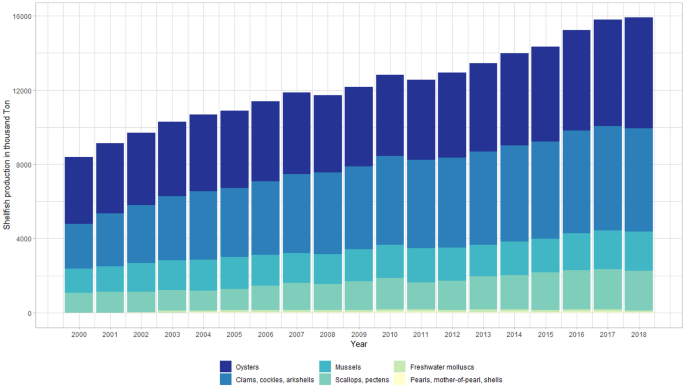
            ")). Among the many species farmed commercially, bivalve shellfish, hereafter referred to as “shellfish,” have experienced an increase in global annual harvest of over 90% from 8.3 million tonnes to 15.9 million tonnes between 2000 and 2018 (FAO [2020b](/article/10.1007/s11367-021-01978-y#ref-CR28 "FAO (2020b) The State of World Fisheries and Aquaculture. Sustainability in action. In Nature and Resources.
              https://doi.org/10.4060/ca9229en

            ")). Mussels in particular have seen the greatest increase in production compared to the other shellfish species. Within the last two decades, total mussel production has increased by 62%, followed by oysters (60%); scallops and pectens (46%); clams, cockles, and arkshells (42%); freshwater mollusks (12%); and finally pearls, mother of pearl, and shells (3%) (see Fig. [1](/article/10.1007/s11367-021-01978-y#Fig1)). Shellfish farming is considered sustainable and environmentally-friendly compared with other aquaculture species (Brigolin et al. [2009](/article/10.1007/s11367-021-01978-y#ref-CR11 "Brigolin D, Maschio GD, Rampazzo F, Giani M, Pastres R (2009) An individual-based population dynamic model for estimating biomass yield and nutrient fluxes through an off-shore mussel (Mytilus galloprovincialis) farm. Estuarine Coastal Shelf Sci 82(3):365–376.
              https://doi.org/10.1016/j.ecss.2009.01.029

            ")). It provides multiple ecosystem services, e.g., eutrophication control (Lindahl et al. [2005](/article/10.1007/s11367-021-01978-y#ref-CR49 "Lindahl O, Hart R, Hernroth B, Kollberg S, Loo LO, Olrog L, Rehnstam-Holm AS, Svensson J, Svensson S, Syversen U (2005) Improving marine water quality by mussel farming: a profitable solution for Swedish society. Ambio 34(2):131–138.
              https://doi.org/10.1579/0044-7447-34.2.131

            ")), increase of water transparency, and the promotion of macrophyte growth (positive water quality indicators in the Water Framework Directive (WFD)) (Schröder et al. [2014](/article/10.1007/s11367-021-01978-y#ref-CR63 "Schröder T, Stank J, Schernewski G, Krost P (2014) The impact of a mussel farm on water transparency in the Kiel Fjord. Ocean Coastal Manag 101(PA), 42–52.
              https://doi.org/10.1016/j.ocecoaman.2014.04.034

            ")), as well as promotion of habitat to different species, e.g., algae, worms, snails, crustaceans, and fish (Ysebaert et al. [2009](/article/10.1007/s11367-021-01978-y#ref-CR74 "Ysebaert T, Hart M, Herman PMJ (2009) Impacts of bottom and suspended cultures of mussels Mytilus spp. on the surrounding sedimentary environment and macrobenthic biodiversity. Helgol Mar Res, 63(1), 59–74.
              https://doi.org/10.1007/s10152-008-0136-5

            ")).
Fig. 1
The alternative text for this image may have been generated using AI.
Shellfish production by families during the period 2000–2018. Source: FAO ([2020a](/article/10.1007/s11367-021-01978-y#ref-CR27 "FAO (2020a) Aquaculture production 1950–2018. Fisheries and Aquaculture Information and Statistics Service. http://www.fao.org/fishery/statistics/software/fishstatj/en
"))Aquaculture is a core element of the EU Blue Growth strategy (European Commission [2012](/article/10.1007/s11367-021-01978-y#ref-CR23 "European Commission (2012) Blue Growth – Opportunities for marine and maritime sustainable growth – Communication from the Commission to the european parliament, the Council, the european economic and social Committee and the Committee of the regions. In Publications Office of the European Union. https://doi.org/10.2771/43949
            ")). Shellfish farming as a part of the mentioned strategy has been catching the attention of government agencies and entrepreneurs since it may remediate the eutrophication issues in degraded water bodies, such as the Baltic Sea (Lindahl et al. [2005](/article/10.1007/s11367-021-01978-y#ref-CR49 "Lindahl O, Hart R, Hernroth B, Kollberg S, Loo LO, Olrog L, Rehnstam-Holm AS, Svensson J, Svensson S, Syversen U (2005) Improving marine water quality by mussel farming: a profitable solution for Swedish society. Ambio 34(2):131–138.
              https://doi.org/10.1579/0044-7447-34.2.131

            "); Lindahl and Kollberg [2009](/article/10.1007/s11367-021-01978-y#ref-CR50 "Lindahl O, Kollberg S (2009) Can the EU agri-environmental aid program be extended into the coastal zone to combat eutrophication? Hydrobiologia 629(1):59–64.
              https://doi.org/10.1007/s10750-009-9771-3

            "); Petersen et al. [2014](/article/10.1007/s11367-021-01978-y#ref-CR60 "Petersen JK, Hasler B, Timmermann K, Nielsen P, Tørring DB, Larsen MM, Holmer M (2014) Mussels as a tool for mitigation of nutrients in the marine environment. Mar Pollut Bull 82(1–2):137–143.
              https://doi.org/10.1016/j.marpolbul.2014.03.006

            ")). It is recognized as a prominent cost-effective mechanism to remove nutrients compared with other abatement measures (Gren et al. [2009](/article/10.1007/s11367-021-01978-y#ref-CR35 "Gren IM, Lindahl O, Lindqvist M (2009) Values of mussel farming for combating eutrophication: an application to the Baltic Sea. Ecol Eng 35(5):935–945.
              https://doi.org/10.1016/j.ecoleng.2008.12.033

            ")). Therefore, a variety of projects such as the Baltic EcoMussel project (European Commission [2013](/article/10.1007/s11367-021-01978-y#ref-CR24 "European Commission (2013) Baltic EcoMussel project.
              http://projects.centralbaltic.eu/project/470-baltic-ecomussel

            ")), the Baltic Blue Growth project (BBG) (European Commission [2016](/article/10.1007/s11367-021-01978-y#ref-CR25 "European Commission (2016) Baltic Blue Growth project.
              https://www.submariner-network.eu/balticbluegrowth

            ")), and the BONUS OPTIMUS project (European Commission [2017](/article/10.1007/s11367-021-01978-y#ref-CR26 "European Commission (2017) BONUS OPTIMUS project.
              https://www.bonus-optimus.eu/about

            ")) have been launched to quantify the possible benefits of farming shellfish in the Baltic Sea.
However, shellfish may also have potential negative environmental effects, e.g., ecosystem degradation (Danovaro et al. [2004](/article/10.1007/s11367-021-01978-y#ref-CR21 "Danovaro R, Gambi C, Luna GM, Mirto S (2004) Sustainable impact of mussel farming in the Adriatic Sea (Mediterranean Sea): evidence from biochemical, microbial and meiofaunal indicators. Mar Pollut Bull 49(4):325–333. https://doi.org/10.1016/j.marpolbul.2004.02.038
            ")), energy consumption, climate change, and other effects (Aubin et al. [2018](/article/10.1007/s11367-021-01978-y#ref-CR5 "Aubin J, Fontaine C, Callier M, Roque d’orbcastel, E. (2018) Blue mussel (Mytilus edulis) bouchot culture in Mont-St Michel Bay: potential mitigation effects on climate change and eutrophication. Int J Life Cycle Assess 23(5):1030–1041.
              https://doi.org/10.1007/s11367-017-1403-y

            "); Iribarren et al. [2010a](/article/10.1007/s11367-021-01978-y#ref-CR41 "Iribarren D, Hospido A, Moreira MT, Feijoo G (2010a) Carbon footprint of canned mussels from a business-to-consumer approach. A starting point for mussel processors and policy makers. Environ Sci Policy 13(6), 509–521.
              https://doi.org/10.1016/j.envsci.2010.05.003

            "), [b](/article/10.1007/s11367-021-01978-y#ref-CR42 "Iribarren D, Moreira MT, Feijoo G (2010b) Implementing by-product management into the life cycle assessment of the mussel sector. Resour Conserv Recycl 54(12):1219–1230.
              https://doi.org/10.1016/j.resconrec.2010.03.017

            "), [c](/article/10.1007/s11367-021-01978-y#ref-CR43 "Iribarren D, Moreira MT, Feijoo G (2010c) Life Cycle Assessment of fresh and canned mussel processing and consumption in Galicia (NW Spain). Resour Conserv Recycl 55(2):106–117.
              https://doi.org/10.1016/j.resconrec.2010.08.001

            "); Lourguioui et al. [2017](/article/10.1007/s11367-021-01978-y#ref-CR52 "Lourguioui H, Brigolin D, Boulahdid M, Pastres R (2017) A perspective for reducing environmental impacts of mussel culture in Algeria. Int J Life Cycle Assess 22(8):1266–1277.
              https://doi.org/10.1007/s11367-017-1261-7

            "); Tamburini et al. [2020](/article/10.1007/s11367-021-01978-y#ref-CR68 "Tamburini E, Turolla E, Fano EA, Castaldelli G (2020) Sustainability of Mussel (Mytilus galloprovincialis) farming in the Po River delta, northern Italy, based on a life cycle assessment approach. Sustainability 12(9).
              https://doi.org/10.3390/su12093814

            ")) across the entire life cycle production (seeding, collection, growing, harvesting, processing, and waste management). A common tool to assess the environmental impacts also for aquaculture systems is the life cycle assessment (LCA) (Bohnes et al. [2019](/article/10.1007/s11367-021-01978-y#ref-CR8 "Bohnes FA, Hauschild MZ, Schlundt J, Laurent A (2019) Life cycle assessments of aquaculture systems: a critical review of reported findings with recommendations for policy and system development. Rev Aquacult 11(4):1061–1079.
              https://doi.org/10.1111/raq.12280

            ")). The LCA-methodology has been extensively applied in several aquaculture systems (e.g., cages, ponds, recirculating aquaculture systems (RAS)) and species (e.g., salmon, tilapia, catfish, and shrimps) from the beginning of the twenty-first century (Aubin [2013](/article/10.1007/s11367-021-01978-y#ref-CR4 "Aubin Joel (2013) Life Cycle Assessment as applied to environmental choices regarding farmed or wild-caught fish. CAB Reviews, 8(May 2013).
              https://doi.org/10.1079/PAVSNNR20138011

            "); Bohnes et al. [2019](/article/10.1007/s11367-021-01978-y#ref-CR8 "Bohnes FA, Hauschild MZ, Schlundt J, Laurent A (2019) Life cycle assessments of aquaculture systems: a critical review of reported findings with recommendations for policy and system development. Rev Aquacult 11(4):1061–1079.
              https://doi.org/10.1111/raq.12280

            "); Bohnes and Laurent [2019](/article/10.1007/s11367-021-01978-y#ref-CR9 "Bohnes FA, Laurent A (2019) LCA of aquaculture systems: methodological issues and potential improvements. Int J Life Cycle Assess 24(2):324–337.
              https://doi.org/10.1007/s11367-018-1517-x

            "); Cao et al. [2013](/article/10.1007/s11367-021-01978-y#ref-CR12 "Cao L, Diana JS, Keoleian GA (2013) Role of life cycle assessment in sustainable aquaculture. Rev Aquacult 5(2):61–71.
              https://doi.org/10.1111/j.1753-5131.2012.01080.x

            "); Henriksson et al. [2012](/article/10.1007/s11367-021-01978-y#ref-CR37 "Henriksson PJG, Guinée JB, Kleijn R, De Snoo GR (2012) Life cycle assessment of aquaculture systems—a review of methodologies. Int J Life Cycle Assess 17(3):304–313.
              https://doi.org/10.1007/s11367-011-0369-4

            "); Pahri et al. [2015](/article/10.1007/s11367-021-01978-y#ref-CR58 "Pahri SDR, Mohamed AF, Samat A (2015) LCA for open systems: a review of the influence of natural and anthropogenic factors on aquaculture systems. Int J Life Cycle Assess 20(9):1324–1337.
              https://doi.org/10.1007/s11367-015-0929-0

            "); Parker [2012](/article/10.1007/s11367-021-01978-y#ref-CR59 "Parker R (2012) Review of life cycle assessment research on products derived from fisheries and aquaculture : A report for Seafish as part of the collective action to address greenhouse gas emissions in seafood. Sea Fish Industry Authority")). For example, Henriksson et al. ([2012](/article/10.1007/s11367-021-01978-y#ref-CR37 "Henriksson PJG, Guinée JB, Kleijn R, De Snoo GR (2012) Life cycle assessment of aquaculture systems—a review of methodologies. Int J Life Cycle Assess 17(3):304–313.
              https://doi.org/10.1007/s11367-011-0369-4

            ")) reviewed a dozen LCAs from a methodological perspective (including three LCAs on shellfish). Similarly, Parket ([2012](/article/10.1007/s11367-021-01978-y#ref-CR59 "Parker R (2012) Review of life cycle assessment research on products derived from fisheries and aquaculture : A report for Seafish as part of the collective action to address greenhouse gas emissions in seafood. Sea Fish Industry Authority")) reviewed three shellfish studies from 62 reviewed documents (3/62), Aubin ([2013](/article/10.1007/s11367-021-01978-y#ref-CR4 "Aubin Joel (2013) Life Cycle Assessment as applied to environmental choices regarding farmed or wild-caught fish. CAB Reviews, 8(May 2013).
              https://doi.org/10.1079/PAVSNNR20138011

            ")) (3/50), Cao et al. ([2013](/article/10.1007/s11367-021-01978-y#ref-CR12 "Cao L, Diana JS, Keoleian GA (2013) Role of life cycle assessment in sustainable aquaculture. Rev Aquacult 5(2):61–71.
              https://doi.org/10.1111/j.1753-5131.2012.01080.x

            ")) (1/12), Bohnes and Laurent ([2019](/article/10.1007/s11367-021-01978-y#ref-CR9 "Bohnes FA, Laurent A (2019) LCA of aquaculture systems: methodological issues and potential improvements. Int J Life Cycle Assess 24(2):324–337.
              https://doi.org/10.1007/s11367-018-1517-x

            ")) (7/65), and Bohnes et al. ([2019](/article/10.1007/s11367-021-01978-y#ref-CR8 "Bohnes FA, Hauschild MZ, Schlundt J, Laurent A (2019) Life cycle assessments of aquaculture systems: a critical review of reported findings with recommendations for policy and system development. Rev Aquacult 11(4):1061–1079.
              https://doi.org/10.1111/raq.12280

            ")) (7/65) to identify patterns in objectives, parameters, and methodologies in seafood. Finally, Pahri et al. ([2015](/article/10.1007/s11367-021-01978-y#ref-CR58 "Pahri SDR, Mohamed AF, Samat A (2015) LCA for open systems: a review of the influence of natural and anthropogenic factors on aquaculture systems. Int J Life Cycle Assess 20(9):1324–1337.
              https://doi.org/10.1007/s11367-015-0929-0

            ")) analyzed the influence of natural and anthropogenic factors on aquaculture systems by reviewing 15 scientific papers (one shellfish).
Above-mentioned literature review articles represent a large sample of assessments covering several methodological aspects of a LCA such as functional unit, system boundary, data and data quality, allocation methods, environmental assessment method, and result interpretation. Detailed analysis for shellfish aquaculture, however, is still missing. Unlike other aquaculture species, shellfish are filter-feeders that feed on the phytoplankton and organic matter present in the water column (Brigolin et al. [2009](/article/10.1007/s11367-021-01978-y#ref-CR11 "Brigolin D, Maschio GD, Rampazzo F, Giani M, Pastres R (2009) An individual-based population dynamic model for estimating biomass yield and nutrient fluxes through an off-shore mussel (Mytilus galloprovincialis) farm. Estuarine Coastal Shelf Sci 82(3):365–376. https://doi.org/10.1016/j.ecss.2009.01.029
            ")). This fact plays a key role in the relatively low environmental impact of mussel farming compared with other animal production processes since feed production is responsible for about 56% of the total impacts associated with climate change (CC) in seafood production (Aubin et al. [2018](/article/10.1007/s11367-021-01978-y#ref-CR5 "Aubin J, Fontaine C, Callier M, Roque d’orbcastel, E. (2018) Blue mussel (Mytilus edulis) bouchot culture in Mont-St Michel Bay: potential mitigation effects on climate change and eutrophication. Int J Life Cycle Assess 23(5):1030–1041.
              https://doi.org/10.1007/s11367-017-1403-y

            "); Bohnes et al. [2019](/article/10.1007/s11367-021-01978-y#ref-CR8 "Bohnes FA, Hauschild MZ, Schlundt J, Laurent A (2019) Life cycle assessments of aquaculture systems: a critical review of reported findings with recommendations for policy and system development. Rev Aquacult 11(4):1061–1079.
              https://doi.org/10.1111/raq.12280

            ")). Additionally, they do not require the use of antibiotics to fend off diseases (Iribarren et al. [2010b](/article/10.1007/s11367-021-01978-y#ref-CR42 "Iribarren D, Moreira MT, Feijoo G (2010b) Implementing by-product management into the life cycle assessment of the mussel sector. Resour Conserv Recycl 54(12):1219–1230.
              https://doi.org/10.1016/j.resconrec.2010.03.017

            ")).The use of antibiotics potentially creates antimicrobial resistance, an issue that has been acknowledged as one of the biggest threats to global health and food security by the World Health Organization (WHO [2020](/article/10.1007/s11367-021-01978-y#ref-CR72 "WHO (2020) Antibiotic resistance.
              https://www.who.int/en/news-room/fact-sheets/detail/antibiotic-resistance

            ")).
The goals of this study are to conduct a systematic and critical review of existing shellfish LCAs to (1) provide a mapping of studies published up to 2021, (2) identify most common modeling practices and environmental impacts studied, (3) identify hot spots of environmental impacts along the life cycle of the shellfish, and (4) deduce recommendations for future LCA developments in this field of research. Our results are relevant to several stakeholders. Policymakers and entrepreneurs will gain knowledge of the potential environmental impacts and their hot spots in shellfish aquaculture from a broader holistic view that includes the shellfish aquaculture supply chain. Moreover, practitioners will gain insight into the main methodological aspects as well as the role of the nature-related aspects of farming influencing the environmental footprint.
2 Material and methods
This work comprises a systematic literature review of empirical studies conducting an LCA on shellfish aquaculture. It is based on the process described by Khan et al. ([2003](/article/10.1007/s11367-021-01978-y#ref-CR47 "Khan KS, Kunz R, Kleijnen J, Antes G (2003) Five steps to conducting a systematic review. J R Soc Med 96(3):118–121. https://doi.org/10.1258/jrsm.96.3.118
")) to conduct a systematic review, which includes defining review questions, identifying relevant work, selecting criteria, synthetizing the evidence, and interpreting the findings.A literature search of international publications in English was conducted in June 2021 using Scopus. The search string was iteratively tested and refined so that it would be both synthetic and comprehensive. The final search string was as follows:
TITLE-ABS-KEY ( ( "Mussel" OR "bivalvia" OR "oyster" OR "ostrea" OR "Clams" OR "scallops" OR "shellfish") AND ( "life cycle assessment " OR "life cycle analysis" OR "LCA" OR "life cycle inventory" OR "LCI " OR "material flow analysis" OR "sustainability assessment")).
This resulted in 83 documents, which were further screened based on the document’s title, authors, and abstract. To be suitable for inclusion in the review, the document had to be (1) a scientific article, book or book chapter, or report and (2) a study conducting a systematic LCA of shellfish. During this process, documents were rejected because they did not comply with the inclusion criteria. The final sample of articles included 13 documents (10 documents from the initial search in Scopus and three documents added after cross-citation analysis of the documents).
3 Results
This section presents the statistical analysis and the main findings associated with different methodological aspects. As done by Henriksson et al. ([2012](/article/10.1007/s11367-021-01978-y#ref-CR37 "Henriksson PJG, Guinée JB, Kleijn R, De Snoo GR (2012) Life cycle assessment of aquaculture systems—a review of methodologies. Int J Life Cycle Assess 17(3):304–313. https://doi.org/10.1007/s11367-011-0369-4
")), results are divided into the functional unit, system boundary, data and data quality, allocation methods, environmental impact assessment method, and interpretation method.3.1 Statistical analysis
A total of 13 documents were collected from which 10 were peer-reviewed articles, one book chapter, and one reports. Geographical distribution of the studies reveals important discrepancies (see Table 1). The majority of the studies (85%) are located in Europe (four in Spain, three in Italy, one in France, and one in Sweden, Norway, and Scotland, respectively); only one study is located in Africa (Algeria) and South America (Brazil), respectively. About the year of publication, 30% of the sample (four studies) were published in 2010; in addition, 15% (two documents) were published in 2020. The rest of the sample were published between 2012 and 2019.
Table 1 Reviewed documents
Regarding the type of species, mussels are the most studied (71% of the total sample), from which 60% studied the Mediterranean mussel (Mytilus galloprovincialis) and 40% the Blue mussel (Mytilus edulis). Three documents studied oysters (Crassostrea gigas) and one clams (Ruditapes philippinarum) (see Table 1).
The most used technique for the shellfish culture is rafts (28% of the sample four studies); furthermore, longlines represent 21% of the sample (three studies). Beds are used in one study, while nets and bouchots (wooden pilings) are each used once. It is worth noting that the studies associated with the rafts provided by Irribaren et al. ([2010a](/article/10.1007/s11367-021-01978-y#ref-CR41 "Iribarren D, Hospido A, Moreira MT, Feijoo G (2010a) Carbon footprint of canned mussels from a business-to-consumer approach. A starting point for mussel processors and policy makers. Environ Sci Policy 13(6), 509–521. https://doi.org/10.1016/j.envsci.2010.05.003
            "), [b](/article/10.1007/s11367-021-01978-y#ref-CR42 "Iribarren D, Moreira MT, Feijoo G (2010b) Implementing by-product management into the life cycle assessment of the mussel sector. Resour Conserv Recycl 54(12):1219–1230.
              https://doi.org/10.1016/j.resconrec.2010.03.017

            "), [c](/article/10.1007/s11367-021-01978-y#ref-CR43 "Iribarren D, Moreira MT, Feijoo G (2010c) Life Cycle Assessment of fresh and canned mussel processing and consumption in Galicia (NW Spain). Resour Conserv Recycl 55(2):106–117.
              https://doi.org/10.1016/j.resconrec.2010.08.001

            "), [d](/article/10.1007/s11367-021-01978-y#ref-CR44 "Iribarren D, Moreira MT, Feijoo G (2010d) Life Cycle Assessment of the mussel culture. Mussels. In L. E. McGevin (Ed.), Anatomy, Habitat and Environmental Impact (pp. 357–377). Nova Science Publishers.
              https://b-ok.cc/book/1195417/4223ac

            "), [e](/article/10.1007/s11367-021-01978-y#ref-CR45 "Iribarren D, Moreira MT, Feijoo G (2010e) Revisiting the Life Cycle Assessment of mussels from a sectorial perspective. J Clean Prod 18(2):101–111.
              https://doi.org/10.1016/j.jclepro.2009.10.009

            ")) were developed almost with the same data set and similar methodological approach. Moreover, three studies do not provide information regarding the technique used (Alvarenga et al. [2012](/article/10.1007/s11367-021-01978-y#ref-CR2 "de Alvarenga RAF, Galindro BM, de Helpa CF, Soares SR (2012) The recycling of oyster shells: an environmental analysis using Life Cycle Assessment. J Environ Manage 106:102–109.
              https://doi.org/10.1016/j.jenvman.2012.04.017

            "); Fry [2012](/article/10.1007/s11367-021-01978-y#ref-CR32 "Fry J (2012) Carbon Footprint Of Scottish Suspended Mussels And Intertidal Carbon Footprint Of Scottish Suspended Mussels And Intertidal Oysters (SARF078)"); Ziegler et al. [2013](/article/10.1007/s11367-021-01978-y#ref-CR76 "Ziegler F, Winther U, Hognes ES, Emanuelsson A, Sund V, Ellingsen H (2013) The carbon footprint of Norwegian seafood products on the global seafood market. J Ind Ecol 17(1):103–116.
              https://doi.org/10.1111/j.1530-9290.2012.00485.x

            ")).
The most used impact assessment method is the CML method (53% of the sample or seven documents) of which half used CML 2000 and the other CML 2001 (see Table 1). ReCiPe midpoints and ecoindicator 99 endpoints are used twice each. Finally, the most widely used LCA software is SimaPro (69% of the samples).
3.2 Functional unit (FU)
The most common FU used by the reviewed studies (see Table 1) is 1 weight unit (ton or kg) of packaged shellfish. Aubin et al. ([2018](/article/10.1007/s11367-021-01978-y#ref-CR5 "Aubin J, Fontaine C, Callier M, Roque d’orbcastel, E. (2018) Blue mussel (Mytilus edulis) bouchot culture in Mont-St Michel Bay: potential mitigation effects on climate change and eutrophication. Int J Life Cycle Assess 23(5):1030–1041. https://doi.org/10.1007/s11367-017-1403-y
            ")) and Tamburini et al. ([2020](/article/10.1007/s11367-021-01978-y#ref-CR68 "Tamburini E, Turolla E, Fano EA, Castaldelli G (2020) Sustainability of Mussel (Mytilus galloprovincialis) farming in the Po River delta, northern Italy, based on a life cycle assessment approach. Sustainability 12(9).
              https://doi.org/10.3390/su12093814

            ")) defined the FU as 1 ton of packaged mussels. Alvarenga et al. ([2012](/article/10.1007/s11367-021-01978-y#ref-CR2 "de Alvarenga RAF, Galindro BM, de Helpa CF, Soares SR (2012) The recycling of oyster shells: an environmental analysis using Life Cycle Assessment. J Environ Manage 106:102–109.
              https://doi.org/10.1016/j.jenvman.2012.04.017

            ")) and Tamburini et al. ([2019](/article/10.1007/s11367-021-01978-y#ref-CR67 "Tamburini E, Fano EA, Castaldelli G, Turolla E (2019) Life cycle assessment of oyster farming in the Po delta. Northern Italy Resources 8(4):1–17.
              https://doi.org/10.3390/resources8040170

            ")) defined the FU as the provision of a single meal (1 kg of packaged oysters), and Turolla et al. ([2020](/article/10.1007/s11367-021-01978-y#ref-CR69 "Turolla E, Castaldelli G, Fano EA, Tamburini E (2020) Life cycle assessment (LCA) proves that Manila clam farming (Ruditapes philippinarum) is a fully sustainable aquaculture practice and a carbon sink. Sustainability 12(13).
              https://doi.org/10.3390/su12135252

            ")) used 1 ton of packaged clams ready to cook as FU. Lourguioui et al. ([2017](/article/10.1007/s11367-021-01978-y#ref-CR52 "Lourguioui H, Brigolin D, Boulahdid M, Pastres R (2017) A perspective for reducing environmental impacts of mussel culture in Algeria. Int J Life Cycle Assess 22(8):1266–1277.
              https://doi.org/10.1007/s11367-017-1261-7

            ")), Fry ([2012](/article/10.1007/s11367-021-01978-y#ref-CR32 "Fry J (2012) Carbon Footprint Of Scottish Suspended Mussels And Intertidal Carbon Footprint Of Scottish Suspended Mussels And Intertidal Oysters (SARF078)")), and Ziegler et al. ([2013](/article/10.1007/s11367-021-01978-y#ref-CR76 "Ziegler F, Winther U, Hognes ES, Emanuelsson A, Sund V, Ellingsen H (2013) The carbon footprint of Norwegian seafood products on the global seafood market. J Ind Ecol 17(1):103–116.
              https://doi.org/10.1111/j.1530-9290.2012.00485.x

            ")) studied the environmental impacts of 1 ton or kg of fresh mussel without any packaging activities associated.
In contrast to the former Iribarren et al. ([2010c](/article/10.1007/s11367-021-01978-y#ref-CR43 "Iribarren D, Moreira MT, Feijoo G (2010c) Life Cycle Assessment of fresh and canned mussel processing and consumption in Galicia (NW Spain). Resour Conserv Recycl 55(2):106–117. https://doi.org/10.1016/j.resconrec.2010.08.001
            ")) defined the FU as the annual mussel production of a conventional raft (89.74 tonnes). Iribarren et al. ([2010b](/article/10.1007/s11367-021-01978-y#ref-CR42 "Iribarren D, Moreira MT, Feijoo G (2010b) Implementing by-product management into the life cycle assessment of the mussel sector. Resour Conserv Recycl 54(12):1219–1230.
              https://doi.org/10.1016/j.resconrec.2010.03.017

            ")) labeled the FU as the industrial processing and consumption of 1 kg of fresh mussel and 1 kg of canned mussel flesh. Iribarren et al. ([2010d](/article/10.1007/s11367-021-01978-y#ref-CR44 "Iribarren D, Moreira MT, Feijoo G (2010d) Life Cycle Assessment of the mussel culture. Mussels. In L. E. McGevin (Ed.), Anatomy, Habitat and Environmental Impact (pp. 357–377). Nova Science Publishers.
              https://b-ok.cc/book/1195417/4223ac

            ")) defined the FU as 1 kg of edible mussel flesh to compare two industrial processing paths for fresh mussel (freezing of boiled mussels and canning of boiled mussels). Iribarren et al. ([2010a](/article/10.1007/s11367-021-01978-y#ref-CR41 "Iribarren D, Hospido A, Moreira MT, Feijoo G (2010a) Carbon footprint of canned mussels from a business-to-consumer approach. A starting point for mussel processors and policy makers. Environ Sci Policy 13(6), 509–521.
              https://doi.org/10.1016/j.envsci.2010.05.003

            ")) defined the FU as the production of 65 tonnes of calcium carbonate (CaCO3) and 278 tonnes of mussel pâté for the mussel shell and the mussel organic remains, respectively.
Differently, Spångberg et al. ([2013](/article/10.1007/s11367-021-01978-y#ref-CR65 "Spångberg J, Jönsson H, Tidåker P (2013) Bringing nutrients from sea to land — mussels as fertiliser from a life cycle perspective. J Clean Prod 51:234–244. https://doi.org/10.1016/j.jclepro.2013.01.011
")) studied the potential of mussels to replace fertilizer assuming that the mussel fulfill multiple functions: (1) fertilizer value, (2) liming effect, and (3) eutrophication reduction, thus defining the functional unit as the production and application of 1 kg nitrogen, 0.88 kg of phosphorus, and 225 kg CaO on arable land simultaneously.3.3 System boundary
A significant sample (77% of the reviewed studies) applied a cradle to gate boundary with the inclusion of the cleaning and packaging activities within or after the farming stage according to the particular conditions of the market assumed, mainly marketed as fresh meat. Turolla et al. ([2020](/article/10.1007/s11367-021-01978-y#ref-CR69 "Turolla E, Castaldelli G, Fano EA, Tamburini E (2020) Life cycle assessment (LCA) proves that Manila clam farming (Ruditapes philippinarum) is a fully sustainable aquaculture practice and a carbon sink. Sustainability 12(13). https://doi.org/10.3390/su12135252
            ")), Tamburini et al. ([2020](/article/10.1007/s11367-021-01978-y#ref-CR68 "Tamburini E, Turolla E, Fano EA, Castaldelli G (2020) Sustainability of Mussel (Mytilus galloprovincialis) farming in the Po River delta, northern Italy, based on a life cycle assessment approach. Sustainability 12(9).
              https://doi.org/10.3390/su12093814

            ")), Tamburini et al. ([2019](/article/10.1007/s11367-021-01978-y#ref-CR67 "Tamburini E, Fano EA, Castaldelli G, Turolla E (2019) Life cycle assessment of oyster farming in the Po delta. Northern Italy Resources 8(4):1–17.
              https://doi.org/10.3390/resources8040170

            ")), Ziegler et al. ([2013](/article/10.1007/s11367-021-01978-y#ref-CR76 "Ziegler F, Winther U, Hognes ES, Emanuelsson A, Sund V, Ellingsen H (2013) The carbon footprint of Norwegian seafood products on the global seafood market. J Ind Ecol 17(1):103–116.
              https://doi.org/10.1111/j.1530-9290.2012.00485.x

            ")), and Fry ([2012](/article/10.1007/s11367-021-01978-y#ref-CR32 "Fry J (2012) Carbon Footprint Of Scottish Suspended Mussels And Intertidal Carbon Footprint Of Scottish Suspended Mussels And Intertidal Oysters (SARF078)")) included purification (i.e., depuration) of the shellfish (seawater with/without chemicals) and packaging activities after harvesting. Additionally, Iribarren et al. ([2010c](/article/10.1007/s11367-021-01978-y#ref-CR43 "Iribarren D, Moreira MT, Feijoo G (2010c) Life Cycle Assessment of fresh and canned mussel processing and consumption in Galicia (NW Spain). Resour Conserv Recycl 55(2):106–117.
              https://doi.org/10.1016/j.resconrec.2010.08.001

            ")) assume for the mussels to be washed with sea water and packed in sacks prior to industrial processing. Lourguioui et al. ([2017](/article/10.1007/s11367-021-01978-y#ref-CR52 "Lourguioui H, Brigolin D, Boulahdid M, Pastres R (2017) A perspective for reducing environmental impacts of mussel culture in Algeria. Int J Life Cycle Assess 22(8):1266–1277.
              https://doi.org/10.1007/s11367-017-1261-7

            ")) in contrast do not include the packaging stage.
On the other hand, Aubin et al. ([2018](/article/10.1007/s11367-021-01978-y#ref-CR5 "Aubin J, Fontaine C, Callier M, Roque d’orbcastel, E. (2018) Blue mussel (Mytilus edulis) bouchot culture in Mont-St Michel Bay: potential mitigation effects on climate change and eutrophication. Int J Life Cycle Assess 23(5):1030–1041. https://doi.org/10.1007/s11367-017-1403-y
")) included the activities of purification (seawater and without chemicals), separation from ropes and nets, cleaning and brushing, and packaging prior to being sold to the consumers and include the end of life (EoL) of the mussels after the consumption stage.Iribarren et al. ([2010b](/article/10.1007/s11367-021-01978-y#ref-CR42 "Iribarren D, Moreira MT, Feijoo G (2010b) Implementing by-product management into the life cycle assessment of the mussel sector. Resour Conserv Recycl 54(12):1219–1230. https://doi.org/10.1016/j.resconrec.2010.03.017
            ")) initially focus on the industrial processing of two products (fresh mussel and canned mussel) with the inclusion of the consumption stage and EoL. Purification (water with chlorine gas) is performed in this case only for the alternative of fresh mussel. Moreover, the farming stage is aggregated with information obtained from Iribarren et al. ([2010c](/article/10.1007/s11367-021-01978-y#ref-CR43 "Iribarren D, Moreira MT, Feijoo G (2010c) Life Cycle Assessment of fresh and canned mussel processing and consumption in Galicia (NW Spain). Resour Conserv Recycl 55(2):106–117.
              https://doi.org/10.1016/j.resconrec.2010.08.001

            ")). Similarly, Iribarren et al. ([2010a](/article/10.1007/s11367-021-01978-y#ref-CR41 "Iribarren D, Hospido A, Moreira MT, Feijoo G (2010a) Carbon footprint of canned mussels from a business-to-consumer approach. A starting point for mussel processors and policy makers. Environ Sci Policy 13(6), 509–521.
              https://doi.org/10.1016/j.envsci.2010.05.003

            ")) estimated the environmental burdens associated with the use of mussel shell and the organic remains to produce CaCO3 and mussel pâté, respectively.
From the cradle to grave perspective (23% of the reviewed studies), Iribarren et al. ([2010d](/article/10.1007/s11367-021-01978-y#ref-CR44 "Iribarren D, Moreira MT, Feijoo G (2010d) Life Cycle Assessment of the mussel culture. Mussels. In L. E. McGevin (Ed.), Anatomy, Habitat and Environmental Impact (pp. 357–377). Nova Science Publishers. https://b-ok.cc/book/1195417/4223ac
            ")) combined the results obtained in Iribarren et al. ([2010a](/article/10.1007/s11367-021-01978-y#ref-CR41 "Iribarren D, Hospido A, Moreira MT, Feijoo G (2010a) Carbon footprint of canned mussels from a business-to-consumer approach. A starting point for mussel processors and policy makers. Environ Sci Policy 13(6), 509–521.
              https://doi.org/10.1016/j.envsci.2010.05.003

            "), [b](/article/10.1007/s11367-021-01978-y#ref-CR42 "Iribarren D, Moreira MT, Feijoo G (2010b) Implementing by-product management into the life cycle assessment of the mussel sector. Resour Conserv Recycl 54(12):1219–1230.
              https://doi.org/10.1016/j.resconrec.2010.03.017

            "), [c](/article/10.1007/s11367-021-01978-y#ref-CR43 "Iribarren D, Moreira MT, Feijoo G (2010c) Life Cycle Assessment of fresh and canned mussel processing and consumption in Galicia (NW Spain). Resour Conserv Recycl 55(2):106–117.
              https://doi.org/10.1016/j.resconrec.2010.08.001

            ")) to study the potential impacts arising from the mussel sector in Spain. Spångberg et al. ([2013](/article/10.1007/s11367-021-01978-y#ref-CR65 "Spångberg J, Jönsson H, Tidåker P (2013) Bringing nutrients from sea to land — mussels as fertiliser from a life cycle perspective. J Clean Prod 51:234–244.
              https://doi.org/10.1016/j.jclepro.2013.01.011

            ")) studied the potential of mussel to replace conventional fertilizer and to uptake nutrients from the sea. For doing so, the authors included within the system boundary the farming stage, the transport to the farm, the fertilizer production (composting or crossing), the spreading of the fertilizer, and the EoL of the mussel farming materials, the main materials in fishing vessels, machinery, and the rubber (Spångberg et al. [2013](/article/10.1007/s11367-021-01978-y#ref-CR65 "Spångberg J, Jönsson H, Tidåker P (2013) Bringing nutrients from sea to land — mussels as fertiliser from a life cycle perspective. J Clean Prod 51:234–244.
              https://doi.org/10.1016/j.jclepro.2013.01.011

            ")). Similarly, Alvarenga et al. ([2012](/article/10.1007/s11367-021-01978-y#ref-CR2 "de Alvarenga RAF, Galindro BM, de Helpa CF, Soares SR (2012) The recycling of oyster shells: an environmental analysis using Life Cycle Assessment. J Environ Manage 106:102–109.
              https://doi.org/10.1016/j.jenvman.2012.04.017

            ")) assessed the environmental impacts of oyster farming in Brazil including the farming, packaging, consumption, EoL of the shell, and the transport between stages. The study aimed to particularly assess the potential benefit of shell waste to be used as an alternative to the conventional mining extraction of CaCO3.
Capital goods are included into the studies with different levels of coverage mainly due to the lack of reliable data. For example, Alvarenga et al. ([2012](/article/10.1007/s11367-021-01978-y#ref-CR2 "de Alvarenga RAF, Galindro BM, de Helpa CF, Soares SR (2012) The recycling of oyster shells: an environmental analysis using Life Cycle Assessment. J Environ Manage 106:102–109. https://doi.org/10.1016/j.jenvman.2012.04.017
            ")) included only capital goods associated with the farming stages of the oysters; likewise Turolla et al. ([2020](/article/10.1007/s11367-021-01978-y#ref-CR69 "Turolla E, Castaldelli G, Fano EA, Tamburini E (2020) Life cycle assessment (LCA) proves that Manila clam farming (Ruditapes philippinarum) is a fully sustainable aquaculture practice and a carbon sink. Sustainability 12(13).
              https://doi.org/10.3390/su12135252

            ")), Tamburini et al. ([2020](/article/10.1007/s11367-021-01978-y#ref-CR68 "Tamburini E, Turolla E, Fano EA, Castaldelli G (2020) Sustainability of Mussel (Mytilus galloprovincialis) farming in the Po River delta, northern Italy, based on a life cycle assessment approach. Sustainability 12(9).
              https://doi.org/10.3390/su12093814

            ")), and Tamburini et al. ([2019](/article/10.1007/s11367-021-01978-y#ref-CR67 "Tamburini E, Fano EA, Castaldelli G, Turolla E (2019) Life cycle assessment of oyster farming in the Po delta. Northern Italy Resources 8(4):1–17.
              https://doi.org/10.3390/resources8040170

            ")) applied a similar approach and additionally included the technical clothing and gear required for the operation of the farm, though with the exclusion of transport and the EoL stage. Furthermore, Lourguioui et al. ([2017](/article/10.1007/s11367-021-01978-y#ref-CR52 "Lourguioui H, Brigolin D, Boulahdid M, Pastres R (2017) A perspective for reducing environmental impacts of mussel culture in Algeria. Int J Life Cycle Assess 22(8):1266–1277.
              https://doi.org/10.1007/s11367-017-1261-7

            ")) only included the capital goods associated with the construction of the farm (e.g., ropes, floats, anchors), conversely the boat, and machinery involved in other stages were excluded. Similarly, Iribarren et al. ([2010c](/article/10.1007/s11367-021-01978-y#ref-CR43 "Iribarren D, Moreira MT, Feijoo G (2010c) Life Cycle Assessment of fresh and canned mussel processing and consumption in Galicia (NW Spain). Resour Conserv Recycl 55(2):106–117.
              https://doi.org/10.1016/j.resconrec.2010.08.001

            ")) included the capital goods associated with the farming (vessels included) and the EoL of some components, e.g., cotton, nylon, polyethylene, and polypropylene. Moreover, Aubin et al. ([2018](/article/10.1007/s11367-021-01978-y#ref-CR5 "Aubin J, Fontaine C, Callier M, Roque d’orbcastel, E. (2018) Blue mussel (Mytilus edulis) bouchot culture in Mont-St Michel Bay: potential mitigation effects on climate change and eutrophication. Int J Life Cycle Assess 23(5):1030–1041.
              https://doi.org/10.1007/s11367-017-1403-y

            ")) included the production of equipment, e.g., boat and machinery, while EoL is not mentioned. Finally, Spångberg et al. ([2013](/article/10.1007/s11367-021-01978-y#ref-CR65 "Spångberg J, Jönsson H, Tidåker P (2013) Bringing nutrients from sea to land — mussels as fertiliser from a life cycle perspective. J Clean Prod 51:234–244.
              https://doi.org/10.1016/j.jclepro.2013.01.011

            ")) included the production and maintenance of capital goods associated with mussel farming and all agricultural activities involved in the production of the fertilizers.
Few studies (38%) account for the uptake of nutrients, e.g., carbon (C), nitrogen (N), and phosphorus (P). Lourguioui et al. ([2017](/article/10.1007/s11367-021-01978-y#ref-CR52 "Lourguioui H, Brigolin D, Boulahdid M, Pastres R (2017) A perspective for reducing environmental impacts of mussel culture in Algeria. Int J Life Cycle Assess 22(8):1266–1277. https://doi.org/10.1007/s11367-017-1261-7
            ")) and Aubin et al. ([2018](/article/10.1007/s11367-021-01978-y#ref-CR5 "Aubin J, Fontaine C, Callier M, Roque d’orbcastel, E. (2018) Blue mussel (Mytilus edulis) bouchot culture in Mont-St Michel Bay: potential mitigation effects on climate change and eutrophication. Int J Life Cycle Assess 23(5):1030–1041.
              https://doi.org/10.1007/s11367-017-1403-y

            ")) used a model developed by Brigolin et al. ([2009](/article/10.1007/s11367-021-01978-y#ref-CR11 "Brigolin D, Maschio GD, Rampazzo F, Giani M, Pastres R (2009) An individual-based population dynamic model for estimating biomass yield and nutrient fluxes through an off-shore mussel (Mytilus galloprovincialis) farm. Estuarine Coastal Shelf Sci 82(3):365–376.
              https://doi.org/10.1016/j.ecss.2009.01.029

            ")) to estimate the nutrient fluxes and take into account the positive environmental impacts on eutrophication associated with the uptake of nutrients during the entire growing cycle. Similarly, Aubin et al. ([2018](/article/10.1007/s11367-021-01978-y#ref-CR5 "Aubin J, Fontaine C, Callier M, Roque d’orbcastel, E. (2018) Blue mussel (Mytilus edulis) bouchot culture in Mont-St Michel Bay: potential mitigation effects on climate change and eutrophication. Int J Life Cycle Assess 23(5):1030–1041.
              https://doi.org/10.1007/s11367-017-1403-y

            ")) estimated the C fixed in the shell and the C content on the wooden stakes to account for benefits of sequestrating of C. Furthermore, Turolla et al. ([2020](/article/10.1007/s11367-021-01978-y#ref-CR69 "Turolla E, Castaldelli G, Fano EA, Tamburini E (2020) Life cycle assessment (LCA) proves that Manila clam farming (Ruditapes philippinarum) is a fully sustainable aquaculture practice and a carbon sink. Sustainability 12(13).
              https://doi.org/10.3390/su12135252

            ")) estimated the positive impact associated with the C, N, and P fixed in the clam shells using data from Zan et al. ([2014](/article/10.1007/s11367-021-01978-y#ref-CR75 "Zan X, Xu B, Zhang C, Ren Y (2014) Annual variations of biogenic element contents of manila clam (Ruditapes philippinarum) bottom-cultivated in Jiaozhou Bay. China J Ocean Univ China 13(4):637–646.
              https://doi.org/10.1007/s11802-014-2140-5

            ")) and the formula proposed by Ray et al. ([2018](/article/10.1007/s11367-021-01978-y#ref-CR61 "Ray NE, O’Meara T, Wiliamson T, Izursa JL, Kangas PC (2018) Consideration of carbon dioxide release during shell production in LCA of bivalves. Int J Life Cycle Assess 23(5):1042–1048.
              https://doi.org/10.1007/s11367-017-1394-8

            ")) to estimate the carbon dioxide (CO2) release during the formation of the shell. Finally, Spångberg et al. ([2013](/article/10.1007/s11367-021-01978-y#ref-CR65 "Spångberg J, Jönsson H, Tidåker P (2013) Bringing nutrients from sea to land — mussels as fertiliser from a life cycle perspective. J Clean Prod 51:234–244.
              https://doi.org/10.1016/j.jclepro.2013.01.011

            ")) and Fry ([2012](/article/10.1007/s11367-021-01978-y#ref-CR32 "Fry J (2012) Carbon Footprint Of Scottish Suspended Mussels And Intertidal Carbon Footprint Of Scottish Suspended Mussels And Intertidal Oysters (SARF078)")) included positive impacts associated with the sequestration of N, and P. Fry ([2012](/article/10.1007/s11367-021-01978-y#ref-CR32 "Fry J (2012) Carbon Footprint Of Scottish Suspended Mussels And Intertidal Carbon Footprint Of Scottish Suspended Mussels And Intertidal Oysters (SARF078)")) included positive credits for the C, although both authors do not specify the method used for the calculation.
3.4 Data and data quality
The foreground system is mainly modeled with primary data, e.g., interviews and questionnaires. Moreover, data representativeness, a criterion associated with the quality of the data, is documented to different extent. While in Lourguioui et al. ([2017](/article/10.1007/s11367-021-01978-y#ref-CR52 "Lourguioui H, Brigolin D, Boulahdid M, Pastres R (2017) A perspective for reducing environmental impacts of mussel culture in Algeria. Int J Life Cycle Assess 22(8):1266–1277. https://doi.org/10.1007/s11367-017-1261-7
            ")) data gathered represent around 30% of the national Algeria’s mussel production in 2013 (150 tonnes); for the other studies, quantities are mentioned but the representativeness is not explicitly declared. For example, Turolla et al. ([2020](/article/10.1007/s11367-021-01978-y#ref-CR69 "Turolla E, Castaldelli G, Fano EA, Tamburini E (2020) Life cycle assessment (LCA) proves that Manila clam farming (Ruditapes philippinarum) is a fully sustainable aquaculture practice and a carbon sink. Sustainability 12(13).
              https://doi.org/10.3390/su12135252

            ")) interviewed 119 clam farmers representing 988 tons of the harvest of the region. Aubin et al. ([2018](/article/10.1007/s11367-021-01978-y#ref-CR5 "Aubin J, Fontaine C, Callier M, Roque d’orbcastel, E. (2018) Blue mussel (Mytilus edulis) bouchot culture in Mont-St Michel Bay: potential mitigation effects on climate change and eutrophication. Int J Life Cycle Assess 23(5):1030–1041.
              https://doi.org/10.1007/s11367-017-1403-y

            ")) collected data from producers with a total yield between 300 and 450 tonnes per year in 2012 and data for one producer of seeds, since this activity was initially not included in the study.. Additionally, some authors do not declare the type and quality of data provided; e.g., Tamburini et al. ([2020](/article/10.1007/s11367-021-01978-y#ref-CR68 "Tamburini E, Turolla E, Fano EA, Castaldelli G (2020) Sustainability of Mussel (Mytilus galloprovincialis) farming in the Po River delta, northern Italy, based on a life cycle assessment approach. Sustainability 12(9).
              https://doi.org/10.3390/su12093814

            ")) gathered data from different sources, interviews, and questionnaires for 30 mussel farmers representing about 75% of the overall local production, and data based on professional experience of the authors. Tamburini et al. ([2019](/article/10.1007/s11367-021-01978-y#ref-CR67 "Tamburini E, Fano EA, Castaldelli G, Turolla E (2019) Life cycle assessment of oyster farming in the Po delta. Northern Italy Resources 8(4):1–17.
              https://doi.org/10.3390/resources8040170

            ")) used information based on personal experiences and complemented it with interviews of local farmers accounting for a yield of 8 tonnes per year.
Data used in Irribaren et al. ([2010a](/article/10.1007/s11367-021-01978-y#ref-CR41 "Iribarren D, Hospido A, Moreira MT, Feijoo G (2010a) Carbon footprint of canned mussels from a business-to-consumer approach. A starting point for mussel processors and policy makers. Environ Sci Policy 13(6), 509–521. https://doi.org/10.1016/j.envsci.2010.05.003
            "), [b](/article/10.1007/s11367-021-01978-y#ref-CR42 "Iribarren D, Moreira MT, Feijoo G (2010b) Implementing by-product management into the life cycle assessment of the mussel sector. Resour Conserv Recycl 54(12):1219–1230.
              https://doi.org/10.1016/j.resconrec.2010.03.017

            "), [c](/article/10.1007/s11367-021-01978-y#ref-CR43 "Iribarren D, Moreira MT, Feijoo G (2010c) Life Cycle Assessment of fresh and canned mussel processing and consumption in Galicia (NW Spain). Resour Conserv Recycl 55(2):106–117.
              https://doi.org/10.1016/j.resconrec.2010.08.001

            "), [d](/article/10.1007/s11367-021-01978-y#ref-CR44 "Iribarren D, Moreira MT, Feijoo G (2010d) Life Cycle Assessment of the mussel culture. Mussels. In L. E. McGevin (Ed.), Anatomy, Habitat and Environmental Impact (pp. 357–377). Nova Science Publishers.
              https://b-ok.cc/book/1195417/4223ac

            ")) to model the supply chain of the mussel industry in Spain was obtained from the skippers of 22 auxiliary vessels in charge of 80 rafts (7,180 tonnes of total production), and different companies, such as a dispatch center, a canning factory, a factory that processes the mussel shell, and a pâté factory. While presumably the data provided comes from the most important companies in the supply chain, representativeness of the data is not declared. Moreover, complementary data were collected from the suppliers of additional materials, e.g., engines, equipment, and hydraulic cranes. Finally, statistical data and primary data were collected to model the consumption stages.
Alvarenga et al. ([2012](/article/10.1007/s11367-021-01978-y#ref-CR2 "de Alvarenga RAF, Galindro BM, de Helpa CF, Soares SR (2012) The recycling of oyster shells: an environmental analysis using Life Cycle Assessment. J Environ Manage 106:102–109. https://doi.org/10.1016/j.jenvman.2012.04.017
            ")) collected primary data for the farming stage based on the production of oysters in 2006 with quantity and representativeness left undeclared. Additionally, secondary data was used to model the shell processing. Finally, Spångberg et al. ([2013](/article/10.1007/s11367-021-01978-y#ref-CR65 "Spångberg J, Jönsson H, Tidåker P (2013) Bringing nutrients from sea to land — mussels as fertiliser from a life cycle perspective. J Clean Prod 51:234–244.
              https://doi.org/10.1016/j.jclepro.2013.01.011

            ")) do not specify the type of data collected. The authors refer to Kalmar county (Sweden) as location and only mentioned a production of 150 tonnes per year. Moreover, the authors state that data used for the farming stage was based on personal communications with retailers of cultivation materials.
The background system in all the reviewed studies was modeled with ecoinvent database in their different versions: Turolla et al. ([2020](/article/10.1007/s11367-021-01978-y#ref-CR69 "Turolla E, Castaldelli G, Fano EA, Tamburini E (2020) Life cycle assessment (LCA) proves that Manila clam farming (Ruditapes philippinarum) is a fully sustainable aquaculture practice and a carbon sink. Sustainability 12(13). https://doi.org/10.3390/su12135252
            ")), Tamburini et al. ([2020](/article/10.1007/s11367-021-01978-y#ref-CR68 "Tamburini E, Turolla E, Fano EA, Castaldelli G (2020) Sustainability of Mussel (Mytilus galloprovincialis) farming in the Po River delta, northern Italy, based on a life cycle assessment approach. Sustainability 12(9).
              https://doi.org/10.3390/su12093814

            ")), and Tamburini et al. ([2019](/article/10.1007/s11367-021-01978-y#ref-CR67 "Tamburini E, Fano EA, Castaldelli G, Turolla E (2019) Life cycle assessment of oyster farming in the Po delta. Northern Italy Resources 8(4):1–17.
              https://doi.org/10.3390/resources8040170

            ")) version 3.6; Aubin et al. ([2018](/article/10.1007/s11367-021-01978-y#ref-CR5 "Aubin J, Fontaine C, Callier M, Roque d’orbcastel, E. (2018) Blue mussel (Mytilus edulis) bouchot culture in Mont-St Michel Bay: potential mitigation effects on climate change and eutrophication. Int J Life Cycle Assess 23(5):1030–1041.
              https://doi.org/10.1007/s11367-017-1403-y

            ")) version 3.1; Lourguioui et al. ([2017](/article/10.1007/s11367-021-01978-y#ref-CR52 "Lourguioui H, Brigolin D, Boulahdid M, Pastres R (2017) A perspective for reducing environmental impacts of mussel culture in Algeria. Int J Life Cycle Assess 22(8):1266–1277.
              https://doi.org/10.1007/s11367-017-1261-7

            ")) version 3; Alvarenga et al. ([2012](/article/10.1007/s11367-021-01978-y#ref-CR2 "de Alvarenga RAF, Galindro BM, de Helpa CF, Soares SR (2012) The recycling of oyster shells: an environmental analysis using Life Cycle Assessment. J Environ Manage 106:102–109.
              https://doi.org/10.1016/j.jenvman.2012.04.017

            ")) version 2.2; Spångberg et al. ([2013](/article/10.1007/s11367-021-01978-y#ref-CR65 "Spångberg J, Jönsson H, Tidåker P (2013) Bringing nutrients from sea to land — mussels as fertiliser from a life cycle perspective. J Clean Prod 51:234–244.
              https://doi.org/10.1016/j.jclepro.2013.01.011

            ")) version 2.1; and Irribaren et al. ([2010a](/article/10.1007/s11367-021-01978-y#ref-CR41 "Iribarren D, Hospido A, Moreira MT, Feijoo G (2010a) Carbon footprint of canned mussels from a business-to-consumer approach. A starting point for mussel processors and policy makers. Environ Sci Policy 13(6), 509–521.
              https://doi.org/10.1016/j.envsci.2010.05.003

            "), [b](/article/10.1007/s11367-021-01978-y#ref-CR42 "Iribarren D, Moreira MT, Feijoo G (2010b) Implementing by-product management into the life cycle assessment of the mussel sector. Resour Conserv Recycl 54(12):1219–1230.
              https://doi.org/10.1016/j.resconrec.2010.03.017

            "), [c](/article/10.1007/s11367-021-01978-y#ref-CR43 "Iribarren D, Moreira MT, Feijoo G (2010c) Life Cycle Assessment of fresh and canned mussel processing and consumption in Galicia (NW Spain). Resour Conserv Recycl 55(2):106–117.
              https://doi.org/10.1016/j.resconrec.2010.08.001

            "), [d](/article/10.1007/s11367-021-01978-y#ref-CR44 "Iribarren D, Moreira MT, Feijoo G (2010d) Life Cycle Assessment of the mussel culture. Mussels. In L. E. McGevin (Ed.), Anatomy, Habitat and Environmental Impact (pp. 357–377). Nova Science Publishers.
              https://b-ok.cc/book/1195417/4223ac

            ")) and Ziegler et al. ([2013](/article/10.1007/s11367-021-01978-y#ref-CR76 "Ziegler F, Winther U, Hognes ES, Emanuelsson A, Sund V, Ellingsen H (2013) The carbon footprint of Norwegian seafood products on the global seafood market. J Ind Ecol 17(1):103–116.
              https://doi.org/10.1111/j.1530-9290.2012.00485.x

            ")) version 2.0\. Fry ([2012](/article/10.1007/s11367-021-01978-y#ref-CR32 "Fry J (2012) Carbon Footprint Of Scottish Suspended Mussels And Intertidal Carbon Footprint Of Scottish Suspended Mussels And Intertidal Oysters (SARF078)")) does not specify the version used.
3.5 Allocation methods
Most of the studies reviewed (78%) do not apply any allocation method, mainly because the functional unit defined by the different authors is the production of 1 unit weight (shell included) of fresh shellfish (Alvarenga et al. [2012](/article/10.1007/s11367-021-01978-y#ref-CR2 "de Alvarenga RAF, Galindro BM, de Helpa CF, Soares SR (2012) The recycling of oyster shells: an environmental analysis using Life Cycle Assessment. J Environ Manage 106:102–109. https://doi.org/10.1016/j.jenvman.2012.04.017
            "); Aubin et al. [2018](/article/10.1007/s11367-021-01978-y#ref-CR5 "Aubin J, Fontaine C, Callier M, Roque d’orbcastel, E. (2018) Blue mussel (Mytilus edulis) bouchot culture in Mont-St Michel Bay: potential mitigation effects on climate change and eutrophication. Int J Life Cycle Assess 23(5):1030–1041.
              https://doi.org/10.1007/s11367-017-1403-y

            "); Iribarren et al. [2010c](/article/10.1007/s11367-021-01978-y#ref-CR43 "Iribarren D, Moreira MT, Feijoo G (2010c) Life Cycle Assessment of fresh and canned mussel processing and consumption in Galicia (NW Spain). Resour Conserv Recycl 55(2):106–117.
              https://doi.org/10.1016/j.resconrec.2010.08.001

            "); Lourguioui et al. [2017](/article/10.1007/s11367-021-01978-y#ref-CR52 "Lourguioui H, Brigolin D, Boulahdid M, Pastres R (2017) A perspective for reducing environmental impacts of mussel culture in Algeria. Int J Life Cycle Assess 22(8):1266–1277.
              https://doi.org/10.1007/s11367-017-1261-7

            "); Tamburini et al. [2019](/article/10.1007/s11367-021-01978-y#ref-CR67 "Tamburini E, Fano EA, Castaldelli G, Turolla E (2019) Life cycle assessment of oyster farming in the Po delta. Northern Italy Resources 8(4):1–17.
              https://doi.org/10.3390/resources8040170

            "), [2020](/article/10.1007/s11367-021-01978-y#ref-CR68 "Tamburini E, Turolla E, Fano EA, Castaldelli G (2020) Sustainability of Mussel (Mytilus galloprovincialis) farming in the Po River delta, northern Italy, based on a life cycle assessment approach. Sustainability 12(9).
              https://doi.org/10.3390/su12093814

            "); Turolla et al. [2020](/article/10.1007/s11367-021-01978-y#ref-CR69 "Turolla E, Castaldelli G, Fano EA, Tamburini E (2020) Life cycle assessment (LCA) proves that Manila clam farming (Ruditapes philippinarum) is a fully sustainable aquaculture practice and a carbon sink. Sustainability 12(13).
              https://doi.org/10.3390/su12135252

            ")). It is worth noting that Aubin et al. ([2018](/article/10.1007/s11367-021-01978-y#ref-CR5 "Aubin J, Fontaine C, Callier M, Roque d’orbcastel, E. (2018) Blue mussel (Mytilus edulis) bouchot culture in Mont-St Michel Bay: potential mitigation effects on climate change and eutrophication. Int J Life Cycle Assess 23(5):1030–1041.
              https://doi.org/10.1007/s11367-017-1403-y

            ")) in a second step re-defined the functional unit as 1 ton of edible protein to compare the results with other animal products. Therefore, the authors assume that 27% of the wet weight (shell included) is flesh of which 11.9% is protein (Aubin et al. [2018](/article/10.1007/s11367-021-01978-y#ref-CR5 "Aubin J, Fontaine C, Callier M, Roque d’orbcastel, E. (2018) Blue mussel (Mytilus edulis) bouchot culture in Mont-St Michel Bay: potential mitigation effects on climate change and eutrophication. Int J Life Cycle Assess 23(5):1030–1041.
              https://doi.org/10.1007/s11367-017-1403-y

            ")).
On the other hand, Iribarren et al. ([2010b](/article/10.1007/s11367-021-01978-y#ref-CR42 "Iribarren D, Moreira MT, Feijoo G (2010b) Implementing by-product management into the life cycle assessment of the mussel sector. Resour Conserv Recycl 54(12):1219–1230. https://doi.org/10.1016/j.resconrec.2010.03.017
")) performed mass allocation for the industrial processing of the mussel in the cleaning and purification stage given the fact that the dispatch center not only processes mussels. For the remaining industrial activities allocation was not needed because the canned mussel production has its own production line and, therefore, processes involved refer only to the mussels.The substitution approach (also known as avoided burden approach) was applied in Iribarren et al. ([2010a](/article/10.1007/s11367-021-01978-y#ref-CR41 "Iribarren D, Hospido A, Moreira MT, Feijoo G (2010a) Carbon footprint of canned mussels from a business-to-consumer approach. A starting point for mussel processors and policy makers. Environ Sci Policy 13(6), 509–521. https://doi.org/10.1016/j.envsci.2010.05.003
            ")). On the basis that the CaCO3 and mussel pâté produced from the shell and the organic remains avoid additional production of CaCO3 and mussel pâté, respectively. Similarly, Spångberg et al. ([2013](/article/10.1007/s11367-021-01978-y#ref-CR65 "Spångberg J, Jönsson H, Tidåker P (2013) Bringing nutrients from sea to land — mussels as fertiliser from a life cycle perspective. J Clean Prod 51:234–244.
              https://doi.org/10.1016/j.jclepro.2013.01.011

            ")) applied the substitution approach for the production of fertilizer from mussel biomass (flesh and shell).
3.6 Environmental impact assessment method
Regarding the environmental impact categories included, all the studies use climate change (CC), eutrophication (E), and acidification (A). Turolla et al. ([2020](/article/10.1007/s11367-021-01978-y#ref-CR69 "Turolla E, Castaldelli G, Fano EA, Tamburini E (2020) Life cycle assessment (LCA) proves that Manila clam farming (Ruditapes philippinarum) is a fully sustainable aquaculture practice and a carbon sink. Sustainability 12(13). https://doi.org/10.3390/su12135252
            ")), Tamburini et al. ([2020](/article/10.1007/s11367-021-01978-y#ref-CR68 "Tamburini E, Turolla E, Fano EA, Castaldelli G (2020) Sustainability of Mussel (Mytilus galloprovincialis) farming in the Po River delta, northern Italy, based on a life cycle assessment approach. Sustainability 12(9).
              https://doi.org/10.3390/su12093814

            ")), and Iribarren et al. ([2010a](/article/10.1007/s11367-021-01978-y#ref-CR41 "Iribarren D, Hospido A, Moreira MT, Feijoo G (2010a) Carbon footprint of canned mussels from a business-to-consumer approach. A starting point for mussel processors and policy makers. Environ Sci Policy 13(6), 509–521.
              https://doi.org/10.1016/j.envsci.2010.05.003

            "), [b](/article/10.1007/s11367-021-01978-y#ref-CR42 "Iribarren D, Moreira MT, Feijoo G (2010b) Implementing by-product management into the life cycle assessment of the mussel sector. Resour Conserv Recycl 54(12):1219–1230.
              https://doi.org/10.1016/j.resconrec.2010.03.017

            "), [c](/article/10.1007/s11367-021-01978-y#ref-CR43 "Iribarren D, Moreira MT, Feijoo G (2010c) Life Cycle Assessment of fresh and canned mussel processing and consumption in Galicia (NW Spain). Resour Conserv Recycl 55(2):106–117.
              https://doi.org/10.1016/j.resconrec.2010.08.001

            "), [d](/article/10.1007/s11367-021-01978-y#ref-CR44 "Iribarren D, Moreira MT, Feijoo G (2010d) Life Cycle Assessment of the mussel culture. Mussels. In L. E. McGevin (Ed.), Anatomy, Habitat and Environmental Impact (pp. 357–377). Nova Science Publishers.
              https://b-ok.cc/book/1195417/4223ac

            "), [e](/article/10.1007/s11367-021-01978-y#ref-CR45 "Iribarren D, Moreira MT, Feijoo G (2010e) Revisiting the Life Cycle Assessment of mussels from a sectorial perspective. J Clean Prod 18(2):101–111.
              https://doi.org/10.1016/j.jclepro.2009.10.009

            ")) included the photochemical oxidant formation (POF), ozone layer depletion (OD), marine aquatic ecotoxicity (MET), and human toxicity (HT). While Turolla et al. ([2020](/article/10.1007/s11367-021-01978-y#ref-CR69 "Turolla E, Castaldelli G, Fano EA, Tamburini E (2020) Life cycle assessment (LCA) proves that Manila clam farming (Ruditapes philippinarum) is a fully sustainable aquaculture practice and a carbon sink. Sustainability 12(13).
              https://doi.org/10.3390/su12135252

            ")) included fossil depletion (FD) and water depletion (WDP) Iribarren et al. ([2010a](/article/10.1007/s11367-021-01978-y#ref-CR41 "Iribarren D, Hospido A, Moreira MT, Feijoo G (2010a) Carbon footprint of canned mussels from a business-to-consumer approach. A starting point for mussel processors and policy makers. Environ Sci Policy 13(6), 509–521.
              https://doi.org/10.1016/j.envsci.2010.05.003

            "), [b](/article/10.1007/s11367-021-01978-y#ref-CR42 "Iribarren D, Moreira MT, Feijoo G (2010b) Implementing by-product management into the life cycle assessment of the mussel sector. Resour Conserv Recycl 54(12):1219–1230.
              https://doi.org/10.1016/j.resconrec.2010.03.017

            "), [c](/article/10.1007/s11367-021-01978-y#ref-CR43 "Iribarren D, Moreira MT, Feijoo G (2010c) Life Cycle Assessment of fresh and canned mussel processing and consumption in Galicia (NW Spain). Resour Conserv Recycl 55(2):106–117.
              https://doi.org/10.1016/j.resconrec.2010.08.001

            "), [d](/article/10.1007/s11367-021-01978-y#ref-CR44 "Iribarren D, Moreira MT, Feijoo G (2010d) Life Cycle Assessment of the mussel culture. Mussels. In L. E. McGevin (Ed.), Anatomy, Habitat and Environmental Impact (pp. 357–377). Nova Science Publishers.
              https://b-ok.cc/book/1195417/4223ac

            "), [e](/article/10.1007/s11367-021-01978-y#ref-CR45 "Iribarren D, Moreira MT, Feijoo G (2010e) Revisiting the Life Cycle Assessment of mussels from a sectorial perspective. J Clean Prod 18(2):101–111.
              https://doi.org/10.1016/j.jclepro.2009.10.009

            ")) included abiotic depletion (AD), fresh water aquatic ecotoxicity (FET), and terrestrial ecotoxicity (TET). Alvarenga et al. ([2012](/article/10.1007/s11367-021-01978-y#ref-CR2 "de Alvarenga RAF, Galindro BM, de Helpa CF, Soares SR (2012) The recycling of oyster shells: an environmental analysis using Life Cycle Assessment. J Environ Manage 106:102–109.
              https://doi.org/10.1016/j.jenvman.2012.04.017

            ")) and Tamburini et al. ([2019](/article/10.1007/s11367-021-01978-y#ref-CR67 "Tamburini E, Fano EA, Castaldelli G, Turolla E (2019) Life cycle assessment of oyster farming in the Po delta. Northern Italy Resources 8(4):1–17.
              https://doi.org/10.3390/resources8040170

            ")) used eco-indicator 99-H (hierarchic version) to account for the impact in human health (HH), ecosystem quality (EQ), and resource depletion (RD). In a second step Tamburini et al. ([2019](/article/10.1007/s11367-021-01978-y#ref-CR67 "Tamburini E, Fano EA, Castaldelli G, Turolla E (2019) Life cycle assessment of oyster farming in the Po delta. Northern Italy Resources 8(4):1–17.
              https://doi.org/10.3390/resources8040170

            ")) use the ReCiPe midpoint (H) to perform comparisons with other aquaculture products.
Water dependency (WD) and energy use (EU) were used in some studies (35%). Lourguioui et al. ([2017](/article/10.1007/s11367-021-01978-y#ref-CR52 "Lourguioui H, Brigolin D, Boulahdid M, Pastres R (2017) A perspective for reducing environmental impacts of mussel culture in Algeria. Int J Life Cycle Assess 22(8):1266–1277. https://doi.org/10.1007/s11367-017-1261-7
            ")) and Aubin et al. ([2018](/article/10.1007/s11367-021-01978-y#ref-CR5 "Aubin J, Fontaine C, Callier M, Roque d’orbcastel, E. (2018) Blue mussel (Mytilus edulis) bouchot culture in Mont-St Michel Bay: potential mitigation effects on climate change and eutrophication. Int J Life Cycle Assess 23(5):1030–1041.
              https://doi.org/10.1007/s11367-017-1403-y

            ")) used the Cumulative Energy Demand (CED) method (Frischknecht et al. [2007](/article/10.1007/s11367-021-01978-y#ref-CR31 "Frischknecht R, Editors NJ, Althaus H-J, Bauer C, Doka G, Dones R, Hischier R, Hellweg S, Köllner T, Loerincik Y, Margni M (2007) Implementation of Life Cycle Impact Assessment Methods (Vol. 150, Issue 3).
              http://www.ecoinvent.org/fileadmin/documents/en/03_LCIA-Implementation.pdf

            ")) to account for the energy consumption. Moreover, Aubin et al. ([2018](/article/10.1007/s11367-021-01978-y#ref-CR5 "Aubin J, Fontaine C, Callier M, Roque d’orbcastel, E. (2018) Blue mussel (Mytilus edulis) bouchot culture in Mont-St Michel Bay: potential mitigation effects on climate change and eutrophication. Int J Life Cycle Assess 23(5):1030–1041.
              https://doi.org/10.1007/s11367-017-1403-y

            ")) used the method developed by Aubin et al. ([2009](/article/10.1007/s11367-021-01978-y#ref-CR3 "Aubin J, Papatryphon E, van der Werf HMG, Chatzifotis S (2009) Assessment of the environmental impact of carnivorous finfish production systems using life cycle assessment. J Clean Prod 17(3):354–361.
              https://doi.org/10.1016/j.jclepro.2008.08.008

            ")) to assess WDP impact. Additionally, Spångberg et al. ([2013](/article/10.1007/s11367-021-01978-y#ref-CR65 "Spångberg J, Jönsson H, Tidåker P (2013) Bringing nutrients from sea to land — mussels as fertiliser from a life cycle perspective. J Clean Prod 51:234–244.
              https://doi.org/10.1016/j.jclepro.2013.01.011

            ")) calculated the EU but no clear reference of the method used is provided. Turolla et al. ([2020](/article/10.1007/s11367-021-01978-y#ref-CR69 "Turolla E, Castaldelli G, Fano EA, Tamburini E (2020) Life cycle assessment (LCA) proves that Manila clam farming (Ruditapes philippinarum) is a fully sustainable aquaculture practice and a carbon sink. Sustainability 12(13).
              https://doi.org/10.3390/su12135252

            ")) used the WD indicator provided by ReCiPe.
3.7 Result interpretation
A few studies (23% of the total) only applied a contribution analysis to identify the most significant stages or materials influencing the environmental impacts of the system under study (Fry 2012; Iribarren et al. [2010b](/article/10.1007/s11367-021-01978-y#ref-CR42 "Iribarren D, Moreira MT, Feijoo G (2010b) Implementing by-product management into the life cycle assessment of the mussel sector. Resour Conserv Recycl 54(12):1219–1230. https://doi.org/10.1016/j.resconrec.2010.03.017
            "), [d](/article/10.1007/s11367-021-01978-y#ref-CR44 "Iribarren D, Moreira MT, Feijoo G (2010d) Life Cycle Assessment of the mussel culture. Mussels. In L. E. McGevin (Ed.), Anatomy, Habitat and Environmental Impact (pp. 357–377). Nova Science Publishers.
              https://b-ok.cc/book/1195417/4223ac

            ")).
The environmental impacts associated with the farming stage are mainly related to energy consumption. Lourguioui et al. ([2017](/article/10.1007/s11367-021-01978-y#ref-CR52 "Lourguioui H, Brigolin D, Boulahdid M, Pastres R (2017) A perspective for reducing environmental impacts of mussel culture in Algeria. Int J Life Cycle Assess 22(8):1266–1277. https://doi.org/10.1007/s11367-017-1261-7
            ")) suggest that around 57.6% (CC) and 59.7% (A) of the total impacts are linked to the energy consumption (fuel and electricity), from which the fuel consumption of the vessels represents 19.5% (CC) and 27.9% (A) of the total impacts; conversely, the electricity consumed during the farming, washing, cleaning, and grading represents 38.1% (CC) and 31.8% (A) of the total impacts. Moreover, the longlines and the buildings required for the processing of the mussels each produce around 20% of the burdens in the impact categories studied. Similar ranges are provided by Iribarren et al. ([2010c](/article/10.1007/s11367-021-01978-y#ref-CR43 "Iribarren D, Moreira MT, Feijoo G (2010c) Life Cycle Assessment of fresh and canned mussel processing and consumption in Galicia (NW Spain). Resour Conserv Recycl 55(2):106–117.
              https://doi.org/10.1016/j.resconrec.2010.08.001

            ")) where the electricity consumption accounts for between 15% (ODP) and 80% (CC) of the impacts and the fuel consumption produces around 80% (OD) and 5% (POF) of the total impacts across the different impact categories analyzed. Furthermore, Aubin et al. ([2018](/article/10.1007/s11367-021-01978-y#ref-CR5 "Aubin J, Fontaine C, Callier M, Roque d’orbcastel, E. (2018) Blue mussel (Mytilus edulis) bouchot culture in Mont-St Michel Bay: potential mitigation effects on climate change and eutrophication. Int J Life Cycle Assess 23(5):1030–1041.
              https://doi.org/10.1007/s11367-017-1403-y

            ")) suggest that the fuel consumption represents between 38% (CED) and 54% (A) of the burdens across the impact categories studied. While in Turolla et al. ([2020](/article/10.1007/s11367-021-01978-y#ref-CR69 "Turolla E, Castaldelli G, Fano EA, Tamburini E (2020) Life cycle assessment (LCA) proves that Manila clam farming (Ruditapes philippinarum) is a fully sustainable aquaculture practice and a carbon sink. Sustainability 12(13).
              https://doi.org/10.3390/su12135252

            ")) the values range between 30% (CC) and 80% (FD), and in Tamburini et al. ([2020](/article/10.1007/s11367-021-01978-y#ref-CR68 "Tamburini E, Turolla E, Fano EA, Castaldelli G (2020) Sustainability of Mussel (Mytilus galloprovincialis) farming in the Po River delta, northern Italy, based on a life cycle assessment approach. Sustainability 12(9).
              https://doi.org/10.3390/su12093814

            ")), the values range between 50% (CC) and 88% (OD) of the total impacts across the different categories.
Similar results can be found for the industrial processing stage. Iribarren et al. ([2010b](/article/10.1007/s11367-021-01978-y#ref-CR42 "Iribarren D, Moreira MT, Feijoo G (2010b) Implementing by-product management into the life cycle assessment of the mussel sector. Resour Conserv Recycl 54(12):1219–1230. https://doi.org/10.1016/j.resconrec.2010.03.017
            ")) suggest that the electricity represents between 5% (EP) and 95% (POF) of the total impacts across the different environmental impact categories, whereas the chloride used during the purification stage accounts for around 5% (A) and 35% (ODP) of the total impacts. Similar results can be found for the valorization of the shell and the organic remains. Iribarren et al. ([2010a](/article/10.1007/s11367-021-01978-y#ref-CR41 "Iribarren D, Hospido A, Moreira MT, Feijoo G (2010a) Carbon footprint of canned mussels from a business-to-consumer approach. A starting point for mussel processors and policy makers. Environ Sci Policy 13(6), 509–521.
              https://doi.org/10.1016/j.envsci.2010.05.003

            ")) refer to an impact contribution 30% (AD) and 50% (A) for the energy consumption.
To assess the influence of data quality and the assumptions made on the results, 33% of the total studies conducted an uncertainty and a sensitivity analysis. Lourguioui et al. ([2017](/article/10.1007/s11367-021-01978-y#ref-CR52 "Lourguioui H, Brigolin D, Boulahdid M, Pastres R (2017) A perspective for reducing environmental impacts of mussel culture in Algeria. Int J Life Cycle Assess 22(8):1266–1277. https://doi.org/10.1007/s11367-017-1261-7
            ")) used a scenario analysis to study the impact of the mussel production under two scenarios (competitive and cooperative) for the post-harvesting stages. Similarly, Aubin et al. ([2018](/article/10.1007/s11367-021-01978-y#ref-CR5 "Aubin J, Fontaine C, Callier M, Roque d’orbcastel, E. (2018) Blue mussel (Mytilus edulis) bouchot culture in Mont-St Michel Bay: potential mitigation effects on climate change and eutrophication. Int J Life Cycle Assess 23(5):1030–1041.
              https://doi.org/10.1007/s11367-017-1403-y

            ")) assessed the influence of different assumptions related with the credits granted for the uptake of C. Tamburini et al. ([2020](/article/10.1007/s11367-021-01978-y#ref-CR68 "Tamburini E, Turolla E, Fano EA, Castaldelli G (2020) Sustainability of Mussel (Mytilus galloprovincialis) farming in the Po River delta, northern Italy, based on a life cycle assessment approach. Sustainability 12(9).
              https://doi.org/10.3390/su12093814

            ")) evaluated three different assumptions: (1) substitution of an electric engine on the boat for a diesel engine, (2) replacing of 50% of the high-density polyethylene (HDPE) used with hemp textile yarn as the material for the socks, and (3) replacing 100% of the HDPE used with hemp textile yarn for the socks. Finally, Tamburini et al. ([2019](/article/10.1007/s11367-021-01978-y#ref-CR67 "Tamburini E, Fano EA, Castaldelli G, Turolla E (2019) Life cycle assessment of oyster farming in the Po delta. Northern Italy Resources 8(4):1–17.
              https://doi.org/10.3390/resources8040170

            ")) studied the potential environmental benefits of producing the seeds in situ instead of importing them in France. All above mentioned studies conducted an uncertainty analysis for the foreground data.
Finally, Turolla et al. ([2020](/article/10.1007/s11367-021-01978-y#ref-CR69 "Turolla E, Castaldelli G, Fano EA, Tamburini E (2020) Life cycle assessment (LCA) proves that Manila clam farming (Ruditapes philippinarum) is a fully sustainable aquaculture practice and a carbon sink. Sustainability 12(13). https://doi.org/10.3390/su12135252
            ")) conducted only an uncertainty analysis, while Irribaren et al. ([2010a](/article/10.1007/s11367-021-01978-y#ref-CR41 "Iribarren D, Hospido A, Moreira MT, Feijoo G (2010a) Carbon footprint of canned mussels from a business-to-consumer approach. A starting point for mussel processors and policy makers. Environ Sci Policy 13(6), 509–521.
              https://doi.org/10.1016/j.envsci.2010.05.003

            "), [c](/article/10.1007/s11367-021-01978-y#ref-CR43 "Iribarren D, Moreira MT, Feijoo G (2010c) Life Cycle Assessment of fresh and canned mussel processing and consumption in Galicia (NW Spain). Resour Conserv Recycl 55(2):106–117.
              https://doi.org/10.1016/j.resconrec.2010.08.001

            ")), Spångberg et al. ([2013](/article/10.1007/s11367-021-01978-y#ref-CR65 "Spångberg J, Jönsson H, Tidåker P (2013) Bringing nutrients from sea to land — mussels as fertiliser from a life cycle perspective. J Clean Prod 51:234–244.
              https://doi.org/10.1016/j.jclepro.2013.01.011

            ")), and Alvarenga et al. ([2012](/article/10.1007/s11367-021-01978-y#ref-CR2 "de Alvarenga RAF, Galindro BM, de Helpa CF, Soares SR (2012) The recycling of oyster shells: an environmental analysis using Life Cycle Assessment. J Environ Manage 106:102–109.
              https://doi.org/10.1016/j.jenvman.2012.04.017

            ")) performed only a sensitivity analysis. Irribaren et al. ([2010c](/article/10.1007/s11367-021-01978-y#ref-CR43 "Iribarren D, Moreira MT, Feijoo G (2010c) Life Cycle Assessment of fresh and canned mussel processing and consumption in Galicia (NW Spain). Resour Conserv Recycl 55(2):106–117.
              https://doi.org/10.1016/j.resconrec.2010.08.001

            ")) estimated the effects of a reduction of the energy demand for capital goods (reduction of 10%, 20%, and 50%) on the environmental impacts of the mussel farm. Iribarren et al. ([2010a](/article/10.1007/s11367-021-01978-y#ref-CR41 "Iribarren D, Hospido A, Moreira MT, Feijoo G (2010a) Carbon footprint of canned mussels from a business-to-consumer approach. A starting point for mussel processors and policy makers. Environ Sci Policy 13(6), 509–521.
              https://doi.org/10.1016/j.envsci.2010.05.003

            ")) studied different EoL paths for the mussel shell, e.g., incineration, landfill, and the production of CaCO3, and the mussel organic remains, e.g., production of fish meal and mussel pâté. Spångberg et al. ([2013](/article/10.1007/s11367-021-01978-y#ref-CR65 "Spångberg J, Jönsson H, Tidåker P (2013) Bringing nutrients from sea to land — mussels as fertiliser from a life cycle perspective. J Clean Prod 51:234–244.
              https://doi.org/10.1016/j.jclepro.2013.01.011

            ")) assessed the influence of changes in materials and diesel consumption of the vessels. Moreover, the mussel fertilizer was compared with chemical fertilizer and meat meal. Finally, Alvarenga et al. ([2012](/article/10.1007/s11367-021-01978-y#ref-CR2 "de Alvarenga RAF, Galindro BM, de Helpa CF, Soares SR (2012) The recycling of oyster shells: an environmental analysis using Life Cycle Assessment. J Environ Manage 106:102–109.
              https://doi.org/10.1016/j.jenvman.2012.04.017

            ")) evaluated the potential environmental impacts of different EoL paths for the oyster shell, e.g., landfill and production of CaCO3.
It is worth mentioning that regarding the EoL of the shell and organic remains, Iribarren et al. ([2010a](/article/10.1007/s11367-021-01978-y#ref-CR41 "Iribarren D, Hospido A, Moreira MT, Feijoo G (2010a) Carbon footprint of canned mussels from a business-to-consumer approach. A starting point for mussel processors and policy makers. Environ Sci Policy 13(6), 509–521. https://doi.org/10.1016/j.envsci.2010.05.003
            ")) suggest that the shell sent to a landfill disposal shows a better environmental profile compared with the incineration alternative. However, landfill disposal does not offer marketable products. In contrast the valorization of the organic remains by producing mussel pâté is economically and socially favored and has a better environmental profile than the fish meal alternative (Iribarren et al. [2010a](/article/10.1007/s11367-021-01978-y#ref-CR41 "Iribarren D, Hospido A, Moreira MT, Feijoo G (2010a) Carbon footprint of canned mussels from a business-to-consumer approach. A starting point for mussel processors and policy makers. Environ Sci Policy 13(6), 509–521.
              https://doi.org/10.1016/j.envsci.2010.05.003

            ")).
4 Discussion
This section discusses the main findings associated with above summarized methodological aspects of the LCA.
4.1 Functional unit
The functional unit follows the goal and scope of the study (ISO-14044 2006) and it can be understood as the bridge between the life cycle inventory (LCI) of the product system and the environmental impacts. Moreover, the functional unit allows for comparisons to be made between different product systems. Thus, different goals may require different functional units and consequently different system boundaries may be needed; e.g., if canned mussels ready to cook are chosen as a functional unit as done in Iribarren et al. ([2010b](/article/10.1007/s11367-021-01978-y#ref-CR42 "Iribarren D, Moreira MT, Feijoo G (2010b) Implementing by-product management into the life cycle assessment of the mussel sector. Resour Conserv Recycl 54(12):1219–1230. https://doi.org/10.1016/j.resconrec.2010.03.017
            ")), the boundaries under study should include the industrial processing of the harvested mussel, whereas the transport, EoL of the shell, and organic remains could remain as optional in accordance with the goal of the study. Similarly, if the pursued goal is to understand the environmental impacts associated with the farming stages, the activities associated with the post-harvesting stage, e.g., industrial processing, distribution, and consumption, may remain outside of the system boundaries and the functional unit should be in accordance, e.g., 1 kg harvested shellfish as done in Iribarren et al. ([2010c](/article/10.1007/s11367-021-01978-y#ref-CR43 "Iribarren D, Moreira MT, Feijoo G (2010c) Life Cycle Assessment of fresh and canned mussel processing and consumption in Galicia (NW Spain). Resour Conserv Recycl 55(2):106–117.
              https://doi.org/10.1016/j.resconrec.2010.08.001

            ")).
A proper definition of the functional unit becomes critical when comparisons of farmed species or culture techniques are intended. For example, when shellfish is compared with other animal products, e.g., fish, the functional unit of 1 kg fresh shellfish, commonly used in the reviewed studies (see Table 1), does not provide a fair comparison between systems. This is mainly because shellfish is composed of two elements (meat and shell), from which, according with Aubin et al. ([2018](/article/10.1007/s11367-021-01978-y#ref-CR5 "Aubin J, Fontaine C, Callier M, Roque d’orbcastel, E. (2018) Blue mussel (Mytilus edulis) bouchot culture in Mont-St Michel Bay: potential mitigation effects on climate change and eutrophication. Int J Life Cycle Assess 23(5):1030–1041. https://doi.org/10.1007/s11367-017-1403-y
            ")) for the case of the blue mussel (_Mytilus edulis_), the meat represents only 27% of the total weight. Therefore, when comparing the two different systems the result on average may be underestimated in favor of shellfish. In this case, a most suitable function should be 1 kg of edible meat. Furthermore, McAuliffe et al. ([2020](/article/10.1007/s11367-021-01978-y#ref-CR53 "McAuliffe GA, Takahashi T, Lee MRF (2020) Applications of nutritional functional units in commodity-level life cycle assessment (LCA) of agri-food systems. Int J Life Cycle Assess 25(2):208–221.
              https://doi.org/10.1007/s11367-019-01679-7

            ")) argues that food-based LCAs should be assessed and compared on the basis of the true function of the food (provided nutrition). In this case, comparisons should be made in function of energy-based (kcal) or nutrition-based (protein) as done in Aubin et al. ([2018](/article/10.1007/s11367-021-01978-y#ref-CR5 "Aubin J, Fontaine C, Callier M, Roque d’orbcastel, E. (2018) Blue mussel (Mytilus edulis) bouchot culture in Mont-St Michel Bay: potential mitigation effects on climate change and eutrophication. Int J Life Cycle Assess 23(5):1030–1041.
              https://doi.org/10.1007/s11367-017-1403-y

            ")). The authors compared the mussel and scallop production, respectively, against other types of animal protein production (cow milk, chicken, pork, egg, beef, and fish from aquaculture) on the basis of their nutritional content. For doing so, e.g., Aubin et al. ([2018](/article/10.1007/s11367-021-01978-y#ref-CR5 "Aubin J, Fontaine C, Callier M, Roque d’orbcastel, E. (2018) Blue mussel (Mytilus edulis) bouchot culture in Mont-St Michel Bay: potential mitigation effects on climate change and eutrophication. Int J Life Cycle Assess 23(5):1030–1041.
              https://doi.org/10.1007/s11367-017-1403-y

            ")) assumed that the mussel has 27% of flesh with a protein content of 11.9%. It is worth mentioning that compared with agricultural animal products (above mentioned) per ton of edible protein, mussel production is more energy demanding (between 225.27 and 335.36 MJ/Ton protein) than agricultural animal products (between 81.39 and 158.88 MJ/Ton protein) as mussels have a smaller yield in edible protein (Aubin et al. [2018](/article/10.1007/s11367-021-01978-y#ref-CR5 "Aubin J, Fontaine C, Callier M, Roque d’orbcastel, E. (2018) Blue mussel (Mytilus edulis) bouchot culture in Mont-St Michel Bay: potential mitigation effects on climate change and eutrophication. Int J Life Cycle Assess 23(5):1030–1041.
              https://doi.org/10.1007/s11367-017-1403-y

            ")). However, when climate change impact is compared, the result for the shellfish is much lower (296 kg CO2 eq/ton protein) than for the other mentioned animal protein (between 19.53 and 83.15 Ton CO2 eq /ton protein) studied by Aubin et al. ([2018](/article/10.1007/s11367-021-01978-y#ref-CR5 "Aubin J, Fontaine C, Callier M, Roque d’orbcastel, E. (2018) Blue mussel (Mytilus edulis) bouchot culture in Mont-St Michel Bay: potential mitigation effects on climate change and eutrophication. Int J Life Cycle Assess 23(5):1030–1041.
              https://doi.org/10.1007/s11367-017-1403-y

            ")).
Comparisons between different systems become complex when the system under study is deemed to provide multiple functions rather than one. Spångberg et al. ([2013](/article/10.1007/s11367-021-01978-y#ref-CR65 "Spångberg J, Jönsson H, Tidåker P (2013) Bringing nutrients from sea to land — mussels as fertiliser from a life cycle perspective. J Clean Prod 51:234–244. https://doi.org/10.1016/j.jclepro.2013.01.011
")) suggest that the mussel base fertilizer may supply different functions: fertilizer value, liming effect, and eutrophication reduction. In order to conduct comparison with conventional fertilizer the authors include a wastewater treatment plant to the conventional fertilizer system to equalize the nutrient removal function of the mussel. Although the study highlighted the importance of considering the multiple functions provided by mussels applied to agricultural land, the system expansions should be executed and treated with care and documented transparently.It is recommended to use sensitivity analysis to properly assess the influence of the functional unit on the results as done in Iribarren et al. ([2010d](/article/10.1007/s11367-021-01978-y#ref-CR44 "Iribarren D, Moreira MT, Feijoo G (2010d) Life Cycle Assessment of the mussel culture. Mussels. In L. E. McGevin (Ed.), Anatomy, Habitat and Environmental Impact (pp. 357–377). Nova Science Publishers. https://b-ok.cc/book/1195417/4223ac
            ")). Besides, in agreement with Henriksson et al. ([2012](/article/10.1007/s11367-021-01978-y#ref-CR37 "Henriksson PJG, Guinée JB, Kleijn R, De Snoo GR (2012) Life cycle assessment of aquaculture systems—a review of methodologies. Int J Life Cycle Assess 17(3):304–313.
              https://doi.org/10.1007/s11367-011-0369-4

            ")) the functional unit should be carefully defined when comparisons between cultures are intended, as the definition of edible goods depends on cultural consumer preferences.
4.2 System boundary
To provide a comprehensive analysis of the environmental impacts associated with shellfish a full life cycle perspective is needed. Stages such as the industrial processing, transport, and consumption may increase the environmental burdens, while others like EoL may bring environmental benefits (Bohnes et al. [2019](/article/10.1007/s11367-021-01978-y#ref-CR8 "Bohnes FA, Hauschild MZ, Schlundt J, Laurent A (2019) Life cycle assessments of aquaculture systems: a critical review of reported findings with recommendations for policy and system development. Rev Aquacult 11(4):1061–1079. https://doi.org/10.1111/raq.12280
            ")). This is particularly important for processed products with added value (Lourguioui et al. [2017](/article/10.1007/s11367-021-01978-y#ref-CR52 "Lourguioui H, Brigolin D, Boulahdid M, Pastres R (2017) A perspective for reducing environmental impacts of mussel culture in Algeria. Int J Life Cycle Assess 22(8):1266–1277.
              https://doi.org/10.1007/s11367-017-1261-7

            ")). In such regards, few studies included the impacts associated with the supply chain beyond the cultivation stage. Similar results can be found for other types of aquaculture systems, e.g., fish and shrimp (Bohnes et al. [2019](/article/10.1007/s11367-021-01978-y#ref-CR8 "Bohnes FA, Hauschild MZ, Schlundt J, Laurent A (2019) Life cycle assessments of aquaculture systems: a critical review of reported findings with recommendations for policy and system development. Rev Aquacult 11(4):1061–1079.
              https://doi.org/10.1111/raq.12280

            "); Henriksson et al. [2012](/article/10.1007/s11367-021-01978-y#ref-CR37 "Henriksson PJG, Guinée JB, Kleijn R, De Snoo GR (2012) Life cycle assessment of aquaculture systems—a review of methodologies. Int J Life Cycle Assess 17(3):304–313.
              https://doi.org/10.1007/s11367-011-0369-4

            ")).
Industrial processing may add significant environmental impacts to the system depending on the type of product produced, e.g., fresh mussel or canned mussel. Iribarren et al. ([2010b](/article/10.1007/s11367-021-01978-y#ref-CR42 "Iribarren D, Moreira MT, Feijoo G (2010b) Implementing by-product management into the life cycle assessment of the mussel sector. Resour Conserv Recycl 54(12):1219–1230. https://doi.org/10.1016/j.resconrec.2010.03.017
            "), [d](/article/10.1007/s11367-021-01978-y#ref-CR44 "Iribarren D, Moreira MT, Feijoo G (2010d) Life Cycle Assessment of the mussel culture. Mussels. In L. E. McGevin (Ed.), Anatomy, Habitat and Environmental Impact (pp. 357–377). Nova Science Publishers.
              https://b-ok.cc/book/1195417/4223ac

            ")) found that across impact categories the processing of fresh mussels is responsible for between 60% (FEP) and 95% (E) of the environmental impacts; in contrast, the canned mussel alternative is responsible for about 5% (MET) and 60% (E) of the impacts. In both cases farming is the second most significant stage and the consumption stage is not significant (Iribarren et al. [2010b](/article/10.1007/s11367-021-01978-y#ref-CR42 "Iribarren D, Moreira MT, Feijoo G (2010b) Implementing by-product management into the life cycle assessment of the mussel sector. Resour Conserv Recycl 54(12):1219–1230.
              https://doi.org/10.1016/j.resconrec.2010.03.017

            ")). Differences between the two types of industrial processing are mainly related to the purification stages, while for the fresh mussel the purification is achieved with chlorine. In facilities with high energy consumption, canned processing is conducted in optimized facilities and does not require a purification stage (Iribarren et al. [2010b](/article/10.1007/s11367-021-01978-y#ref-CR42 "Iribarren D, Moreira MT, Feijoo G (2010b) Implementing by-product management into the life cycle assessment of the mussel sector. Resour Conserv Recycl 54(12):1219–1230.
              https://doi.org/10.1016/j.resconrec.2010.03.017

            "), [d](/article/10.1007/s11367-021-01978-y#ref-CR44 "Iribarren D, Moreira MT, Feijoo G (2010d) Life Cycle Assessment of the mussel culture. Mussels. In L. E. McGevin (Ed.), Anatomy, Habitat and Environmental Impact (pp. 357–377). Nova Science Publishers.
              https://b-ok.cc/book/1195417/4223ac

            ")). It is worth mentioning that Iribarren et al. ([2010b](/article/10.1007/s11367-021-01978-y#ref-CR42 "Iribarren D, Moreira MT, Feijoo G (2010b) Implementing by-product management into the life cycle assessment of the mussel sector. Resour Conserv Recycl 54(12):1219–1230.
              https://doi.org/10.1016/j.resconrec.2010.03.017

            ")) provide the only study in which chlorine is used in the purification of the mussel. Similarly, Spångberg et al. ([2013](/article/10.1007/s11367-021-01978-y#ref-CR65 "Spångberg J, Jönsson H, Tidåker P (2013) Bringing nutrients from sea to land — mussels as fertiliser from a life cycle perspective. J Clean Prod 51:234–244.
              https://doi.org/10.1016/j.jclepro.2013.01.011

            ")) suggest that the processing of the mussel into fertilizer represents more than 60% of the environmental impacts associated with CC; additionally, around 35% of the CC impacts are associated with the farming stage.
The EoL stage may have significant burdens across the different impact categories studied depending on the fate of the shells. Alvarenga et al. ([2012](/article/10.1007/s11367-021-01978-y#ref-CR2 "de Alvarenga RAF, Galindro BM, de Helpa CF, Soares SR (2012) The recycling of oyster shells: an environmental analysis using Life Cycle Assessment. J Environ Manage 106:102–109. https://doi.org/10.1016/j.jenvman.2012.04.017
            ")) suggest that EoL may represent between 1 and 41% of the total impacts when the shell is disposed of in a landfill or processed into CaCO3, respectively. Similarly, Iribarren et al. ([2010a](/article/10.1007/s11367-021-01978-y#ref-CR41 "Iribarren D, Hospido A, Moreira MT, Feijoo G (2010a) Carbon footprint of canned mussels from a business-to-consumer approach. A starting point for mussel processors and policy makers. Environ Sci Policy 13(6), 509–521.
              https://doi.org/10.1016/j.envsci.2010.05.003

            ")) state that, across impact categories, the processing of shell into CaCO3 may represent between 10 and 30% of the total burdens. Conversely, the mussel pâté may account for around 5% and 16% of the total impacts.
Capital goods represent a non-negligible impact across the different impact categories and stages. Iribarren et al. ([2010c](/article/10.1007/s11367-021-01978-y#ref-CR43 "Iribarren D, Moreira MT, Feijoo G (2010c) Life Cycle Assessment of fresh and canned mussel processing and consumption in Galicia (NW Spain). Resour Conserv Recycl 55(2):106–117. https://doi.org/10.1016/j.resconrec.2010.08.001
            ")) demonstrate that capital goods associated with the mussel farming may represent between 21 and 103% of total impacts across the different environmental categories, including positive benefits. In contrast the capital goods associated with the industrial processing of the mussel may represent between 18 and 30% of the environmental impacts associated with the A, E, and CC environmental impact categories (Lourguioui et al. [2017](/article/10.1007/s11367-021-01978-y#ref-CR52 "Lourguioui H, Brigolin D, Boulahdid M, Pastres R (2017) A perspective for reducing environmental impacts of mussel culture in Algeria. Int J Life Cycle Assess 22(8):1266–1277.
              https://doi.org/10.1007/s11367-017-1261-7

            ")). Results provided by Iribarren et al. ([2010c](/article/10.1007/s11367-021-01978-y#ref-CR43 "Iribarren D, Moreira MT, Feijoo G (2010c) Life Cycle Assessment of fresh and canned mussel processing and consumption in Galicia (NW Spain). Resour Conserv Recycl 55(2):106–117.
              https://doi.org/10.1016/j.resconrec.2010.08.001

            ")) and Lourguioui et al. ([2017](/article/10.1007/s11367-021-01978-y#ref-CR52 "Lourguioui H, Brigolin D, Boulahdid M, Pastres R (2017) A perspective for reducing environmental impacts of mussel culture in Algeria. Int J Life Cycle Assess 22(8):1266–1277.
              https://doi.org/10.1007/s11367-017-1261-7

            ")) suggest that the environmental burdens arising from the capital goods used in the industrial processing stage are significantly lower but non-negligible to those associated with the farming stage.
Contrary to the farming stage in which the capital goods are to some extend included, the capital goods in the industrial processing stage are commonly excluded mainly due to the lack of reliable data and the widely spread assumption that in a long life span, commonly 20–25 years for industrial facilities and 30 years for vessels, the environmental impacts associated to capital goods become negligible (Iribarren et al. [2010a](/article/10.1007/s11367-021-01978-y#ref-CR41 "Iribarren D, Hospido A, Moreira MT, Feijoo G (2010a) Carbon footprint of canned mussels from a business-to-consumer approach. A starting point for mussel processors and policy makers. Environ Sci Policy 13(6), 509–521. https://doi.org/10.1016/j.envsci.2010.05.003
            "), [b](/article/10.1007/s11367-021-01978-y#ref-CR42 "Iribarren D, Moreira MT, Feijoo G (2010b) Implementing by-product management into the life cycle assessment of the mussel sector. Resour Conserv Recycl 54(12):1219–1230.
              https://doi.org/10.1016/j.resconrec.2010.03.017

            "), [c](/article/10.1007/s11367-021-01978-y#ref-CR43 "Iribarren D, Moreira MT, Feijoo G (2010c) Life Cycle Assessment of fresh and canned mussel processing and consumption in Galicia (NW Spain). Resour Conserv Recycl 55(2):106–117.
              https://doi.org/10.1016/j.resconrec.2010.08.001

            "), [d](/article/10.1007/s11367-021-01978-y#ref-CR44 "Iribarren D, Moreira MT, Feijoo G (2010d) Life Cycle Assessment of the mussel culture. Mussels. In L. E. McGevin (Ed.), Anatomy, Habitat and Environmental Impact (pp. 357–377). Nova Science Publishers.
              https://b-ok.cc/book/1195417/4223ac

            "), [e](/article/10.1007/s11367-021-01978-y#ref-CR45 "Iribarren D, Moreira MT, Feijoo G (2010e) Revisiting the Life Cycle Assessment of mussels from a sectorial perspective. J Clean Prod 18(2):101–111.
              https://doi.org/10.1016/j.jclepro.2009.10.009

            ")).
Effort should be made in expanding the system boundary beyond the farming stages and in gathering information about the capital goods. One alternative to solve the issues associated with the exclusion of processes or stages via cut-off is the environmentally extended input–output analysis (EEIOA) (Suh et al. 2004). The EEIOA is a top-down technique that uses monetary units to estimate environmental burdens across industry transactions (Suh et al. 2004) and is particularly useful to account for the impacts of flows for which no detailed data is available (Henriksson et al. [2012](/article/10.1007/s11367-021-01978-y#ref-CR37 "Henriksson PJG, Guinée JB, Kleijn R, De Snoo GR (2012) Life cycle assessment of aquaculture systems—a review of methodologies. Int J Life Cycle Assess 17(3):304–313. https://doi.org/10.1007/s11367-011-0369-4
")). In EEIOA the capital goods can be taken into account once the monetary expenditures associated with it are available. In any case, the system boundary as well as the main inclusions and exclusions should be in consistency with the goal of the study and clearly declared in order to add transparency and facilitate interpretations and comparisons between studies (ISO-14044 [2006](/article/10.1007/s11367-021-01978-y#ref-CR46 "ISO-14044 (2006) ISO 14044- Environmental management—life cycle assessment—requirements and guidelines. International Organization for Standardization (ISO)")).In contrast to other aquaculture species, shellfish are a buffer against eutrophication (Nizzoli et al. [2005](/article/10.1007/s11367-021-01978-y#ref-CR57 "Nizzoli D, Welsh DT, Bartoli M, Viaroli P (2005) Impacts of mussel (Mytilus galloprovincialis) farming on oxygen consumption and nutrient recycling in a eutrophic coastal lagoon. Hydrobiologia 550(1):183–198. https://doi.org/10.1007/s10750-005-4378-9
            ")). They are filter-feeders and fix nutrients, e.g., N and P in the flesh and shell during their outgrowing. While the uptake of nutrients from shellfish has been well documented (Lindahl et al. [2005](/article/10.1007/s11367-021-01978-y#ref-CR49 "Lindahl O, Hart R, Hernroth B, Kollberg S, Loo LO, Olrog L, Rehnstam-Holm AS, Svensson J, Svensson S, Syversen U (2005) Improving marine water quality by mussel farming: a profitable solution for Swedish society. Ambio 34(2):131–138.
              https://doi.org/10.1579/0044-7447-34.2.131

            "); Lindahl and Kollberg [2009](/article/10.1007/s11367-021-01978-y#ref-CR50 "Lindahl O, Kollberg S (2009) Can the EU agri-environmental aid program be extended into the coastal zone to combat eutrophication? Hydrobiologia 629(1):59–64.
              https://doi.org/10.1007/s10750-009-9771-3

            "); Petersen et al. [2014](/article/10.1007/s11367-021-01978-y#ref-CR60 "Petersen JK, Hasler B, Timmermann K, Nielsen P, Tørring DB, Larsen MM, Holmer M (2014) Mussels as a tool for mitigation of nutrients in the marine environment. Mar Pollut Bull 82(1–2):137–143.
              https://doi.org/10.1016/j.marpolbul.2014.03.006

            ")), the accounting for this ecosystem service has not been fully explored in LCA studies as 23% of the sample include positive credits for the uptake of nutrients. See Aubin et al. ([2018](/article/10.1007/s11367-021-01978-y#ref-CR5 "Aubin J, Fontaine C, Callier M, Roque d’orbcastel, E. (2018) Blue mussel (Mytilus edulis) bouchot culture in Mont-St Michel Bay: potential mitigation effects on climate change and eutrophication. Int J Life Cycle Assess 23(5):1030–1041.
              https://doi.org/10.1007/s11367-017-1403-y

            ")) (_Mytilus edulis_), Lourguioui et al. ([2017](/article/10.1007/s11367-021-01978-y#ref-CR52 "Lourguioui H, Brigolin D, Boulahdid M, Pastres R (2017) A perspective for reducing environmental impacts of mussel culture in Algeria. Int J Life Cycle Assess 22(8):1266–1277.
              https://doi.org/10.1007/s11367-017-1261-7

            ")), (_Mytilus galloprovincialis_), and Turolla et al. ([2020](/article/10.1007/s11367-021-01978-y#ref-CR69 "Turolla E, Castaldelli G, Fano EA, Tamburini E (2020) Life cycle assessment (LCA) proves that Manila clam farming (Ruditapes philippinarum) is a fully sustainable aquaculture practice and a carbon sink. Sustainability 12(13).
              https://doi.org/10.3390/su12135252

            ")) (_Ruditapes philippinarum_).
Shellfish have been recently proposed as an alternative method to carbon (C) sequestration (Ray et al. [2018](/article/10.1007/s11367-021-01978-y#ref-CR61 "Ray NE, O’Meara T, Wiliamson T, Izursa JL, Kangas PC (2018) Consideration of carbon dioxide release during shell production in LCA of bivalves. Int J Life Cycle Assess 23(5):1042–1048. https://doi.org/10.1007/s11367-017-1394-8
            ")). Its potential and relevance has been debated (Filgueira et al. [2015](/article/10.1007/s11367-021-01978-y#ref-CR29 "Filgueira R, Byron CJ, Comeau LA, Costa-Pierce B, Cranford PJ, Ferreira JG, Grant J, Guyondet T, Jansen HM, Landry T, McKindsey CW, Petersen JK, Reid GK, Robinson SMC, Smaal A, Sonier R, Strand, Strohmeier T (2015) An integrated ecosystem approach for assessing the potential role of cultivated bivalve shells as part of the carbon trading system. Mar Ecol Prog Ser 518:281–287.
              https://doi.org/10.3354/meps11048

            "), [2019](/article/10.1007/s11367-021-01978-y#ref-CR30 "Filgueira R, Strohmeier T, Strand Ø (2019) Regulating services of bivalve molluscs in the context of the carbon cycle and implications for ecosystem valuation. In Goods and Services of Marine Bivalves (pp. 231–251).
              https://doi.org/10.1007/978-3-319-96776-9

            "); Ray et al. [2018](/article/10.1007/s11367-021-01978-y#ref-CR61 "Ray NE, O’Meara T, Wiliamson T, Izursa JL, Kangas PC (2018) Consideration of carbon dioxide release during shell production in LCA of bivalves. Int J Life Cycle Assess 23(5):1042–1048.
              https://doi.org/10.1007/s11367-017-1394-8

            ")) mainly for the lack of consensus on (1) which biological process needs to be taken into account, (2) how to include them, and (3) the relevant scale to apply the CO2 budget (Alonso et al. [2021](/article/10.1007/s11367-021-01978-y#ref-CR1 "Alonso AA, XA Álvarez-Salgado XA, Antelo LT (2021) Assessing the impact of bivalve aquaculture on the carbon circular economy. J Clean Prod 279.
              https://doi.org/10.1016/j.jclepro.2020.123873

            ")). According to Figueira et al. ([2015](/article/10.1007/s11367-021-01978-y#ref-CR29 "Filgueira R, Byron CJ, Comeau LA, Costa-Pierce B, Cranford PJ, Ferreira JG, Grant J, Guyondet T, Jansen HM, Landry T, McKindsey CW, Petersen JK, Reid GK, Robinson SMC, Smaal A, Sonier R, Strand, Strohmeier T (2015) An integrated ecosystem approach for assessing the potential role of cultivated bivalve shells as part of the carbon trading system. Mar Ecol Prog Ser 518:281–287.
              https://doi.org/10.3354/meps11048

            "), [2019](/article/10.1007/s11367-021-01978-y#ref-CR30 "Filgueira R, Strohmeier T, Strand Ø (2019) Regulating services of bivalve molluscs in the context of the carbon cycle and implications for ecosystem valuation. In Goods and Services of Marine Bivalves (pp. 231–251).
              https://doi.org/10.1007/978-3-319-96776-9

            ")) the carbon accounting in shellfish is mainly based on the balance between (1) the CO2 emitted by the respiration, (2) the C fixed in the shell, and (3) CO2 release by the biogenetic precipitation of calcium carbonate (CaCO3) during the formation of the shell, while according to the same author, the (4) food ingestion, (5) the biodeposition (feces and pseudo-feces), and (6) the fate of the shell are not generally considered (Filgueira et al. [2015](/article/10.1007/s11367-021-01978-y#ref-CR29 "Filgueira R, Byron CJ, Comeau LA, Costa-Pierce B, Cranford PJ, Ferreira JG, Grant J, Guyondet T, Jansen HM, Landry T, McKindsey CW, Petersen JK, Reid GK, Robinson SMC, Smaal A, Sonier R, Strand, Strohmeier T (2015) An integrated ecosystem approach for assessing the potential role of cultivated bivalve shells as part of the carbon trading system. Mar Ecol Prog Ser 518:281–287.
              https://doi.org/10.3354/meps11048

            "), [2019](/article/10.1007/s11367-021-01978-y#ref-CR30 "Filgueira R, Strohmeier T, Strand Ø (2019) Regulating services of bivalve molluscs in the context of the carbon cycle and implications for ecosystem valuation. In Goods and Services of Marine Bivalves (pp. 231–251).
              https://doi.org/10.1007/978-3-319-96776-9

            "); Ray et al. [2018](/article/10.1007/s11367-021-01978-y#ref-CR61 "Ray NE, O’Meara T, Wiliamson T, Izursa JL, Kangas PC (2018) Consideration of carbon dioxide release during shell production in LCA of bivalves. Int J Life Cycle Assess 23(5):1042–1048.
              https://doi.org/10.1007/s11367-017-1394-8

            ")).
LCA studies that include carbon balances take into account carbon fixation in the shell of the mussel and the CO2 emitted during its formation. However, the CO2 emitted during respiration is not counted as it is assumed that CO2 from respiration enters a short biological cycle that recycles CO2 from respiration through autotrophic processes (photosynthesis) (Ray et al. [2018](/article/10.1007/s11367-021-01978-y#ref-CR61 "Ray NE, O’Meara T, Wiliamson T, Izursa JL, Kangas PC (2018) Consideration of carbon dioxide release during shell production in LCA of bivalves. Int J Life Cycle Assess 23(5):1042–1048. https://doi.org/10.1007/s11367-017-1394-8
            ")). This procedure is applied in Aubin et al. ([2018](/article/10.1007/s11367-021-01978-y#ref-CR5 "Aubin J, Fontaine C, Callier M, Roque d’orbcastel, E. (2018) Blue mussel (Mytilus edulis) bouchot culture in Mont-St Michel Bay: potential mitigation effects on climate change and eutrophication. Int J Life Cycle Assess 23(5):1030–1041.
              https://doi.org/10.1007/s11367-017-1403-y

            ")) and Fry ([2012](/article/10.1007/s11367-021-01978-y#ref-CR32 "Fry J (2012) Carbon Footprint Of Scottish Suspended Mussels And Intertidal Carbon Footprint Of Scottish Suspended Mussels And Intertidal Oysters (SARF078)")). Furthermore, the CO2 release during the formation of shell is accounted only by Turolla et al. ([2020](/article/10.1007/s11367-021-01978-y#ref-CR69 "Turolla E, Castaldelli G, Fano EA, Tamburini E (2020) Life cycle assessment (LCA) proves that Manila clam farming (Ruditapes philippinarum) is a fully sustainable aquaculture practice and a carbon sink. Sustainability 12(13).
              https://doi.org/10.3390/su12135252

            ")). According to Ray et al. ([2018](/article/10.1007/s11367-021-01978-y#ref-CR61 "Ray NE, O’Meara T, Wiliamson T, Izursa JL, Kangas PC (2018) Consideration of carbon dioxide release during shell production in LCA of bivalves. Int J Life Cycle Assess 23(5):1042–1048.
              https://doi.org/10.1007/s11367-017-1394-8

            ")), the emissions produced by the precipitation of CaCO3 do not belong to the biological cycle and thus should be taken into account. The authors estimate that this increases the CC impact category up to 250% (Ray et al. [2018](/article/10.1007/s11367-021-01978-y#ref-CR61 "Ray NE, O’Meara T, Wiliamson T, Izursa JL, Kangas PC (2018) Consideration of carbon dioxide release during shell production in LCA of bivalves. Int J Life Cycle Assess 23(5):1042–1048.
              https://doi.org/10.1007/s11367-017-1394-8

            ")). Finally, Lourguioui et al. ([2017](/article/10.1007/s11367-021-01978-y#ref-CR52 "Lourguioui H, Brigolin D, Boulahdid M, Pastres R (2017) A perspective for reducing environmental impacts of mussel culture in Algeria. Int J Life Cycle Assess 22(8):1266–1277.
              https://doi.org/10.1007/s11367-017-1261-7

            ")) include food ingestion, biodeposition, respiration, and carbon fixation in the shell into the C balance by applying a model proposed by Brigolin ([2009](/article/10.1007/s11367-021-01978-y#ref-CR11 "Brigolin D, Maschio GD, Rampazzo F, Giani M, Pastres R (2009) An individual-based population dynamic model for estimating biomass yield and nutrient fluxes through an off-shore mussel (Mytilus galloprovincialis) farm. Estuarine Coastal Shelf Sci 82(3):365–376.
              https://doi.org/10.1016/j.ecss.2009.01.029

            ")) to estimate the biomass yield and nutrient fluxes of a mussel farm.
Alternatives to include the flux of nutrients P, N, and C (e.g., associated with the biodeposition, respiration, and nutrient fixation in the shell) into LCAs can be found in the literature. Baldan et al. (2018) provide an R package (RAC) to account for the C, N, and P content in feces and pseudo-feces for different shellfishes. The RAC package is built upon the formulas proposed by Brigolin ([2009](/article/10.1007/s11367-021-01978-y#ref-CR11 "Brigolin D, Maschio GD, Rampazzo F, Giani M, Pastres R (2009) An individual-based population dynamic model for estimating biomass yield and nutrient fluxes through an off-shore mussel (Mytilus galloprovincialis) farm. Estuarine Coastal Shelf Sci 82(3):365–376. https://doi.org/10.1016/j.ecss.2009.01.029
            ")) for the Mediterranean mussel (_Mytilus galloprovincialis_) and Solidoro et al. ([2009](/article/10.1007/s11367-021-01978-y#ref-CR64 "Solidoro C, Bastianini M, Bandelj V, Codermatz R, Cossarini G, Canu DM, Ravagnan E, Salon S, Trevisani S (2009) Current state, scales of variability, and trends of biogeochemical properties in the northern Adriatic Sea. J Geophys Res: Oceans 114(7):1–21.
              https://doi.org/10.1029/2008JC004838

            ")) for the Manila clam (_Ruditapes philippinarum_). Moreover, Ray et al. ([2018](/article/10.1007/s11367-021-01978-y#ref-CR61 "Ray NE, O’Meara T, Wiliamson T, Izursa JL, Kangas PC (2018) Consideration of carbon dioxide release during shell production in LCA of bivalves. Int J Life Cycle Assess 23(5):1042–1048.
              https://doi.org/10.1007/s11367-017-1394-8

            ")) propose a simple formula based on (1) the shell mass at harvest, (2) the percentage of shell made up of CaCO3, and (3) the ratio of CO2 released per CaCO3 to account for the emissions released by the shell formation. It is worth mentioning that as (3) depends on the pH, temperature, and salinity of the area the author used the R package (_seacarb_) to easily estimate the ratio. Such developments may help to have a better understanding of the potential benefit of shellfish to sequestrate carbon.
While the inclusion of positive benefits from the uptake of nutrients and the sequestration of C into the studies may add complexity and be target of discussion, the results provide a more accurate picture of the reality and therefore should be encouraged. Studies accounting for such benefits should be supported with a sensitivity analysis and results should be provided with and without the potential benefit in order to ensure transparency and facilitate comparisons with other studies as done in Aubin et al. ([2018](/article/10.1007/s11367-021-01978-y#ref-CR5 "Aubin J, Fontaine C, Callier M, Roque d’orbcastel, E. (2018) Blue mussel (Mytilus edulis) bouchot culture in Mont-St Michel Bay: potential mitigation effects on climate change and eutrophication. Int J Life Cycle Assess 23(5):1030–1041. https://doi.org/10.1007/s11367-017-1403-y
")) and Fry ([2012](/article/10.1007/s11367-021-01978-y#ref-CR32 "Fry J (2012) Carbon Footprint Of Scottish Suspended Mussels And Intertidal Carbon Footprint Of Scottish Suspended Mussels And Intertidal Oysters (SARF078)")).Not covered by any of the reviewed documents is the natural condition of the farming area. Shellfish are mostly cultured in open aquaculture systems (OAS) and their yields and potential environmental impacts depend to a large extent on physical, chemical, and biological factors such as temperature, salinity, phytoplankton content in the water, sediment fluxes, oxygen fluxes, currents, and tidal conditions rather than on cultivation technique (Pahri et al. [2015](/article/10.1007/s11367-021-01978-y#ref-CR58 "Pahri SDR, Mohamed AF, Samat A (2015) LCA for open systems: a review of the influence of natural and anthropogenic factors on aquaculture systems. Int J Life Cycle Assess 20(9):1324–1337. https://doi.org/10.1007/s11367-015-0929-0
            ")). For example, the growth of the blue mussel in the Baltic Sea was found to be positively correlated with the salinity and the phytoplankton content in water in Gren et al. ([2009](/article/10.1007/s11367-021-01978-y#ref-CR35 "Gren IM, Lindahl O, Lindqvist M (2009) Values of mussel farming for combating eutrophication: an application to the Baltic Sea. Ecol Eng 35(5):935–945.
              https://doi.org/10.1016/j.ecoleng.2008.12.033

            ")); additionally, temperatures in the range of 8.3 °C and 20 °C are suggested as optimal for the growth of the blue mussel (Kittner and Riisgård [2005](/article/10.1007/s11367-021-01978-y#ref-CR48 "Kittner C, Riisgård HU (2005) Effect of temperature on filtration rate in the mussel Mytilus edulis: no evidence for temperature compensation. Mar Ecol Prog Ser 305(August):147–152.
              https://doi.org/10.3354/meps305147

            ")). Moreover, the eutrophication impacts of OAS rely on the natural conditions of the waterbody, which are also influenced by external natural and anthropogenic factors due to the absence of physical boundaries (Pahri et al. [2015](/article/10.1007/s11367-021-01978-y#ref-CR58 "Pahri SDR, Mohamed AF, Samat A (2015) LCA for open systems: a review of the influence of natural and anthropogenic factors on aquaculture systems. Int J Life Cycle Assess 20(9):1324–1337.
              https://doi.org/10.1007/s11367-015-0929-0

            ")). Furthermore, as mentioned above, factors such as the pH, temperature, and salinity determinate the CO2 released during the formation of the shell, thus significantly influencing the CC impact category.
Knowing the natural state of the waterbody and the seabed will help to better understand whether the potential environmental burdens are produced by the system itself or by the natural conditions of the area (Pahri et al. [2015](/article/10.1007/s11367-021-01978-y#ref-CR58 "Pahri SDR, Mohamed AF, Samat A (2015) LCA for open systems: a review of the influence of natural and anthropogenic factors on aquaculture systems. Int J Life Cycle Assess 20(9):1324–1337. https://doi.org/10.1007/s11367-015-0929-0
            ")). For doing so, data can be collected through observations, secondary data, or fieldwork. Statistical analysis, whenever necessary, may be used to measure whether there is any significant variation on the studied variables during the farming period (Pahri et al. [2015](/article/10.1007/s11367-021-01978-y#ref-CR58 "Pahri SDR, Mohamed AF, Samat A (2015) LCA for open systems: a review of the influence of natural and anthropogenic factors on aquaculture systems. Int J Life Cycle Assess 20(9):1324–1337.
              https://doi.org/10.1007/s11367-015-0929-0

            ")). For detailed review of the influence of natural factors on aquaculture systems, see Pahri et al. ([2015](/article/10.1007/s11367-021-01978-y#ref-CR58 "Pahri SDR, Mohamed AF, Samat A (2015) LCA for open systems: a review of the influence of natural and anthropogenic factors on aquaculture systems. Int J Life Cycle Assess 20(9):1324–1337.
              https://doi.org/10.1007/s11367-015-0929-0

            ")). The collection of such data, however, may be limited by constrains in time and budget. Nonetheless, data of such physiochemical factors are, in many cases, available free of charge in different databases, e.g., the European Union’s Earth Observation Programme (Copernicus) (CMEMS [2021](/article/10.1007/s11367-021-01978-y#ref-CR18 "CMEMS (2021) Copernicus Marine Environment Monitoring Service.
              https://marine.copernicus.eu/

            ")). Such data can be used, due to the lack of LCA methods, in parallel to the life cycle inventory assessment (LCIA) to determine whether the farm alters the natural local conditions potentially affecting the ecosystem (see Sect. 4.5 for more detail how it may be implemented).
Regarding the technology, shellfish are cultured worldwide in a wide range of techniques. Mussels are produced in on-bottom techniques (i.e., beds), rafts, bouchots, longlines, and nets, while the longlines are the most worldwide spread technique (Lourguioui et al. [2017](/article/10.1007/s11367-021-01978-y#ref-CR52 "Lourguioui H, Brigolin D, Boulahdid M, Pastres R (2017) A perspective for reducing environmental impacts of mussel culture in Algeria. Int J Life Cycle Assess 22(8):1266–1277. https://doi.org/10.1007/s11367-017-1261-7
            ")). Rafts and bouchots are considered regional practices mainly used in Spain and France, respectively (Aubin et al. [2018](/article/10.1007/s11367-021-01978-y#ref-CR5 "Aubin J, Fontaine C, Callier M, Roque d’orbcastel, E. (2018) Blue mussel (Mytilus edulis) bouchot culture in Mont-St Michel Bay: potential mitigation effects on climate change and eutrophication. Int J Life Cycle Assess 23(5):1030–1041.
              https://doi.org/10.1007/s11367-017-1403-y

            "); Iribarren [2010](/article/10.1007/s11367-021-01978-y#ref-CR40 "Iribarren D (2010) Life Cycle Assessment of Mussel and Turbot Aquaculture. Universidade de santiago de compostela")). Although shellfish yields depend mainly on natural conditions of the area, the farming technique constrains to some extend the stocking density, e.g., around 80 tonnes/raft (Iribarren [2010](/article/10.1007/s11367-021-01978-y#ref-CR40 "Iribarren D (2010) Life Cycle Assessment of Mussel and Turbot Aquaculture. Universidade de santiago de compostela")) and 60 kg/bouchot (Aubin et al. [2018](/article/10.1007/s11367-021-01978-y#ref-CR5 "Aubin J, Fontaine C, Callier M, Roque d’orbcastel, E. (2018) Blue mussel (Mytilus edulis) bouchot culture in Mont-St Michel Bay: potential mitigation effects on climate change and eutrophication. Int J Life Cycle Assess 23(5):1030–1041.
              https://doi.org/10.1007/s11367-017-1403-y

            ")). Moreover, the material requirements and maintenance vary significantly across techniques; e.g., techniques different to the bouchot often use concrete for anchoring blocks (Aubin et al. [2018](/article/10.1007/s11367-021-01978-y#ref-CR5 "Aubin J, Fontaine C, Callier M, Roque d’orbcastel, E. (2018) Blue mussel (Mytilus edulis) bouchot culture in Mont-St Michel Bay: potential mitigation effects on climate change and eutrophication. Int J Life Cycle Assess 23(5):1030–1041.
              https://doi.org/10.1007/s11367-017-1403-y

            "); Iribarren et al. [2010c](/article/10.1007/s11367-021-01978-y#ref-CR43 "Iribarren D, Moreira MT, Feijoo G (2010c) Life Cycle Assessment of fresh and canned mussel processing and consumption in Galicia (NW Spain). Resour Conserv Recycl 55(2):106–117.
              https://doi.org/10.1016/j.resconrec.2010.08.001

            "); Lourguioui et al. [2017](/article/10.1007/s11367-021-01978-y#ref-CR52 "Lourguioui H, Brigolin D, Boulahdid M, Pastres R (2017) A perspective for reducing environmental impacts of mussel culture in Algeria. Int J Life Cycle Assess 22(8):1266–1277.
              https://doi.org/10.1007/s11367-017-1261-7

            "); Tamburini et al. [2020](/article/10.1007/s11367-021-01978-y#ref-CR68 "Tamburini E, Turolla E, Fano EA, Castaldelli G (2020) Sustainability of Mussel (Mytilus galloprovincialis) farming in the Po River delta, northern Italy, based on a life cycle assessment approach. Sustainability 12(9).
              https://doi.org/10.3390/su12093814

            ")), the rafts and bouchots are made of wood, while the longlines are mainly based on nylon, polyethylene, and polypropylene (Tamburini et al. [2020](/article/10.1007/s11367-021-01978-y#ref-CR68 "Tamburini E, Turolla E, Fano EA, Castaldelli G (2020) Sustainability of Mussel (Mytilus galloprovincialis) farming in the Po River delta, northern Italy, based on a life cycle assessment approach. Sustainability 12(9).
              https://doi.org/10.3390/su12093814

            ")). The life span of the materials also varies across materials, e.g., raft (20 years) (Iribarren [2010](/article/10.1007/s11367-021-01978-y#ref-CR40 "Iribarren D (2010) Life Cycle Assessment of Mussel and Turbot Aquaculture. Universidade de santiago de compostela")), bouchot (at least 15 years) (Aubin et al. [2018](/article/10.1007/s11367-021-01978-y#ref-CR5 "Aubin J, Fontaine C, Callier M, Roque d’orbcastel, E. (2018) Blue mussel (Mytilus edulis) bouchot culture in Mont-St Michel Bay: potential mitigation effects on climate change and eutrophication. Int J Life Cycle Assess 23(5):1030–1041.
              https://doi.org/10.1007/s11367-017-1403-y

            ")), and longlines (between 35 and 50 years) (Tamburini et al. [2020](/article/10.1007/s11367-021-01978-y#ref-CR68 "Tamburini E, Turolla E, Fano EA, Castaldelli G (2020) Sustainability of Mussel (Mytilus galloprovincialis) farming in the Po River delta, northern Italy, based on a life cycle assessment approach. Sustainability 12(9).
              https://doi.org/10.3390/su12093814

            ")). The different material requirements for the techniques may significantly change the final environmental burdens of the farms. Transparent documentation helps practitioners to draw more detailed conclusions and to conduct fair comparisons.
4.3 Data and data quality
Reviewed documentation suggests that the type and quality of the data varies significantly across studies. Concerning the foreground system, primary data sources, e.g., interviews, questionnaires, and personal communication, are the most common sources of information. Additionally, data based on personal experiences of the authors have been used, e.g., in Tamburini et al. ([2019](/article/10.1007/s11367-021-01978-y#ref-CR67 "Tamburini E, Fano EA, Castaldelli G, Turolla E (2019) Life cycle assessment of oyster farming in the Po delta. Northern Italy Resources 8(4):1–17. https://doi.org/10.3390/resources8040170
            "), [2020](/article/10.1007/s11367-021-01978-y#ref-CR68 "Tamburini E, Turolla E, Fano EA, Castaldelli G (2020) Sustainability of Mussel (Mytilus galloprovincialis) farming in the Po River delta, northern Italy, based on a life cycle assessment approach. Sustainability 12(9).
              https://doi.org/10.3390/su12093814

            ")). In general, inventory details of the data collected remain unpublished in most of the cases. Therefore, it is not possible to reproduce the results. This issue has been acknowledged in previous studies for aquaculture systems (Bohnes et al. [2019](/article/10.1007/s11367-021-01978-y#ref-CR8 "Bohnes FA, Hauschild MZ, Schlundt J, Laurent A (2019) Life cycle assessments of aquaculture systems: a critical review of reported findings with recommendations for policy and system development. Rev Aquacult 11(4):1061–1079.
              https://doi.org/10.1111/raq.12280

            "); Henriksson et al. [2012](/article/10.1007/s11367-021-01978-y#ref-CR37 "Henriksson PJG, Guinée JB, Kleijn R, De Snoo GR (2012) Life cycle assessment of aquaculture systems—a review of methodologies. Int J Life Cycle Assess 17(3):304–313.
              https://doi.org/10.1007/s11367-011-0369-4

            ")) and in LCAs in general (Ayres [1995](/article/10.1007/s11367-021-01978-y#ref-CR6 "Ayres RU (1995) Life cycle analysis: a critique. Resour Conserv Recycl 14(3–4):199–223.
              https://doi.org/10.1016/0921-3449(95)00017-D

            "); De Smet and Stalmans [1996](/article/10.1007/s11367-021-01978-y#ref-CR22 "De Smet B, Stalmans M (1996) LCI data and data quality thoughts and considerations. Int J Life Cycle Assess 1(2):96–104.
              https://doi.org/10.1007/BF02978653

            ")). In such regards, only three studies provide, to some extent, information regarding the data and source used (Alvarenga et al. [2012](/article/10.1007/s11367-021-01978-y#ref-CR2 "de Alvarenga RAF, Galindro BM, de Helpa CF, Soares SR (2012) The recycling of oyster shells: an environmental analysis using Life Cycle Assessment. J Environ Manage 106:102–109.
              https://doi.org/10.1016/j.jenvman.2012.04.017

            "); Spångberg et al. [2013](/article/10.1007/s11367-021-01978-y#ref-CR65 "Spångberg J, Jönsson H, Tidåker P (2013) Bringing nutrients from sea to land — mussels as fertiliser from a life cycle perspective. J Clean Prod 51:234–244.
              https://doi.org/10.1016/j.jclepro.2013.01.011

            "); Tamburini et al. [2019](/article/10.1007/s11367-021-01978-y#ref-CR67 "Tamburini E, Fano EA, Castaldelli G, Turolla E (2019) Life cycle assessment of oyster farming in the Po delta. Northern Italy Resources 8(4):1–17.
              https://doi.org/10.3390/resources8040170

            ")). The latter provides complete information of the quantities and processes used to build the background system of the study.
Data for the studies ranged from single farm (Lourguioui et al. [2017](/article/10.1007/s11367-021-01978-y#ref-CR52 "Lourguioui H, Brigolin D, Boulahdid M, Pastres R (2017) A perspective for reducing environmental impacts of mussel culture in Algeria. Int J Life Cycle Assess 22(8):1266–1277. https://doi.org/10.1007/s11367-017-1261-7
            ")) to samples of different farmers located in a specific area (Aubin et al. [2018](/article/10.1007/s11367-021-01978-y#ref-CR5 "Aubin J, Fontaine C, Callier M, Roque d’orbcastel, E. (2018) Blue mussel (Mytilus edulis) bouchot culture in Mont-St Michel Bay: potential mitigation effects on climate change and eutrophication. Int J Life Cycle Assess 23(5):1030–1041.
              https://doi.org/10.1007/s11367-017-1403-y

            "); Iribarren et al. [2010c](/article/10.1007/s11367-021-01978-y#ref-CR43 "Iribarren D, Moreira MT, Feijoo G (2010c) Life Cycle Assessment of fresh and canned mussel processing and consumption in Galicia (NW Spain). Resour Conserv Recycl 55(2):106–117.
              https://doi.org/10.1016/j.resconrec.2010.08.001

            "); Tamburini et al. [2019](/article/10.1007/s11367-021-01978-y#ref-CR67 "Tamburini E, Fano EA, Castaldelli G, Turolla E (2019) Life cycle assessment of oyster farming in the Po delta. Northern Italy Resources 8(4):1–17.
              https://doi.org/10.3390/resources8040170

            "), [2020](/article/10.1007/s11367-021-01978-y#ref-CR68 "Tamburini E, Turolla E, Fano EA, Castaldelli G (2020) Sustainability of Mussel (Mytilus galloprovincialis) farming in the Po River delta, northern Italy, based on a life cycle assessment approach. Sustainability 12(9).
              https://doi.org/10.3390/su12093814

            "); Turolla et al. [2020](/article/10.1007/s11367-021-01978-y#ref-CR69 "Turolla E, Castaldelli G, Fano EA, Tamburini E (2020) Life cycle assessment (LCA) proves that Manila clam farming (Ruditapes philippinarum) is a fully sustainable aquaculture practice and a carbon sink. Sustainability 12(13).
              https://doi.org/10.3390/su12135252

            ")). According to Henriksson et al. ([2012](/article/10.1007/s11367-021-01978-y#ref-CR37 "Henriksson PJG, Guinée JB, Kleijn R, De Snoo GR (2012) Life cycle assessment of aquaculture systems—a review of methodologies. Int J Life Cycle Assess 17(3):304–313.
              https://doi.org/10.1007/s11367-011-0369-4

            ")) the foreground data quality in aquaculture depends on the region and the intensity of the system. Thus, detailed records of inventory may be better recorded in systems with high yields or in areas regulated by local or regional authorities. While Iribarren et al. ([2010c](/article/10.1007/s11367-021-01978-y#ref-CR43 "Iribarren D, Moreira MT, Feijoo G (2010c) Life Cycle Assessment of fresh and canned mussel processing and consumption in Galicia (NW Spain). Resour Conserv Recycl 55(2):106–117.
              https://doi.org/10.1016/j.resconrec.2010.08.001

            ")) study an area with 98% of Spain’s mussel production, the region studied by Aubin et al. ([2018](/article/10.1007/s11367-021-01978-y#ref-CR5 "Aubin J, Fontaine C, Callier M, Roque d’orbcastel, E. (2018) Blue mussel (Mytilus edulis) bouchot culture in Mont-St Michel Bay: potential mitigation effects on climate change and eutrophication. Int J Life Cycle Assess 23(5):1030–1041.
              https://doi.org/10.1007/s11367-017-1403-y

            ")) is regulated by the “Appellation d’Origine Contrôlée” (AOC) label, and in Turolla et al. ([2020](/article/10.1007/s11367-021-01978-y#ref-CR69 "Turolla E, Castaldelli G, Fano EA, Tamburini E (2020) Life cycle assessment (LCA) proves that Manila clam farming (Ruditapes philippinarum) is a fully sustainable aquaculture practice and a carbon sink. Sustainability 12(13).
              https://doi.org/10.3390/su12135252

            ")), the production of clams is managed by cooperatives under the control of local authorities. Collecting data on smaller or artisanal producers as well from cooperatives, e.g., shared facilities (for depuration and packing), may (1) help to improve the data and their quality, (2) help to better understand the main stakeholders and incentives of the shellfish industry, and (3) provide evidence to strive sound political decisions.
Only one study by Tamburini et al. ([2020](/article/10.1007/s11367-021-01978-y#ref-CR68 "Tamburini E, Turolla E, Fano EA, Castaldelli G (2020) Sustainability of Mussel (Mytilus galloprovincialis) farming in the Po River delta, northern Italy, based on a life cycle assessment approach. Sustainability 12(9). https://doi.org/10.3390/su12093814
            ")) provides information on the representativeness of the data in a systematic manner. The authors use the pedigree matrix (Ciroth et al. [2016](/article/10.1007/s11367-021-01978-y#ref-CR17 "Ciroth A, Muller S, Weidema B, Lesage P (2016) Empirically based uncertainty factors for the pedigree matrix in ecoinvent. Int J Life Cycle Assess 21(9):1338–1348.
              https://doi.org/10.1007/s11367-013-0670-5

            "); Muller et al. [2016](/article/10.1007/s11367-021-01978-y#ref-CR55 "Muller S, Lesage P, Ciroth A, Mutel C, Weidema BP, Samson R (2016) The application of the pedigree approach to the distributions foreseen in ecoinvent v3. The Int J Life Cycle Assess 21(9):1327–1337.
              https://doi.org/10.1007/s11367-014-0759-5

            "); Weidema and Wesnæs [1996](/article/10.1007/s11367-021-01978-y#ref-CR71 "Weidema BP, Wesnæs MS (1996) Data quality management for life cycle inventories-an example of using data quality indicators. J Clean Prod 4(3–4):167–174.
              https://doi.org/10.1016/S0959-6526(96)00043-1

            ")), a semi-quantitative approach based on five different components, e.g., reliability, completeness, temporal correlation, geographical correlation, and a further technological correlation to account for the quality of the data. The main advantage of the pedigree matrix is that it has been introduced in the ecoinvent database and it can be used to conduct uncertainty analysis by means of Monte Carlo analysis simulation (Muller et al. [2016](/article/10.1007/s11367-021-01978-y#ref-CR55 "Muller S, Lesage P, Ciroth A, Mutel C, Weidema BP, Samson R (2016) The application of the pedigree approach to the distributions foreseen in ecoinvent v3. The Int J Life Cycle Assess 21(9):1327–1337.
              https://doi.org/10.1007/s11367-014-0759-5

            ")).
Data and data quality reporting is a concern in any LCA study. According to ISO 14044 (2006) data used for both foreground and background system should be clearly declared in order to meet the goal and scope of the studies. Thus, data sources as well as the treatment of missing data or assumptions should be transparently documented. The ISO standard, however, does not demand publication of all data used (Henriksson et al. [2012](/article/10.1007/s11367-021-01978-y#ref-CR37 "Henriksson PJG, Guinée JB, Kleijn R, De Snoo GR (2012) Life cycle assessment of aquaculture systems—a review of methodologies. Int J Life Cycle Assess 17(3):304–313. https://doi.org/10.1007/s11367-011-0369-4
            ")). Data published along with the studies are important to ensure transparency and reproducibility of the results. Thus, it is recommended to the extent of the possibilities to provide the data used to build the background without revealing sensitive information, e.g., the name of the suppliers. Regarding the foreground system, it is suggested to provide information on the material and processes used. Henriksson et al. ([2012](/article/10.1007/s11367-021-01978-y#ref-CR37 "Henriksson PJG, Guinée JB, Kleijn R, De Snoo GR (2012) Life cycle assessment of aquaculture systems—a review of methodologies. Int J Life Cycle Assess 17(3):304–313.
              https://doi.org/10.1007/s11367-011-0369-4

            ")) suggest providing ecoinvent data ID numbers rather than the names of the ecoinvent data sets to create a comparable baseline across multiple studies. Moreover, it is advised to use pedigree matrices to systematically report the quality of the data used. This information will help practitioners in better understanding the models.
4.4 Allocation methods
Mussel shells can be treated as a co-product used to produce fertilizers (Spångberg et al. [2013](/article/10.1007/s11367-021-01978-y#ref-CR65 "Spångberg J, Jönsson H, Tidåker P (2013) Bringing nutrients from sea to land — mussels as fertiliser from a life cycle perspective. J Clean Prod 51:234–244. https://doi.org/10.1016/j.jclepro.2013.01.011
            ")), CaCO3 (Alvarenga et al. [2012](/article/10.1007/s11367-021-01978-y#ref-CR2 "de Alvarenga RAF, Galindro BM, de Helpa CF, Soares SR (2012) The recycling of oyster shells: an environmental analysis using Life Cycle Assessment. J Environ Manage 106:102–109.
              https://doi.org/10.1016/j.jenvman.2012.04.017

            "); Iribarren et al. [2010a](/article/10.1007/s11367-021-01978-y#ref-CR41 "Iribarren D, Hospido A, Moreira MT, Feijoo G (2010a) Carbon footprint of canned mussels from a business-to-consumer approach. A starting point for mussel processors and policy makers. Environ Sci Policy 13(6), 509–521.
              https://doi.org/10.1016/j.envsci.2010.05.003

            ")), or as a substitute to sand used in concrete to fabricate artificial reefs (Carral et al. [2018](/article/10.1007/s11367-021-01978-y#ref-CR14 "Carral L, Alvarez-Feal JC, Tarrio-Saavedra J, Rodriguez Guerreiro MJ, Fraguela JÁ (2018) Social interest in developing a green modular artificial reef structure in concrete for the ecosystems of the Galician rías. J Clean Prod 172:1881–1898.
              https://doi.org/10.1016/j.jclepro.2017.11.252

            ")). Allocation in shellfish LCAs, however, is to some extent avoided by treating the two potential products (flesh and shell) as one single product (Alvarenga et al. [2012](/article/10.1007/s11367-021-01978-y#ref-CR2 "de Alvarenga RAF, Galindro BM, de Helpa CF, Soares SR (2012) The recycling of oyster shells: an environmental analysis using Life Cycle Assessment. J Environ Manage 106:102–109.
              https://doi.org/10.1016/j.jenvman.2012.04.017

            "); Iribarren et al. ([2010a](/article/10.1007/s11367-021-01978-y#ref-CR41 "Iribarren D, Hospido A, Moreira MT, Feijoo G (2010a) Carbon footprint of canned mussels from a business-to-consumer approach. A starting point for mussel processors and policy makers. Environ Sci Policy 13(6), 509–521.
              https://doi.org/10.1016/j.envsci.2010.05.003

            "), [b](/article/10.1007/s11367-021-01978-y#ref-CR42 "Iribarren D, Moreira MT, Feijoo G (2010b) Implementing by-product management into the life cycle assessment of the mussel sector. Resour Conserv Recycl 54(12):1219–1230.
              https://doi.org/10.1016/j.resconrec.2010.03.017

            "), [c](/article/10.1007/s11367-021-01978-y#ref-CR43 "Iribarren D, Moreira MT, Feijoo G (2010c) Life Cycle Assessment of fresh and canned mussel processing and consumption in Galicia (NW Spain). Resour Conserv Recycl 55(2):106–117.
              https://doi.org/10.1016/j.resconrec.2010.08.001

            "), [d](/article/10.1007/s11367-021-01978-y#ref-CR44 "Iribarren D, Moreira MT, Feijoo G (2010d) Life Cycle Assessment of the mussel culture. Mussels. In L. E. McGevin (Ed.), Anatomy, Habitat and Environmental Impact (pp. 357–377). Nova Science Publishers.
              https://b-ok.cc/book/1195417/4223ac

            "), [e](/article/10.1007/s11367-021-01978-y#ref-CR45 "Iribarren D, Moreira MT, Feijoo G (2010e) Revisiting the Life Cycle Assessment of mussels from a sectorial perspective. J Clean Prod 18(2):101–111.
              https://doi.org/10.1016/j.jclepro.2009.10.009

            ")) and by assuming that the product is marketed mainly as fresh product.
Substitution approaches have been used in studies that attempt to add value to the waste (shell and organic remains). Iribarren et al. ([2010a](/article/10.1007/s11367-021-01978-y#ref-CR41 "Iribarren D, Hospido A, Moreira MT, Feijoo G (2010a) Carbon footprint of canned mussels from a business-to-consumer approach. A starting point for mussel processors and policy makers. Environ Sci Policy 13(6), 509–521. https://doi.org/10.1016/j.envsci.2010.05.003
            ")) assume that 100 tonnes of mussel shell and 100 tonnes of organic remains may avoid the production of 65 tonnes of CaCO3, and 192 tonnes of boiled ham, respectively. Similarly, Alvarenga et al. ([2012](/article/10.1007/s11367-021-01978-y#ref-CR2 "de Alvarenga RAF, Galindro BM, de Helpa CF, Soares SR (2012) The recycling of oyster shells: an environmental analysis using Life Cycle Assessment. J Environ Manage 106:102–109.
              https://doi.org/10.1016/j.jenvman.2012.04.017

            ")) use the shell to avoid the mining extraction of CaCO3. Finally, Spångberg et al. ([2013](/article/10.1007/s11367-021-01978-y#ref-CR65 "Spångberg J, Jönsson H, Tidåker P (2013) Bringing nutrients from sea to land — mussels as fertiliser from a life cycle perspective. J Clean Prod 51:234–244.
              https://doi.org/10.1016/j.jclepro.2013.01.011

            ")) state that system expansion was used, but it is not clear whether credits were granted to the system. In contrast to aquaculture of fish where the feed inputs are co-products of other systems (Henriksson et al. [2012](/article/10.1007/s11367-021-01978-y#ref-CR37 "Henriksson PJG, Guinée JB, Kleijn R, De Snoo GR (2012) Life cycle assessment of aquaculture systems—a review of methodologies. Int J Life Cycle Assess 17(3):304–313.
              https://doi.org/10.1007/s11367-011-0369-4

            ")), shellfish do not need to be fed and allocation arising from the food production is not required.
Allocation methods are controversial in LCA studies mainly because they can bias the results depending on the system under study. Thus, it should be well justified and documented. Moreover, its sensitivity should be tested in order to improve the robustness of the results (ISO-14044 2006).
4.5 Environmental impact assessment method
CML is the major impact assessment method used in the reviewed documents presumably because it is a well-documented method that includes more than 1700 different flows and characterization factors (Guinée et al. 2002) and is according to Parker (2012) the most commonly applied method in seafood LCAs. Additionally, recent articles use updated methods such as ReCiPe (RIVM et al. [2016](/article/10.1007/s11367-021-01978-y#ref-CR62 "RIVM, D. N. I. for P. H. and the E., Radboud University Nijmegen; Norwegian University of Science and Technology, PRé (2016) ReCiPe®. https://pre-sustainability.com/articles/recipe/
")).Regarding the environmental impacts categories, CC, A, and E are assessed in all of the reviewed studies with the exception of two studies that only study CC (Fry 2012; Ziegler et al. [2013](/article/10.1007/s11367-021-01978-y#ref-CR76 "Ziegler F, Winther U, Hognes ES, Emanuelsson A, Sund V, Ellingsen H (2013) The carbon footprint of Norwegian seafood products on the global seafood market. J Ind Ecol 17(1):103–116. https://doi.org/10.1111/j.1530-9290.2012.00485.x
            ")). These impact categories are commonly considered in LCA of agricultural (Spångberg et al. [2013](/article/10.1007/s11367-021-01978-y#ref-CR65 "Spångberg J, Jönsson H, Tidåker P (2013) Bringing nutrients from sea to land — mussels as fertiliser from a life cycle perspective. J Clean Prod 51:234–244.
              https://doi.org/10.1016/j.jclepro.2013.01.011

            ")) and aquaculture (Henriksson et al. [2012](/article/10.1007/s11367-021-01978-y#ref-CR37 "Henriksson PJG, Guinée JB, Kleijn R, De Snoo GR (2012) Life cycle assessment of aquaculture systems—a review of methodologies. Int J Life Cycle Assess 17(3):304–313.
              https://doi.org/10.1007/s11367-011-0369-4

            ")) systems. POF, OD, and MET are the most commonly included impact categories besides the above mentioned. Other impact categories like energy use (3/13 studies) and water depletion (2/13) are poorly covered.
Although the ISO 14044 (2006) does not suggest a particular impact assessment method, the selection of any particular method should be well justified. All reviewed studies documented the method applied, but the selection criteria remain unclear. Only Aubin et al. ([2018](/article/10.1007/s11367-021-01978-y#ref-CR5 "Aubin J, Fontaine C, Callier M, Roque d’orbcastel, E. (2018) Blue mussel (Mytilus edulis) bouchot culture in Mont-St Michel Bay: potential mitigation effects on climate change and eutrophication. Int J Life Cycle Assess 23(5):1030–1041. https://doi.org/10.1007/s11367-017-1403-y
            ")) and Lourguioui et al. ([2017](/article/10.1007/s11367-021-01978-y#ref-CR52 "Lourguioui H, Brigolin D, Boulahdid M, Pastres R (2017) A perspective for reducing environmental impacts of mussel culture in Algeria. Int J Life Cycle Assess 22(8):1266–1277.
              https://doi.org/10.1007/s11367-017-1261-7

            ")) declared that the impact categories were selected based on (1) the frequency of use in previous studies (Lourguioui et al. [2017](/article/10.1007/s11367-021-01978-y#ref-CR52 "Lourguioui H, Brigolin D, Boulahdid M, Pastres R (2017) A perspective for reducing environmental impacts of mussel culture in Algeria. Int J Life Cycle Assess 22(8):1266–1277.
              https://doi.org/10.1007/s11367-017-1261-7

            ")) and (2) on guidelines in aquaculture LCAs (Aubin et al. [2018](/article/10.1007/s11367-021-01978-y#ref-CR5 "Aubin J, Fontaine C, Callier M, Roque d’orbcastel, E. (2018) Blue mussel (Mytilus edulis) bouchot culture in Mont-St Michel Bay: potential mitigation effects on climate change and eutrophication. Int J Life Cycle Assess 23(5):1030–1041.
              https://doi.org/10.1007/s11367-017-1403-y

            ")). From the reviewed studies it is possible to argue that the selection of the method is mainly driven by the possibility to compare the results with previous studies applying the same method. Moreover, effort should be made in using more updated impact assessment methods (e.g., ReCiPe, an updated version of CML (Guinée et al. [2002](/article/10.1007/s11367-021-01978-y#ref-CR36 "Guinée J, Gorrée M, Heijungs R, Huppes G, Kleijn R, de Koning A, van Oers L, Wegener Sleeswijk A, Suh S, Udo de Haes H, de Bruijn H, van Duin R, Huijbregts M (2002) Handbook on Life Cycle Assessment:Operational Guide to the ISO Standards (Jeroen Guinée (ed.)). Springer Netherlands")), and eco-indicator 99 (Goedkoop and Spriensma [2001](/article/10.1007/s11367-021-01978-y#ref-CR34 "Goedkoop M, Spriensma R (2001) The Eco-indicator 99 — a damage oriented method for Life Cycle Impact Assessment. Assessment, 144"))) that allows to calculate 18 different midpoint indicators and three endpoint indicators (RIVM et al. [2016](/article/10.1007/s11367-021-01978-y#ref-CR62 "RIVM, D. N. I. for P. H. and the E., Radboud University Nijmegen; Norwegian University of Science and Technology, PRé (2016) ReCiPe®.
              https://pre-sustainability.com/articles/recipe/

            ")). Additionally, ILCD (International Reference Life Cycle Data System) recommendations developed by the Joint Research Centre (JRC) of the European Commission aimed to establish a standardized common LCA impact method approach (ILCD [2018](/article/10.1007/s11367-021-01978-y#ref-CR39 "ILCD (2018) ILCD inpact method.
              https://eplca.jrc.ec.europa.eu/?page_id=86

            ")) could be used. In any case the characterization factors should be the latest available versions (Henriksson et al. [2012](/article/10.1007/s11367-021-01978-y#ref-CR37 "Henriksson PJG, Guinée JB, Kleijn R, De Snoo GR (2012) Life cycle assessment of aquaculture systems—a review of methodologies. Int J Life Cycle Assess 17(3):304–313.
              https://doi.org/10.1007/s11367-011-0369-4

            ")).
Environmental impacts associated with biodiversity are not discussed in any of the reviewed studies. Positive impacts are mainly associated with the provision of habitat by other organisms (formation of natural and artificial reefs), cycling of nutrients and the creation of sediment, and increasing seabed roughness that potentially can lead to a richer ecological communities under the farm and the surroundings (van der Schatte Olivier et al. [2020](/article/10.1007/s11367-021-01978-y#ref-CR70 "van der Schatte Olivier A, Jones L, Vay LL, Christie M, Wilson J, Malham SK (2020) A global review of the ecosystem services provided by bivalve aquaculture. Rev Aquacult 12(1):3–25. https://doi.org/10.1111/raq.12301
            ")). On the other hand, shellfish farming can cause alteration of biodiversity mostly by biodeposition of (pseudo) feces. Biodeposition may increase local biogenic sedimentation, affects oxygen fluxes, and potentially change the faunal community structure of the area under and in the vicinity of the farm (Carlsson et al. [2010](/article/10.1007/s11367-021-01978-y#ref-CR13 "Carlsson MS, Glud RN, Petersen JK (2010) Degradation of mussel (Mytilus edulis) fecal pellets released from hanging long-lines upon sinking and after settling at the sediment. Can J Fish Aquat Sci 67(9):1376–1387.
              https://doi.org/10.1139/F10-067

            "); Nizzoli et al. [2005](/article/10.1007/s11367-021-01978-y#ref-CR57 "Nizzoli D, Welsh DT, Bartoli M, Viaroli P (2005) Impacts of mussel (Mytilus galloprovincialis) farming on oxygen consumption and nutrient recycling in a eutrophic coastal lagoon. Hydrobiologia 550(1):183–198.
              https://doi.org/10.1007/s10750-005-4378-9

            "); Ysebaert et al. [2009](/article/10.1007/s11367-021-01978-y#ref-CR74 "Ysebaert T, Hart M, Herman PMJ (2009) Impacts of bottom and suspended cultures of mussels Mytilus spp. on the surrounding sedimentary environment and macrobenthic biodiversity. Helgol Mar Res, 63(1), 59–74.
              https://doi.org/10.1007/s10152-008-0136-5

            ")). Moreover, shellfish farming may potentially increase the risk of species invasion (introduction of non-native species) (Aubin et al. [2018](/article/10.1007/s11367-021-01978-y#ref-CR5 "Aubin J, Fontaine C, Callier M, Roque d’orbcastel, E. (2018) Blue mussel (Mytilus edulis) bouchot culture in Mont-St Michel Bay: potential mitigation effects on climate change and eutrophication. Int J Life Cycle Assess 23(5):1030–1041.
              https://doi.org/10.1007/s11367-017-1403-y

            ")) and the transfer of diseases (Brenner et al. [2014](/article/10.1007/s11367-021-01978-y#ref-CR10 "Brenner M, Fraser D, Van Nieuwenhove K, O’Beirn F, Buck BH, Mazurié J, Thorarinsdottir G, Dolmer P, Sanchez-Mata A, Strand O, Flimlin G, Miossec L, Kamermans P (2014) Bivalve aquaculture transfers in Atlantic Europe. Part B: Environmental impacts of transfer activities. Ocean Coastal Manage 89:139–146.
              https://doi.org/10.1016/j.ocecoaman.2013.10.009

            ")). Such impacts are rarely covered in LCA methodologies (Cao et al. [2013](/article/10.1007/s11367-021-01978-y#ref-CR12 "Cao L, Diana JS, Keoleian GA (2013) Role of life cycle assessment in sustainable aquaculture. Rev Aquacult 5(2):61–71.
              https://doi.org/10.1111/j.1753-5131.2012.01080.x

            "); Henriksson et al. [2012](/article/10.1007/s11367-021-01978-y#ref-CR37 "Henriksson PJG, Guinée JB, Kleijn R, De Snoo GR (2012) Life cycle assessment of aquaculture systems—a review of methodologies. Int J Life Cycle Assess 17(3):304–313.
              https://doi.org/10.1007/s11367-011-0369-4

            "); Pahri et al. [2015](/article/10.1007/s11367-021-01978-y#ref-CR58 "Pahri SDR, Mohamed AF, Samat A (2015) LCA for open systems: a review of the influence of natural and anthropogenic factors on aquaculture systems. Int J Life Cycle Assess 20(9):1324–1337.
              https://doi.org/10.1007/s11367-015-0929-0

            ")).
The challenge of taking biodiversity impacts into account in LCA has been discussed for more than 20 years (Chaudhary et al. [2015](/article/10.1007/s11367-021-01978-y#ref-CR15 "Chaudhary A, Verones F, De Baan L, Hellweg S (2015) Quantifying land use impacts on biodiversity: combining species-area models and vulnerability indicators. Environ Sci Technol 49(16):9987–9995. https://doi.org/10.1021/acs.est.5b02507
            "); Curran et al. [2011](/article/10.1007/s11367-021-01978-y#ref-CR19 "Curran M, de Baan L, De Schryver A, Van Zelm R, Hellweg S, Koellner T, Sonnemann G, Huijbregts M (2011) Toward meaningful end points of biodiversity. Environ Sci Technol 45(1):70–79"); Winter et al. [2017](/article/10.1007/s11367-021-01978-y#ref-CR73 "Winter L, Lehmann A, Finogenova N, Finkbeiner M (2017) Including biodiversity in life cycle assessment — state of the art, gaps and research needs. Environ Impact Assess Rev, 67(October 2016), 88–100.
              https://doi.org/10.1016/j.eiar.2017.08.006

            ")). Most of the attempts to include biodiversity in LCA are based on impacts of land use change (Winter et al. [2017](/article/10.1007/s11367-021-01978-y#ref-CR73 "Winter L, Lehmann A, Finogenova N, Finkbeiner M (2017) Including biodiversity in life cycle assessment — state of the art, gaps and research needs. Environ Impact Assess Rev, 67(October 2016), 88–100.
              https://doi.org/10.1016/j.eiar.2017.08.006

            ")), which is considered as the main driver of global biodiversity loss (Chaudhary et al. [2015](/article/10.1007/s11367-021-01978-y#ref-CR15 "Chaudhary A, Verones F, De Baan L, Hellweg S (2015) Quantifying land use impacts on biodiversity: combining species-area models and vulnerability indicators. Environ Sci Technol 49(16):9987–9995.
              https://doi.org/10.1021/acs.est.5b02507

            "); Winter et al. [2017](/article/10.1007/s11367-021-01978-y#ref-CR73 "Winter L, Lehmann A, Finogenova N, Finkbeiner M (2017) Including biodiversity in life cycle assessment — state of the art, gaps and research needs. Environ Impact Assess Rev, 67(October 2016), 88–100.
              https://doi.org/10.1016/j.eiar.2017.08.006

            ")). Additionally, Winter et al. ([2017](/article/10.1007/s11367-021-01978-y#ref-CR73 "Winter L, Lehmann A, Finogenova N, Finkbeiner M (2017) Including biodiversity in life cycle assessment — state of the art, gaps and research needs. Environ Impact Assess Rev, 67(October 2016), 88–100.
              https://doi.org/10.1016/j.eiar.2017.08.006

            ")) and Gabel et al. ([2016](/article/10.1007/s11367-021-01978-y#ref-CR33 "Gabel VM, Meier MS, Köpke U, Stolze M (2016) The challenges of including impacts on biodiversity in agricultural life cycle assessments. J Environ Manage 181:249–260.
              https://doi.org/10.1016/j.jenvman.2016.06.030

            ")) provide an updated review of available methods (e.g., for land use/occupation, water use/consumption, invasive species, overfishing) and indicators (e.g., ecological footprint, ocean health index, water quality index for biodiversity, freshwater quality) to assess biodiversity in LCAs. Both reviews conclude that, despite the availability of methods to include biodiversity impacts into LCA, they are rarely used in common LCA practice presumably because (1) there are limitations posed by the LCA methodological framework; i.e., impacts in LCA are required to be generic in space, be free of interaction between impact pathways, and be strongly linked to a functional unit (Curran et al. [2011](/article/10.1007/s11367-021-01978-y#ref-CR19 "Curran M, de Baan L, De Schryver A, Van Zelm R, Hellweg S, Koellner T, Sonnemann G, Huijbregts M (2011) Toward meaningful end points of biodiversity. Environ Sci Technol 45(1):70–79")); (2) the lack of operational models for assessing biodiversity; and (3) the lack of interest in the topic of the practitioners (Winter et al. [2017](/article/10.1007/s11367-021-01978-y#ref-CR73 "Winter L, Lehmann A, Finogenova N, Finkbeiner M (2017) Including biodiversity in life cycle assessment — state of the art, gaps and research needs. Environ Impact Assess Rev, 67(October 2016), 88–100.
              https://doi.org/10.1016/j.eiar.2017.08.006

            ")).
Additionally, due to the specific biological and physico-chemical conditions in water bodies, land-based impact categories may not reflect impacts on aquatic systems well. Thus, the development of aquaculture-specific impact categories (e.g., biotic resource depletion, seafloor disturbance) should be endorsed (Aubin [2013](/article/10.1007/s11367-021-01978-y#ref-CR4 "Aubin Joel (2013) Life Cycle Assessment as applied to environmental choices regarding farmed or wild-caught fish. CAB Reviews, 8(May 2013). https://doi.org/10.1079/PAVSNNR20138011
            "); Bohnes et al. [2019](/article/10.1007/s11367-021-01978-y#ref-CR8 "Bohnes FA, Hauschild MZ, Schlundt J, Laurent A (2019) Life cycle assessments of aquaculture systems: a critical review of reported findings with recommendations for policy and system development. Rev Aquacult 11(4):1061–1079.
              https://doi.org/10.1111/raq.12280

            "); Bohnes and Laurent [2019](/article/10.1007/s11367-021-01978-y#ref-CR9 "Bohnes FA, Laurent A (2019) LCA of aquaculture systems: methodological issues and potential improvements. Int J Life Cycle Assess 24(2):324–337.
              https://doi.org/10.1007/s11367-018-1517-x

            "); Cao et al. [2013](/article/10.1007/s11367-021-01978-y#ref-CR12 "Cao L, Diana JS, Keoleian GA (2013) Role of life cycle assessment in sustainable aquaculture. Rev Aquacult 5(2):61–71.
              https://doi.org/10.1111/j.1753-5131.2012.01080.x

            "); Henriksson et al. [2012](/article/10.1007/s11367-021-01978-y#ref-CR37 "Henriksson PJG, Guinée JB, Kleijn R, De Snoo GR (2012) Life cycle assessment of aquaculture systems—a review of methodologies. Int J Life Cycle Assess 17(3):304–313.
              https://doi.org/10.1007/s11367-011-0369-4

            "); Pahri et al. [2015](/article/10.1007/s11367-021-01978-y#ref-CR58 "Pahri SDR, Mohamed AF, Samat A (2015) LCA for open systems: a review of the influence of natural and anthropogenic factors on aquaculture systems. Int J Life Cycle Assess 20(9):1324–1337.
              https://doi.org/10.1007/s11367-015-0929-0

            ")).
One potential alternative to cope with the above mentioned limitations of including biodiversity and seafloor disturbance impacts into shellfish and aquaculture LCAs is to combine the LCA method with other assessment tools, as is recommended by Bohnes et al. ([2019](/article/10.1007/s11367-021-01978-y#ref-CR8 "Bohnes FA, Hauschild MZ, Schlundt J, Laurent A (2019) Life cycle assessments of aquaculture systems: a critical review of reported findings with recommendations for policy and system development. Rev Aquacult 11(4):1061–1079. https://doi.org/10.1111/raq.12280
            ")). For example, analysis of variance (ANOVA) was applied in studies such as Ysebaert et al. ([2009](/article/10.1007/s11367-021-01978-y#ref-CR74 "Ysebaert T, Hart M, Herman PMJ (2009) Impacts of bottom and suspended cultures of mussels Mytilus spp. on the surrounding sedimentary environment and macrobenthic biodiversity. Helgol Mar Res, 63(1), 59–74.
              https://doi.org/10.1007/s10152-008-0136-5

            ")), Danovaro et al. ([2004](/article/10.1007/s11367-021-01978-y#ref-CR21 "Danovaro R, Gambi C, Luna GM, Mirto S (2004) Sustainable impact of mussel farming in the Adriatic Sea (Mediterranean Sea): evidence from biochemical, microbial and meiofaunal indicators. Mar Pollut Bull 49(4):325–333.
              https://doi.org/10.1016/j.marpolbul.2004.02.038

            ")), Moriki et al. ([2008](/article/10.1007/s11367-021-01978-y#ref-CR54 "Moriki A, Galinou-Mitsoudi S, Petridis D, Kosti D, Savvidis Y, Dimitriadis X, Koutitas C, Alvanou L (2008) Environmental impacts of intensive mussel culture in the coastal waters of the Gulf of Thessaloniki (N. Greece). Fresenius Environ Bull 17(11 B), 1945–1955")), Christensen et al. ([2003](/article/10.1007/s11367-021-01978-y#ref-CR16 "Christensen PB, Glud RN, Dalsgaard T, Gillespie P (2003) Impacts of longline mussel farming on oxygen and nitrogen dynamics and biological communities of coastal sediments. Aquacult 218(1–4):567–588.
              https://doi.org/10.1016/S0044-8486(02)00587-2

            ")), and da Costa and Nalesso ([2006](/article/10.1007/s11367-021-01978-y#ref-CR20 "da Costa KG, Nalesso RC (2006) Effects of mussel farming on macrobenthic community structure in Southeastern Brazil. Aquacult 258(1–4):655–663.
              https://doi.org/10.1016/j.aquaculture.2006.04.023

            ")) to assess the interactions of shellfish farming with the environment (sediment and biodiversity assessment). The ecosystem services such as increasing water transparency, promotion of macrophyte growth (Schröder et al. [2014](/article/10.1007/s11367-021-01978-y#ref-CR63 "Schröder T, Stank J, Schernewski G, Krost P (2014) The impact of a mussel farm on water transparency in the Kiel Fjord. Ocean Coastal Manag 101(PA), 42–52.
              https://doi.org/10.1016/j.ocecoaman.2014.04.034

            ")), and the promotion of habitat (Ysebaert et al. [2009](/article/10.1007/s11367-021-01978-y#ref-CR74 "Ysebaert T, Hart M, Herman PMJ (2009) Impacts of bottom and suspended cultures of mussels Mytilus spp. on the surrounding sedimentary environment and macrobenthic biodiversity. Helgol Mar Res, 63(1), 59–74.
              https://doi.org/10.1007/s10152-008-0136-5

            ")) can also be measured. However, it is worth mentioning that although statistics techniques are relatively simple to conduct, the data required (i.e., sampling collection) are intensive in time and resources and therefore their application may be limited.
4.6 Interpretation methods
While all the reviewed studies conduct a contribution analysis, only four studies (30% of the total sample) conduct a sensitivity analysis to test different scenarios and hypothesis and an uncertainty analysis to the foreground data to test the variability of the results (Aubin et al. [2018](/article/10.1007/s11367-021-01978-y#ref-CR5 "Aubin J, Fontaine C, Callier M, Roque d’orbcastel, E. (2018) Blue mussel (Mytilus edulis) bouchot culture in Mont-St Michel Bay: potential mitigation effects on climate change and eutrophication. Int J Life Cycle Assess 23(5):1030–1041. https://doi.org/10.1007/s11367-017-1403-y
            "); Lourguioui et al. [2017](/article/10.1007/s11367-021-01978-y#ref-CR52 "Lourguioui H, Brigolin D, Boulahdid M, Pastres R (2017) A perspective for reducing environmental impacts of mussel culture in Algeria. Int J Life Cycle Assess 22(8):1266–1277.
              https://doi.org/10.1007/s11367-017-1261-7

            "); Tamburini et al. [2019](/article/10.1007/s11367-021-01978-y#ref-CR67 "Tamburini E, Fano EA, Castaldelli G, Turolla E (2019) Life cycle assessment of oyster farming in the Po delta. Northern Italy Resources 8(4):1–17.
              https://doi.org/10.3390/resources8040170

            "), [2020](/article/10.1007/s11367-021-01978-y#ref-CR68 "Tamburini E, Turolla E, Fano EA, Castaldelli G (2020) Sustainability of Mussel (Mytilus galloprovincialis) farming in the Po River delta, northern Italy, based on a life cycle assessment approach. Sustainability 12(9).
              https://doi.org/10.3390/su12093814

            ")). Sensitivity analysis has been used to test different scenarios, mainly associated with the consumption of energy and materials, uptake of nutrients, and EoL alternatives. Regarding the uncertainty analysis, the Monte Carlo simulation (1000 iterations) is the most common method applied (Muller et al. [2016](/article/10.1007/s11367-021-01978-y#ref-CR55 "Muller S, Lesage P, Ciroth A, Mutel C, Weidema BP, Samson R (2016) The application of the pedigree approach to the distributions foreseen in ecoinvent v3. The Int J Life Cycle Assess 21(9):1327–1337.
              https://doi.org/10.1007/s11367-014-0759-5

            ")). The Monte Carlo simulation is a widely used method to perform error propagation for model parameters (Lo et al. [2005](/article/10.1007/s11367-021-01978-y#ref-CR51 "Lo SC, Ma HW, Lo SL (2005) Quantifying and reducing uncertainty in life cycle assessment using the Bayesian Monte Carlo method. Sci Total Environ 340(1–3):23–33.
              https://doi.org/10.1016/j.scitotenv.2004.08.020

            ")).
The ISO standard states that the interpretation phase comprises the evaluation of the results based on the limitations and main assumptions made in conducting the study. Moreover, conclusions and recommendations should be provided (ISO-14044 2006). For doing so, a complete analysis of the results should be provided to test whether the main limitations or assumptions within the study have a significant effect on the results. Thus, it is suggested in agreement with Henriksson et al. ([2012](/article/10.1007/s11367-021-01978-y#ref-CR37 "Henriksson PJG, Guinée JB, Kleijn R, De Snoo GR (2012) Life cycle assessment of aquaculture systems—a review of methodologies. Int J Life Cycle Assess 17(3):304–313. https://doi.org/10.1007/s11367-011-0369-4
            ")), Aubin ([2013](/article/10.1007/s11367-021-01978-y#ref-CR4 "Aubin Joel (2013) Life Cycle Assessment as applied to environmental choices regarding farmed or wild-caught fish. CAB Reviews, 8(May 2013).
              https://doi.org/10.1079/PAVSNNR20138011

            ")), Henriksson et al. ([2015](/article/10.1007/s11367-021-01978-y#ref-CR38 "Henriksson PJG, Rico A, Zhang W, Ahmad-Al-Nahid S, Newton R, Phan LT, Zhang Z, Jaithiang J, Dao HM, Phu TM, Little DC, Murray FJ, Satapornvanit K, Liu L, Liu Q, Haque MM, Kruijssen F, De Snoo GR, Heijungs R, Guinée JB (2015) Comparison of Asian aquaculture products by use of statistically supported life cycle assessment. Environ Sci Technol 49(24):14176–14183.
              https://doi.org/10.1021/acs.est.5b04634

            ")), and Bohnes and Laurent ([2019](/article/10.1007/s11367-021-01978-y#ref-CR9 "Bohnes FA, Laurent A (2019) LCA of aquaculture systems: methodological issues and potential improvements. Int J Life Cycle Assess 24(2):324–337.
              https://doi.org/10.1007/s11367-018-1517-x

            ")) that efforts should be made to ensure the robustness of the results by means of a sensitivity and an uncertainty analysis with the support of statistical tools (e.g., Monte Carlo simulation).
5 Conclusions
This work conducts the first critical review of shellfish LCA studies. For doing so, a literature review was conducted initially with 83 documents from which only 13 satisfied the selection criteria for the review. Results reveal that (1) shellfish LCAs are found for mussels, clams, and oysters, from which mussels, particularly Mytilus galloprovincialis and Mytilus edulis, are the most studied. A few studies assess the environmental impact of clam and oyster farming; (2) geographically, studies concentrated in Europe (mostly Spain and Italy) make up the majority of the studies while, Brazil, Algeria, France, Norway, and Sweden are represented by one study each.
The following methodological trends were identified: (1) most of the studies conduct an analysis of the farming and the packaging stages. Full LCAs from cradle to grave are needed to better understand the environmental impact associated with the shellfish supply chain; (2) allocations are avoided in the studies since the functional unit is usually defined as whole fresh shellfish comprising of shell and flesh as it is marketed; (3) CML method is the most applied environmental impact assessment method, and the impact categories of CC, A, and E are the most commonly assessed; (4) scenario analysis is used frequently to test assumptions associated with the consumption of energy and materials, uptake of nutrients, and EoL alternatives; and (5) capital goods linked to the post-farming stage are mainly omitted from the system, mainly due to the lack of reliable data and because it is assumed that in a long life span the environmental impacts associated to capital goods become negligible.
Positive benefits from the shellfish farming are included only in some studies whether for the uptake of nutrients during the growing cycle or for delivering additional services (included by means of the substitution method). Credits for the uptake of nutrients have been included in fewer studies (38% of the total sample), most of them associated with nitrogen and phosphorous. Credits for the removal of carbon were only granted in three studies owing to the fact that the carbon sequestration potential of shellfish farming is still controversial (Ray et al. [2018](/article/10.1007/s11367-021-01978-y#ref-CR61 "Ray NE, O’Meara T, Wiliamson T, Izursa JL, Kangas PC (2018) Consideration of carbon dioxide release during shell production in LCA of bivalves. Int J Life Cycle Assess 23(5):1042–1048. https://doi.org/10.1007/s11367-017-1394-8
")). While the discussion whether shellfish farming may be considered an alternative to sequestrate C is open, the uptake of nutrients (nitrogen and phosphorous) has been well documented and therefore it is suggested to consider such benefits in future studies. Additionally, benefits have been granted in some studies for avoiding the conventional mining extraction of CaCO3 and the production of mussel pâté.Effort should be made in (1) moving forward to most updated assessment methods such as the ILCD or ReCiPe method as well with the inclusion of more environmental categories; (2) applying sensitivity and uncertainty analysis to test the significance of the results and provide better support to the discussions and recommendations; (3) conducting additional assessments, when is possible, to account for the local and regional impacts on the water bodies and the vicinity (e.g., sediment and biodiversity assessment); (4) collecting data related with the capital goods involved in the systems; (5) providing data associated with the back and foreground system as online resources in order to facilitate comparison and replication of the results; and (6) provide information regarding the natural conditions of the farming area as they may determine not only the total yields but also environmental needs and impacts (e.g., eutrophication and climate change) of the shellfish farming.
Finally, future studies on shellfish production and its environmental impact should increase the resolution and explore other farmed species, regions, and culture techniques in order to fill the knowledge gap of shellfish aquaculture and advance to a sustainable shellfish aquaculture.
6 Data availability.
All data generated or analyzed during this study are included in this published article.
References
- Alonso AA, XA Álvarez-Salgado XA, Antelo LT (2021) Assessing the impact of bivalve aquaculture on the carbon circular economy. J Clean Prod 279. https://doi.org/10.1016/j.jclepro.2020.123873
- de Alvarenga RAF, Galindro BM, de Helpa CF, Soares SR (2012) The recycling of oyster shells: an environmental analysis using Life Cycle Assessment. J Environ Manage 106:102–109. https://doi.org/10.1016/j.jenvman.2012.04.017
Article CAS Google Scholar - Aubin J, Papatryphon E, van der Werf HMG, Chatzifotis S (2009) Assessment of the environmental impact of carnivorous finfish production systems using life cycle assessment. J Clean Prod 17(3):354–361. https://doi.org/10.1016/j.jclepro.2008.08.008
Article CAS Google Scholar - Aubin Joel (2013) Life Cycle Assessment as applied to environmental choices regarding farmed or wild-caught fish. CAB Reviews, 8(May 2013). https://doi.org/10.1079/PAVSNNR20138011
- Aubin J, Fontaine C, Callier M, Roque d’orbcastel, E. (2018) Blue mussel (Mytilus edulis) bouchot culture in Mont-St Michel Bay: potential mitigation effects on climate change and eutrophication. Int J Life Cycle Assess 23(5):1030–1041. https://doi.org/10.1007/s11367-017-1403-y
Article CAS Google Scholar - Ayres RU (1995) Life cycle analysis: a critique. Resour Conserv Recycl 14(3–4):199–223. https://doi.org/10.1016/0921-3449(95)00017-D
Article Google Scholar - Baldan D, Maria E, Porporato D, Pastres R, Brigolin D (2018) An R package for simulating growth and organic wastage in aquaculture farms in response to environmental conditions and husbandry practices. 1–14
- Bohnes FA, Hauschild MZ, Schlundt J, Laurent A (2019) Life cycle assessments of aquaculture systems: a critical review of reported findings with recommendations for policy and system development. Rev Aquacult 11(4):1061–1079. https://doi.org/10.1111/raq.12280
Article Google Scholar - Bohnes FA, Laurent A (2019) LCA of aquaculture systems: methodological issues and potential improvements. Int J Life Cycle Assess 24(2):324–337. https://doi.org/10.1007/s11367-018-1517-x
Article CAS Google Scholar - Brenner M, Fraser D, Van Nieuwenhove K, O’Beirn F, Buck BH, Mazurié J, Thorarinsdottir G, Dolmer P, Sanchez-Mata A, Strand O, Flimlin G, Miossec L, Kamermans P (2014) Bivalve aquaculture transfers in Atlantic Europe. Part B: Environmental impacts of transfer activities. Ocean Coastal Manage 89:139–146. https://doi.org/10.1016/j.ocecoaman.2013.10.009
Article Google Scholar - Brigolin D, Maschio GD, Rampazzo F, Giani M, Pastres R (2009) An individual-based population dynamic model for estimating biomass yield and nutrient fluxes through an off-shore mussel (Mytilus galloprovincialis) farm. Estuarine Coastal Shelf Sci 82(3):365–376. https://doi.org/10.1016/j.ecss.2009.01.029
Article CAS Google Scholar - Cao L, Diana JS, Keoleian GA (2013) Role of life cycle assessment in sustainable aquaculture. Rev Aquacult 5(2):61–71. https://doi.org/10.1111/j.1753-5131.2012.01080.x
Article Google Scholar - Carlsson MS, Glud RN, Petersen JK (2010) Degradation of mussel (Mytilus edulis) fecal pellets released from hanging long-lines upon sinking and after settling at the sediment. Can J Fish Aquat Sci 67(9):1376–1387. https://doi.org/10.1139/F10-067
Article CAS Google Scholar - Carral L, Alvarez-Feal JC, Tarrio-Saavedra J, Rodriguez Guerreiro MJ, Fraguela JÁ (2018) Social interest in developing a green modular artificial reef structure in concrete for the ecosystems of the Galician rías. J Clean Prod 172:1881–1898. https://doi.org/10.1016/j.jclepro.2017.11.252
Article Google Scholar - Chaudhary A, Verones F, De Baan L, Hellweg S (2015) Quantifying land use impacts on biodiversity: combining species-area models and vulnerability indicators. Environ Sci Technol 49(16):9987–9995. https://doi.org/10.1021/acs.est.5b02507
Article CAS Google Scholar - Christensen PB, Glud RN, Dalsgaard T, Gillespie P (2003) Impacts of longline mussel farming on oxygen and nitrogen dynamics and biological communities of coastal sediments. Aquacult 218(1–4):567–588. https://doi.org/10.1016/S0044-8486(02)00587-2
Article Google Scholar - Ciroth A, Muller S, Weidema B, Lesage P (2016) Empirically based uncertainty factors for the pedigree matrix in ecoinvent. Int J Life Cycle Assess 21(9):1338–1348. https://doi.org/10.1007/s11367-013-0670-5
Article Google Scholar - CMEMS (2021) Copernicus Marine Environment Monitoring Service. https://marine.copernicus.eu/
- Curran M, de Baan L, De Schryver A, Van Zelm R, Hellweg S, Koellner T, Sonnemann G, Huijbregts M (2011) Toward meaningful end points of biodiversity. Environ Sci Technol 45(1):70–79
Article CAS Google Scholar - da Costa KG, Nalesso RC (2006) Effects of mussel farming on macrobenthic community structure in Southeastern Brazil. Aquacult 258(1–4):655–663. https://doi.org/10.1016/j.aquaculture.2006.04.023
Article Google Scholar - Danovaro R, Gambi C, Luna GM, Mirto S (2004) Sustainable impact of mussel farming in the Adriatic Sea (Mediterranean Sea): evidence from biochemical, microbial and meiofaunal indicators. Mar Pollut Bull 49(4):325–333. https://doi.org/10.1016/j.marpolbul.2004.02.038
Article CAS Google Scholar - De Smet B, Stalmans M (1996) LCI data and data quality thoughts and considerations. Int J Life Cycle Assess 1(2):96–104. https://doi.org/10.1007/BF02978653
Article Google Scholar - European Commission (2012) Blue Growth – Opportunities for marine and maritime sustainable growth – Communication from the Commission to the european parliament, the Council, the european economic and social Committee and the Committee of the regions. In Publications Office of the European Union. https://doi.org/10.2771/43949
- European Commission (2013) Baltic EcoMussel project. http://projects.centralbaltic.eu/project/470-baltic-ecomussel
- European Commission (2016) Baltic Blue Growth project. https://www.submariner-network.eu/balticbluegrowth
- European Commission (2017) BONUS OPTIMUS project. https://www.bonus-optimus.eu/about
- FAO (2020a) Aquaculture production 1950–2018. Fisheries and Aquaculture Information and Statistics Service. http://www.fao.org/fishery/statistics/software/fishstatj/en
- FAO (2020b) The State of World Fisheries and Aquaculture. Sustainability in action. In Nature and Resources. https://doi.org/10.4060/ca9229en
- Filgueira R, Byron CJ, Comeau LA, Costa-Pierce B, Cranford PJ, Ferreira JG, Grant J, Guyondet T, Jansen HM, Landry T, McKindsey CW, Petersen JK, Reid GK, Robinson SMC, Smaal A, Sonier R, Strand, Strohmeier T (2015) An integrated ecosystem approach for assessing the potential role of cultivated bivalve shells as part of the carbon trading system. Mar Ecol Prog Ser 518:281–287. https://doi.org/10.3354/meps11048
Article CAS Google Scholar - Filgueira R, Strohmeier T, Strand Ø (2019) Regulating services of bivalve molluscs in the context of the carbon cycle and implications for ecosystem valuation. In Goods and Services of Marine Bivalves (pp. 231–251). https://doi.org/10.1007/978-3-319-96776-9
- Frischknecht R, Editors NJ, Althaus H-J, Bauer C, Doka G, Dones R, Hischier R, Hellweg S, Köllner T, Loerincik Y, Margni M (2007) Implementation of Life Cycle Impact Assessment Methods (Vol. 150, Issue 3). http://www.ecoinvent.org/fileadmin/documents/en/03_LCIA-Implementation.pdf
- Fry J (2012) Carbon Footprint Of Scottish Suspended Mussels And Intertidal Carbon Footprint Of Scottish Suspended Mussels And Intertidal Oysters (SARF078)
- Gabel VM, Meier MS, Köpke U, Stolze M (2016) The challenges of including impacts on biodiversity in agricultural life cycle assessments. J Environ Manage 181:249–260. https://doi.org/10.1016/j.jenvman.2016.06.030
Article Google Scholar - Goedkoop M, Spriensma R (2001) The Eco-indicator 99 — a damage oriented method for Life Cycle Impact Assessment. Assessment, 144
- Gren IM, Lindahl O, Lindqvist M (2009) Values of mussel farming for combating eutrophication: an application to the Baltic Sea. Ecol Eng 35(5):935–945. https://doi.org/10.1016/j.ecoleng.2008.12.033
Article Google Scholar - Guinée J, Gorrée M, Heijungs R, Huppes G, Kleijn R, de Koning A, van Oers L, Wegener Sleeswijk A, Suh S, Udo de Haes H, de Bruijn H, van Duin R, Huijbregts M (2002) Handbook on Life Cycle Assessment:Operational Guide to the ISO Standards (Jeroen Guinée (ed.)). Springer Netherlands
- Henriksson PJG, Guinée JB, Kleijn R, De Snoo GR (2012) Life cycle assessment of aquaculture systems—a review of methodologies. Int J Life Cycle Assess 17(3):304–313. https://doi.org/10.1007/s11367-011-0369-4
Article Google Scholar - Henriksson PJG, Rico A, Zhang W, Ahmad-Al-Nahid S, Newton R, Phan LT, Zhang Z, Jaithiang J, Dao HM, Phu TM, Little DC, Murray FJ, Satapornvanit K, Liu L, Liu Q, Haque MM, Kruijssen F, De Snoo GR, Heijungs R, Guinée JB (2015) Comparison of Asian aquaculture products by use of statistically supported life cycle assessment. Environ Sci Technol 49(24):14176–14183. https://doi.org/10.1021/acs.est.5b04634
Article CAS Google Scholar - ILCD (2018) ILCD inpact method. https://eplca.jrc.ec.europa.eu/?page_id=86
- Iribarren D (2010) Life Cycle Assessment of Mussel and Turbot Aquaculture. Universidade de santiago de compostela
- Iribarren D, Hospido A, Moreira MT, Feijoo G (2010a) Carbon footprint of canned mussels from a business-to-consumer approach. A starting point for mussel processors and policy makers. Environ Sci Policy 13(6), 509–521. https://doi.org/10.1016/j.envsci.2010.05.003
- Iribarren D, Moreira MT, Feijoo G (2010b) Implementing by-product management into the life cycle assessment of the mussel sector. Resour Conserv Recycl 54(12):1219–1230. https://doi.org/10.1016/j.resconrec.2010.03.017
Article Google Scholar - Iribarren D, Moreira MT, Feijoo G (2010c) Life Cycle Assessment of fresh and canned mussel processing and consumption in Galicia (NW Spain). Resour Conserv Recycl 55(2):106–117. https://doi.org/10.1016/j.resconrec.2010.08.001
Article Google Scholar - Iribarren D, Moreira MT, Feijoo G (2010d) Life Cycle Assessment of the mussel culture. Mussels. In L. E. McGevin (Ed.), Anatomy, Habitat and Environmental Impact (pp. 357–377). Nova Science Publishers. https://b-ok.cc/book/1195417/4223ac
- Iribarren D, Moreira MT, Feijoo G (2010e) Revisiting the Life Cycle Assessment of mussels from a sectorial perspective. J Clean Prod 18(2):101–111. https://doi.org/10.1016/j.jclepro.2009.10.009
Article Google Scholar - ISO-14044 (2006) ISO 14044- Environmental management—life cycle assessment—requirements and guidelines. International Organization for Standardization (ISO)
- Khan KS, Kunz R, Kleijnen J, Antes G (2003) Five steps to conducting a systematic review. J R Soc Med 96(3):118–121. https://doi.org/10.1258/jrsm.96.3.118
Article Google Scholar - Kittner C, Riisgård HU (2005) Effect of temperature on filtration rate in the mussel Mytilus edulis: no evidence for temperature compensation. Mar Ecol Prog Ser 305(August):147–152. https://doi.org/10.3354/meps305147
Article Google Scholar - Lindahl O, Hart R, Hernroth B, Kollberg S, Loo LO, Olrog L, Rehnstam-Holm AS, Svensson J, Svensson S, Syversen U (2005) Improving marine water quality by mussel farming: a profitable solution for Swedish society. Ambio 34(2):131–138. https://doi.org/10.1579/0044-7447-34.2.131
Article Google Scholar - Lindahl O, Kollberg S (2009) Can the EU agri-environmental aid program be extended into the coastal zone to combat eutrophication? Hydrobiologia 629(1):59–64. https://doi.org/10.1007/s10750-009-9771-3
Article Google Scholar - Lo SC, Ma HW, Lo SL (2005) Quantifying and reducing uncertainty in life cycle assessment using the Bayesian Monte Carlo method. Sci Total Environ 340(1–3):23–33. https://doi.org/10.1016/j.scitotenv.2004.08.020
Article CAS Google Scholar - Lourguioui H, Brigolin D, Boulahdid M, Pastres R (2017) A perspective for reducing environmental impacts of mussel culture in Algeria. Int J Life Cycle Assess 22(8):1266–1277. https://doi.org/10.1007/s11367-017-1261-7
Article CAS Google Scholar - McAuliffe GA, Takahashi T, Lee MRF (2020) Applications of nutritional functional units in commodity-level life cycle assessment (LCA) of agri-food systems. Int J Life Cycle Assess 25(2):208–221. https://doi.org/10.1007/s11367-019-01679-7
Article Google Scholar - Moriki A, Galinou-Mitsoudi S, Petridis D, Kosti D, Savvidis Y, Dimitriadis X, Koutitas C, Alvanou L (2008) Environmental impacts of intensive mussel culture in the coastal waters of the Gulf of Thessaloniki (N. Greece). Fresenius Environ Bull 17(11 B), 1945–1955
- Muller S, Lesage P, Ciroth A, Mutel C, Weidema BP, Samson R (2016) The application of the pedigree approach to the distributions foreseen in ecoinvent v3. The Int J Life Cycle Assess 21(9):1327–1337. https://doi.org/10.1007/s11367-014-0759-5
Article Google Scholar - Naylor RL, Hardy RW, Buschmann AH, Bush SR, Cao L, Klinger DH, Little DC, Lubchenco J, Shumway SE, Troell M (2021) A 20-year retrospective review of global aquaculture. Nature 591(7851):551–563. https://doi.org/10.1038/s41586-021-03308-6
Article CAS Google Scholar - Nizzoli D, Welsh DT, Bartoli M, Viaroli P (2005) Impacts of mussel (Mytilus galloprovincialis) farming on oxygen consumption and nutrient recycling in a eutrophic coastal lagoon. Hydrobiologia 550(1):183–198. https://doi.org/10.1007/s10750-005-4378-9
Article CAS Google Scholar - Pahri SDR, Mohamed AF, Samat A (2015) LCA for open systems: a review of the influence of natural and anthropogenic factors on aquaculture systems. Int J Life Cycle Assess 20(9):1324–1337. https://doi.org/10.1007/s11367-015-0929-0
Article Google Scholar - Parker R (2012) Review of life cycle assessment research on products derived from fisheries and aquaculture : A report for Seafish as part of the collective action to address greenhouse gas emissions in seafood. Sea Fish Industry Authority
- Petersen JK, Hasler B, Timmermann K, Nielsen P, Tørring DB, Larsen MM, Holmer M (2014) Mussels as a tool for mitigation of nutrients in the marine environment. Mar Pollut Bull 82(1–2):137–143. https://doi.org/10.1016/j.marpolbul.2014.03.006
Article CAS Google Scholar - Ray NE, O’Meara T, Wiliamson T, Izursa JL, Kangas PC (2018) Consideration of carbon dioxide release during shell production in LCA of bivalves. Int J Life Cycle Assess 23(5):1042–1048. https://doi.org/10.1007/s11367-017-1394-8
Article CAS Google Scholar - RIVM, D. N. I. for P. H. and the E., Radboud University Nijmegen; Norwegian University of Science and Technology, PRé (2016) ReCiPe®. https://pre-sustainability.com/articles/recipe/
- Schröder T, Stank J, Schernewski G, Krost P (2014) The impact of a mussel farm on water transparency in the Kiel Fjord. Ocean Coastal Manag 101(PA), 42–52. https://doi.org/10.1016/j.ocecoaman.2014.04.034
- Solidoro C, Bastianini M, Bandelj V, Codermatz R, Cossarini G, Canu DM, Ravagnan E, Salon S, Trevisani S (2009) Current state, scales of variability, and trends of biogeochemical properties in the northern Adriatic Sea. J Geophys Res: Oceans 114(7):1–21. https://doi.org/10.1029/2008JC004838
Article CAS Google Scholar - Spångberg J, Jönsson H, Tidåker P (2013) Bringing nutrients from sea to land — mussels as fertiliser from a life cycle perspective. J Clean Prod 51:234–244. https://doi.org/10.1016/j.jclepro.2013.01.011
Article CAS Google Scholar - Suh S, Lenzen M, Treloar GJ, Hondo H, Horvath A, Huppes G, Jolliet O, Klann U, Krewitt W, Moriguchi Y, Munksgaard J, Norris G (2004) Critical review system boundary selection in life-cycle inventories using hybrid approaches. Environ Sci Technol 38(3):657–664
Article CAS Google Scholar - Tamburini E, Fano EA, Castaldelli G, Turolla E (2019) Life cycle assessment of oyster farming in the Po delta. Northern Italy Resources 8(4):1–17. https://doi.org/10.3390/resources8040170
Article Google Scholar - Tamburini E, Turolla E, Fano EA, Castaldelli G (2020) Sustainability of Mussel (Mytilus galloprovincialis) farming in the Po River delta, northern Italy, based on a life cycle assessment approach. Sustainability 12(9). https://doi.org/10.3390/su12093814
- Turolla E, Castaldelli G, Fano EA, Tamburini E (2020) Life cycle assessment (LCA) proves that Manila clam farming (Ruditapes philippinarum) is a fully sustainable aquaculture practice and a carbon sink. Sustainability 12(13). https://doi.org/10.3390/su12135252
- van der Schatte Olivier A, Jones L, Vay LL, Christie M, Wilson J, Malham SK (2020) A global review of the ecosystem services provided by bivalve aquaculture. Rev Aquacult 12(1):3–25. https://doi.org/10.1111/raq.12301
Article Google Scholar - Weidema BP, Wesnæs MS (1996) Data quality management for life cycle inventories-an example of using data quality indicators. J Clean Prod 4(3–4):167–174. https://doi.org/10.1016/S0959-6526(96)00043-1
Article Google Scholar - WHO (2020) Antibiotic resistance. https://www.who.int/en/news-room/fact-sheets/detail/antibiotic-resistance
- Winter L, Lehmann A, Finogenova N, Finkbeiner M (2017) Including biodiversity in life cycle assessment — state of the art, gaps and research needs. Environ Impact Assess Rev, 67(October 2016), 88–100. https://doi.org/10.1016/j.eiar.2017.08.006
- Ysebaert T, Hart M, Herman PMJ (2009) Impacts of bottom and suspended cultures of mussels Mytilus spp. on the surrounding sedimentary environment and macrobenthic biodiversity. Helgol Mar Res, 63(1), 59–74. https://doi.org/10.1007/s10152-008-0136-5
- Zan X, Xu B, Zhang C, Ren Y (2014) Annual variations of biogenic element contents of manila clam (Ruditapes philippinarum) bottom-cultivated in Jiaozhou Bay. China J Ocean Univ China 13(4):637–646. https://doi.org/10.1007/s11802-014-2140-5
Article CAS Google Scholar - Ziegler F, Winther U, Hognes ES, Emanuelsson A, Sund V, Ellingsen H (2013) The carbon footprint of Norwegian seafood products on the global seafood market. J Ind Ecol 17(1):103–116. https://doi.org/10.1111/j.1530-9290.2012.00485.x
Article CAS Google Scholar