Genetic basis of total colourblindness among the Pingelapese islanders (original) (raw)
- Letter
- Published: July 2000
- Jun-Ming Yang1,
- Yingying Li2,
- Danping Zhu2,
- Jane N. Hurd4,
- Thomas N. Mitchell2,
- Eduardo D. Silva1,2 &
- …
- Irene Hussels Maumenee2
Nature Genetics volume 25, pages 289–293 (2000) Cite this article
- 2101 Accesses
- 214 Citations
- 27 Altmetric
- Metrics details
Abstract
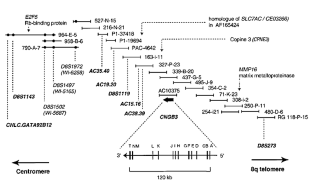
Complete achromatopsia is a rare, autosomal recessive disorder characterized by photophobia, low visual acuity, nystagmus and a total inability to distinguish colours. In this disease, cone photoreceptors, the retinal sensory neurons mediating colour vision, seem viable but fail to generate an electrical response to light1,2. Achromatopsia, or rod monochromatism, was first mapped to 2p11–2q12 (MIM 216900; ref. 3), where it is associated with missense mutations in CNGA3 (ref. 4). CNGA3 encodes the α-subunit of the cone cyclic nucleotide-gated cation channel, which generates the light-evoked electrical responses of cone photoreceptors5,6,7. A second locus at 8q21–q22 has been identified among the Pingelapese islanders of Micronesia8,9, who have a high incidence of recessive achromatopsia10,11 (MIM 262300). Here we narrow the achromatopsia locus to 1.4 cM and show that Pingelapese achromatopsia segregates with a missense mutation at a highly conserved site in CNGB3, a new gene that encodes the β-subunit of the cone cyclic nucleotide-gated cation channel. Two independent frameshift deletions establish that achromatopsia is the null phenotype of CNGB3. Combined with earlier findings, our results demonstrate that both α- and β-subunits of the cGMP-gated channel are essential for phototransduction in all three classes of cones.
This is a preview of subscription content, access via your institution
Access options
Subscribe to this journal
Receive 12 print issues and online access
$259.00 per year
only $21.58 per issue
Buy this article
- Purchase on SpringerLink
- Instant access to the full article PDF.
USD 39.95
Prices may be subject to local taxes which are calculated during checkout
Additional access options:
Figure 1: Physical map of the achromatopsia disease interval at 8q21–q22.
The alternative text for this image may have been generated using AI.
Figure 2: Protein sequence and structure of CNGB3.

The alternative text for this image may have been generated using AI.
Figure 3: CNGB3 mutations.

The alternative text for this image may have been generated using AI.
Figure 4: Inheritance of deletion mutations.

The alternative text for this image may have been generated using AI.
Accession codes
Accessions
GenBank/EMBL/DDBJ
References
- Krill, A.E. Clinical characteristics. in Hereditary Retinal and Choroidal Diseases (eds Krill, A.E. & Archer D.B.) (Harper & Row, Hagerstown, 1977).
Google Scholar - Sharpe, L.T. & Nordby, K. Total colour blindness: an introduction . in Night Vision: Basic, Clinical and Applied Aspects (eds Hess, R.F., Sharpe, L.T. & Nordby, K.) (Cambridge University Press, Cambridge, 1990).
Google Scholar - Arbour, N.C. et al. Homozygosity mapping of achromatopsia to chromosome 2 using DNA pooling. Hum. Mol. Genet. 6, 689– 684 (1997).
Article CAS Google Scholar - Kohl, S. et al. Total colourblindness is caused by mutations in the gene encoding the α-subunit of the cone photoreceptor cGMP-gated cation channel. Nature Genet. 19, 257–259 (1998).
Article CAS Google Scholar - Wissinger, B. et al. Cloning, chromosomal localization and functional expression of the gene encoding the α-subunit of the cGMP-gated channel in human cone photoreceptors. Eur. J. Neurosci. 9, 2512–2521 (1997).
Article CAS Google Scholar - Yau, K.-W. et al. Cyclic nucleotide-gated channels: an expanding new family of ion channels. Proc. Natl Acad. Sci. USA 91, 3481–3483 (1994).
Article CAS Google Scholar - Zagotta, W.N. & Siegelbaum, S.A. Structure and function of the cyclic nucleotide-gated channels. Annu. Rev. Neurosci. 19, 235–263 (1996).
Article CAS Google Scholar - Winick, J.D. et al. Homozygosity mapping of the achromatopsia locus in the Pingelapese . Am. J. Hum. Genet. 64, 1679– 1685 (1999).
Article CAS Google Scholar - Milunsky, A., Huang, X.L., Milunsky, J., DeStefano, A. & Baldwin, C.T. A locus for autosomal recessive achromatopsia on human chromosome 8q. Clin. Genet. 56, 82–85 (1999).
Article CAS Google Scholar - Brody, J.A., Hussels, I.E., Brink, E. & Torres, J. Hereditary blindness among Pingelapese people of Eastern Caroline islands. Lancet 1, 1253–1257 (1970).
Article CAS Google Scholar - Hussels, I.E. & Morton, N.E. Pingelap and Mokil atolls: achromatopsia . Am. J. Hum. Genet. 24, 304– 309 (1972).
CAS PubMed PubMed Central Google Scholar - Morton, N.E., Lew, R., Hussels, I.E. & Little, G.F. Pingelap and Mokil atolls: historical genetics. Am. J. Hum. Genet. 24, 277–289 (1972).
CAS PubMed PubMed Central Google Scholar - Hurd, J.N. A History and Some Traditions of Pingelap, an Atoll in the Eastern Caroline Islands Thesis, Univ. Hawaii (1977).
Google Scholar - Sheffield, V. et al. A collection of tri- and tetranucleotide repeat markers used to generate high quality, high resolution human genome-wide linkage maps. Hum. Mol. Genet. 4, 1837–1844 (1995).
Article CAS Google Scholar - Ott, J. in Analysis of Human Genetic Linkage (Johns Hopkins University Press, Baltimore, 1999).
Google Scholar - Chen, T.-Y et al. A new subunit of cyclic nucleotide-gated channel in retinal rods. Nature 362, 764–767 (1993).
Article CAS Google Scholar - Ardell, M.D. et al. The β subunit of human rod photoreceptor cGMP-gated cation channel is generated from a complex transcription unit. FEBS Lett. 389, 213–218 ( 1996).
Article CAS Google Scholar - Grunwald, M.E., Yu, W.P., Yu, H.H. & Yau, K.-W. Identification of a domain on the β-subunit of the rod cGMP-gated cation channel that mediates inhibition by calcium-calmodulin. J. Biol. Chem. 273, 9148–9157 (1998).
Article CAS Google Scholar - Korschen, H.G. et al. Interaction of glutamic-acid-rich proteins with the cGMP signalling pathway in rod photoreceptors. Nature 400, 761–766 (1999).
Article CAS Google Scholar - Dryja, T.P. et al. Mutations in the gene encoding the α-subunit of the rod cGMP-gated channel in autosomal recessive retinitis pigmentosa. Proc. Natl Acad. Sci. USA 92, 10177– 10181 (1995).
Article CAS Google Scholar - Nathans, J., Thomas, D. & Hogness, D.S. Molecular genetics of human color vision: the genes encoding blue, green and red pigments. Science 232, 193–202 (1986).
Article CAS Google Scholar - Altschul, S.F. et al. Gapped BLAST and PSI-BLAST: a new generation of protein database search programs. Nucleic Acids Res. 25, 3389–3402 (1997).
Article CAS Google Scholar - Boguski, M.S., Lowe, T.M. & Tolstoshev, C.M. dbEST-database for expressed sequence tags. Nature Genet. 4, 332–333 (1993).
Article CAS Google Scholar
Acknowledgements
We thank the Micronesian families; patients visiting the clinic; the Old Dominion Eye Bank; N.R. Miller, J.S. Sunness and C.A. Applegate for electroretinographic results; and S. Dharmaraj, M.F. Goldberg, V.A. McKusick, J. Nathans, E.M. Sundin and R.S. Weinberg for advice and assistance. This work was funded by the Edel and Krieble Funds of the Johns Hopkins Center for Hereditary Eye Diseases (I.H.M.), The Foundation For Retinal Research (I.H.M.), The Grousbeck Family Foundation (I.H.M.), The Louise Sloan Trust (I.H.M.), a Wilmer Intramural Grant (O.H.S., I.H.M.), an Unrestricted Grant from Research to Prevent Blindness (M.F. Goldberg), NIH R01-EY10813 (O.H.S.) and a Research To Prevent Blindness Lew Wasserman Award (O.H.S.). E.D.S. is supported by a fellowship from Praxis XXI, Sub-Programa Ciencia e Tecnologia do 2 Quadro Comunitario de Apoio, Portuguese Ministry for Science and Technology.
Author information
Authors and Affiliations
- Laboratory of Developmental Genetics, Johns Hopkins University School of Medicine, Baltimore, Maryland, USA
Olof H. Sundin, Jun-Ming Yang & Eduardo D. Silva - Department of Ophthalmology, Johns Hopkins Center for Hereditary Eye Diseases, Johns Hopkins University School of Medicine, Baltimore, Maryland, USA
Yingying Li, Danping Zhu, Thomas N. Mitchell, Eduardo D. Silva & Irene Hussels Maumenee - Department of Molecular Biology and Genetics, Johns Hopkins University School of Medicine, Baltimore, Maryland , USA
Olof H. Sundin - 1120 C Street SE, Washington DC, USA
Jane N. Hurd
Authors
- Olof H. Sundin
- Jun-Ming Yang
- Yingying Li
- Danping Zhu
- Jane N. Hurd
- Thomas N. Mitchell
- Eduardo D. Silva
- Irene Hussels Maumenee
Corresponding author
Correspondence toOlof H. Sundin.
Supplementary information
Rights and permissions
About this article
Cite this article
Sundin, O., Yang, JM., Li, Y. et al. Genetic basis of total colourblindness among the Pingelapese islanders .Nat Genet 25, 289–293 (2000). https://doi.org/10.1038/77162
- Received: 09 February 2000
- Accepted: 24 May 2000
- Issue date: July 2000
- DOI: https://doi.org/10.1038/77162