Extending the lifetime of a quantum bit with error correction in superconducting circuits (original) (raw)
- Letter
- Published: 20 July 2016
- Andrei Petrenko1 na1,
- Reinier Heeres1,
- Philip Reinhold1,
- Zaki Leghtas1 nAff3,
- Brian Vlastakis1,
- Yehan Liu1,
- Luigi Frunzio1,
- S. M. Girvin1,
- L. Jiang1,
- Mazyar Mirrahimi1,2,
- M. H. Devoret1 &
- …
- R. J. Schoelkopf1
Nature volume 536, pages 441–445 (2016)Cite this article
- 28k Accesses
- 893 Citations
- 200 Altmetric
- Metrics details
Subjects
Abstract
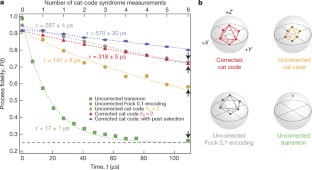
Quantum error correction (QEC) can overcome the errors experienced by qubits1 and is therefore an essential component of a future quantum computer. To implement QEC, a qubit is redundantly encoded in a higher-dimensional space using quantum states with carefully tailored symmetry properties. Projective measurements of these parity-type observables provide error syndrome information, with which errors can be corrected via simple operations2. The ‘break-even’ point of QEC—at which the lifetime of a qubit exceeds the lifetime of the constituents of the system—has so far remained out of reach3. Although previous works have demonstrated elements of QEC4,5,6,7,8,9,10,11,12,13,14,15,16, they primarily illustrate the signatures or scaling properties of QEC codes rather than test the capacity of the system to preserve a qubit over time. Here we demonstrate a QEC system that reaches the break-even point by suppressing the natural errors due to energy loss for a qubit logically encoded in superpositions of Schrödinger-cat states17 of a superconducting resonator18,19,20,21. We implement a full QEC protocol by using real-time feedback to encode, monitor naturally occurring errors, decode and correct. As measured by full process tomography, without any post-selection, the corrected qubit lifetime is 320 microseconds, which is longer than the lifetime of any of the parts of the system: 20 times longer than the lifetime of the transmon, about 2.2 times longer than the lifetime of an uncorrected logical encoding and about 1.1 longer than the lifetime of the best physical qubit (the |0〉f and |1〉f Fock states of the resonator). Our results illustrate the benefit of using hardware-efficient qubit encodings rather than traditional QEC schemes. Furthermore, they advance the field of experimental error correction from confirming basic concepts to exploring the metrics that drive system performance and the challenges in realizing a fault-tolerant system.
This is a preview of subscription content, access via your institution
Access options
Subscribe to this journal
Receive 51 print issues and online access
$199.00 per year
only $3.90 per issue
Buy this article
- Purchase on SpringerLink
- Instant access to the full article PDF.
USD 39.95
Prices may be subject to local taxes which are calculated during checkout
Additional access options:
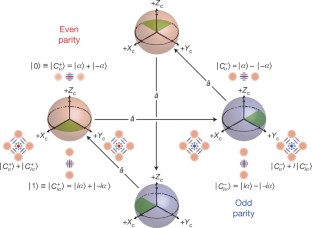
Figure 1: The cat-code cycle.
The alternative text for this image may have been generated using AI.
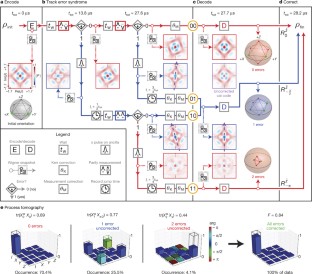
Figure 2: Example of a two-step quantum trajectory executed by the QEC state machine.
The alternative text for this image may have been generated using AI.
Figure 3: QEC process tomography.
The alternative text for this image may have been generated using AI.
References
- Shor, P. W. Scheme for reducing decoherence in quantum computer memory. Phys. Rev. A 52, R2493–R2496 (1995)
Article CAS ADS Google Scholar - Nielsen, M. & Chuang, I. Quantum Computation and Quantum Information (Cambridge Univ. Press, 2010)
- Devoret, M. H. & Schoelkopf, R. J. Superconducting circuits for quantum information: an outlook. Science 339, 1169–1174 (2013)
Article CAS ADS Google Scholar - Cory, D. et al. Experimental quantum error correction. Phys. Rev. Lett. 81, 2152–2155 (1998)
Article CAS ADS Google Scholar - Knill, E., Laflamme, R., Martinez, R. & Negrevergne, C. Benchmarking quantum computers: the five-qubit error correcting code. Phys. Rev. Lett. 86, 5811–5814 (2001)
Article CAS ADS Google Scholar - Chiaverini, J. et al. Realization of quantum error correction. Nature 432, 602–605 (2004)
Article CAS ADS Google Scholar - Schindler, P. et al. Experimental repetitive quantum error correction. Science 332, 1059–1061 (2011)
Article CAS ADS Google Scholar - Waldherr, G. et al. Quantum error correction in a solid-state hybrid spin register. Nature 506, 204–207 (2014)
Article CAS ADS Google Scholar - Taminiau, T. H., Cramer, J., van der Sar, T., Dobrovitski, V. V. & Hanson, R. Universal control and error correction in multi-qubit spin registers in diamond. Nat. Nanotechnol. 9, 171–176 (2014)
Article CAS ADS Google Scholar - Cramer, J. et al. Repeated quantum error correction on a continuously encoded qubit by real-time feedback. Nat. Commun. 7, 11526 (2016)
Article CAS ADS Google Scholar - Pittman, T. B., Jacobs, B. C. & Franson, J. D. Demonstration of quantum error correction using linear optics. Phys. Rev. A 71, 052332 (2005)
Article ADS Google Scholar - Aoki, T. et al. Quantum error correction beyond qubits. Nat. Phys. 5, 541–546 (2009)
Article CAS Google Scholar - Reed, M. D. et al. Realization of three-qubit quantum error correction with superconducting circuits. Nature 482, 382–385 (2012)
Article CAS ADS Google Scholar - Kelly, J. et al. State preservation by repetitive error detection in a superconducting quantum circuit. Nature 519, 66–69 (2015)
Article CAS ADS Google Scholar - Córcoles, A. D. et al. Demonstration of a quantum error detection code using a square lattice of four superconducting qubits. Nat. Commun. 6, 6979 (2015)
Article ADS Google Scholar - Ristè, D. et al. Detecting bit-flip errors in a logical qubit using stabilizer measurements. Nat. Commun. 6, 6983 (2015)
Article ADS Google Scholar - Haroche, S. & Raimond, J.-M. Exploring the Quantum: Atoms, Cavities, and Photons (Oxford Univ. Press, 2006)
- Leghtas, Z. et al. Hardware-efficient autonomous quantum memory protection. Phys. Rev. Lett. 111, 120501 (2013)
Article ADS Google Scholar - Mirrahimi, M. et al. Dynamically protected cat-qubits: a new paradigm for universal quantum computation. New J. Phys. 16, 045014 (2014)
Article ADS Google Scholar - Vlastakis, B. et al. Deterministically encoding quantum information using 100-photon Schrödinger cat states. Science 342, 607–610 (2013)
Article CAS ADS MathSciNet Google Scholar - Sun, L. et al. Tracking photon jumps with repeated quantum non-demolition parity measurements. Nature 511, 444–448 (2014)
Article CAS ADS Google Scholar - Steane, A. M. Error correcting codes in quantum theory. Phys. Rev. Lett. 77, 793–797 (1996)
Article CAS ADS MathSciNet Google Scholar - Braunstein, S. L. & van Loock, P. Quantum information with continuous variables. Rev. Mod. Phys. 77, 513–577 (2005)
Article ADS MathSciNet Google Scholar - Leghtas, Z. et al. Confining the state of light to a quantum manifold by engineered two-photon loss. Science 347, 853–857 (2015)
Article CAS ADS Google Scholar - Fowler, A. G., Mariantoni, M., Martinis, J. M. & Cleland, A. N. Surface codes: towards practical large-scale quantum computation. Phys. Rev. A 86, 032324 (2012)
Article ADS Google Scholar - Wallraff, A. et al. Strong coupling of a single photon to a superconducting qubit using circuit quantum electrodynamics. Nature 431, 162–167 (2004)
Article CAS ADS Google Scholar - Paik, H. et al. Observation of high coherence in Josephson junction qubits measured in a three-dimensional circuit QED architecture. Phys. Rev. Lett. 107, 240501 (2011)
Article ADS Google Scholar - Vijay, R., Slichter, D. H. & Siddiqi, I. Observation of quantum jumps in a superconducting artificial atom. Phys. Rev. Lett. 106, 110502 (2011)
Article CAS ADS Google Scholar - Bergeal, N. et al. Phase-preserving amplification near the quantum limit with a Josephson ring modulator. Nature 465, 64–68 (2010)
Article CAS ADS Google Scholar - Bertet, P. et al. Direct measurement of the Wigner function of a one-photon Fock state in a cavity. Phys. Rev. Lett. 89, 200402 (2002)
Article CAS ADS Google Scholar
Acknowledgements
We thank K. Sliwa, A. Narla and L. Sun for discussions. This research was supported by the US Army Research Office (W911NF-14-1-0011). A.P. was supported by the National Science Foundation (NSF) (PHY-1309996). S.M.G. acknowledges additional support from NSF DMR-1301798. Facilities use was supported by the Yale Institute for Nanoscience and Quantum Engineering (YINQE), the Yale SEAS cleanroom and the NSF (MRSECDMR 1119826).
Author information
Author notes
- Zaki Leghtas
Present address: †Present address: Centre Automatique et Systèmes, Mines-ParisTech, PSL Research University, 60, boulevard Saint-Michel, 75006 Paris, France., - Nissim Ofek and Andrei Petrenko: These authors contributed equally to this work.
Authors and Affiliations
- Departments of Physics and Applied Physics, Yale University, New Haven, 06510, Connecticut, USA
Nissim Ofek, Andrei Petrenko, Reinier Heeres, Philip Reinhold, Zaki Leghtas, Brian Vlastakis, Yehan Liu, Luigi Frunzio, S. M. Girvin, L. Jiang, Mazyar Mirrahimi, M. H. Devoret & R. J. Schoelkopf - QUANTIC team, INRIA de Paris, 2 Rue Simone Iff, Paris, 75012, France
Mazyar Mirrahimi
Authors
- Nissim Ofek
- Andrei Petrenko
- Reinier Heeres
- Philip Reinhold
- Zaki Leghtas
- Brian Vlastakis
- Yehan Liu
- Luigi Frunzio
- S. M. Girvin
- L. Jiang
- Mazyar Mirrahimi
- M. H. Devoret
- R. J. Schoelkopf
Contributions
A.P. and N.O. performed the experiment and analysed the data. N.O. designed and built the feedback architecture with help from Y.L. under the supervision of R.J.S. and M.H.D. R.H. and P.R. developed the optimal control pulses. M.M., Z.L., L.J., S.M.G. and B.V. provided theoretical support. R.H. and L.F. fabricated the transmon qubit. R.J.S. supervised the project. A.P., N.O., L.F. and R.J.S. wrote the manuscript with feedback from all authors.
Corresponding authors
Correspondence toNissim Ofek, Andrei Petrenko or R. J. Schoelkopf.
Ethics declarations
Competing interests
R.J.S., M.H.D. and L.F. are founders and equity shareholders of Quantum Circuits, Inc.
Supplementary information
Supplementary Information (download PDF )
This file contains Supplementary Text and Data including Supplementary Methods, additional references, Supplementary Tables 1-2 and Supplementary Figures 1-11. (PDF 7058 kb)
PowerPoint slides
Rights and permissions
About this article
Cite this article
Ofek, N., Petrenko, A., Heeres, R. et al. Extending the lifetime of a quantum bit with error correction in superconducting circuits.Nature 536, 441–445 (2016). https://doi.org/10.1038/nature18949
- Received: 12 February 2016
- Accepted: 08 June 2016
- Published: 20 July 2016
- Issue date: 25 August 2016
- DOI: https://doi.org/10.1038/nature18949
This article is cited by
Editorial Summary
Extended quantum error correction
Although quantum error correction is a crucial ingredient when building a fully-fledged quantum computer, experimental demonstrations of this concept have so far been incomplete proof-of-principles. Here, Nissim Ofek et al. take another important step towards practical quantum error correction. Encoding a logical state in superpositions of Schrödinger-cat states, the authors demonstrate that they can extend the lifetime of a superconducting qubit beyond the lifetime of any of its constituents. Although the scheme is not fully fault-tolerant, it demonstrates all of the crucial ingredients of quantum error correction. Because the scheme is hardware efficient, it might become the method of choice when correcting errors in superconducting qubits.