Earth’s first stable continents did not form by subduction (original) (raw)
- Letter
- Published: 27 February 2017
- Michael Brown2,
- Nicholas J. Gardiner1,
- Christopher L. Kirkland1 &
- …
- R. Hugh Smithies3
Nature volume 543, pages 239–242 (2017) Cite this article
- 15k Accesses
- 403 Citations
- 261 Altmetric
- Metrics details
Subjects
A Corrigendum to this article was published on 10 May 2017
Abstract
The geodynamic environment in which Earth’s first continents formed and were stabilized remains controversial1. Most exposed continental crust that can be dated back to the Archaean eon (4 billion to 2.5 billion years ago) comprises tonalite–trondhjemite–granodiorite rocks (TTGs) that were formed through partial melting of hydrated low-magnesium basaltic rocks2; notably, these TTGs have ‘arc-like’ signatures of trace elements and thus resemble the continental crust produced in modern subduction settings3. In the East Pilbara Terrane, Western Australia, low-magnesium basalts of the Coucal Formation at the base of the Pilbara Supergroup have trace-element compositions that are consistent with these being source rocks for TTGs. These basalts may be the remnants of a thick (more than 35 kilometres thick), ancient (more than 3.5 billion years old) basaltic crust4,5 that is predicted to have existed if Archaean mantle temperatures were much hotter than today’s6,7,8. Here, using phase equilibria modelling of the Coucal basalts, we confirm their suitability as TTG ‘parents’, and suggest that TTGs were produced by around 20 per cent to 30 per cent melting of the Coucal basalts along high geothermal gradients (of more than 700 degrees Celsius per gigapascal). We also analyse the trace-element composition of the Coucal basalts, and propose that these rocks were themselves derived from an earlier generation of high-magnesium basaltic rocks, suggesting that the arc-like signature in Archaean TTGs was inherited from an ancestral source lineage. This protracted, multistage process for the production and stabilization of the first continents—coupled with the high geothermal gradients—is incompatible with modern-style plate tectonics, and favours instead the formation of TTGs near the base of thick, plateau-like basaltic crust9. Thus subduction was not required to produce TTGs in the early Archaean eon.
This is a preview of subscription content, access via your institution
Access options
Access Nature and 54 other Nature Portfolio journals
Get Nature+, our best-value online-access subscription
$32.99 / 30 days
cancel any time
Subscribe to this journal
Receive 51 print issues and online access
$199.00 per year
only $3.90 per issue
Buy this article
- Purchase on SpringerLink
- Instant access to the full article PDF.
USD 39.95
Prices may be subject to local taxes which are calculated during checkout
Additional access options:
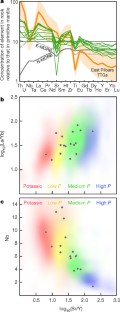
Figure 1: Trace-element geochemistry.
The alternative text for this image may have been generated using AI.
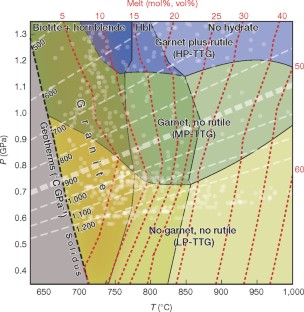
Figure 2: Phase equilibria modelling.
The alternative text for this image may have been generated using AI.
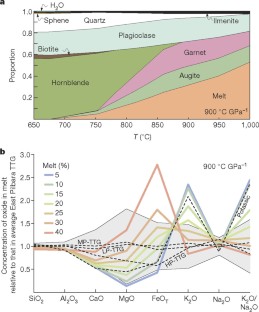
Figure 3: For the average Coucal basalt, a plot of calculated modal proportions for melting along an apparent geotherm of 900 °C GPa−1, and a comparison of calculated melt compositions with natural TTGs.
The alternative text for this image may have been generated using AI.
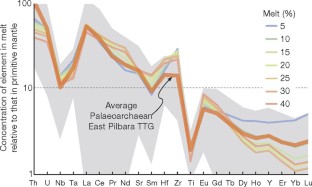
Figure 4: Trace-element modelling.
The alternative text for this image may have been generated using AI.
References
- Condie, K. C. & Pease, V. When Did Plate Tectonics Begin On Planet Earth? 7th edn (Geol. Soc. Am., 2008)
- Johnson, T. E., Brown, M., Kaus, B. J. P. & VanTongeren, J. A. Delamination and recycling of Archaean crust caused by gravitational instabilities. Nat. Geosci. 7, 47–52 (2013)
Article ADS Google Scholar - Rapp, R. P., Shimizu, N. & Norman, M. D. Growth of early continental crust by partial melting of eclogite. Nature 425, 605–609 (2003)
Article CAS ADS Google Scholar - Smithies, R. H., Champion, D. C. & Van Kranendonk, M. J. Formation of Paleoarchean continental crust through infracrustal melting of enriched basalt. Earth Planet. Sci. Lett. 281, 298–306 (2009)
Article CAS ADS Google Scholar - Zegers, T. E. & van Keken, P. E. Middle Archean continent formation by crustal delamination. Geology 29, 1083–1086 (2001)
Article CAS ADS Google Scholar - Herzberg, C., Condie, K. & Korenaga, J. Thermal history of the Earth and its petrological expression. Earth Planet. Sci. Lett. 292, 79–88 (2010)
Article CAS ADS Google Scholar - Herzberg, C. & Rudnick, R. Formation of cratonic lithosphere: an integrated thermal and petrological model. Lithos 149, 4–15 (2012)
Article CAS ADS Google Scholar - Korenaga, J. Urey ratio and the structure and evolution of Earth’s mantle. Rev. Geophys. 46, RG2007 (2008)
- Sizova, E., Gerya, T., Stüwe, K. & Brown, M. Generation of felsic crust in the Archean: a geodynamic modeling perspective. Precambr. Res. 271, 198–224 (2015)
Article CAS ADS Google Scholar - Moyen, J. F. The composite Archaean grey gneisses: petrological significance, and evidence for a non-unique tectonic setting for Archaean crustal growth. Lithos 123, 21–36 (2011)
Article CAS ADS Google Scholar - Rapp, R. P. & Watson, E. B. Dehydration melting of metabasalt at 8–32 kbar: implications for continental growth and crust-mantle recycling. J. Petrol. 36, 891–931 (1995)
Article CAS ADS Google Scholar - Foley, S., Tiepolo, M. & Vannucci, R. Growth of early continental crust controlled by melting of amphibolite in subduction zones. Nature 417, 837–840 (2002)
Article CAS ADS Google Scholar - Martin, H. The Archean grey gneisses and the genesis of continental crust. Dev. Precamb. Geol. 11, 205–259 (1994)
Article Google Scholar - Smithies, R. H. The Archaean tonalite-trondhjemite-granodiorite (TTG) series is not an analogue of Cenozoic adakite. Earth Planet. Sci. Lett. 182, 115–125 (2000)
Article CAS ADS Google Scholar - Bédard, J. H. A catalytic delamination-driven model for coupled genesis of Archaean crust and sub-continental lithospheric mantle. Geochim. Cosmochim. Acta 70, 1188–1214 (2006)
Article ADS Google Scholar - Willbold, M., Hegner, E., Stracke, A. & Rocholl, A. Continental geochemical signatures in dacites from Iceland and implications for models of early Archaean crust formation. Earth Planet. Sci. Lett. 279, 44–52 (2009)
Article CAS ADS Google Scholar - Moyen, J. F. & Stevens, G. in Archean Geodynamics and Environments (eds Benn, K., Mareschal, J.-C. & Condie, K. C ) 149–175 (Am. Geophys. Union, 2006)
- Martin, H. & Moyen, J.-F. Secular changes in tonalite-trondhjemite-granodiorite composition as markers of the progressive cooling of Earth. Geology 30, 319–322 (2002)
Article CAS ADS Google Scholar - Green, E. C. R. et al. Activity-composition relations for the calculation of partial melting equilibria in metabasic rocks. J. Metamorph. Geol. 34, 845–869 (2016)
Article CAS ADS Google Scholar - Van Kranendonk, M. J., Hickman, A. H., Smithes, R. H. & Nelson, D. R. Geology and tectonic evolution of the Archean North Pilbara Terrain, Pilbara Craton, Western Australia. Econ. Geol. 97, 695–732 (2002)
CAS Google Scholar - Van Kranendonk, M. J. et al. Making it thick: a volcanic plateau origin of Palaeoarchean continental lithosphere of the Pilbara and Kaapvaal cratons. Geol. Soc. Spec. Publ. 389, 83–111 (2015)
Article ADS Google Scholar - Kerrich, R., Polat, A., Wyman, D. & Hollings, P. Trace element systematics of Mg-, to Fe-tholeiitic basalt suites of the Superior Province: implications for Archean mantle reservoirs and greenstone belt genesis. Lithos 46, 163–187 (1999)
Article CAS ADS Google Scholar - Condie, K. C. Incompatible element ratios in oceanic basalts and komatiites: tracking deep mantle sources and continental growth rates with time. Geochem. Geophys. Geosyst. 4, 1–28 (2003)
Article Google Scholar - Berry, A. J. et al. Oxidation state of iron in komatiitic melt inclusions indicates hot Archaean mantle. Nature 455, 960–963 (2008)
Article CAS ADS Google Scholar - Brown, M. The contribution of metamorphic petrology to understanding lithosphere evolution and geodynamics. Geosci. Frontiers 5, 553–569 (2014)
Article Google Scholar - Xiong, X. et al. Partitioning of Nb and Ta between rutile and felsic melt and the fractionation of Nb/Ta during partial melting of hydrous metabasalt. Geochim. Cosmochim. Acta 75, 1673–1692 (2011)
Article CAS ADS Google Scholar - McKenzie, D. & O’Nions, R. K. Partial melt distributions from inversion of rare earth element concentrations. J. Petrol. 32, 1021–1091 (1991)
Article CAS ADS Google Scholar - Sun, S.-s. & McDonough, W. F. Chemical and isotopic systematics of oceanic basalts: implications for mantle composition and processes. Geol. Soc. Spec. Publ. 42, 313–345 (1989)
Article ADS Google Scholar - Powell, R. & Holland, T. J. B. An internally consistent dataset with uncertainties and correlations: 3. Applications to geobarometry, worked examples and a computer program. J. Metamorph. Geol. 6, 173–204 (1988)
Article CAS ADS Google Scholar - Holland, T. J. B. & Powell, R. An improved and extended internally consistent thermodynamic dataset for phases of petrological interest, involving a new equation of state for solids. J. Metamorph. Geol. 29, 333–383 (2011)
Article CAS ADS Google Scholar - White, R. W., Powell, R., Holland, T. J. B., Johnson, T. E. & Green, E. C. R. New mineral activity-composition relations for thermodynamic calculations in metapelitic systems. J. Metamorph. Geol. 32, 261–286 (2014)
Article CAS ADS Google Scholar - White, R. W., Powell, R. & Clarke, G. L. The interpretation of reaction textures in Fe-rich metapelitic granulites of the Musgrave Block, Central Australia: constraints from mineral equilibria calculations in the system. J. Metamorph. Geol. 20, 41–55 (2002)
Article CAS ADS Google Scholar - White, R., Powell, R., Holland, T. & Worley, B. The effect of TiO2 and Fe2O3 on metapelitic assemblages at greenschist and amphibolite facies conditions: mineral equilibria calculations in the system K2O-FeO-MgO-Al2O3-SiO2-H2O-TiO2-Fe2O3 . J. Metamorph. Geol. 18, 497–511 (2000)
Article CAS ADS Google Scholar - Holland, T. & Powell, R. Activity–composition relations for phases in petrological calculations: an asymmetric multicomponent formulation. Contrib. Mineral. Petrol. 145, 492–501 (2003)
Article CAS ADS Google Scholar - Boehnke, P., Watson, E. B., Trail, D., Harrison, T. M. & Schmitt, A. K. Zircon saturation re-revisited. Chem. Geol. 351, 324–334 (2013)
Article CAS ADS Google Scholar - Stimac, J. & Hickmott, D. Trace-element partition coefficients for ilmenite, orthopyroxene and pyrrhotite in rhyolite determined by micro-PIXE analysis. Chem. Geol. 117, 313–330 (1994)
Article CAS ADS Google Scholar
Acknowledgements
We acknowledge financial support from The Institute of Geoscience Research (TIGeR) at Curtin University. R.H.S. publishes with the permission of the Executive Director, Geological Survey of Western Australia.
Author information
Authors and Affiliations
- Department of Applied Geology, The Institute for Geoscience Research (TIGeR), Centre for Exploration Targeting – Curtin node, Australian Research Council Centre of Excellence for Core to Crust Fluid Systems, Curtin University, GPO Box U1987, Perth, 6845, Western Australia, Australia
Tim E. Johnson, Nicholas J. Gardiner & Christopher L. Kirkland - Department of Geology, Laboratory for Crustal Petrology, University of Maryland, College Park, Maryland, 20742-4211, USA
Michael Brown - Geological Survey of Western Australia, 100 Plain Street, East Perth, 6004, Western Australia, Australia
R. Hugh Smithies
Authors
- Tim E. Johnson
- Michael Brown
- Nicholas J. Gardiner
- Christopher L. Kirkland
- R. Hugh Smithies
Contributions
T.E.J. conceived the project and performed the phase equilibria calculations. N.J.G. undertook the trace-element modelling. All authors analysed the data and contributed to writing the paper.
Corresponding author
Correspondence toTim E. Johnson.
Ethics declarations
Competing interests
The authors declare no competing financial interests.
Additional information
Reviewer Information Nature thanks J. Bédard, R. Rapp and the other anonymous reviewer(s) for their contribution to the peer review of this work.
Extended data figures and tables
Extended Data Figure 1 Variation diagrams for samples of the Coucal basalts.
a, La/Nb versus Ti/Gd ratios. b, La/Nb ratios versus MgO (wt%) concentration. c, La/Nb ratios versus wt% silica (SiO2, anhydrous) concentrations. d, Th/Nb ratios versus wt% SiO2 (anhydrous) concentrations. Five samples (green dots) that define a trend to higher La/Nb and Th/Nb ratios with increasing SiO2 levels and decreasing Ti/Gd ratios are thought to have undergone assimilation of felsic crust4 and were excluded from subsequent modelling. The remaining ten samples (pink dots), with low Th/Nb and La/Nb ratios, are considered to be free of major crustal influence22,23.
Extended Data Figure 2 Full phase diagram for the average Coucal basalt.
Full pressure–temperature (P–T) pseudosection for the average uncontaminated Coucal basalt (n = 10), using an Fe3+/ΣFe ratio of 0.1 (ref. 24) and a water content just sufficient to saturate the solidus at 1.0 GPa. The red dashed lines show melt proportions as mol% on a one-oxide basis to approximate vol%. The white dashed lines show linear geotherms in °C per gigapascal. The 900 °C GPa−1 geotherm discussed in detail in the text, is shown in yellow. This diagram forms the basis for the simplified version shown in Fig. 2. aug, augite; bi, biotite; g, garnet; hb, hornblende; H2O, aqueous fluid; ilm, ilmenite; ksp, K-feldspar; L, melt; mt, magnetite; muscovite (mu); opx, orthopyroxene; pl, plagioclase; q, quartz; ru, rutile; sph, sphene = titanite.
Extended Data Figure 3 Apparent geotherms recorded in metamorphic rocks dated to 2.4 Gyr ago or older.
The geotherms (T/P) are shown in units of °C per gigapascal. All but one rock of Archaean age (2.5 Gyr or older) record apparent geotherms of 500 °C GPa−1 or higher, and most are more than, or much more than, 700 °C GPa−1 (M.B. and T.E.J., manuscript in preparation). These findings are consistent with a global database of TTG compositions, 76% of which are LP- and MP-TTGs10 (see yellow and green fields in Fig. 2).
Extended Data Figure 4 Calculated melt compositions for melting along apparent geotherms of 700 °C GPa−1 and 1,100 °C GPa−1.
Calculated composition of melt produced from the average Coucal basalt along linear geotherms of 700 °C GPa−1 (top) and 1,100 °C GPa−1 (bottom) at various melt fractions (5–40%), normalized to the average composition of Palaeoarchaean East Pilbara TTG. The grey shaded region shows the 2_σ_ envelope on the average Palaeoarchaean East Pilbara TTG data. Also shown are the average composition of TTGs and potassic granitoids worldwide10. As with the 900 °C GPa−1 data (Fig. 3a), the modelled melt compositions fit best at melt fractions of 20–30 mol% (approximate vol%).
Extended Data Figure 5 Calculated modal proportion for melting along apparent geotherms of 700 °C GPa−1 and 1,100 °C GPa−1.
Plots of modal proportions versus temperature (also known as modebox diagrams) showing the changing abundance of phases, modelled along linear geotherms of 700 °C GPa−1 (top) and 1,100 °C GPa−1 (bottom). Assemblages developed along the cooler geotherm (700 °C GPa−1) contain (at temperatures greater than 700 °C) abundant garnet, as well as a small quantity (<2 mol%) of suprasolidus sphene (titanite) at lower temperatures (less than 750 °C), of ilmenite at intermediate temperatures (700–860 °C), and of rutile at temperatures higher than 800 °C (that is, these assemblages are HP-TTGs). Little garnet and no rutile forms along the 1,100 °C GPa−1 geotherm, consistent with the formation of LP- and MP-TTGs; all of these assemblages contain a small amount (less than 2 mol%) of ilmenite, but no sphene.
Extended Data Table 1 Major-element oxide (wt%) and trace-element (p.p.m.) bulk rock composition of Coucal basalts
Extended Data Table 2 Major-element oxide (wt%) and trace-element (p.p.m.) bulk rock composition of Palaeoarchaean East Pilbara Terrane (EPT) TTGs
Extended Data Table 3 Calculated modes (in mol%, approximating vol%) of minerals and melt at various temperatures along the 900 °C GPa−1, 700 °C GPa−1 and 1,100 °C GPa−1 geotherms
Extended Data Table 4 Normalized anhydrous compositions (wt%) of the average East Pilbara Terrane (EPT) TTG, average potassic grey gneisses, LP-, MP- and HP-TTGs, and modelled melts in the NCKFMAS system
Extended Data Table 5 The partition coefficients (D) used for trace-element modelling
Supplementary information
PowerPoint slides
Rights and permissions
About this article
Cite this article
Johnson, T., Brown, M., Gardiner, N. et al. Earth’s first stable continents did not form by subduction.Nature 543, 239–242 (2017). https://doi.org/10.1038/nature21383
- Received: 08 September 2016
- Accepted: 05 January 2017
- Published: 27 February 2017
- Issue date: 09 March 2017
- DOI: https://doi.org/10.1038/nature21383
This article is cited by
Editorial Summary
Early continents not formed by subduction
Tim Johnson et al. perform phase equilibria modelling of the Coucal basalts from Western Australia and confirm their suitability as parent rocks of the Archaean continental crust. The authors suggest that these early crustal rocks were produced by 20–30 per cent melting along high geothermal gradients. They conclude that the production and stabilization of the first continents required a protracted, multistage process. When coupled with the high geothermal gradients, this suggests that the continents did not form by subduction. Instead it favours a 'stagnant lid' regime in the early Archaean eon in which a single, rigid plate lay over the mantle.