Acid-sensing ion channel-1 contributes to axonal degeneration in autoimmune inflammation of the central nervous system (original) (raw)
- Letter
- Published: 11 November 2007
- Matthew J Craner2,
- Ruth Etzensperger1,
- Sandra Vergo1,
- John A Wemmie3,
- Michael J Welsh4,
- Angela Vincent2 &
- …
- Lars Fugger1,5
Nature Medicine volume 13, pages 1483–1489 (2007) Cite this article
- 3856 Accesses
- 374 Citations
- 17 Altmetric
- Metrics details
Abstract
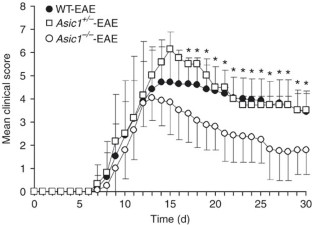
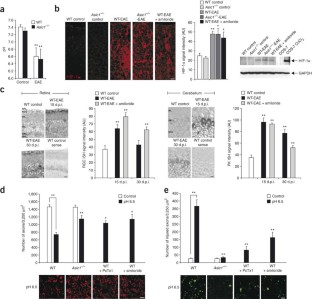
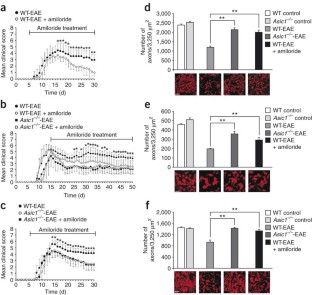
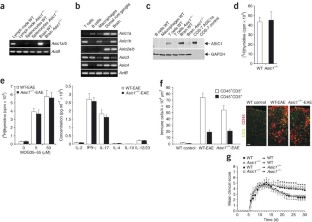
Multiple sclerosis is a neuroinflammatory disease associated with axonal degeneration1,2. The neuronally expressed, proton-gated acid-sensing ion channel-1 (ASIC1)3,4 is permeable to Na+ and Ca2+, and excessive accumulation of these ions is associated with axonal degeneration5. We tested the hypothesis that ASIC1 contributes to axonal degeneration in inflammatory lesions of the central nervous system (CNS). After induction of experimental autoimmune encephalomyelitis (EAE), Asic1 −/− mice showed both a markedly reduced clinical deficit and reduced axonal degeneration compared to wild-type mice. Consistently with acidosis-mediated injury, pH measurements in the spinal cord of EAE mice showed tissue acidosis sufficient to open ASIC1. The acidosis-related protective effect of Asic1 disruption was also observed in nerve explants in vitro. Amiloride, a licensed and clinically safe blocker of ASICs, was equally neuroprotective in nerve explants and in EAE. Although ASICs are also expressed by immune cells, this expression is unlikely to explain the neuroprotective effect of Asic1 inactivation, as CNS inflammation was similar in wild-type and Asic1 −/− mice. In addition, adoptive transfer of T cells from wild-type mice did not affect the protection mediated by Asic1 disruption. These results suggest that ASIC1 blockers could provide neuroprotection in multiple sclerosis.
This is a preview of subscription content, access via your institution
Access options
Subscribe to this journal
Receive 12 print issues and online access
$259.00 per year
only $21.58 per issue
Buy this article
- Purchase on SpringerLink
- Instant access to the full article PDF.
USD 39.95
Prices may be subject to local taxes which are calculated during checkout
Additional access options:
Figure 1: Asic1 disruption ameliorates disease severity in EAE mice.
The alternative text for this image may have been generated using AI.
Figure 2: Acidosis in inflammatory CNS tissue and upregulation of ASIC1 in inflammatory EAE brains mediate axonal degeneration.
The alternative text for this image may have been generated using AI.
Figure 3: ASIC1 disruption or blockade by amiloride ameliorates disease severity and axonal loss in EAE mice.
The alternative text for this image may have been generated using AI.
Figure 4: The neuroprotective effect of ASIC1 inactivation or blockade does not depend on ASIC1-expressing T cells.
The alternative text for this image may have been generated using AI.
References
- Lovas, G., Szilagyi, N., Majtenyi, K., Palkovits, M. & Komoly, S. Axonal changes in chronic demyelinated cervical spinal cord plaques. Brain 123, 308–317 (2000).
Article Google Scholar - Kornek, B. et al. Multiple sclerosis and chronic autoimmune encephalomyelitis: a comparative quantitative study of axonal injury in active, inactive and remyelinated lesions. Am. J. Pathol. 157, 267–276 (2000).
Article CAS Google Scholar - Wemmie, J.A. et al. Acid-sensing ion channel 1 is localized in brain regions with high synaptic density and contributes to fear conditioning. J. Neurosci. 23, 5496–5502 (2003).
Article CAS Google Scholar - Waldmann, R., Champigny, G., Bassilana, F., Heurteaux, C. & Lazdunski, M. A proton-gated cation channel involved in acid-sensing. Nature 386, 173–177 (1997).
Article CAS Google Scholar - Stys, P.K. & Lopachin, R.M. Mechanisms of calcium and sodium fluxes in anoxic myelinated central nervous system axons. Neuroscience 82, 21–32 (1998).
Article CAS Google Scholar - Waxman, S.G. Ions, energy and axonal injury: towards a molecular neurology of multiple sclerosis. Trends Mol. Med. 12, 192–195 (2006).
Article CAS Google Scholar - Lassmann, H. Multiple sclerosis: is there neurodegeneration independent from inflammation? J. Neurol. Sci. 259, 3–6 (2007).
Article CAS Google Scholar - Dutta, R. et al. Mitochondrial dysfunction as a cause of axonal degeneration in multiple sclerosis patients. Ann. Neurol. 59, 478–489 (2006).
Article CAS Google Scholar - Stys, P.K. General mechanisms of axonal damage and its prevention. J. Neurol. Sci. 233, 3–13 (2005).
Article CAS Google Scholar - Wemmie, J.A., Price, M.P. & Welsh, M.J. Acid-sensing ion channels: advances, questions and therapeutic opportunities. Trends Neurosci. 29, 578–586 (2006).
Article CAS Google Scholar - Zha, X.M., Wemmie, J.A., Green, S.H. & Welsh, M.J. Acid-sensing ion channel 1a is a postsynaptic proton receptor that affects the density of dendritic spines. Proc. Natl. Acad. Sci. USA 103, 16556–16561 (2006).
Article CAS Google Scholar - Xiong, Z.G. et al. Neuroprotection in ischemia: blocking calcium-permeable acid-sensing ion channels. Cell 118, 687–698 (2004).
Article CAS Google Scholar - Steinman, L. & Zamvil, S.S. How to successfully apply animal studies in experimental allergic encephalomyelitis to research on multiple sclerosis. Ann. Neurol. 60, 12–21 (2006).
Article CAS Google Scholar - Benson, C.J. et al. Heteromultimers of DEG/ENaC subunits form H+-gated channels in mouse sensory neurons. Proc. Natl. Acad. Sci. USA 99, 2338–2343 (2002).
Article CAS Google Scholar - Bitsch, A. et al. Inflammatory CNS demyelination: histopathologic correlation with in vivo quantitative proton MR spectroscopy. AJNR Am. J. Neuroradiol. 20, 1619–1627 (1999).
CAS PubMed Google Scholar - Aboul-Enein, F. et al. Preferential loss of myelin-associated glycoprotein reflects hypoxia-like white matter damage in stroke and inflammatory brain diseases. J. Neuropathol. Exp. Neurol. 62, 25–33 (2003).
Article CAS Google Scholar - Graumann, U., Reynolds, R., Steck, A.J. & Schaeren-Wiemers, N. Molecular changes in normal appearing white matter in multiple sclerosis are characteristic of neuroprotective mechanisms against hypoxic insult. Brain Pathol. 13, 554–573 (2003).
Article CAS Google Scholar - Immke, D.C. & McCleskey, E.W. Lactate enhances the acid-sensing Na+ channel on ischemia-sensing neurons. Nat. Neurosci. 4, 869–870 (2001).
Article CAS Google Scholar - Mamet, J., Baron, A., Lazdunski, M. & Voilley, N. Proinflammatory mediators, stimulators of sensory neuron excitability via the expression of acid-sensing ion channels. J. Neurosci. 22, 10662–10670 (2002).
Article CAS Google Scholar - Allan, S.M., Tyrrell, P.J. & Rothwell, N.J. Interleukin-1 and neuronal injury. Nat. Rev. Immunol. 5, 629–640 (2005).
Article CAS Google Scholar - Cannella, B. & Raine, C.S. The adhesion molecule and cytokine profile of multiple sclerosis lesions. Ann. Neurol. 37, 424–435 (1995).
Article CAS Google Scholar - Escoubas, P. et al. Isolation of a tarantula toxin specific for a class of proton-gated Na+ channels. J. Biol. Chem. 275, 25116–25121 (2000).
Article CAS Google Scholar - Trapp, B.D. et al. Axonal transection in the lesions of multiple sclerosis. N. Engl. J. Med. 338, 278–285 (1998).
Article CAS Google Scholar - Kleyman, T.R. & Cragoe, E.J. Jr. Amiloride and its analogs as tools in the study of ion transport. J. Membr. Biol. 105, 1–21 (1988).
Article CAS Google Scholar - Craner, M.J., Hains, B.C., Lo, A.C., Black, J.A. & Waxman, S.G. Co-localization of sodium channel Nav1.6 and the sodium-calcium exchanger at sites of axonal injury in the spinal cord in EAE. Brain 127, 294–303 (2004).
Article Google Scholar - Craner, M.J. et al. Molecular changes in neurons in multiple sclerosis: altered axonal expression of Nav1.2 and Nav1.6 sodium channels and Na+/Ca2+ exchanger. Proc. Natl. Acad. Sci. USA 101, 8168–8173 (2004).
Article CAS Google Scholar - Beeton, C. et al. Kv1.3 channels are a therapeutic target for T cell–mediated autoimmune diseases. Proc. Natl. Acad. Sci. USA 103, 17414–17419 (2006).
Article CAS Google Scholar - Chen, C.C., England, S., Akopian, A.N. & Wood, J.N. A sensory neuron–specific, proton-gated ion channel. Proc. Natl. Acad. Sci. USA 95, 10240–10245 (1998).
Article CAS Google Scholar - Wemmie, J.A. et al. The acid-activated ion channel ASIC contributes to synaptic plasticity, learning, and memory. Neuron 34, 463–477 (2002).
Article CAS Google Scholar - Craner, M.J. et al. Temporal course of upregulation of Nav1.8 in Purkinje neurons parallels the progression of clinical deficit in experimental allergic encephalomyelitis. J. Neuropathol. Exp. Neurol. 62, 968–975 (2003).
Article Google Scholar
Acknowledgements
We thank C. Pugh's laboratory for assistance with HIF-1α western blotting. Work in the authors' laboratories is supported by the Danish (L.F.) and UK Medical Research Councils (L.F., A.V.), the Karen Elise Jensen Foundation, the Lundbeck Foundation, the Danish Multiple Sclerosis Society, the European Union (European Commission Descartes Prize and FP6 Neuropromise, Functional Genomics in Mutant Mouse Models as Tools to Investigate the Complexity of Human Immunological Disease (Mugen) and Autoimmunity and Rheumatic Disease Research Groups (ARDIS)) and G.B. Holding (Viby) ApS (L.F.). M.A.F. is supported by the Deutsche Forschungsgemeinschaft (DFG FR1720/1-1) and the Medical Research Council Career Development Fellowship. R.E. is supported by the Schweizerische Multiple Sklerose Gesellschaft and a Berrow Scholarship.
Author information
Authors and Affiliations
- Medical Research Council Human Immunology Unit and Department of Clinical Neurology, Weatherall Institute of Molecular Medicine, John Radcliffe Hospital, University of Oxford, Oxford, OX3 9DS, UK
Manuel A Friese, Ruth Etzensperger, Sandra Vergo & Lars Fugger - Neurosciences Group, Weatherall Institute of Molecular Medicine, John Radcliffe Hospital, University of Oxford, Oxford, OX3 9DS, UK
Matthew J Craner & Angela Vincent - Department of Psychiatry, University of Iowa and Veteran's Affairs Hospital, Iowa City, 52242, Iowa, USA
John A Wemmie - Howard Hughes Medical Institute, University of Iowa, Iowa City, 52242, Iowa, USA
Michael J Welsh - Clinical Institute, Aarhus University Hospital, Skejby Sygehus, Aarhus, 8200 N, Denmark
Lars Fugger
Authors
- Manuel A Friese
- Matthew J Craner
- Ruth Etzensperger
- Sandra Vergo
- John A Wemmie
- Michael J Welsh
- Angela Vincent
- Lars Fugger
Contributions
M.A.F. and L.F. formulated the hypothesis and initiated and organized the study. M.A.F. and M.J.C. performed the main experimental work and analyzed the data. R.E. and S.V. helped with some experimental procedures. L.F. oversaw the experiments, analyzed the data and provided the main funding for the research. A.V. contributed to data discussion. M.A.F. and M.J.C. drafted the manuscript and L.F. and A.V. helped with writing the final manuscript. J.A.W. and M.J.W. generated Asic1 −/− mice and the antibody to ASIC1 and contributed to data discussion.
Corresponding author
Correspondence toLars Fugger.
Ethics declarations
Competing interests
The Medical Research Council UK has filed a patent application entitled "Treatment for demyelinating disease" (priority US filing no. 60/830681, priority GB filing no. 0614058.6; priority date 14th July 2006), which is based on the research described in this paper. M.A.F. and L.F. are listed as inventors in this application.
Supplementary information
Rights and permissions
About this article
Cite this article
Friese, M., Craner, M., Etzensperger, R. et al. Acid-sensing ion channel-1 contributes to axonal degeneration in autoimmune inflammation of the central nervous system.Nat Med 13, 1483–1489 (2007). https://doi.org/10.1038/nm1668
- Received: 15 May 2007
- Accepted: 20 September 2007
- Published: 11 November 2007
- Issue date: December 2007
- DOI: https://doi.org/10.1038/nm1668