Interpretations of the Paris climate target (original) (raw)
- Correspondence
- Published: 19 March 2018
Nature Geoscience volume 11, pages 220–221 (2018) Cite this article
- 3173 Accesses
- 42 Citations
- 241 Altmetric
- Metrics details
Subjects
To the Editor — In the 2015 UNFCCC Paris Agreement, article 2 expresses the target of “Holding the increase in global temperature to well below 2 °C above pre-industrial levels and pursuing efforts to limit the temperature increase to 1.5 °C … recognizing that this would significantly reduce the risks and impacts of climate change”1. Different interpretations of the precise meaning of the phrases ‘increase in global temperature’2 and ‘pre-industrial’3 could have large effects on mitigation requirements and corresponding social, policy and political responses. Here we suggest that levels of current global mean surface warming since pre-industrial times that are higher than those derived by Millar et al. could have been calculated using alternative, but equally valid, assumptions as the ones made by those authors.
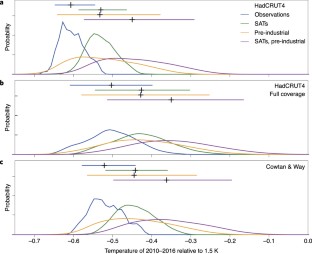
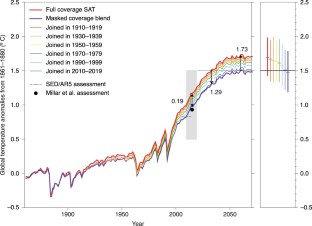
In the work by Millar and colleagues4, an observational dataset (HadCRUT4)5 was used to estimate current levels of anthropogenic warming above 1861–1880 (0.93 °C as of 2015) and thereby determine the amount of warming remaining before the 1.5 °C target is reached. HadCRUT4, in common with most datasets, calculates global mean surface temperature (GMST) as a blend of surface air temperature (SAT) measurements over land and sea surface temperatures (SSTs) over the ocean. It only has partial global coverage, limited to where the observations exist. As such, data from the Arctic, which has been found to be warming much faster than the global mean, are not included. By choosing to use this observational dataset Millar and co-workers have implicitly assumed a definition of GMST that is restricted to observational coverage, measured as a blend of SATs and SSTs. In addition, they assume that 1861–1880 is representative of pre-industrial conditions as used in the UNFCCC Structured Expert Dialogue (SED)6. However, this approach has potential shortcomings. For example, when model simulations are processed in a similar way to the observations, they show less warming with the SED method, compared to an alternative approach where complete global coverage of SAT is assumed. It therefore seems likely that the SED approach underestimates the warming that has actually occurred in global air temperatures7. In addition, changes in GMST could have been calculated from a different baseline. As industrialization was already under way by the late nineteenth century, an earlier period could be more appropriate for a pre-industrial baseline.
This is a preview of subscription content, access via your institution
Relevant articles
Open Access articles citing this article.
Access options
Access Nature and 54 other Nature Portfolio journals
Get Nature+, our best-value online-access subscription
$32.99 / 30 days
cancel any time
Subscribe to this journal
Receive 12 print issues and online access
$259.00 per year
only $21.58 per issue
Buy this article
- Purchase on SpringerLink
- Instant access to the full article PDF.
USD 39.95
Prices may be subject to local taxes which are calculated during checkout
Additional access options:
Fig. 1: Present global temperatures relative to 1.5 °C above pre-industrial temperatures.
The alternative text for this image may have been generated using AI.
Fig. 2: Global temperature for CMIP5 model simulations with RCP2.6 projections.
The alternative text for this image may have been generated using AI.
References
- Adoption of the Paris Agreement FCCC/CP/2015/10/Add.1 (United Nations Framework Convention on Climate Change, 2015).
- Rogelj, J., Schleussner, C.-F. & Hare, W. Geophys. Res. Lett. 44, 662–10,665 (2017). 10.
Article Google Scholar - Schurer, A. P., Mann, M. E., Hawkins, E., Tett, S. F. B. & Hegerl, G. C. Nat. Clim. Change 7, 563–567 (2017).
Article Google Scholar - Millar, R. J. et al. Nat. Geosci. 10, 741–747 (2017).
Article Google Scholar - Morice, C. P., Kennedy, J. J., Rayner, N. A. & Jones, P. D. J. Geophys. Res. Atmos 117, D08101 (2012).
Article Google Scholar - Report on the Structured Expert Dialogue on the 2013–2015 Review FCCC/SB/2015/INF.1 (2015).
- Cowtan, K. et al. Geophys. Res. Lett. 42, 6526–6534 (2015).
Article Google Scholar - Cowtan, K. & Way, R. G. Q. J. R. Meteorol. Soc. 140, 1935–1944 (2014).
Article Google Scholar - Hawkins, E. et al. Bull. Am. Meteorol. Soc. 98, 1841–1856 (2017).
Article Google Scholar - Kirtman, B. et al. in Climate Change 2013: The Physical Science Basis (eds Stocker, T. F. et al.) 953–1028 (IPCC, Cambridge Univ. Press, 2013).
- King, A. D., Karoly, D. J. & Henley, B. J. Nat. Clim. Change 7, 412–416 (2017).
Article Google Scholar - Gruber, N. et al. Science 337, 220–3 (2012).
Article Google Scholar
Author information
Authors and Affiliations
- School of GeoSciences, University of Edinburgh, Crew Building, Edinburgh, UK
A. P. Schurer, V. Scott & S. F. B. Tett - Department of Chemistry, University of York, Heslington, York, UK
K. Cowtan - NCAS-Climate, Department of Meteorology, University of Reading, Reading, UK
E. Hawkins - Department of Meteorology and Atmospheric Science & Earth and Environmental Systems Institute, Pennsylvania State University, State College, Pennsylvania, USA
M. E. Mann
Authors
- A. P. Schurer
- K. Cowtan
- E. Hawkins
- M. E. Mann
- V. Scott
- S. F. B. Tett
Corresponding author
Correspondence toA. P. Schurer.
Rights and permissions
About this article
Cite this article
Schurer, A.P., Cowtan, K., Hawkins, E. et al. Interpretations of the Paris climate target.Nature Geosci 11, 220–221 (2018). https://doi.org/10.1038/s41561-018-0086-8
- Published: 19 March 2018
- Version of record: 19 March 2018
- Issue date: April 2018
- DOI: https://doi.org/10.1038/s41561-018-0086-8