Trends and seasonal cycles in the isotopic composition of nitrous oxide since 1940 (original) (raw)
- Letter
- Published: 11 March 2012
- P. Croteau1 nAff8,
- K. A. Boering1,
- D. M. Etheridge2,
- D. Ferretti3,
- P. J. Fraser2,
- K-R. Kim4,
- P. B. Krummel2,
- R. L. Langenfelds2,
- T. D. van Ommen5,6,
- L. P. Steele2 &
- …
- C. M. Trudinger2
Nature Geoscience volume 5, pages 261–265 (2012) Cite this article
- 4418 Accesses
- 245 Citations
- 79 Altmetric
- Metrics details
Subjects
Abstract
The atmospheric nitrous oxide mixing ratio has increased by 20% since 1750 (ref. 1). Given that nitrous oxide is both a long-lived greenhouse gas2 and a stratospheric ozone-depleting substance3, this increase is of global concern. However, the magnitude and geographic distribution of nitrous oxide sources, and how they have changed over time, is uncertain4,5. A key unknown is the influence of the stratospheric circulation4,5, which brings air depleted in nitrous oxide to the surface. Here, we report the oxygen and intramolecular nitrogen isotopic compositions of nitrous oxide in firn air samples from Antarctica and archived air samples from Cape Grim, Tasmania, spanning 1940–2005. We detect seasonal cycles in the isotopic composition of nitrous oxide at Cape Grim. The phases and amplitudes of these seasonal cycles allow us to distinguish between the influence of the stratospheric sink and the oceanic source at this site, demonstrating that isotope measurements can help in the attribution and quantification of surface sources in general. Large interannual variations and long-term decreasing trends in isotope composition are also apparent. These long-term trends allow us to distinguish between natural and anthropogenic sources of nitrous oxide, and confirm that the rise in atmospheric nitrous oxide levels is largely the result of an increased reliance on nitrogen-based fertilizers.
This is a preview of subscription content, access via your institution
Access options
Subscribe to this journal
Receive 12 print issues and online access
$259.00 per year
only $21.58 per issue
Buy this article
- Purchase on SpringerLink
- Instant access to the full article PDF.
USD 39.95
Prices may be subject to local taxes which are calculated during checkout
Additional access options:
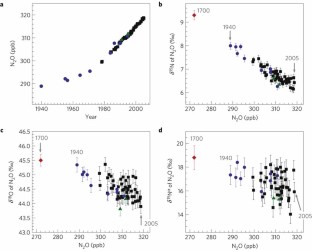
Figure 1: Changes in N2O since 1940.
The alternative text for this image may have been generated using AI.
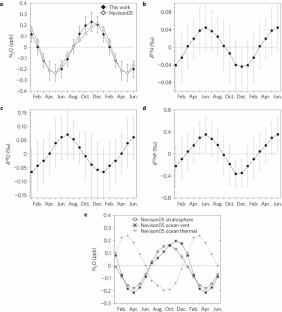
Figure 2: Mean seasonal cycles for 1978–2005.
The alternative text for this image may have been generated using AI.
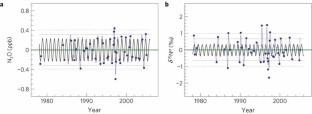
Figure 3: Large interannual variations in the mean seasonal cycles for 1978–2005.
The alternative text for this image may have been generated using AI.
References
- MacFarling-Meure, C. et al. Law Dome CO2, CH4, and N2O ice core records extended to 2000 years BP. Geophys. Res. Lett. 33, L14810 (2006).
Article Google Scholar - IPCC Climate Change 2007: The Physical Science Basis (eds Solomon, S. et al.) (Cambridge Univ. Press, 2007).
- Ravishankara, A. R., Daniel, J. S. & Portman, R. W. Nitrous oxide (N2O): The dominant ozone-depleting substance emitted in the 21st century. Science 326, 123–125 (2009).
Article Google Scholar - Hirsch, A. I. et al. Inverse modeling estimates of the global nitrous oxide surface flux from 1998–2001. Glob. Biogeochem. Cycles 20, GB1008 (2006).
Article Google Scholar - Huang, J. et al. Estimation of regional emissions of nitrous oxide from 1997 to 2005 using multinetwork measurements, a chemical transport model, and an inverse method. J. Geophys. Res. 113, D17313 (2008).
Article Google Scholar - Davidson, E. A. The contribution of manure and fertilizer nitrogen to atmospheric nitrous oxide since 1860. Nature Geosci. 2, 659–662 (2009).
Article Google Scholar - Galloway, J. N. et al. Transformation of the nitrogen cycle: Recent trends, questions, and potential solutions. Science 320, 889–892 (2008).
Article Google Scholar - Nevison, C. D. et al. Southern Ocean ventilation inferred from seasonal cycles of atmospheric N2O and O2/N2 at Cape Grim, Tasmania. Tellus 57, 218–229 (2005).
Article Google Scholar - Nevison, C. D. et al. Exploring causes of interannual variability in the seasonal cycles of tropospheric nitrous oxide. Atmos. Chem. Phys. 11, 3713–3730 (2011).
Article Google Scholar - Jiang, X. et al. Seasonal cycle of N2O: Analysis of data. Glob. Biogeochem. Cycles 21, GB1006 (2007).
Article Google Scholar - Yoshida, N. & Toyoda, S. Constraining the atmospheric N2O budget from intramolecular site preference in N2O isotopomers. Nature 405, 330–334 (2000).
Article Google Scholar - Kim, K-R. & Craig, H. Nitrogen-15 and oxygen-18 characteristics of nitrous oxide: A global perspective. Science 262, 1855–1857 (1993).
Article Google Scholar - Pérez, T. et al. Identifying the agricultural imprint on the global N2O budget using stable isotopes. J. Geophys. Res. 106, 9869–9878 (2001).
Article Google Scholar - Toyoda, S. et al. Characterization and production and consumption processes of N2O emitted from temperate agricultural soils determined via isotopomer ratio analysis. Glob. Biogeochem. Cycles 25, GB2008 (2011).
Article Google Scholar - Yung, Y. L. & Miller, C. E. Isotopic fractionation of stratospheric nitrous oxide. Science 278, 1778–1780 (1997).
Article Google Scholar - Röckmann, T., Brenninkmeijer, C. A. M., Wollenhaupt, M., Crowley, J. N. & Crutzen, P. J. Measurement of the isotopic fractionation of 15N14N16O, 14N15N16O and 14N14N18O in the UV photolysis of nitrous oxide. Geophys. Res. Lett. 27, 1399–1402 (2000).
Article Google Scholar - McLinden, C. A., Prather, M. J. & Johnson, M. S. Global modeling of N2O isotopomers: Stratospheric enrichment, isotope-budgets and the 17O–18O mass-independent anomaly. J. Geophys. Res. 108, 4233 (2003).
Article Google Scholar - Rahn, T. & Wahlen, M. A reassessment of the global isotopic budget of atmospheric nitrous oxide. Glob. Biogeochem. Cycles 14, 537–543 (2000).
Article Google Scholar - Park, S., Atlas, E. L. & Boering, K. A. Measurements of N2O isotopologues in the stratosphere: Influence of transport on the apparent enrichment factors and the isotopologue fluxes to the troposphere. J. Geophys. Res. 109, D01305 (2004).
Google Scholar - Sowers, T., Rodebaugh, A., Yoshida, N. & Toyoda, S. Extending the records of the isotopic composition of atmospheric N2O back to 1800 AD from firn air trapped in snow at the South Pole and the Greenland Ice Sheet Project II ice core. Glob. Biogeochem. Cycles 16, 1129–1138 (2002).
Article Google Scholar - Röckmann, T., Kaiser, J. & Brenninkmeijer, C. A. M. The isotopic fingerprint of the pre-industrial and the anthropogenic N2O source. Atmos. Chem. Phys. 3, 315–323 (2003).
Article Google Scholar - Bernard, S. et al. Constraints on N2O budget changes since pre-industrial time from new firn air and ice core isotope measurements. Atmos. Chem. Phys. 6, 493–503 (2006).
Article Google Scholar - Ishijima, K. et al. Temporal variations of the atmospheric nitrous oxide concentration and its _δ_15N and _δ_18O for the latter half of the 20th century reconstructed from firn air analyses. J. Geophys. Res. 112, D03305 (2007).
Article Google Scholar - Röckmann, T. & Levin, I. High-precision determination of the changing isotopic composition of atmospheric N2O from 1990 to 2002. J. Geophys. Res. 110, D21304 (2005).
Article Google Scholar - Sutka, R. L. et al. Distinguishing nitrous oxide production from nitrification and denitrification on the basis of isotopomer abundances. Appl. Environ. Microbiol. 72, 638–644 (2006).
Article Google Scholar - Popp, B. N. et al. Nitrogen and oxygen isotopomeric constraints on the origins and sea-to-air flux of N2O in the oligotrophic subtropical North Pacific gyre. Glob. Biogeochem. Cycles 16, 1064 (2002).
Article Google Scholar - Yamagishi, H. et al. Role of nitrification and denitrification on the nitrous oxide cycle in the eastern tropical North Pacific and Gulf of California. J. Geophys. Res. 112, G02015 (2007).
Article Google Scholar - Langenfelds, R. L. et al. Interannual growth rate variations of atmospheric CO2 and its _δ_13C, H2, CH4, and CO between 1992 and 1999 linked to biomass burning. Glob. Biogeochem. Cycles 16, 1048 (2002).
Article Google Scholar - Simmonds, P. G. et al. A burning question. Can recent growth rate anomalies in the greenhouse gases be attributed to large-scale biomass burning events? Atmos. Environ. 39, 2513–2517 (2005).
Article Google Scholar - Crutzen, P. J., Mosier, A. R., Smith, K. A. & Winiwarter, W. N2O release from agro-biofuel production negates global warming reduction by replacing fossil fuels. Atmos. Chem. Phys. 8, 389–395 (2008).
Article Google Scholar
Acknowledgements
This work was supported by the UC Berkeley Atmospheric Sciences Center, the NASA Upper Atmosphere Research Program (NNX09AJ95G) and the Camille Dreyfus Teacher-Scholar Award (KAB) through UC Berkeley; the Brain Korea 21 Program and Korea NRF grant 2011-0013756 (S.P.) through the School of Earth and Environmental Sciences at Seoul National University; and the Australia Government’s Cooperative Research Centres Programme (T.D.v.O.). Long-term support by the Australian Government Bureau of Meteorology for the Cape Grim Air Archive Program is also gratefully acknowledged, and we are indebted to many Cape Grim staff for their diligent efforts in collecting the air archive samples. We thank S. Wofsy for comments on the analyses and manuscript and K-Y. Kim for additional insights from a cyclostationary empirical orthogonal function analysis of the data.
Author information
Author notes
- S. Park
Present address: Present address: School of Earth and Environmental Sciences (BK21), Seoul National University, Seoul 151-742, Republic of Korea, - P. Croteau
Present address: Present address: Aerodyne Research, Inc., 45 Manning Rd., Billerica, Massachusetts 01821, USA,
Authors and Affiliations
- Departments of Earth & Planetary Science and of Chemistry, University of California, Berkeley, California 94720, USA
S. Park, P. Croteau & K. A. Boering - Centre for Australian Weather and Climate Research/CSIRO Marine and Atmospheric Research, Private Bag 1, Aspendale, Victoria 3195, Australia
D. M. Etheridge, P. J. Fraser, P. B. Krummel, R. L. Langenfelds, L. P. Steele & C. M. Trudinger - Formerly of National Institute of Water and Atmospheric Research, Private Bag 14901, Wellington 6021, New Zealand
D. Ferretti - School of Earth and Environmental Sciences/Research Institute of Oceanography, College of Natural Sciences, Seoul National University, Seoul 151-747, Republic of Korea
K-R. Kim - Australian Antarctic Division, Channel Highway, Kingston, Tasmania 7050, Australia
T. D. van Ommen - Antarctic Climate and Ecosystems Cooperative Research Centre, University of Tasmania, Private Bag 80, Hobart, Tasmania 7001, Australia
T. D. van Ommen
Authors
- S. Park
- P. Croteau
- K. A. Boering
- D. M. Etheridge
- D. Ferretti
- P. J. Fraser
- K-R. Kim
- P. B. Krummel
- R. L. Langenfelds
- T. D. van Ommen
- L. P. Steele
- C. M. Trudinger
Contributions
S.P., P.C., and K.A.B. carried out the isotope measurements, analysed the results, interpreted the data and wrote the manuscript; P.C. developed and ran the box model, S.P. carried out the red-noise spectral calculations and both contributed equally to this work; R.L.L. and P.B.K. carried out the Cape Grim Air Archive time-series analyses; R.L.L., L.P.S., P.B.K. and P.J.F. provided air samples from the Cape Grim Air Archive, N2O mixing ratio measurements and manuscript comments. P.J.F., KRK, R.L.L. and L.P.S. proposed the study, gave conceptual advice and manuscript comments; D.M.E., D.F., C.M.T. and T.D.v.O. provided firn air samples and dating of those samples. C.M.T. modelled air movement in the firn and made the gravitational and diffusion corrections.
Corresponding author
Correspondence toK. A. Boering.
Ethics declarations
Competing interests
The authors declare no competing financial interests.
Supplementary information
Rights and permissions
About this article
Cite this article
Park, S., Croteau, P., Boering, K. et al. Trends and seasonal cycles in the isotopic composition of nitrous oxide since 1940.Nature Geosci 5, 261–265 (2012). https://doi.org/10.1038/ngeo1421
- Received: 09 August 2011
- Accepted: 12 February 2012
- Published: 11 March 2012
- Issue date: April 2012
- DOI: https://doi.org/10.1038/ngeo1421