The sculpting of Jupiter’s gossamer rings by its shadow (original) (raw)
- Letter
- Published: 01 May 2008
Nature volume 453, pages 72–75 (2008)Cite this article
- 432 Accesses
- 37 Citations
- 5 Altmetric
- Metrics details
Abstract
Dust near Jupiter is produced when interplanetary impactors collide energetically with small inner moons, and is organized into a main ring, an inner halo, and two fainter and more distant gossamer rings1,2. Most of these structures are constrained by the orbits of the moons3 Adrastea, Metis, Amalthea and Thebe, but a faint outward protrusion called the Thebe extension behaves differently and has eluded understanding. Here we report on dust impacts detected during the Galileo spacecraft’s traversal of the outer ring region4: we find a gap in the rings interior to Thebe’s orbit5, grains on highly inclined paths, and a strong excess of submicrometre-sized dust just inside Amalthea’s orbit. We present detailed modelling that shows that the passage of ring particles through Jupiter’s shadow creates the Thebe extension and fully accounts for these Galileo results. Dust grains alternately charge and discharge when traversing shadow boundaries, allowing the planet’s powerful magnetic field to excite orbital eccentricities6 and, when conditions are right, inclinations as well.
This is a preview of subscription content, access via your institution
Access options
Subscribe to this journal
Receive 51 print issues and online access
$199.00 per year
only $3.90 per issue
Buy this article
- Purchase on SpringerLink
- Instant access to the full article PDF.
USD 39.95
Prices may be subject to local taxes which are calculated during checkout
Additional access options:
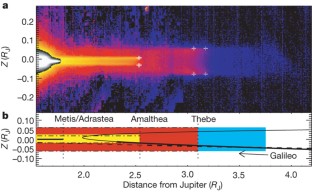
Figure 1: Overview of Jupiter’s diffuse ring system.
The alternative text for this image may have been generated using AI.
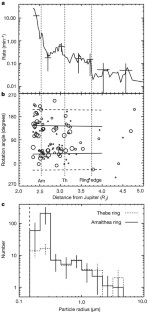
Figure 2: Galileo dust data.
The alternative text for this image may have been generated using AI.
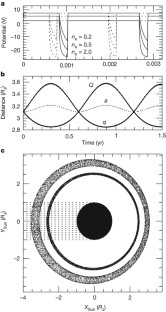
Figure 3: Variations of the electric potential during shadow passages.
The alternative text for this image may have been generated using AI.
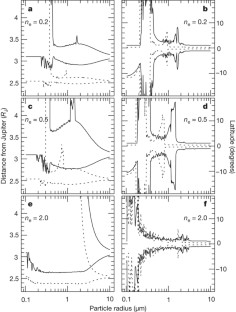
Figure 4: Radial and vertical mobility of dust.
The alternative text for this image may have been generated using AI.
References
- Burns, J. A. et al. The formation of Jupiter’s faint rings. Science 284, 1146–1150 (1999)
Article ADS CAS Google Scholar - Burns, J. A. et al. in Jupiter: Planet, Satellites & Magnetosphere (eds Bagenal, F., McKinnon, B. & Dowling, T.) 241–262 (Cambridge Univ. Press, Cambridge, UK, 2003)
Google Scholar - Ockert-Bell, M. E. et al. The structure of Jupiter’s ring system as revealed by the Galileo imaging experiment. Icarus 138, 188–213 (1999)
Article ADS Google Scholar - Krüger, H. Jupiter’s Dust Disc, an Astrophysical Laboratory. Thesis, Ruprecht-Karls-Universität (Shaker, Aachen, 2003)
Google Scholar - Showalter, M. R., de Pater, I., Verbanac, G., Hamilton, D. P. & Burns, J. A. Properties and dynamics of Jupiter’s gossamer rings from Galileo, Voyager, Hubble and Keck images. Icarus (in the press)
- Horányi, M. & Burns, J. A. Charged dust dynamics — Orbital resonance due to planetary shadows. J. Geophys. Res. 96, 19283–19289 (1991)
Article ADS Google Scholar - de Pater, I. et al. Keck infrared observations of Jupiter's ring system near Earth’s 1997 ring plane crossing. Icarus 138, 214–223 (1999)
Article ADS Google Scholar - Throop, H. B. et al. The jovian rings: New results derived from Cassini, Galileo, Voyager and Earth-based observations. Icarus 172, 59–77 (2004)
Article ADS Google Scholar - Showalter, M. R. et al. A new look at Jupiter’s ring system: Preliminary results from New Horizons. AAS/Div. Dyn. Astron. Meet. 38, no. 12.07 (2007)
- Grün, E. et al. The Galileo dust detector. Space Sci. Rev. 60, 317–340 (1992)
Article ADS Google Scholar - Moissl, R. Galileo’s Staubmessungen in Jupiters Gossamer-Ringen. Thesis, Ruprecht-Karls-Universität. (2005)
Google Scholar - Hamilton, D. P. & Burns, J. A. Ejection of dust from Jupiter’s gossamer ring. Nature 364, 695–699 (1993)
Article ADS Google Scholar - Schaffer, L. & Burns, J. A. Stochastic charging of dust grains in planetary rings: Diffusion rates and their effects on Lorentz resonances. J. Geophys. Res. 100, 213–234 (1995)
Article ADS Google Scholar - Hamilton, D. P. Motion of dust in a planetary magnetosphere: Orbit-averaged equations for oblateness, electromagnetic, and radiation forces with application to Saturn’s E ring. Icarus 101, 244–264 (1993)
Article ADS Google Scholar - Hamilton, D. P. The asymmetric time-variable rings of Mars. Icarus 119, 153–172 (1996)
Article ADS Google Scholar - Horányi, M., Morfill, G. E. & Grün, E. Mechanism for the acceleration and ejection of dust grains from Jupiter’s magnetosphere. Nature 363, 144–146 (1993)
Article ADS Google Scholar - Gurnett, D. A., Grün, E., Gallagher, D., Kurth, W. S. & Scarf, F. L. Micron-sized particles detected near Saturn by the Voyager plasma wave instrument. Icarus 53, 236–254 (1983)
Article ADS Google Scholar - Srama, R. et al. In situ dust measurements in the inner Saturnian system. Planet. Space Sci. 54, 967–987 (2006)
Article ADS Google Scholar - Horányi, M. & Cravens, T. E. The structure and dynamics of Jupiter’s ring. Nature 381, 293–298 (1996)
Article ADS Google Scholar
Acknowledgements
We thank the Galileo project for a successful mission. This research was supported by grants from NASA Exobiology (D.P.H.) and DLR (H.K.).
Author Contributions H.K. did all of the data analysis and created Figs 1 and 2. D.P.H. did the analytic work and numerical modelling, including Figs 3 and 4.
Author information
Authors and Affiliations
- Astronomy Department, University of Maryland, College Park, Maryland 20742-2421, USA,
Douglas P. Hamilton - Max-Planck-Institut für Sonnensystemforschung, Max-Planck-Strasse 2, 37191 Katlenburg-Lindau, Germany ,
Harald Krüger - Max-Planck-Institut für Kernphysik, Postfach 103980, 69029 Heidelberg, Germany ,
Harald Krüger
Authors
- Douglas P. Hamilton
- Harald Krüger
Corresponding author
Correspondence toDouglas P. Hamilton.
Rights and permissions
About this article
Cite this article
Hamilton, D., Krüger, H. The sculpting of Jupiter’s gossamer rings by its shadow.Nature 453, 72–75 (2008). https://doi.org/10.1038/nature06886
- Received: 16 August 2007
- Accepted: 28 February 2008
- Issue date: 01 May 2008
- DOI: https://doi.org/10.1038/nature06886
This article is cited by
The Dawn of Dust Astronomy
- Eberhard Grün
- Harald Krüger
- Ralf Srama
Space Science Reviews (2019)
Dust Phenomena Relating to Airless Bodies
- J. R. Szalay
- A. R. Poppe
- F. Spahn
Space Science Reviews (2018)
Small particles dominate Saturn’s Phoebe ring to surprisingly large distances
- Douglas P. Hamilton
- Michael F. Skrutskie
- Frank J. Masci
Nature (2015)
Environments in the Outer Solar System
- N. Krupp
- K. K. Khurana
- F. Neubauer
Space Science Reviews (2010)
Saturn's largest ring
- Anne J. Verbiscer
- Michael F. Skrutskie
- Douglas P. Hamilton
Nature (2009)