The contribution of China’s emissions to global climate forcing (original) (raw)
- Letter
- Published: 16 March 2016
- Thomas Gasser3,4,
- Philippe Ciais3,
- Shilong Piao1,5,
- Shu Tao1,
- Yves Balkanski3,
- Didier Hauglustaine3,
- Juan-Pablo Boisier3,
- Zhuo Chen1,
- Mengtian Huang1,
- Laurent Zhaoxin Li6,
- Yue Li1,
- Hongyan Liu1,
- Junfeng Liu1,
- Shushi Peng1,
- Zehao Shen1,
- Zhenzhong Sun1,
- Rong Wang3,
- Tao Wang3,
- Guodong Yin1,
- Yi Yin3,
- Hui Zeng1,
- Zhenzhong Zeng1 &
- …
- Feng Zhou1
Nature volume 531, pages 357–361 (2016) Cite this article
- 20k Accesses
- 274 Citations
- 247 Altmetric
- Metrics details
Subjects
Abstract
Knowledge of the contribution that individual countries have made to global radiative forcing is important to the implementation of the agreement on “common but differentiated responsibilities” reached by the United Nations Framework Convention on Climate Change. Over the past three decades, China has experienced rapid economic development[1](/articles/nature17165#ref-CR1 "National Bureau of Statistics of China. Gross Domestic Product Index Since 1978 http://data.stats.gov.cn/english/easyquery.htm?cn=C01
             (see ‘National Accounts’ for GDP) (2014)"), accompanied by increased emission of greenhouse gases, ozone precursors and aerosols[2](/articles/nature17165#ref-CR2 "Boden, T. A., Marland, G. & Andres, R. J. Global, Regional, and National Fossil-Fuel CO 2 Emissions
              http://dx.doi.org/10.3334/CDIAC/00001_V2013

             (Carbon Dioxide Information Analysis Center, Oak Ridge National Laboratory, US DOE, 2013)"),[3](/articles/nature17165#ref-CR3 "Emission Database for Global Atmospheric Research (EDGAR) Release version 4.2,
              http://edgar.jrc.ec.europa.eu

             (European Commission, Joint Research Centre, Netherlands Environmental Assessment Agency, 2011)"), but the magnitude of the associated radiative forcing has remained unclear. Here we use a global coupled biogeochemistry–climate model[4](/articles/nature17165#ref-CR4 "Gasser, T. Attribution Régionalisée des Causes Anthropiques du Changement Climatique
              https://tel.archives-ouvertes.fr/tel-01135456

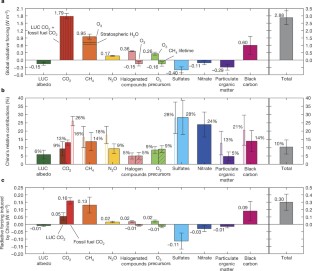
            , PhD thesis, Univ. Pierre et Marie Curie (2014)"),[5](/articles/nature17165#ref-CR5 "Cherubini, F., Gasser, T., Bright, R. M., Ciais, P. & Stromman, A. H. Linearity between temperature peak and bioenergy CO2 emission rates. Nature Clim. Change 4, 983–987 (2014)") and a chemistry and transport model[6](/articles/nature17165#ref-CR6 "Hauglustaine, D. A. et al. Interactive chemistry in the Laboratoire de Météorologie Dynamique general circulation model: description and background tropospheric chemistry evaluation. J. Geophys. Res. 109, D04314 (2004)") to quantify China’s present-day contribution to global radiative forcing due to well-mixed greenhouse gases, short-lived atmospheric climate forcers and land-use-induced regional surface albedo changes. We find that China contributes 10% ± 4% of the current global radiative forcing. China’s relative contribution to the positive (warming) component of global radiative forcing, mainly induced by well-mixed greenhouse gases and black carbon aerosols, is 12% ± 2%. Its relative contribution to the negative (cooling) component is 15% ± 6%, dominated by the effect of sulfate and nitrate aerosols. China’s strongest contributions are 0.16 ± 0.02 watts per square metre for CO2 from fossil fuel burning, 0.13 ± 0.05 watts per square metre for CH4, −0.11 ± 0.05 watts per square metre for sulfate aerosols, and 0.09 ± 0.06 watts per square metre for black carbon aerosols. China’s eventual goal of improving air quality will result in changes in radiative forcing in the coming years: a reduction of sulfur dioxide emissions would drive a faster future warming, unless offset by larger reductions of radiative forcing from well-mixed greenhouse gases and black carbon.
This is a preview of subscription content, access via your institution
Access options
Subscribe to this journal
Receive 52 print issues and online access
$199.00 per year
only $3.83 per issue
Buy this article
- Purchase on SpringerLink
- Instant access to the full article PDF.
USD 39.95
Prices may be subject to local taxes which are calculated during checkout
Additional access options:
Figure 1: Attribution of present-day global RF and its components to China.
The alternative text for this image may have been generated using AI.
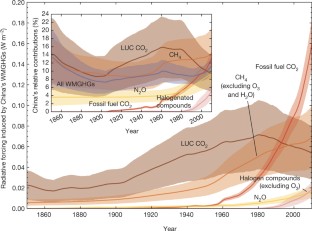
Figure 2: Historical time series of China’s absolute and relative contributions to the RF of WMGHGs.
The alternative text for this image may have been generated using AI.
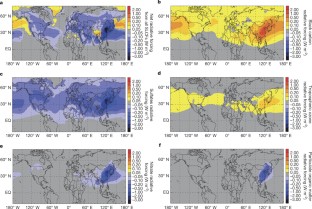
Figure 3: Spatial distribution of RFs from China-induced SLCFs.
The alternative text for this image may have been generated using AI.
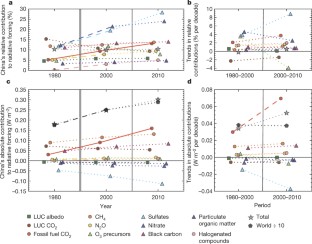
Figure 4: Recent decadal trends of China’s contributions to the global RF and its components.
The alternative text for this image may have been generated using AI.
References
- National Bureau of Statistics of China. Gross Domestic Product Index Since 1978 http://data.stats.gov.cn/english/easyquery.htm?cn=C01 (see ‘National Accounts’ for GDP) (2014)
- Boden, T. A., Marland, G. & Andres, R. J. Global, Regional, and National Fossil-Fuel CO 2 Emissionshttp://dx.doi.org/10.3334/CDIAC/00001_V2013 (Carbon Dioxide Information Analysis Center, Oak Ridge National Laboratory, US DOE, 2013)
- Emission Database for Global Atmospheric Research (EDGAR) Release version 4.2, http://edgar.jrc.ec.europa.eu (European Commission, Joint Research Centre, Netherlands Environmental Assessment Agency, 2011)
- Gasser, T. Attribution Régionalisée des Causes Anthropiques du Changement Climatiquehttps://tel.archives-ouvertes.fr/tel-01135456, PhD thesis, Univ. Pierre et Marie Curie (2014)
- Cherubini, F., Gasser, T., Bright, R. M., Ciais, P. & Stromman, A. H. Linearity between temperature peak and bioenergy CO2 emission rates. Nature Clim. Change 4, 983–987 (2014)
Article CAS ADS Google Scholar - Hauglustaine, D. A. et al. Interactive chemistry in the Laboratoire de Météorologie Dynamique general circulation model: description and background tropospheric chemistry evaluation. J. Geophys. Res. 109, D04314 (2004)
Article ADS Google Scholar - Myhre, G. et al. in Climate Change 2013: The Physical Science Basis. Contribution of Working Group I to the Fifth Assessment Report of the Intergovernmental Panel on Climate Change (eds Stocker, T. F. et al..) 659–740 (Cambridge Univ. Press, 2013)
- Boisier, J. P., de Noblet-Ducoudré, N. & Ciais, P. Inferring past land use-induced changes in surface albedo from satellite observations: a useful tool to evaluate model simulations. Biogeosciences 10, 1501–1516 (2013)
Article ADS Google Scholar - Ciais, P. et al. Attributing the increase in atmospheric CO2 to emitters and absorbers. Nature Clim. Change 3, 926–930 (2013)
Article CAS ADS Google Scholar - Höhne, N. et al. Contributions of individual countries emissions to climate change and their uncertainty. Clim. Change 106, 359–391 (2011)
Article ADS Google Scholar - United Nations Framework Convention on Climate Change (UNFCCC). Methodological Issues: Scientific and Methodological Assessment of Contributions to Climate Change, Report of the Expert Meeting, Note by the Secretariat, http://unfccc.int/resource/docs/2002/sbsta/inf14.pdf (UNFCCC, 2002)
- Trudinger, C. & Enting, I. Comparison of formalisms for attributing responsibility for climate change: non-linearities in the Brazilian proposal approach. Clim. Change 68, 67–99 (2005)
Article CAS ADS Google Scholar - Houghton, R. A. & Hackler, J. L. Sources and sinks of carbon from land-use change in China. Glob. Biogeochem. Cycles 17, 1034 (2003)
Article ADS Google Scholar - Piao, S. L. et al. The carbon balance of terrestrial ecosystems in China. Nature 458, 1009–1013 (2009)
Article CAS ADS Google Scholar - Jain, A. K., Meiyappan, P., Song, Y. & House, J. I. CO2 emissions from land-use change affected more by nitrogen cycle, than by the choice of land-cover data. Glob. Change Biol. 19, 2893–2906 (2013)
Article ADS Google Scholar - Davis, S. J., Matthews, D. & Caldeira, K. Future CO2 emissions and climate change from existing energy infrastructure. Science 329, 1330–1333 (2010)
Article CAS ADS Google Scholar - Ha-Duong, M., Grubb, M. J. & Hourcade, J. C. Influence of socioeconomic inertia and uncertainty on optimal CO2-emission abatement. Nature 390, 270–273 (1997)
Article CAS ADS Google Scholar - Boucher, O. & Reddy, M. S. Climate trade-off between black carbon and carbon dioxide emissions. Energy Policy 36, 193–200 (2008)
Article Google Scholar - Shindell, D. et al. Simultaneously mitigating near-term climate change and improving human health and food security. Science 335, 183–189 (2012)
Article CAS ADS Google Scholar - Klimont, Z., Smith, S. J. & Cofala, J. The last decade of global anthropogenic sulphur dioxide: 2000–2011 emissions. Environ. Res. Lett. 8, 014003 (2013)
Article ADS Google Scholar - Huneeus, N., Boucher, O. & Chevallier, F. Atmospheric inversion of SO2 and primary aerosol emissions for the year 2010. Atmos. Chem. Phys. 13, 6555–6573 (2013)
Article ADS Google Scholar - Boucher, O. et al. in Climate Change 2013: The Physical Science Basis. Contribution of Working Group I to the Fifth Assessment Report of the Intergovernmental Panel on Climate Change (eds Stocker, T. F. et al..) 571–657 (Cambridge Univ. Press, 2013)
- Carslaw, K. S. et al. Large contribution of natural aerosols to uncertainty in indirect forcing. Nature 503, 67–71 (2013)
Article CAS ADS Google Scholar - Yu, H. et al. A multimodel assessment of the influence of regional anthropogenic emission reductions on aerosol direct radiative forcing and the role of intercontinental transport. J. Geophys. Res. 118, 700–720 (2013)
CAS Google Scholar - Gasser, T. & Ciais, P. A theoretical framework for the net land-to-atmosphere CO2 flux and its implications in the definition of “emissions from land-use change”. Earth Syst. Dyn. 4, 171–186 (2013)
Article ADS Google Scholar - Wang, R. et al. High-resolution mapping of combustion processes and implications for CO2 emissions. Atmos. Chem. Phys. 13, 5189–5203 (2013)
Article ADS Google Scholar - Zhou, F. et al. A new high-resolution N2O emission inventory for China in 2008. Environ. Sci. Technol. 48, 8538–8547 (2014)
Article CAS ADS Google Scholar - Stohl, A. et al. Evaluating the climate and air quality impacts of short-lived pollutants. Atmos. Chem. Phys. 15, 10529–10566 (2015)
Article CAS ADS Google Scholar - Granier, C. et al. Evolution of anthropogenic and biomass burning emissions of air pollutants at global and regional scales during the 1980–2010 period. Clim. Change 109, 163–190 (2011)
- Fry, M. M. et al. The influence of ozone precursor emissions from four world regions on tropospheric composition and radiative climate forcing. J. Geophys. Res. 117, D07306 (2012)
Article ADS Google Scholar
Acknowledgements
We thank M. Schulz for help with Supplementary Fig. 7, and H. Yu for sharing data from ref. 24. This study is supported by the National Natural Science Foundation of China (grant numbers 41371443, 41390240) and the 111 project (grant number B14001). It is also part of the ACACCYA project funded by the GIS Climat-Environnement-Société. T.G. is supported by the European Research Council Synergy grant ERC-2013-SyG-610028 IMBALANCE-P.
Author information
Authors and Affiliations
- Sino-French Institute for Earth System Science, Laboratory for Earth Surface Processes, College of Urban and Environmental Sciences, Peking University, Beijing, 100871, China
Bengang Li, Shilong Piao, Shu Tao, Zhuo Chen, Mengtian Huang, Yue Li, Hongyan Liu, Junfeng Liu, Shushi Peng, Zehao Shen, Zhenzhong Sun, Guodong Yin, Hui Zeng, Zhenzhong Zeng & Feng Zhou - Jiangsu Center for Collaborative Innovation in Geographical Information Resource Development and Application, Nanjing, 210023, China
Bengang Li - Laboratoire des Sciences du Climat et de l’Environnement, CEA-CNRS-UVSQ, Gif-sur-Yvette, 91191, France
Thomas Gasser, Philippe Ciais, Yves Balkanski, Didier Hauglustaine, Juan-Pablo Boisier, Rong Wang, Tao Wang & Yi Yin - Centre International de Recherche en Environnement et Développement, CNRS-PontsParisTech-EHESS-AgroParisTech-CIRAD, Nogent-sur-Marne, 94736, France
Thomas Gasser - Key Laboratory of Alpine Ecology and Biodiversity, Institute of Tibetan Plateau Research, Center for Excellence in Tibetan Earth Science, Chinese Academy of Sciences, Beijing, 100085, China
Shilong Piao - Laboratoire de Météorologie Dynamique, CNRS, Université Pierre et, Marie Curie—Paris 6, Paris, 75252, France
Laurent Zhaoxin Li
Authors
- Bengang Li
- Thomas Gasser
- Philippe Ciais
- Shilong Piao
- Shu Tao
- Yves Balkanski
- Didier Hauglustaine
- Juan-Pablo Boisier
- Zhuo Chen
- Mengtian Huang
- Laurent Zhaoxin Li
- Yue Li
- Hongyan Liu
- Junfeng Liu
- Shushi Peng
- Zehao Shen
- Zhenzhong Sun
- Rong Wang
- Tao Wang
- Guodong Yin
- Yi Yin
- Hui Zeng
- Zhenzhong Zeng
- Feng Zhou
Contributions
B.L., T.G., P.C., S. Piao and S.T. designed the study. Simulations and output analysis were performed by T.G. for OSCAR and the overall integration; by D.H., R.W. and Y.B. for LMDz-INCA; by J.-P.B. and L.Z.L. for LUC albedo reconstructions; by Y.B. for black carbon albedo; by Z.C. and Y.B. for secondary organic aerosols; and by B.L., T.G., D.H. and R.W. for model evaluation. B.L., S. Peng, Y.Y. and F.Z. provided additional data and analysis. Writing was led by B.L., with substantial inputs from T.G., P.C., S. Piao, S.T., Y.B., D.H. and R.W. All authors participated in the study, the interpretation of the results, and the outline of the paper, through regular meetings and discussion over the past three years.
Corresponding author
Correspondence toBengang Li.
Ethics declarations
Competing interests
The authors declare no competing financial interests.
Supplementary information
Supplementary Information (download PDF )
This file contains a Supplementary Discussion, Supplementary Methods, additional references, Supplementary Tables 1-2 and Supplementary Figures 1-9. (PDF 3695 kb)
Supplementary Data (download ZIP )
This zipped file contains the source code of OSCAR, used to estimate China’s contribution to WMGHGs and to perform the overall integration and uncertainty analysis, along with any input data used in this study. (ZIP 19740 kb)
PowerPoint slides
Source data
Rights and permissions
About this article
Cite this article
Li, B., Gasser, T., Ciais, P. et al. The contribution of China’s emissions to global climate forcing.Nature 531, 357–361 (2016). https://doi.org/10.1038/nature17165
- Received: 20 May 2014
- Accepted: 19 January 2016
- Published: 16 March 2016
- Issue date: 17 March 2016
- DOI: https://doi.org/10.1038/nature17165
This article is cited by
Editorial Summary
China's impact on the global climate system
Rapid industrialization is often thought to have increased China's impact on the climate system, but the magnitude of the change has remained stubbornly difficult to quantify. Bengang Li et al. use biogeochemical and atmospheric models, combined with a suite of observational data sets, to provide sectoral estimates, with uncertainties. They find that China is responsible for about 10% of the global increase in radiative forcing (essentially, the additional warming) since pre-industrial conditions. Carbon dioxode is the single biggest warming factor, but methane and black carbon are also important. Sulfate aerosols provide a strong counteractive effect, and efforts to reduce pollution could have the effect of accelerating China's contribution to radiative forcing, unless simultaneous emission reductions are put into place.