Impacts of incentives to reduce emissions from deforestation on global species extinctions (original) (raw)
- Letter
- Published: 05 February 2012
- Ana S. L. Rodrigues3 na1,
- Mykola Gusti4,5,
- Andrew Balmford6,
- Steffen Fritz4,
- Michael Obersteiner4,
- R. Kerry Turner2 &
- …
- Thomas M. Brooks7,8,9
Nature Climate Change volume 2, pages 350–355 (2012) Cite this article
- 3517 Accesses
- 106 Citations
- 27 Altmetric
- Metrics details
Subjects
Abstract
Deforestation is a major source of anthropogenic greenhouse gas emissions1, and the greatest single driver of species extinctions2. The reduction of emissions from deforestation and forest degradation (REDD) has been formally recognized as a climate change mitigation option. REDD might have important co-benefits for biodiversity conservation3,4,5,6,7,8,9,10, yet the extent of these benefits will depend on as-yet untested associations between fine-scale spatial patterns of deforestation, species distributions and carbon stocks. Here we combine a global land-use model11 and spatial data on species distributions[12](/articles/nclimate1375#ref-CR12 "IUCN 2009 IUCN Red List of Threatened Species (2009); available at http://www.iucnredlist.org
."),[13](/articles/nclimate1375#ref-CR13 "Schipper, J. et al. The status of the world’s land and marine mammals: Diversity, threat, and knowledge. Science 322, 225–230 (2008)."),[14](/articles/nclimate1375#ref-CR14 "Stuart, S. N. et al. Status and trends of amphibian declines and extinctions worldwide. Science 306, 1783–1786 (2004).") to explore scenarios of future deforestation within REDD-eligible countries, to quantify and map the potential impacts on species extinctions as increased by forest loss and decreased by carbon conservation. We found that the continuation of historical deforestation rates is likely to result in large numbers of species extinctions, but that an adequately funded REDD programme could substantially reduce these losses. Under our deforestation scenarios, the projected benefits of REDD were remarkably consistent across the four methods used to estimate extinctions, but spatially variable, and highly dependent on the level of carbon payments. Our results indicate that, if well designed, adequately funded and broadly implemented, carbon-based forest conservation could play a major role in biodiversity conservation as well as climate change mitigation.This is a preview of subscription content, access via your institution
Access options
Subscribe to this journal
Receive 12 print issues and online access
$259.00 per year
only $21.58 per issue
Buy this article
- Purchase on SpringerLink
- Instant access to the full article PDF.
USD 39.95
Prices may be subject to local taxes which are calculated during checkout
Additional access options:
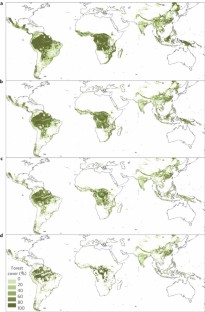
Figure 1: Changes in forest cover over the twenty-first century, within presumed REDD-eligible regions.
The alternative text for this image may have been generated using AI.
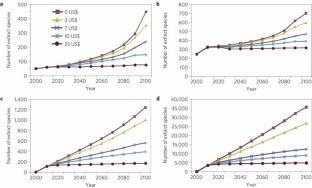
Figure 2: Number of estimated species extinctions under each scenario of carbon price, over time.
The alternative text for this image may have been generated using AI.
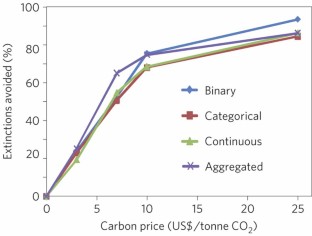
Figure 3: Relationship between carbon price and the estimated effects of REDD in avoiding extinctions.
The alternative text for this image may have been generated using AI.
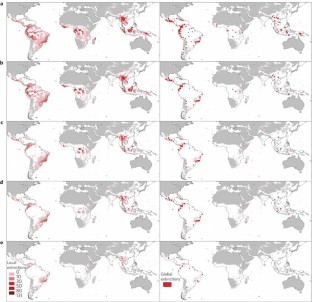
Figure 4: Spatial patterns of estimated species extinctions under different scenarios.
The alternative text for this image may have been generated using AI.
References
- IPCC Climate Change 2007: Mitigation of Climate Change (eds Metz B., Davidson O., Bosch P., Dave R., Meyer L.) (Cambridge Univ. Press, 2007).
- Baillie, J. et al. 2004 IUCN Red List of Threatened Species. A Global Species Assessment (IUCN—The World Conservation Union, 2004).
Google Scholar - Miles, L. & Kapos, V. Reducing greenhouse gas emissions from deforestation and forest degradation: Global land-use implications. Science 320, 1454–1455 (2008).
Article CAS Google Scholar - Strassburg, B. B. N. et al. Global congruence of carbon storage and biodiversity in terrestrial ecosystems. Conserv. Lett. 3, 98–105 (2010).
Article Google Scholar - Venter, O. et al. Harnessing carbon payments to protect biodiversity. Science 326, 1368 (2009).
Article CAS Google Scholar - Strassburg, B., Turner, R. K., Fisher, B., Schaeffer, R. & Lovett, A. Reducing emissions from deforestation—The ‘combined incentives’ mechanism and empirical simulations. Glob. Environ. Change 19, 265–278 (2009).
Article Google Scholar - Venter, O. et al. Carbon payments as a safeguard for threatened tropical mammals. Conserv. Lett. 2, 123–129 (2009).
Article Google Scholar - Rodrigues, A. S. L. et al. Boom-and-bust development patterns across the Amazon Deforestation Frontier. Science 324, 1435–1437 (2009).
Article CAS Google Scholar - Busch, J., Godoy, F., Turner, W. R. & Harvey, C. A. Biodiversity co-benefits of reducing emissions from deforestation under alternative reference levels and levels of finance. Conserv. Lett. 4, 101–115 (2010).
Article Google Scholar - Paoli, G. D. et al. Biodiversity conservation in the REDD. Carbon Balance Manag. 5, 7 (2010).
Article Google Scholar - Kindermann, G. et al. Global cost estimates of reducing carbon emissions through avoided deforestation. Proc. Natl Acad. Sci. USA 105, 10302–10307 (2008).
Article CAS Google Scholar - IUCN 2009 IUCN Red List of Threatened Species (2009); available at http://www.iucnredlist.org.
- Schipper, J. et al. The status of the world’s land and marine mammals: Diversity, threat, and knowledge. Science 322, 225–230 (2008).
Article CAS Google Scholar - Stuart, S. N. et al. Status and trends of amphibian declines and extinctions worldwide. Science 306, 1783–1786 (2004).
Article CAS Google Scholar - Gullison, R. et al. Tropical forests and climate policy. Science 316, 985–986 (2007).
Article CAS Google Scholar - Pimm, S. L., Russell, G. J., Gittleman, J. L. & Brooks, T. M. The future of biodiversity. Science 269, 347–350 (1995).
Article CAS Google Scholar - Capoor, K. & Ambrosi, P. State and Trends of the Carbon Market 2009 (The World Bank, 2009).
Google Scholar - Riahi, K. & Nakicenovic, N. (eds) Greenhouse Gases—Integrated Assessment Technol. Forecasting Soc. Change 74 (Special Issue) 873–1108 (2007).
- Isbell, F. et al. High plant diversity is needed to maintain ecosystem services. Nature 477, 199–202 (2011).
Article CAS Google Scholar - Manne, L., Brooks, T. & Pimm, S. Relative risk of extinction of passerine birds on continents and islands. Nature 399, 258–261 (1999).
Article CAS Google Scholar - Thomas, C. et al. Extinction risk from climate change. Nature 427, 145–148 (2004).
Article CAS Google Scholar - Malhi, Y. et al. Climate change, deforestation, and the fate of the Amazon. Science 319, 169–172 (2008).
Article CAS Google Scholar - Gardner, T., Barlow, J., Parry, L. & Peres, C. Predicting the uncertain future of tropical forest species in a data vacuum. Biotropica 39, 25–30 (2007).
Article Google Scholar - Fisher, B. et al. Implementation and opportunity costs of reducing deforestation and forest degradation in Tanzania. Nature Clim. Change 1, 161–164 (2011).
Article Google Scholar - Harvey, C. A., Dickson, B. & Kormos, C. Opportunities for achieving biodiversity conservation through REDD. Conserv. Lett. 3, 56–61 (2010).
Article Google Scholar - Stickler, C. M. et al. The potential ecological costs and cobenefits of REDD: A critical review and case study from the Amazon region. Glob. Change Biol. 15, 2803–2824 (2009).
Article Google Scholar - Putz, F. & Redford, K. Dangers of carbon-based conservation. Glob. Environ. Change 19, 400–401 (2009).
Article Google Scholar - Balmford, A. et al. The convention on biological diversity’s 2010 target. Science 307, 212–213 (2005).
Article CAS Google Scholar - He, F. & Hubbell, S. P. Species–area relationships always overestimate extinction rates from habitat loss. Nature 473, 368–371 (2011).
Article CAS Google Scholar - Brooks, T. M. et al. Extinctions: Consider all species. Nature 474, 284 (2011).
Article CAS Google Scholar
Acknowledgements
A.B. and R.K.T. acknowledge the support of the Leverhulme Trust’s Valuing the Arc Programme. M.O., M.G. and S.F. were funded by the GEOBENE project (grant agreement 037063, GOCE) under the European Community’s Sixth Framework Programme. B.B.N.S. was supported by CAPES.
Author information
Author notes
- Bernardo B. N. Strassburg and Ana S. L. Rodrigues: These authors contributed equally to this work
Authors and Affiliations
- International Institute for Sustainability (IIS), Rio de Janeiro, RJ, 22450-130, Brazil
Bernardo B. N. Strassburg - Centre for Social and Economic Research on the Global Environment (CSERGE), School of Environmental Sciences, University of East Anglia, Norwich, Norfolk NR4 7TJ, UK
Bernardo B. N. Strassburg & R. Kerry Turner - UMR5175 Centre d’Ecologie Fonctionnelle et Evolutive, CNRS, 1919 Route de Mende, 34293 Montpellier cedex 5, France
Ana S. L. Rodrigues - International Institute of Applied Systems Analysis, A-2361 Laxenburg, Austria
Mykola Gusti, Steffen Fritz & Michael Obersteiner - Department of International Information, Lviv Polytechnic National University, 12 St. Bandera St., 79013 Lviv, Ukraine
Mykola Gusti - Department of Zoology, University of Cambridge, Cambridge CB2 3EJ, UK
Andrew Balmford - NatureServe, 4600 N. Fairfax Drive, 7th Floor, Arlington, Virgina 22203, USA
Thomas M. Brooks - World Agroforestry Center (ICRAF), University of the Philippines Los Baños, Laguna 4031, Philippines
Thomas M. Brooks - School of Geography and Environmental Studies, University of Tasmania, Hobart, Tasmania 7001, Australia
Thomas M. Brooks
Authors
- Bernardo B. N. Strassburg
- Ana S. L. Rodrigues
- Mykola Gusti
- Andrew Balmford
- Steffen Fritz
- Michael Obersteiner
- R. Kerry Turner
- Thomas M. Brooks
Contributions
B.B.N.S. and A.S.L.R contributed equally to this work. The study was conceived by B.B.N.S.. The initial design was developed by B.B.N.S., A.S.L.R., T.M.B. and M.O., A.S.L.R., M.G. and B.B.N.S. conducted the analyses. All authors contributed technical expertise and interpreted the results. B.B.N.S. and A.S.L.R. wrote the initial draft of the manuscript. All authors commented on subsequent drafts.
Corresponding author
Correspondence toBernardo B. N. Strassburg.
Ethics declarations
Competing interests
The authors declare no competing financial interests.
Supplementary information
Rights and permissions
About this article
Cite this article
Strassburg, B., Rodrigues, A., Gusti, M. et al. Impacts of incentives to reduce emissions from deforestation on global species extinctions.Nature Clim Change 2, 350–355 (2012). https://doi.org/10.1038/nclimate1375
- Received: 18 April 2011
- Accepted: 14 December 2011
- Published: 05 February 2012
- Issue date: May 2012
- DOI: https://doi.org/10.1038/nclimate1375