3.2 Diets (original) (raw)
Three diet scenarios are defined in the Calculator by default: No change, Healthy diet, and Fat diet (Or a diet high in fat, sugar, and meat).No change corresponds to the 2010 consumption profile taken from the FAO. Healthy diet corresponds to an average of the range indicated by the EAT-Lancet report for each food group (Willett et al., 2019). The EAT-Lancet report quantitatively describes a universal healthy reference diet for an average adult with a total daily energy intake of about 2,500 kcal per capita. In order to take the structure of the population into account, we have multiplied the EAT-Lancet recommendations by the ratio between the average national MDER (Lupton et al, 2002) and the total kilocalories in the EAT-Lancet diet.
We have defined the Fat Diet as a high share of meat products, oil, and sugar in the total food intake (Table 4). We compute the difference between the kilocalorie consumption per food group in the selected diet and the consumption level observed in 2010. This difference is then progressively reduced over time starting in 2015 in order to match the selected diet in 2050. Corresponding shifters are computed for each time step, depending on the chosen implementation rate. The shifters are the same for all the products within a certain food group (Appendix 1).
Table 4. Definition of healthy diet and fat diet scenarios in average kilocalorie per capita per day
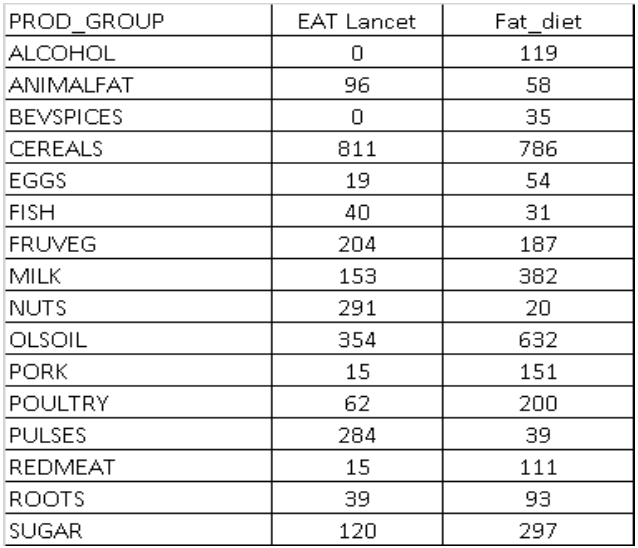
Note: For the description of the acronyms for the food groups, see Appendix 1. The products grouped in the table above as ALCOHOL (wine, beer and other alcoholic beverages) and BEVSPICES (cacao, beverages, spices and tobacco) are not included in the EAT-Lancet guidelines and hence are equal to zero. The table also does not include the food groups categories of OLSCAKE and OTHER. These are the values before adjustment of the average diets to reflect the population structure.
Table 5. List of tables related to the diet scenarios
