The climate responsibilities of industrial meat and dairy producers (original) (raw)
Abstract
Our view of responsibility for climate change has expanded to include the actions of firms, particularly fossil fuel producers. Yet analysis of animal agriculture’s role in climate change—estimated as 14.5% of anthropogenic greenhouse gas emissions—has mainly focused on the sector as a whole. Here we examine the world’s 35 largest meat and dairy companies for their commitments to mitigating climate change and find four companies that have made an explicit commitment to net-zero emissions by 2050. In general, these commitments emphasized mitigating energy use, with minimal focus on emissions (e.g., methane) from animal and land use, which make the biggest warming contributions in the agricultural sector. We also compare the companies’ projected global emissions under a business-as-usual scenario to their headquarter countries’ future emissions, assuming each country’s compliance with their commitments to the Paris Climate Agreement. Taking this view of responsibility and emissions accounting (which is not the conception of responsibility in the Paris Agreement), our results show that including industrial meat and dairy producers’ full global emissions in national accounting would impact national targets for greenhouse gas reductions. As examples, by our calculations, two companies—Fonterra in New Zealand, and Nestlé in Switzerland—would make up more than 100% of their headquarter country’s total emissions target in the coming decade. Finally, we evaluated using 20 yes-or-no questions and a variety of sources the transparency of emissions reporting, mitigation commitments, and influence on public opinion and politics of the 10 US meat and dairy companies. According to the evidence we collected, all 10 US companies have contributed to efforts to undermine climate-related policies. Each of these analyses approaches responsibility in new and different ways. Under the swiftly changing social conditions provoked by climate change, we can expect new imaginings of responsibility for GHG emissions, as well as increased attention to the role of corporate actors and their accountability for climate change impacts.
Access this article
Subscribe and save
- Starting from 10 chapters or articles per month
- Access and download chapters and articles from more than 300k books and 2,500 journals
- Cancel anytime View plans
Buy Now
Price excludes VAT (USA)
Tax calculation will be finalised during checkout.
Instant access to the full article PDF.
Fig. 1

The alternative text for this image may have been generated using AI.
Fig. 2

The alternative text for this image may have been generated using AI.
Fig. 3
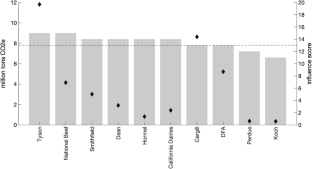
The alternative text for this image may have been generated using AI.
Change history
05 March 2022
A Correction to this paper has been published: https://doi.org/10.1007/s10584-022-03330-1
References
- Alexandratos N, Bruinsma J (2012) World agriculture: towards 2015/2030_._ Food and agriculture Organization of the United Nations. http://www.fao.org/fileadmin/templates/esa/Global_persepctives/world_ag_2030_50_201 2_rev.pdf. Accessed 28 Sep 2019
- American Meat Institute (2009) Climate change and animal agriculture: the facts. American Meat Institute. https://www.meatinstitute.org/index.php?ht=a/GetDocumentAction/i/52379
- Banerjee N, Gustin G, Cushman J (2018) The Farm Bureau: big oil’s unnoticed ally fighting climate science and policy. InsideClimate News. https://insideclimatenews.org/news/20122018/american-farm-bureau-fossil-fuel-nexus-climate-change-denial-science-agriculture-carbon-policy-opposition. Accessed 28 Sep 2019
- Baumgartner F, Berry J, Hojnacki M, Kimball D, Leech B (2009) Lobbying and policy changes: who wins, who loses, and why. University of Chicago Press, Chicago
- Beef Research (2019) Beef facts: sustainability. Cattlemen’s Beef Board and National Cattlemen’s Beef Association. https://www.beefresearch.org/sustainability/index.html. Accessed 28 Sep 2019
- Brulle RJ (2014) Institutionalizing delay: foundation funding and the creation of U.S. climate change counter-movement organizations. Clim Chang 122:681–694. https://doi.org/10.1007/s10584-013-1018-7
Article Google Scholar - Broder JM (2009) House passes bill to address threat of climate change. The New York Times.
- Cargill (2019) 2019 Annual report. Cargill. https://www.cargill.com/doc/1432144962450/2019-annual-report.pdf
- Carpenter D, Judge-Lord D, Libgober B, Rashin S (2020) Data and methods for analyzing special interest influence in rulemaking. Int Groups Adv 9:425–435. https://doi.org/10.1057/s41309-020-00094-w
Article Google Scholar - Chakravarty S, Chikkatur A, De Coninck H, Pacala S, Socolow R, Tavoni M (2009) Sharing global CO2 emission reductions among one billion high emitters. Proc Natl Acad Sci 106(29):11884–11888
Article Google Scholar - Environmental Protection Agency (EPA) (2019) Greenhouse gas equivalencies calculator. https://www.epa.gov/energy/greenhouse-gas-equivalencies-calculator
- Eshel G, Shepon A, Makov T, Milo R (2014) Land, irrigation water, greenhouse gas, and reactive nitrogen burdens of meat, eggs, and dairy production in the United States. Proc Natl Acad Sci U S A 111(33):11996–12001. https://doi.org/10.1073/pnas.1402183111
Article Google Scholar - Etter L (2009) Food firms fret over potential impact of climate bill. The Wall Street Journal. https://www.wsj.com/articles/SB125012590566427831
- Evers-Hillstrom K (2018) Farm Bill’s corporate farm subsidies remain intact after extensive lobbying. OpenSecrets News. https://www.opensecrets.org/news/2018/12/farm-bill-corporate-farm-subsidies-intact-after-lobbying/
- Ewell C, Cullis-Suzuki S, Ediger M, Hocevar J, Miller D, Jacquet J (2017) Potential ecological and social benefits of a moratorium on transshipment on the high seas. Mar Policy 18:293–300. https://doi.org/10.1016/j.marpol.2017.04.004
Article Google Scholar - Food and Agriculture Organization of the United Nations (FAO) (2011) World livestock 2011: livestock in food security. http://www.fao.org/3/i2373e/i2373e.pdf
- Food and Agriculture Organization of the United Nations (FAO). GLEAM 2.0 – Assessment of greenhouse gas emissions and mitigation potential. http://www.fao.org/gleam/results/en. Accessed 10 June 2020
- Fonterra (2019) Submission on the Climate Change Response (Zero Carbon) Amendment Bill. Fonterra Co-operative Group. https://www.fonterra.com/content/dam/fonterra-public-website/fonterra-new-zealand/documents/pdf/fonterra-submission-zero-carbon-july-2019.pdf.
- Frumhoff P, Heede R, Oreskes N (2015) The climate responsibilities of industrial carbon producers. Clim Chan 132:151–171. https://doi.org/10.1007/s10584-015-1472-5
Article Google Scholar - Garnett T, Godde C, Muller A, Röös E, Smith P, De Boer I, zu Ermgassen E, Herrero M, van Middelaar, Schader C, van Zanten H (2017) Grazed and confused? Food Climate Research Network. https://www.fcrn.org.uk/sites/default/files/project-files/fcrn_gnc_report.pdf
- Gerber PJ, Steinfeld H, Henderson B, Mottet A, Opio C, Dijkman J, Falcucci A, Tempio G (2013). Tackling climate change through livestock: a global assessment of emissions and mitigation opportunities. Food and Agriculture Organization. http://www.fao.org/docrep/018/i3437e/i3437e.pdf
- GRAIN (2017). Big meat and dairy’s supersized climate footprint. https://www.grain.org/article/entries/5825-big-meat-and-dairy-s-supersized-climate-footprint
- GRAIN and the Institute for Agriculture and Trade Policy (IATP) (2018) Emissions impossible: how big meat and dairy are heating up the planet. https://www.grain.org/article/entries/5976-emissions-impossible-how-big-meat-and-dairy-are-heating-up-the-planet.
- Greenhouse Gas Protocol (n.d.) About us. World Resources Institute and World Business Council for Sustainable Development. https://ghgprotocol.org/about-us
- Greenhouse Gas Protocol (2014) GHG Protocol Agricultural Guidance. World Resources Institute and World Business Council for Sustainable Development. https://ghgprotocol.org/sites/default/files/standards/GHG%20Protocol%20Agricultural%20Guidance%20%28April%2026%29_0.pdf
- Gutknecht G (2019) Where are the real scientists? Alpha News. https://alphanewsmn.com/gutknecht-where-are-the-real-scientists/.
- Heede R (2014) Tracing anthropogenic carbon dioxide and methane emissions to fossil fuel and cement producers, 1854–2010. Clim Chan 122:229–241. https://doi.org/10.1007/s10584-013-0986-y
Article Google Scholar - Herrero M, Havlík P, Valin H, Notenbaert A, Rufino MC, Thornton P, Blümmel WF, Grace D, Obersteiner M (2013) Biomass use, production, feed efficiencies, and greenhouse gas emissions from global livestock systems. Proc Natl Acad Sci U S A 110(52):20888–20893. https://doi.org/10.1073/pnas.1308149110
Article Google Scholar - Herrero M, Henderson B, Havlík P, Thornton P, Conant T, Smith P, Wirsenius S, Hristov A, Gerber P, Gill M, Butterbach-Bahl K, Valin H, Garnett T, Stehfest E (2016) Greenhouse gas mitigation potentials in the livestock sector. Nat Clim Chang 6(5):452–461. https://doi.org/10.1038/nclimate2925
Article Google Scholar - Jamieson D (2015) Responsibility and climate change. Global Justice: Theory Practice Rhetoric 8:23–42
Google Scholar - JBS (2019) Annual and sustainability report 2019. JBS S.A. https://jbs.com.br/wp-content/uploads/2020/05/ras-jbs-2019-eng-final.pdf.
- Kysar D (2011) What climate change can do about tort law. Environmental Law 41(1):1–71
Google Scholar - Leroy, F., Hite, A.H., Gregorino, P. 2020. Livestock in evolving Foodscapes and Thoughtscapes front. Sustain Food Syst, 14 July 2020 https://www.frontiersin.org/articles/10.3389/fsufs.2020.00105/full
- Mijares Peña SC (2014) Human rights violations by Canadian companies abroad: Choc v. Hudbay Minerals Inc. Western Journal of Legal Studies 5(1):1–19
Google Scholar - Nestlé (2018) How many factories do you have? Nestlé Global. https://www.nestle.com/ask-nestle/our-company/answers/how-many-factories-do-you-have.
- Pork Checkoff (2020) Pork industry releases new sustainability report. The National Pork Board. https://www.pork.org/news/pork-industry-releases-new-sustainability-report/.
- Ranganathan J et al. (2004) The Greenhouse Gas Protocol: A Corporate Accounting and Reporting Standard. World Resources Institute and World Business Council for Sustainable Development. https://ghgprotocol.org/sites/default/files/standards/ghg-protocol-revised.pdf
- Reisinger A, Clark H (2018) How much do direct livestock emissions actually contribute to global warming? Glob Chang Biol 24(4):1749–1761. https://doi.org/10.1111/gcb.13975
Article Google Scholar - Ripple WJ, Smith P, Haberl H, Montzka SA, Mcalpine C, Boucher DH (2014) Ruminants, climate change and climate policy. Nat Clim Chang 4:2–5. https://doi.org/10.1038/nclimate2081
Article Google Scholar - Rotz CA, Asem-Hiablie S, Place S, Thoma G (2019) Environmental footprints of beef cattle production in the United States. Agric Syst 169:1–13. https://doi.org/10.1016/j.agsy.2018.11.005
Article Google Scholar - Shoup ME (2017) Dairy Industry disputes GRAIN report on global GHG emissions. Dairy Reporter. https://www.dairyreporter.com/Article/2017/11/15/Dairy-industry-disputes-GRAIN-report-on-global-GHG-emissions.
- Smith P, Martino D, Cai Z, Gwary D, Janzen H, Kumar P et al (2008) Greenhouse gas mitigation in agriculture. Philosophical transactions of the Royal Society of London. Biological Sciences 363(1492):789–813. https://doi.org/10.1098/rstb.2007.2184
Article Google Scholar - Stanescu V (2019) “Cowgate”: meat eating and climate change denial. In: Almiron N, Xifra J (eds) Climate change denial and public relations: strategic communication and interest groups in climate inaction. Routledge, London, pp 178–194
Chapter Google Scholar - Steinfeld H, Gerber P, Wassenaar T, Castel V, Rosales M, de Haan C (2006) Livestock’s long shadow. Food and Agriculture Organization of the United Nations. http://www.fao.org/3/a-a0701e.pdf. Accessed 12 Jan 2019
- Stevnhøj H (2019) The beef report case in brief. Aarhus University https://newsroom.au.dk/en/news/show/artikel/koedsagen-faa-overblikket-her/.
- Stuart-Smith RF et al (2021) Increased outburst flood hazard from Lake Palcacocha due to human induced glacier retreat. Nat Geosci 14:85–90
Article Google Scholar - Tubiello FN, Salvatore M, Cóndor Golec RD, Ferrara A, Rossi S, Biancalani R, S Federici, H Jacobs, Flammini A (2014) Agriculture, forestry and other land use emissions by sources and removals by sinks. Food and Agriculture Organization of the United Nations, http://www.fao.org/docrep/019/i3671e/i3671e.pdf
- Tyson (2019) 2019 Sustainability report, environment: energy & emissions. Tyson Foods, Inc https://www.tysonsustainability.com/environment/energy-emissions
- UNFCCC (n.d.) NDC Registry. https://www4.unfccc.int/sites/ndcstaging/pages/All.aspx
- UNFCCC. Greenhouse Gas Inventory Data. United Nations Framework Convention on Climate Change. https://di.unfccc.int/time_series
- U.S. House of Representatives (2009) Final Vote Results for Roll Call 477. Office of the Clerk, U.S. House of Representatives. https://clerk.house.gov/evs/2009/roll477.xml
- Willett W, Rockström J, Loken B, Springmann M, Lang T, Vermeulen S et al (2019) The Lancet Commissions Food in the Anthropocene: the EAT-Lancet Commission on healthy diets from sustainable food systems. https://doi.org/10.1016/S0140-6736(18)31788-4
- Wollenberg RM, Smith P, Havlík P, Obersteiner M, Tubiello FN et al (2016) Reducing emissions from agriculture to meet the 2°C target. Glob Chang Biol 22:3859–3864. https://doi.org/10.1111/gcb.13340
Article Google Scholar
Author information
Authors and Affiliations
- Department of Environmental Studies, New York University, New York, NY, 10003, USA
Oliver Lazarus, Sonali McDermid & Jennifer Jacquet - Department of the History of Science, Harvard University, Cambridge, MA, 02138, USA
Oliver Lazarus
Authors
- Oliver Lazarus
- Sonali McDermid
- Jennifer Jacquet
Corresponding author
Correspondence toJennifer Jacquet.
Additional information
Publisher’s note
Springer Nature remains neutral with regard to jurisdictional claims in published maps and institutional affiliations.
The article has been corrected: the abstract was missing from the online publication.
Supplementary information
ESM 1 (download XLSX )
Database of emissions calculations for each company, as well as for countries (XLSX 518 kb)
ESM 2 (download XLSX )
Database of influence research, which includes follow-up answers for each company to the twenty criteria questions (XLSX 613 kb)
Rights and permissions
About this article
Cite this article
Lazarus, O., McDermid, S. & Jacquet, J. The climate responsibilities of industrial meat and dairy producers.Climatic Change 165, 30 (2021). https://doi.org/10.1007/s10584-021-03047-7
- Received: 17 April 2020
- Accepted: 24 September 2020
- Published: 25 March 2021
- Version of record: 25 March 2021
- DOI: https://doi.org/10.1007/s10584-021-03047-7