What Is SEO - Search Engine Optimization? (original) (raw)
SEO stands for Search Engine Optimization and helps search engines understand your website’s content and connect it with users by delivering relevant, valuable results based on their search queries.
The goal of SEO is to rank on the first page of search engine results pages (SERPs) for the most relevant and valuable keywords to your target demographic, driving qualified traffic to your site.
SEO is considered a digital marketing practice and can be applied to any website. It helps improve a site’s visibility on search engines like Google and Microsoft Bing. Whether your site promotes products, offers services, or shares expert knowledge on a specific topic, SEO can help drive traffic and increase online visibility.
The better visibility your pages have in search results, the more likely you are to be found and visited.
This introductory guide will explain in more detail what SEO is and what it entails in 2025.
Technology is constantly evolving, which means that websites – and the way they are structured – evolve. So do the devices we use to access search engines.
A web search can be voice activated and a click may be a tap on a mobile phone screen. Even the results we see from our search engine of choice may be summarized by artificial intelligence (AI).
We will explain all these different aspects of SEO as well as provide resources for your continued learning.
How is SEO different from SEM and PPC?
SEM and PPC are two other common terms you will read about often here on Search Engine Land and hear about in the larger search marketing community.
It can also be helpful to distinguish what SEO is from what it is not.
Here, we’ll explain the difference in terminologies, what these abbreviations mean and how they extend to different disciplines.
SEO vs. SEM
SEM stands for search engine marketing – or, as it is more commonly known, search marketing.
Search marketing is a type of digital marketing. It is an umbrella term for the combination of SEO and PPC (pay-per-click, e.g. Google Ads) activities that drive traffic via organic search and paid search, respectively.
So how do SEO and SEM differ? Technically they aren’t different – SEO is simply one-half of SEM:
- SEO: Driving organic results clicks from search engines.
- SEM: Driving organic and paid results clicks from search engines.
- PPC: Driving paid results clicks from search engines.
Here’s the best way to think about SEM, SEO and PPC:
Imagine SEM is a coin. SEO is one side of that coin. PPC is on the flip side.
SEO vs. PPC
PPC: stands for pay-per-click – a type of digital marketing where advertisers are charged whenever one of their ads gets clicked on.
Advertisers bid on specific keywords or phrases that they want their ads to appear for in the search engine results.
When a user searches for one of those keywords or phrases, the advertiser’s ad (paid listing) will appear among the top results.
So again, if we think of search marketing as a coin, SEO and PPC are two sides of the same coin:
- With PPC, the advertiser pays when a search user clicks their paid listing.
- With SEO the search result listing has not been directly paid for, though SEO is sold as a service and the process of optimizing pages and websites takes time and investment, so it is important to understand that organic search isn’t “free.”
Some people have debated “SEO vs. PPC” – which channel is more valuable or has a better return on investment (ROI). However, SEO and PPC are complementary digital marketing channels. Ideally, you should always choose both (as long as your budget allows it).
As we mentioned before, the terms SEM and PPC are used within the industry interchangeably. However, that isn’t the case here on Search Engine Land.
Whenever we mention “SEM,” it will be because we’re referring to both SEO (organic search) and PPC (paid search).
If you’re curious about the history behind how “SEM” came to mean “PPC” at the exclusion of SEO, you can dig deeper in these articles:
Why is SEO important?
SEO is a critical marketing channel.
- Organic search delivers 53% of all website traffic, according to a 2019 BrightEdge study.
- More than 8.5 billion searches happen every day on Google Search and Google owns 91% of the global search engine market.
With such incredible audience reach, there’s no surprise that in turn, the global SEO industry is forecast to reach a staggering $122.11 billion by 2028.
SEO drives real business results for brands, businesses and organizations of all sizes. This is because the act of searching, or the search user interface (be it a typed, voiced or image query format) has become second nature for internet users worldwide, as the primary way to access the information sought, within the sea of billions of webpages (4.3 billion pages on the indexed web, as of September 2024).
Whenever people want to go somewhere, do something, find information, research or buy a product/service – their journey typically begins with a search.
However, search is incredibly fragmented – particularly for consumer-intent activities. Users may search on traditional web search engines (e.g., Google, Microsoft Bing), social platforms (e.g., YouTube, TikTok) or retailer websites (e.g., Amazon).
In fact, last year 56% of U.S. online shoppers started their product search on Amazon, compared to 46% who started on a search engine like Google. Also of note from that same research:
- 37% start on Walmart.
- 25% start on YouTube.
- 20% start on Facebook.
- 19% start on Instagram.
- 19% start on TikTok.
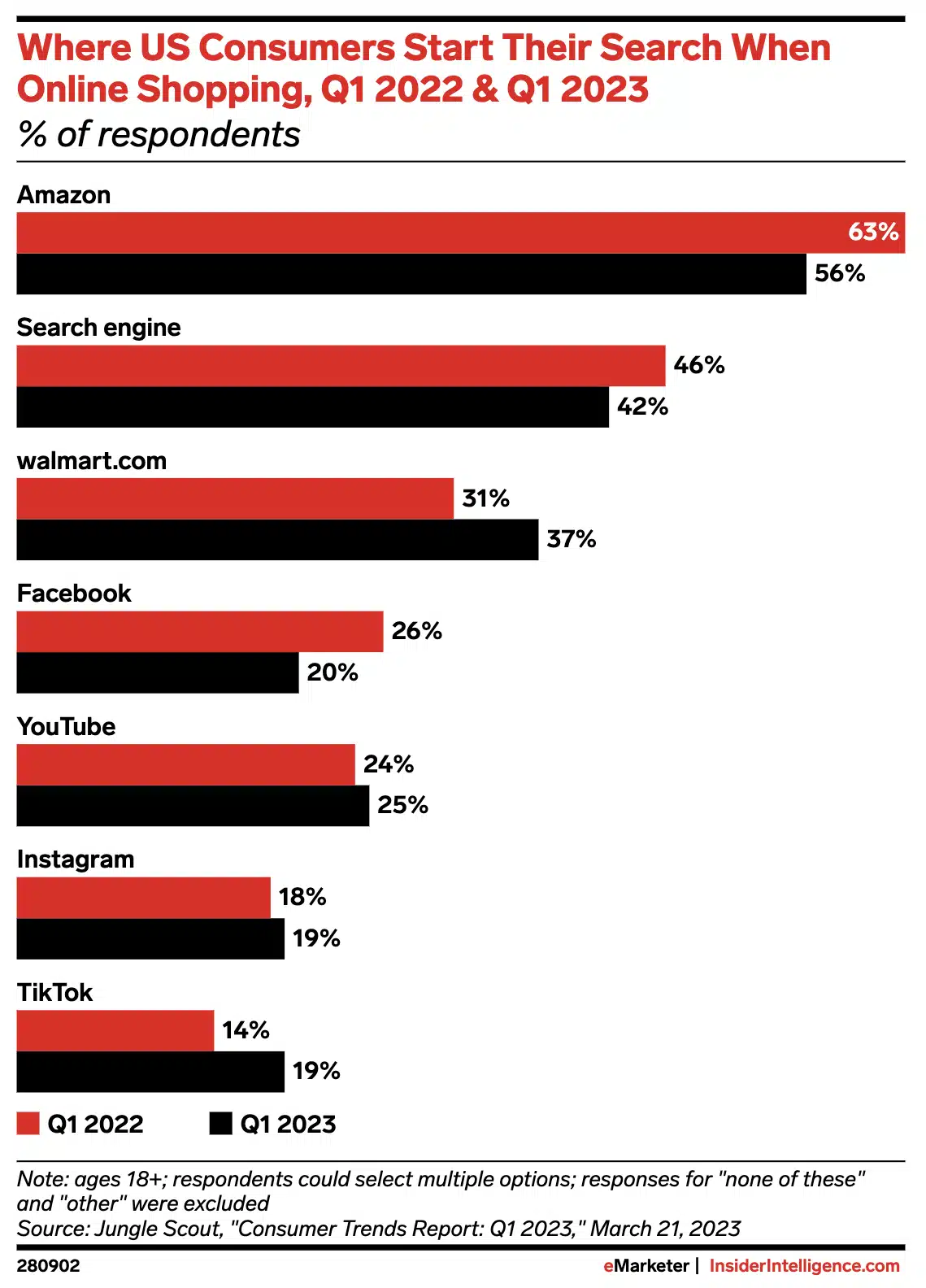
Another interesting aspect of this data compared to the previous years is the growth in social sources, particularly TikTok, as a place to search for both products and knowledge searches (think “how to do X” types of search activities).
In fact, when it comes to Gen Z a staggering 51% of women in this age group prefer to start a search on TikTok above all other online sources of information according to a 2023 study.
Trillions of searches are conducted every year. Search is often the primary source of traffic for websites, which makes it essential to be “search engine friendly” on any platform where people can search for your brand or business.
What this all means is that improving your visibility, and ranking higher in search results than your competition, can positively impact your bottom line,
SEO is also incredibly important because the search engine results pages (or SERPs) are super competitive – filled with search features (and PPC ads). SERP features include:
- AI Overviews.
- Knowledge panels.
- Featured snippets.
- Maps.
- Images.
- Videos.
- Top stories (news).
- People Also Ask.
- Carousels.
Another reason SEO is critical for brands and businesses: unlike other marketing channels, good SEO work is sustainable. When a paid campaign ends, so does the traffic. Traffic from social media traffic is at best unreliable – and a fraction of what it once was.
SEO is the foundation of holistic marketing, where everything your company does matters. Once you understand what your users want, you can then implement that knowledge across your:
- Campaigns (paid and organic).
- Website content.
- Social media properties.
Organic search is a channel that drives the traffic you need to achieve key business goals (e.g., conversions, visits, sales). It also builds trust – a website that ranks well is generally regarded as authoritative or trustworthy, which are key elements Google wants to reward with better rankings.
Types of SEO and specializations
Imagine SEO as a sports team. To win, you need a strong offense and defense. But you also need fans (an audience).
Think of technical optimization as your defense, content optimization as your offense, and off-site optimization as ways to attract, engage and retain a loyal fanbase:
- Technical SEO: Optimizing the technical aspects of a website.
- On-site SEO: Optimizing the content on a website for users and search engines.
- Off-site SEO: Creating brand assets (e.g., people, marks, values, vision, slogans, catchphrases, colors) and doing things that will ultimately enhance brand awareness and recognition (i.e., demonstrating and growing its expertise, authority and trustworthiness) and demand generation.
You maintain 100% control over content and technical optimizations. That’s not always true with off-site (you can’t control links from other sites or if platforms you rely on end up shutting down or making a major change), but those activities are still a key part of this SEO trinity of success.

Technical optimization (technical SEO)
Optimizing the technical elements of a website is crucial and fundamental for SEO success.
It all starts with architecture – creating a website that can be crawled and indexed by search engines. As Gary Illyes, Google’s trends analyst, once put it in a Reddit AMA: “MAKE THAT DAMN SITE CRAWLABLE.”
You want to make it easy for search engines to discover and access all of the content on your pages (i.e., text, images, videos). Key technical elements include URL structure, navigation and internal linking.
User experience is another critical part of technical optimization. Search engines stress the importance of pages that load quickly and provide a good page experience. Elements such as Core Web Vitals, mobile-friendliness and usability, HTTPS and avoiding intrusive interstitials all matter in technical SEO.
Another area of technical optimization is structured data (a.k.a., schema). Adding this code to your website can help search engines better understand your content and enhance your appearance in the search results.
Plus, web hosting services, CMS (content management system) and site security all play a role in SEO.
Content optimization (on-page SEO)
In SEO, your content needs to be optimized for two primary audiences: people and search engines. This means optimizing the content your audience will see (what’s actually on the page) as well as what search engines will see (the code).
The goal is always to publish helpful, high-quality content. You can do this through a combination of understanding your audience’s wants and needs, data and Google’s guidance.
When optimizing content for people, you should make sure it:
- Covers relevant topics with which you have experience or expertise.
- Includes keywords people would use to find the content.
- Is unique or original.
- Is well-written and free of grammatical and spelling errors.
- Is up to date, containing accurate information.
- Includes multimedia (e.g., images, videos).
- Is better than your SERP competitors.
- Is readable – structured to make it easy for people to understand the information you’re sharing (think: subheadings, paragraph length, use bolding/italics, ordered/unordered lists, reading level, etc.).
For search engines, some key content elements to optimize for are:
- Title tags
- Meta description
- Header tags (H1-H6)
- Image alt text
- Open graph metadata
Generative engine optimization (GEO) is an emerging specialty within content optimization. GEO is about optimizing your content for visibility in AI-driven search engines (or answer engines) including Google’s AI Overviews and Gemini, OpenAI’s ChatGPT and SearchGPT, Microsoft Copilot and Perplexity.
Brand and authority building (off-site optimization)
Several activities may not be “SEO” in the strictest sense but nonetheless can align with and help contribute indirectly to SEO success.
Link building (the process of acquiring links to a website) is the activity most associated with off-site SEO. There can be great benefits (e.g., rankings, traffic) from getting a diverse number of links pointing at your website from relevant, authoritative, trusted websites.
Link quality beats link quantity. A large quantity of quality links is the goal.
How do you get those links? There are a variety of website promotion methods that synergize with SEO efforts. These include:
- Brand building and brand marketing: Techniques designed to boost recognition and reputation.
- PR: Public relations techniques designed to earn editorially-given links.
- Content marketing: Some popular forms include creating videos, ebooks, research studies, podcasts (or being a guest on other podcasts) and guest posting (or guest blogging).
- Social media marketing and optimization: Claim your brand’s handle on any and all relevant platforms, optimize it fully and share relevant content.
- Listing management: Claiming, verifying and optimizing the information on any platforms where information about your company or website may be listed and found by searchers (e.g., directories, review sites, wikis).
- Ratings and reviews: Getting them, monitoring them and responding to them.
Generally, when talking about off-site, you’re talking about activities that are not going to directly impact your ability to rank from a purely technical standpoint.
However, again, everything your brand does matters. You want your brand to be found anywhere people may search for you.
As such, some people have tried to rebrand “search engine optimization” to actually mean “search experience optimization” or “search everywhere optimization.”
SEO specialties
Search engine optimization also has a few subgenres. Each of these specialty areas is different from “regular SEO” in its own way, generally requiring additional tactics and presenting different challenges.
Five such SEO specialties include:
- Ecommerce SEO: Additional SEO elements include optimizing category pages, product pages, faceted navigation, internal linking structures, product images, product reviews, schema and more.
- Enterprise SEO: This is SEO on a massive scale. Typically this means dealing with a website (or multiple websites/brands) with 1 million+ pages – or it may be based on the size of the organization (typically those making millions or billions in revenue per year). Doing enterprise also typically means delays trying to get SEO changes implemented by the dev team, as well as the involvement of multiple stakeholders.
- International SEO: This is global SEO for international businesses – doing SEO for multiregional or multilingual websites – and optimizing for international search engines such as Baidu or Naver.
- Local SEO: Here, the goal is to optimize websites for visibility in local organic search engine results by managing and obtaining reviews and business listings, among others.
- News SEO: With news, speed is of utmost importance – specifically making sure you get into Google’s index as quickly as possible and appear in places such as Google Discover, Google’s Top Stories and Google News. There’s a need to understand best practices for paywalls, section pages, news-specific structured data, and more.
How does SEO work?
If you found this page via Google, you likely searched for something along the lines of [what is seo?]
This guide is published on Search Engine Land, an authoritative website with expertise and experience in SEO topics (we’ve been covering all SEO changes, big and small, since 2006).
Originally published in 2010, this What is SEO page has earned hundreds of thousands of links.
Put simply, these factors (and others) have helped this guide earn a good reputation with search engines, which has helped it rank in a top 1-3 organic search position in most search engines, for a number of years. It has accumulated signals that demonstrate it is authoritative and trustworthy – and therefore deserves to rank when someone searches for SEO.
But let’s look at SEO more broadly. As a whole, SEO really works through a combination of:
- People: The person or team responsible for doing or ensuring that the strategic, tactical and operational SEO work is completed.
- Processes: The actions taken to make the work more efficient.
- Technology: The platforms and tools used.
- Activities: The end product, or output.
Many other things factor into how SEO works. What follows is a high-level look at the most important knowledge and process elements.
Six critical areas, in combination, make SEO work:
1. Understanding how search engines work
If you want people to find your business via search – on any platform – you need to understand the technical processes behind how the engine works – and then make sure you are providing all the right “signals” to influence that visibility.
When talking about traditional web search engines like Google, there are four separate stages of search:
- Crawling: Search engines use crawlers to discover pages on the web by following links and using sitemaps.
- Rendering: Search engines generate how the page will look using HTML, JavaScript and CSS information.
- Indexing: Search engines analyze the content and metadata of the pages they have discovered and add them to a database (though there’s no guarantee that every page on your website will be indexed).
- Ranking: Complex algorithms look at a variety of signals to determine whether a page is relevant and of high enough quality to show when searchers enter a search query.
However, optimizing for Google search is different from optimizing for search other platforms like YouTube or Amazon.
Let’s take Facebook, for example, where factors such as engagement (Likes, comments, shares, etc.) and who people are connected to matter. Then, on Twitter, signals like recency, interactions, or the author’s credibility are important.
And further complicating things: search engines have added machine learning elements in order to surface content – making it even harder to say “this” or “that” resulted in better or worse performance.
2. Researching
Research is a key part of SEO. Some forms of research that will improve SEO performance include:
- Audience research: It’s important to understand your target audience or market. Who are they (i.e., their demographics and psychographics)? What are their pain points? What questions do they have that you can answer?
- Keyword research: This process helps you identify and incorporate relevant and valuable search terms people use into your pages – and understand how much demand and competition there is to rank for these keywords.
- Competitor research: What are your competitors doing? What are their strengths and weaknesses? What types of content are they publishing?
- Brand/business/client research: What are their goals – and how can SEO help them achieve those goals?
- Website research: A variety of SEO audits can uncover opportunities and issues on a website that are preventing success in organic search. Some audits to consider: technical SEO, content, link profile and E-E-A-T.
- SERP analysis: This will help you understand the search intent for a given query (e.g., is it commercial, transactional, informational or navigational) and create content that is more likely to earn rankings or visibility.
3. Planning
An SEO strategy is your long-term action plan. You need to set goals – and a plan for how you will reach them. Think of your SEO strategy as a roadmap. The path you take likely will change and evolve over time – but the destination should remain clear and unchanged.
Your SEO plan may include things such as:
- Setting goals (e.g., OKRs, SMART)
- Setting expectations (i.e., timelines/milestones).
- Defining and aligning meaningful KPIs and metrics.
- Deciding how projects will be created and implemented (internal, external or a mix).
- Coordinating and communicating with key stakeholders.
- Choosing and implementing tools/technology.
- Hiring, training and structuring a team.
- Setting a budget.
- Measuring and reporting on results.
- Documenting the strategy and process.
4. Creating and implementing
Once all the research is done, it’s time to turn ideas into action. That means:
- Creating new content: Advise your content team on what content needs to be created.
- Recommending or implementing changes or enhancements to existing pages: This could include updating and improving the content, adding internal links, incorporating keywords/topics/entities, or identifying other ways to optimize it further.
- Removing old, outdated or low-quality content: This is any content that isn’t ranking well, driving converting traffic or helping you achieve your SEO goals.
5. Monitoring and maintaining
You need to know when something goes wrong or breaks on your website. Monitoring is critical.
You need to know if traffic drops to a critical page, pages become slow, unresponsive, or fall out of the index, your entire website goes offline, links break, or any other potential catastrophic issues.
6. Analyzing, assessing and reporting on performance
If you don’t measure SEO, you can’t improve it. To make data-driven decisions about SEO, you’ll need to use:
- Website analytics: Set up and use tools (at minimum, free tools such as Google Analytics, Google Search Console and Bing Webmaster Tools) to collect performance data.
- Tools and platforms: There are many “all-in-one” platforms (or suites) that offer multiple tools, but you can also choose to use only select SEO tools to track performance on specific tasks. Or, if you have the resources and none of the tools on the market do exactly what you want, you can make your own tools.
After you’ve collected the data, you’ll need to report on progress. You can create reports using software or manually.
Performance reporting should tell a story and be done at meaningful time intervals, typically comparing to previous report periods (e.g., year over year). This will depend on the type of website (typically, this will be monthly, quarterly, or some other interval),
SEO is ongoing
SEO never ends.
Search engines, user behavior and your competitors are always changing. Websites change and move (and break) over time. Content gets stale.
Your processes should improve and become more efficient.
How SEO evolves
SEO constantly evolves in a number of ways, perhaps most importantly because it is a service and a practice employed at the coalface of how humans interact with information on the web.
What is most important about this, is to consider the web and search engines in the wider context of society.
Libraries, for example, have existed for thousands of years. There is both documentary and archaeological record from as far back as the seventh century BC of the existence of these places to house the collected wisdom of cultures.
In this context, the web (as an information repository and record of dank memes) is still in its infancy. In fact, Google as a search engine has only existed since September 1998.
The web, and the ways we search and retrieve what we want from it, are new in the context of human memory and behavior.
We access search engines through technology devices like computers, mobile phones and home assistants. As technology evolves, so does our behavior in how we use and apply it.
This has implications for how search engines evolve their product capabilities and appearances, which in turn means adaptive changes for what constitutes SEO.
Here are some of the main ways SEO evolves:
Adapting to technology
We have mentioned that technical SEO is one of the main types (or focuses) within SEO. In the past decade, significant changes have occurred in technology, shifting the focus of SEO work to include tasks and tactics that didn’t even exist a decade ago.
- AI-driven search results: Just this year, significant changes in how AI drives some search results and how often such results appear have happened particularly for Google, with AI Overviews and Bing’s generative search results.
- Mobile-first indexing: A decade ago, the SEO industry was constantly preoccupied with focusing on making websites that were optimized to work well on mobile phones, so that they would appear in search engines when used on a mobile phone. By 2021 63% of Google searches in the U.S. occurred on a mobile phone, and the Google Index now favors a site’s mobile performance as its lead indicator (completed 2023).
- Speed and user experience: As device usage and capabilities improve, so do WiFi’s capabilities in terms of speed and penetration — and then our behaviors and expectations of services we consume. If we consider what felt normal a decade ago, when using a mobile phone, for example, we tend to get very frustrated as consumers when we experience anything like the slow-to-load pages with missing content of the noughties.
In the three specific areas of rapid change above, SEO practice must match pace, or fail. Within each of these three areas there are a multitude of component changes, features and technologies that we now consider an everyday part of SEO.
Adapting to society
While technology and the way we use it in everyday life is also a part of societal change, there are additional considerations in the way that society is changing outside of technology that also require SEO considerations and strategic change and development.
- Macroeconomics: Local and global economic recessions, war conflicts and famine have significant effects on large businesses, supply chains, interest rates, credit availability and consumer income and spending. All of these can have both direct and indirect effects on human behavior that require strategic changes in marketing. SEO is a marketing discipline and must adapt strategically when economic conditions are hard and changing.
- The COVID pandemic: Perhaps the first global pandemic in the age of the internet and search engines, the COVID pandemic saw a hard and fast change in consumer behavior driven by public health mandates across the world. So many businesses experienced rapid change as a result of the COVID pandemic, which required significant changes to online and offline marketing strategies at a rate previously never seen.
SEO has taken center stage in recent years as both technology and society have evolved due to progress and innovation as well as for reactive reasons in response to challenges.
- As a marketing discipline and practice, SEO evolves as our society and technology evolves.
- As a career choice, SEO is an ongoing growth area.
SEO as a service
The SEO market will grow from 75.13billionin2023to75.13 billion in 2023 to 75.13billionin2023to88.91 billion in 2024 at an annual growth rate of 18.3%, reaching $170 billion in 2028 at a CAGR of 17.6%, according to the 2024 Research and Markets SEO Services report.
It is no wonder, then, that SEO is also a well-established professional service, considering the ubiquity of search engines and search as an activity, combined with mobile phones’ capabilities and the ever-changing economic climate.
SEO is a marketing discipline and a job title. You can “do” SEO as well as “be” an SEO (search engine optimizer).
There are myriad roles and responsibilities within SEO, as well as many specialisms that reflect the different types of SEO and the skills and capabilities required.
Understanding how to get started with a career in SEO can be slightly overwhelming at first. Unlike more established professions (e.g., law, accounting) there aren’t universally established and recognized formal high-education courses or professional qualifications. Additionally there are a lot of data-skill requirements, as much of the practice of optimization, requires analyzing performance status and planning how and where to improve against the metrics that matter.
Data sources like Google Analytics and Google Search Console are free and the best place to get started with understanding website performance data. In addition, utilizing data from Semrush we’ve created a set of free tools that can give you a great way to get started in understanding performance data:
- Free SEO Checker
- Free Keyword Research Tool
- Free Keyword Difficulty Checker
- Free Keyword Ranking Checker
- Free Keyword Generator
- Free Backlink Research
- Free Website Traffic Checker
- Free Website Authority Checker
- Free SERP Checker
- Free Competitor Analysis Tool
Learning a new discipline may seem daunting at first, but there are many ways to get started. We’ve collated a number of further resources below.
How to learn SEO
Now that you understand more about what SEO is and how it works – how can you learn more?
Reading (or, if you prefer, watching or listening to) the latest SEO news, research, best practices and other developments should become one of your regular habits, whether it’s daily, weekly or monthly. You should also invest in attending at least one or two events per year.
The expectations and behavior of searchers are constantly evolving, which means algorithms are constantly changing to keep up. That, in combination with new breakthroughs in technology (look no further than the explosive rise of ChatGPT in late 2022 and the sudden addition of generative AI to search results in 2023).
Here are some trusted resources and tips to help you grow as an SEO professional.
Search Engine Land’s SEO resources
Search Engine Land has been covering SEO since 2006. In addition to news stories written by our editorial staff, Search Engine Land publishes contributed articles from a diverse group of subject matter experts featuring helpful SEO tips, tactics, trends and analysis.
We’re biased, but we highly suggest you sign up to receive Search Engine Land’s free email newsletter featuring a roundup of the latest SEO news, and insights every weekday.
Search Engine Land also has multiple categories on topics dedicated to specific areas and platforms which you may find helpful:
- All SEO
- Bing SEO
- Content SEO
- Ecommerce SEO
- Enterprise SEO
- Google: E-E-A-T
- Google algorithm updates
- Google Search Console
- Google search features
- Link building
- Local SEO
- News SEO
- Technical SEO
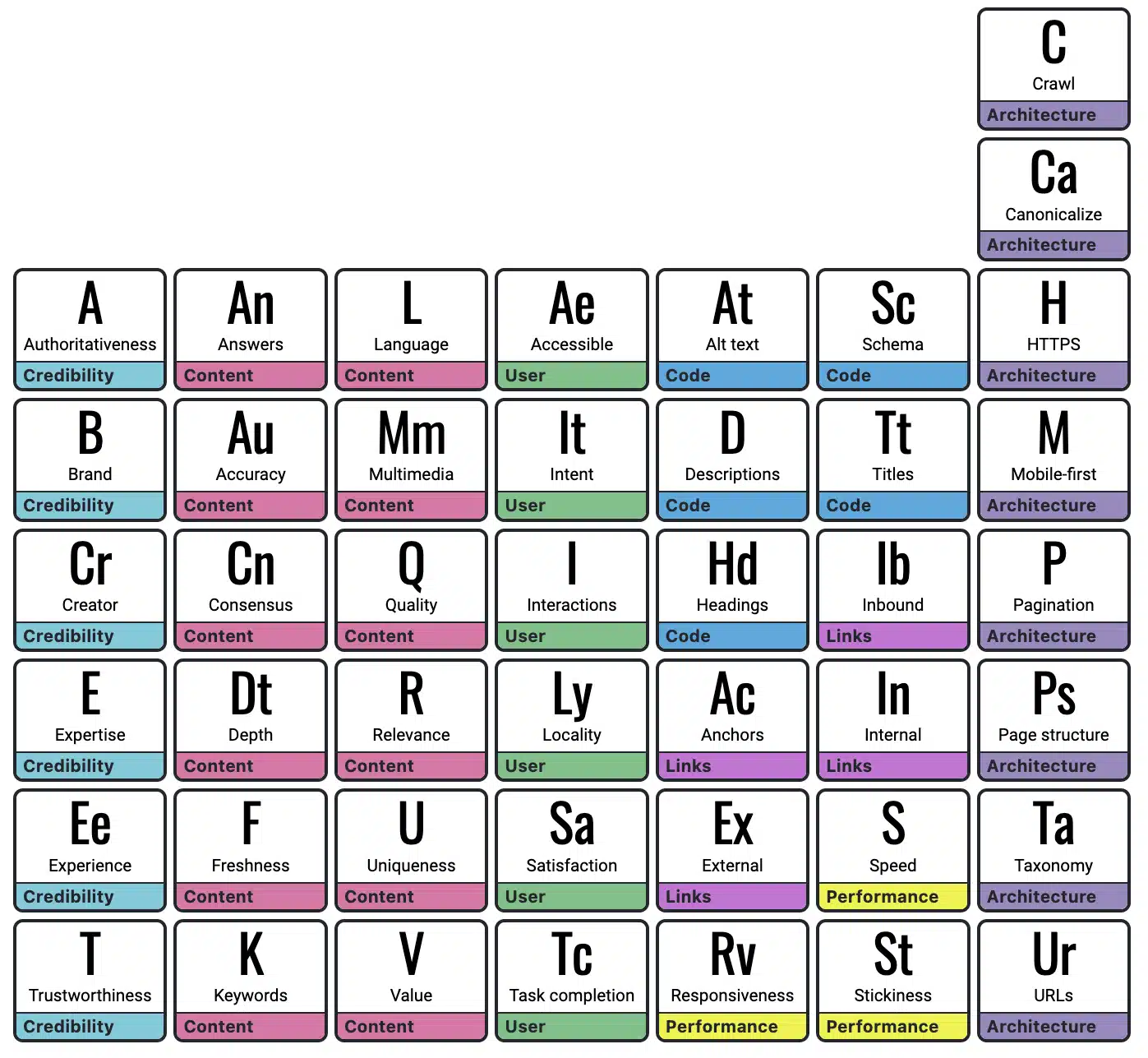
Search Engine Land’s Periodic Table of SEO Elements
Search Engine Land’s interactive Periodic Table of SEO is a resource meant to help you visualize the essential individual elements that combine to creating an optimal SEO strategy, with sustained effort.
Google’s SEO resources
- Google Search Essentials: Google explains technical requirements, spam policies and key best practices in this guide.
- SEO starter guide: An overview of SEO basics, according to Google’s best practices.
- Search quality evaluator guidelines: This document explains how Google instructs human raters to evaluate the quality of its search results by examining the experience, expertise, authoritativeness and trustworthiness of content and websites.
Developing your SEO skills
One of the best ways to learn SEO is to experiment. Hands-on experience is one of the absolute best ways to advance your skills and deepen your SEO knowledge.
Build your own websites – and make them about topics you are passionate about. Try out various tactics and techniques. See what works and what doesn’t.
SEO requires many other skills. Dig deeper into some of those in 13 essential SEO skills you need to succeed.
Another way to advance your career is by attending a search conference. The Search Engine Land team programs the Search Marketing Expo (SMX) conference series, which has a dedicated SEO track that dives into various aspects of SEO and features some excellent speakers and presentations. SMX Advanced takes place in June and SMX Next in November.
Beyond that, there are several other options (free and paid) to learn SEO:
- Websites, blogs and publications.
- Books and ebooks.
- Videos.
- Podcasts.
- Webinars.
- Conferences, events and meetups.
- Courses.
- Training and certification programs.
- Groups (e.g., social media, Slack).
- Newsletters.
- Following experts on social media.
- Forums.
Just be careful. While there are many reliable resources, you (or your clients) will eventually discover outdated or incorrect SEO information.
Bottom line: There are no “universal” truths or some big secret to SEO. The truth is, you have to put in the work in all the phases of SEO to grow your visibility, clicks, traffic, authority, conversions, sales and revenue.
This guide was written by Danny Goodwin, Editorial Director of Search Engine Land & SMX, and editorially reviewed by Nichola Stott, SEO Manager of Third Door Media.
Search Engine Land is owned by Semrush. We remain committed to providing high-quality coverage of marketing topics. Unless otherwise noted, this page’s content was written by either an employee or a paid contractor of Semrush Inc.