Search everywhere optimization: 7 platforms SEOs need to optimize for beyond Google (original) (raw)
What’s the “new” SEO?
It’s “search everywhereoptimization.” This means that, as organic search strategists, we must take more ownership to optimize beyond Google. Search is more fractured than ever, so people turn to places beyond Google to find what they need.
My agency has access to a wealth of proprietary and client data and we’re seeing that, as search fractures, it’s tough to maintain and grow organic traffic. But that doesn’t mean SEO is dying, like some people say. It’s evolving and SEOs need to adapt to help maintain overall traffic levels through new ways of thinking and modern practices.
Even Google’s Search Liaison, Danny Sullivan, recently said, “One of the ways to be successful with Google Search is to think beyond it.”
Some will argue this isn’t an entirely new concept and they’re right. So, why call this the “new” SEO?
This optimization strategy is now a must instead of a bonus or an afterthought.
Instead of appearing in the “Additional ideas and opportunities” section of a roadmap or business review, it should now be a central part of an SEO’s strategic planning.
Unlike in my early SEO days (more than a decade ago), when optimizing across social platforms was more focused on sending signals to Google to help boost visibility there, we must now optimize to show up organically within these platforms. They’ve become more like search engines themselves.
David Shapiro, CMO of Unabated, notes:
- “Search hasn’t been solely about Google for a few years now. Users increasingly seek information across platforms like YouTube, TikTok, ChatGPT and social media. This shift means that SEOs must adapt by focusing on creating content relevant to their brand and tailored to appear natively on these diverse platforms where people spend their time.”
While “search everywhere optimization” is compelling, it’s important first to acknowledge the challenges of implementing this approach.
Drawbacks and roadblocks
Kai Blum, international SEO manager at Intuit Mailchimp, says:
- “Marketing at large organizations can be pretty siloed; often, every channel has a different team. In the last three months, we’ve talked to 14 teams about how SEO best practices can help them specifically and how we could collaborate.”
It’s not uncommon for other teams like social media to think SEOs are stepping on their toes or trying to take over. But that’s not what’s going on.
It’s about having a strategic SEO-focused influence over social.
It’s moving beyond sending authority and engagement signals to capture SERP real estate; it’s better to leverage social media to create demand that will be captured via referral traffic and organic searches on Google.
But some of the current thinking and company architecture at the forefront of corporate America isn’t aligned and creates the following hurdles:
- A lot of brands keep the strategy and execution for these platforms separate in terms of budgets, planning and execution.
- Social media, marketplace and app teams aren’t always welcoming of support, recommendations or insights from organic search teams.
- If leaders aren’t invested in bringing all these channels together, collaboration and planning can be challenging.
Despite these challenges, the potential benefits of optimizing across multiple platforms are too significant to ignore.
Let’s explore how to effectively optimize for various social media platforms.
Consumers are turning to social media for more searches than ever before. Google reports that 40% of young people turn to apps like TikTok and Instagram for search purposes instead of traditional search engines. They want quick, visual answers.
In addition, people share video content with friends twice as much as any other type of content.
Videos help customers better understand your products or services and increase brand awareness.
After watching their Instagram story, 58% of Instagram users feel more connected to a brand.
You’re missing out if you aren’t considering social platforms as search engines in 2024 and beyond.
Here’s an in-depth look at how your audience may use each of our favorite apps and how you should optimize for more substantial visibility.
1. TikTok
Any good SEO has picked up on TikTok’s influence on search demand. People see things on TikTok that lead them to deeper searches on Google. With the introduction of TikTok Shop, shoppers are now using the platform for searches that can result in significant conversions.
Kayla Marcum, manager of global influencer marketing at MANSCAPED, shares:
- “We’re prioritizing organic optimization efforts for TikTok to enhance brand visibility, engage with a broader audience that is searching for solutions related to our products and leverage the platform’s algorithm to boost content reach without relying solely on evergreen promotions. Our goal with TikTok SEO efforts is to appear among the first 8-16 videos when you search for key terms or hashtags related to our products. We onboard creators and provide them with top keywords and hashtags to utilize in their content to increase content discoverability. By strategically using top keywords and hashtags, we’ve accumulated over 18 million views across our TikTok SEO influencer campaigns.”
Here are a few reasons to view TikTok SEO as an integral part of your roadmap.
TikTok is creating search demand
The TikTok app is changing the search terminology landscape. New search terms stem from coined phrases that users display in video captions or specific product names that go viral within the app.
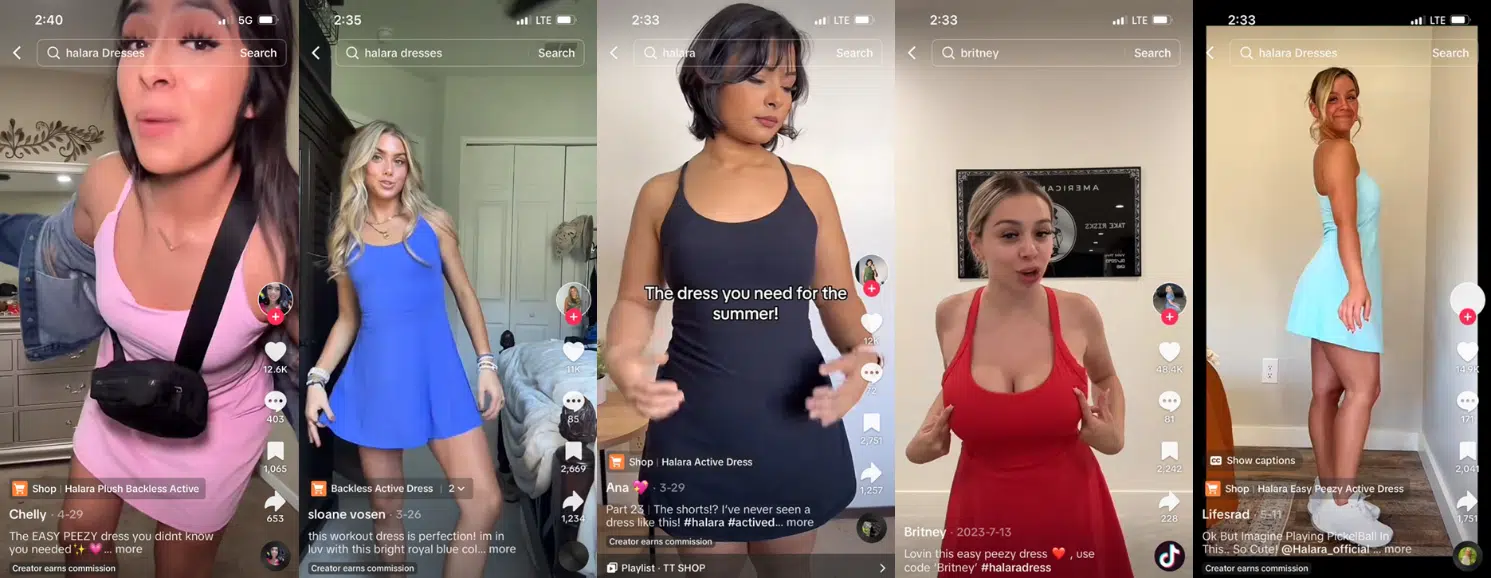
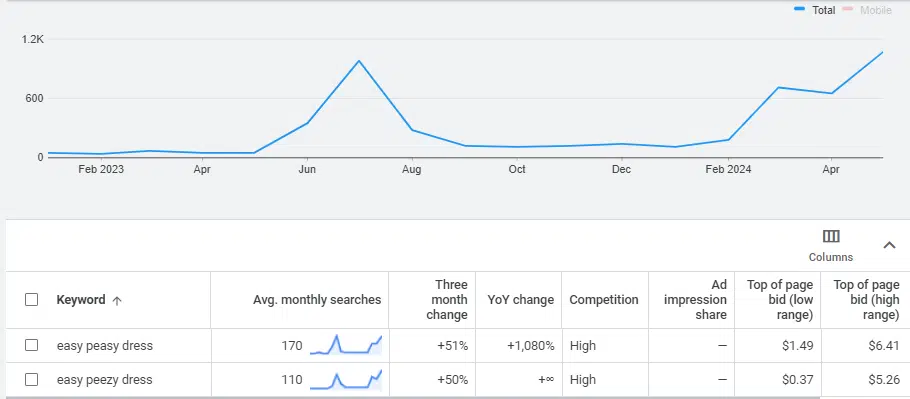
For example, can you guess when the Halara “easy peezy dress” started blowing up on TikTok based on the trend of Google Ads monthly search demand below? If you’re thinking Spring/Summer 2023, that’s correct.
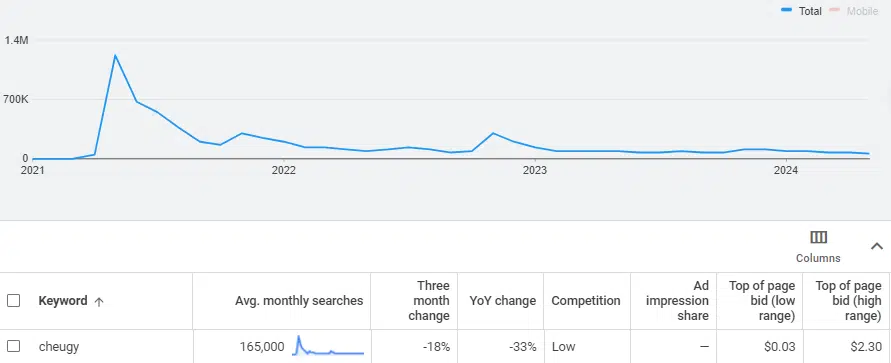
Similarly, given the Google Ads monthly search demand, can you guess when the phrase “cheugy” began going viral on TikTok? Spring 2021 is a safe bet.
TikTok is reigniting search demand
Existing products are experiencing a new surge in popularity and TikTokers’ searches are reintroducing them to consumers.
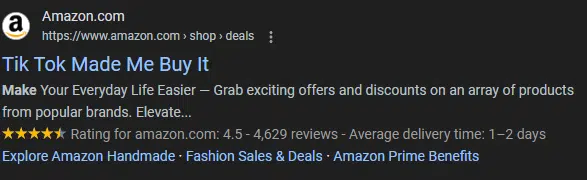
This could happen organically, such as via the “TikTok Effect” (which has inspired the phrase “TikTok made me buy it”) or via pointed influencer partnerships. Either way, it works.
Amazon’s “TikTok Made Me Buy It” strategy:
Physical store strategy:
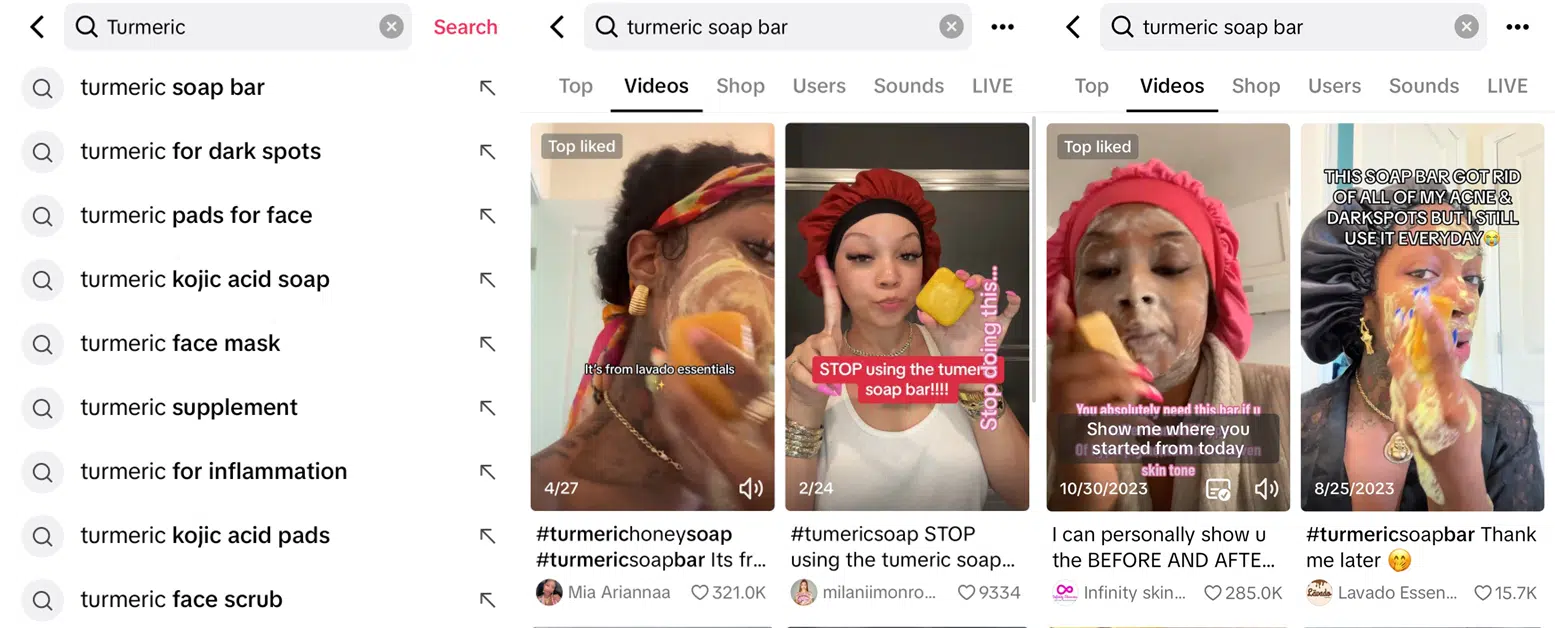
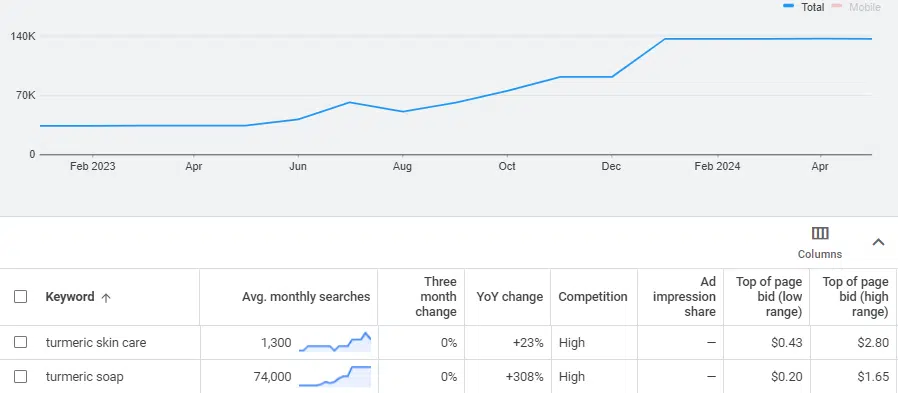
An example is the rise in Google search demand for turmeric skin care and soap following virality on TikTok. Suppose you’re like me and don’t stay on top of the latest beauty trends.
In that case, you might have expected TikTok’s recommended searches for “turmeric” to be followed by phrases such as turmeric powder, turmeric benefits or turmeric tea.
Like Google, TikTok’s algorithm is designed to give people what they want and clearly, people want to know how to use turmeric soaps and products for all things skin health. Turmeric retailers who haven’t caught on yet are missing out on a huge opportunity to expand from health and wellness into beauty.
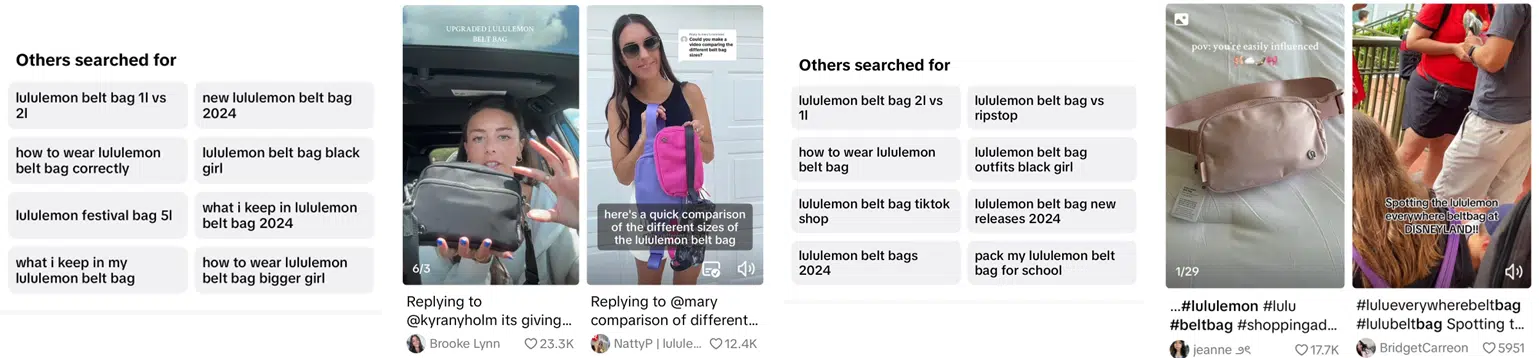
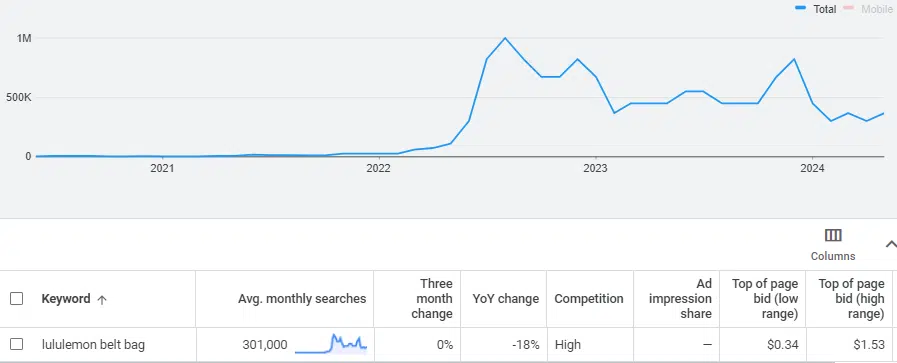
Another example is Lululemon’s belt bag. While they launched it in 2018, they saw explosive growth in search demand when it went viral on TikTok in 2022 (as you can see below with their explosion in Google Ads monthly search demand).
While not as high as when it initially spiked in August 2022, it’s worth noting that the market has remained relatively stable.
Capture bottom-of-funnel searchers in your customers’ Post-TikTok journey
TikTokers often switch to Amazon (more about Amazon below) or search engines for consideration and transactions. Although they’re out there, the shopper that will buy instantly after just one TikTok exposure is rare.
Since TikTok is relatively new to the ecommerce game, customers often do more research on Google and may turn to where they feel safe making purchases, such as Amazon or a brand’s direct site.
Providing middle- and bottom-of-funnel content in an omnichannel approach is the best way to capture searchers continuing their buying journey.
Google is adapting to TikTok
Google shows TikTok videos directly in their search results. Having the right content on TikTok and following search demand and SERP trends could mean carving out more shelf space on Google for your brand.
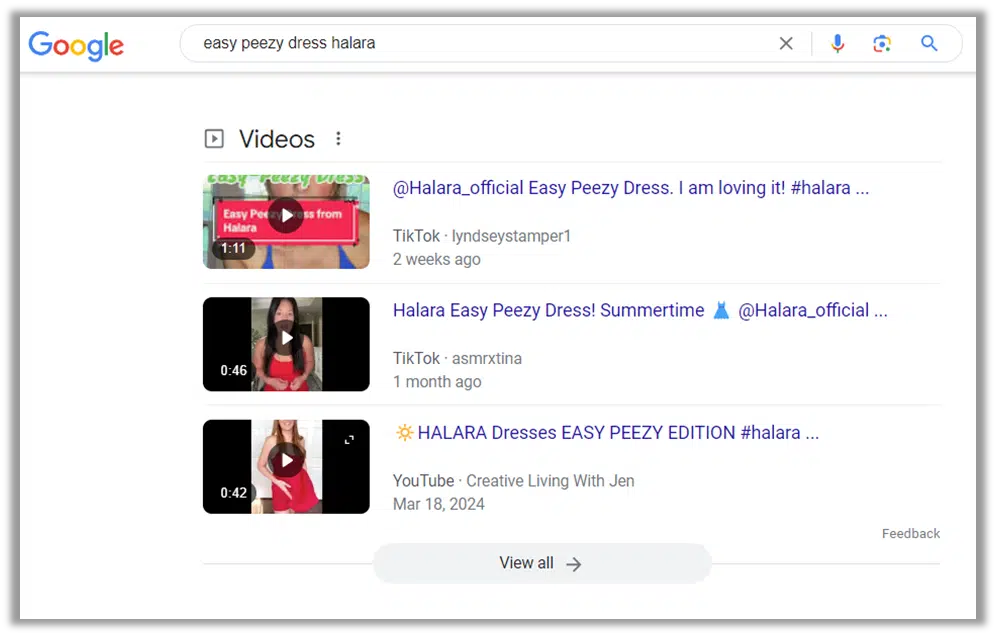
You can also embed your successful TikTok videos on your site (where appropriate) to boost engagement. Based on the recent Google Document leaks, we know this matters. TikTok embeds work just like other content embeds, such as YouTube videos.
The file is hosted on TikTok but pulled into the page where you embed it. The same SEO implications apply to embeds: search engines count the embed as part of the site hosting the content, not part of the site embedding it.
If you’re considering launching TikTok marketing campaigns, it’s important to note that traditional content will not work anymore. TikTok culture differs from any other social platform and brands must adapt and keep up. Your audience will want you to be:
- Authentic
- Unfiltered
- Trendsetting
- Entertaining
- Informative
More people learn from videos these days than ever before. People want quick informational bites and influencers can make content that genuinely resonates with their audience. This is precisely why short-form videos perform so well. Compared to other formats, short-form videos can:
- Boost engagement and expand your reach through social algorithms.
- Position your company as an innovator and expert within your industry.
- Scale brand awareness through the creation of more PR opportunities.
- Grant you the flexibility to repurpose for all social media channels, including YouTube Shorts, TikTok and Instagram Reels.
Optimizing on TikTok takes a much different approach than optimizing for Google. On TikTok, there’s no such thing as keyword stuffing. Brands and content creators would do well to:
- Say keywords in the audio.
- Use keywords in text overlay.
- Put keywords in your audio transcription.
- Use keywords in the video caption.
- Use keywords as #hashtags.
Much like your strategy for the more prominent search engines, you need to balance SEO and brand image and overusing keywords could eventually do more harm than good, but for now, it’s working. And if it isn’t broken, don’t fix it.
What makes a short-form video perform well?
“How can we go viral?” It’s the question that’s on everybody’s mind.
Unfortunately, there’s no tried-and-true formula for getting millions of views, but you can use a few tips and tricks to help your short-form videos perform.
- Consider what you’re covering. Viral or controversial topics tend to get more views and can help boost performance.
- You also can’t go wrong with a solid hook. Make your video’s lead-in catch attention and keep people around. An example might be, “I did nothing but this viral push-up machine for 100 days and it changed my life…”
If you’d rather stay away from controversial topics, the audio you use is another way to hop on viral trends.
Even if you have the audio you want to include, embedding a trending audio file and turning the volume all the way down may still help your video performance.
Just be sure to follow legal best practices regarding music in your content. Some additional ways you can help your video gain traction are:
- Subtitles
- B-roll
- Animations + overlays
- Sound effects
- Stitching your content to trending videos (example with +17 million views here)
While TikTok has captured significant attention, especially among younger users, established platforms like Facebook and Instagram continue to play crucial roles in the social media landscape. Let’s examine how to optimize for these Meta-owned platforms.
2. Facebook and Instagram
Meta recently said it’s focused on engaging users from Gen Z. The original social media titan is seeing its highest young adult usage numbers in three years.
Facebook’s latest statistics show that more than 40 million young adults in the US and Canada are daily active users. This is good news for Mark Zuckerberg and crew, as the app has started to “age up” recently.
If you’re looking to boost your content performance on Meta’s social media channels, follow these tips:
Keyword research and trend jacking
- Know your audience: Understand who you’re trying to connect with before anything else. What are their interests? What problems do they have? Research relevant keywords and trending topics within your niche using social listening tools and hashtag research features on both platforms.
- Ride the wave: Capitalize on trending topics! Integrate them into your content calendar to boost discoverability. But remember, authenticity is critical. Don’t jump on trends that don’t align with your brand and don’t steal exact ideas or captions from other creators.
Speech, text, caption and hashtag optimization
- Craft compelling captions: Write clear, concise captions that grab attention and tell a story. Use keywords naturally throughout the text.
- Hashtags are your friends: Research relevant hashtags to categorize your content and increase discoverability. Use a mix of popular and niche hashtags to reach a wider audience.
- Optimize for voice search: With voice search on the rise, consider including natural language in your captions, as if you’re talking directly to your audience.
Influencer marketing and creator content
Harnessing the power of influencers is essential to maintaining a competitive edge across Instagram and Facebook in 2024.
Influencer marketing can also be a game-changer for your SEO strategy. Some benefits of influencer partnerships are as follows:
- Enhanced brand awareness: Collaborations with influencers amplify your brand presence and reach new potential customers.
- Media placements: Influencers often secure coverage in respected media outlets, enhancing your online presence and search engine rankings.
- Keyword insights: Influencer content can highlight relevant keywords and phrases, aiding in keyword research.
- Engaging content: Repurposing influencer-generated content on your website engages visitors and enriches your site’s value.
- Improved SEO signals: Increased traffic, media placements and engaging content signals to search engines that your site is a valuable resource, further improving your SEO.
- Plan like a pro: Develop a content calendar that mixes different formats, such as images, videos, stories and live streams. This will keep your audience engaged and cater to their diverse preferences.
Video production and channel growth
- Embrace video power: Video is king (and queen) on social media! Utilize Facebook and Instagram Reels, IGTV and Facebook Live to create engaging and informative video content.
- Quality counts: Invest in good lighting, sound and editing to create high-quality videos to hold your audience’s attention.
- Optimize for mobile: Most social media consumption happens on mobile devices. Ensure your videos are captivating on smaller screens and consider vertical filming.
3. YouTube
Staying on top of YouTube SEO best practices is crucial for getting your videos seen and can also have an impact beyond YouTube.
Shapiro further shares:
- “Our experience shows that optimizing for YouTube also positively impacts our visibility on Google. Video thumbnails and content appear prominently in Google search results, driving additional traffic and engagement. Since the beginning of the year, we’ve tripled our YouTube following and YouTube has been a significant driver of new customer acquisition for us. Our video content educates and engages potential customers, leading them to explore our platform further. The ability to repurpose video into other content formats enhances our overall marketing strategy, creating a seamless journey for users from video discovery to engaging with our platform.”
While keywords are still important, YouTube’s algorithm now prioritizes audience engagement metrics. This means creating videos that keep viewers hooked from start to finish. Here’s how:
- Hook them early: Grab attention in the first seconds with a strong intro, captivating visuals or a thought-provoking question.
- Structure for watch time: Break down your video into clear sections, with timestamps in the description, to enable viewers’ easy navigation.
- End screen magic: Use cards and end screens to promote related videos and keep viewers engaged with your channel.
- YouTube SEO: Optimize titles, descriptions and transcripts with relevant keywords for search discovery.
- Video content gap analysis: Ensure your video production strategy is data-backed. Brainstorm video ideas by looking at competitor YouTube channels, what’s trending in your space and where videos may increase engagement for your website content. Then, use tools like vidIQ or AnswerThePublic to identify highly searched, non-brand keywords that can be targeted in your videos. This helps ensure you’re producing videos that people are actively looking for.
- Video tags: Optimize YouTube video tags with a mix of relevant keywords (high-volume, medium-volume and long-tail) to improve search ranking and reach a targeted audience.
- Channel audit: Analyze your channel performance, audience demographics and engagement. Identify improvements for branding, content strategy and audience growth.
- Storytelling and production: Craft compelling storyboards to structure your video. Utilize high-quality visuals, audio and editing techniques for audience retention.
Additionally, you’ll want to focus on your content itself. A single YouTube video has countless opportunities for optimization strategy. You can insert search-friendly keywords in several places. Keep the following tips in mind:
- Strategic titling: Include your target keyword in the video title, but prioritize clarity and intrigue.
- Descriptive yet concise: Craft compelling video descriptions that accurately reflect your content and include relevant keywords and links to relevant pages on your website. Don’t forget timestamps!
- Hashtags still reign: Use relevant hashtags to categorize your video and increase discoverability, but avoid keyword stuffing.
Lastly, there are some impactful, behind-the-scenes technical SEO adjustments you can make to your YouTube content to boost performance and keep pace in 2024:
- Captions are king: Use SRT files to add subtitles and closed captions to improve accessibility and watch time, especially for viewers who watch in silent mode.
- Categorize wisely: While categorization doesn’t directly impact ranking, choosing the right category helps YouTube recommend your video to relevant audiences.
- Custom thumbnails that convert: Design engaging thumbnails that accurately represent your video’s content and entice viewers to click.
4. Pinterest
Pinterest is a visual powerhouse – and with its growing focus on ecommerce, it’s a fantastic platform to drive brand awareness, traffic and sales. Here’s a dive into the latest best practices to optimize your Pinterest presence for maximum impact:
- Keyword research is key: Conduct keyword research to identify relevant terms people use to search for products or inspiration related to your niche.
- Optimize titles and descriptions: Incorporate your target keywords naturally into your pin titles and descriptions, but prioritize readability and enticing users to click.
- Descriptive board names: Choose clear and concise board names with relevant keywords to help users discover your content.
- Alt text matters: Don’t neglect alt text descriptions for your pins. Include relevant keywords to improve search visibility.
- Focus on high-resolution: People visit Pinterest for beautiful images. Use high-quality visuals (ideally with a 2:3 aspect ratio) that are clear, well-lit and eye-catching.
- It doesn’t always have to be images: Incorporate eye-catching video pins to grab attention and showcase your product or service in action.
- Use tools when necessary: Utilize design tools like Canva to create stunning visuals and branded templates for a cohesive look.
- Pinterest ‘about page’: Craft a compelling bio using relevant keywords. Highlight your value proposition, include a call to action and showcase visuals and a website link to attract and convert Pinners.
Beyond social media, several other vital platforms demand attention in our “search everywhere” strategy. These include emerging technologies like generative AI and established ecosystems like app stores and ecommerce platforms.
Get the newsletter search marketers rely on.
Other platforms to keep in mind for optimization
Beyond social platforms, users are turning to many other places to search, including ChatGPT and other generative AI chatbots, app stores and established ecommerce platforms like Amazon.
Like social platforms, it’s essential to carve out some of your strategic thinking toward optimizing for stronger visibility and results here.
5. ChatGPT
Generative engine optimization (GEO) is an emerging practice that optimizes content for generative AI model discoverability and relevance.
With the widespread adoption of generative AI tools like ChatGPT, GEO can be a fundamental driver of leads. Some brands report getting 5% of their overall leads or $100,000 in monthly subscription revenue, from ChatGPT.
I know our agency has gotten leads from ChatGPT – and our newly acquired agency has also acquired a notable customer from a ChatGPT lead.
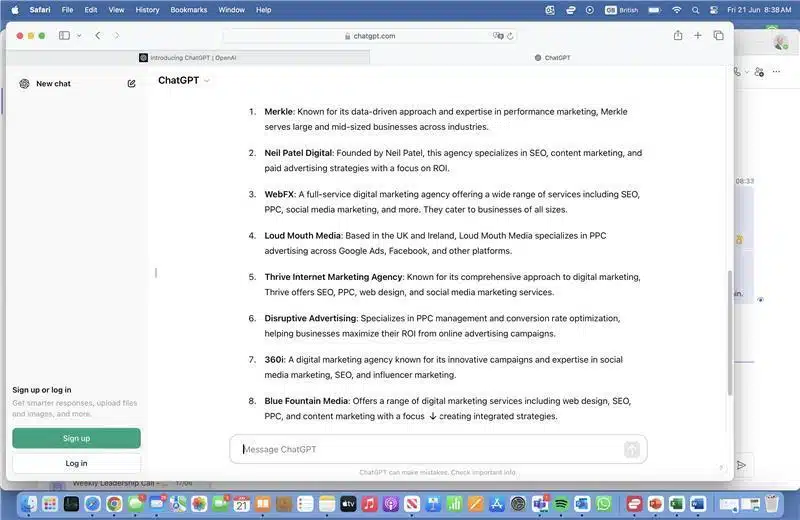
It’s important to note that this is a newer arena in the SEO world. Moving the needle here will probably take longer than traditional Google optimization, but that doesn’t mean it’s not worth pursuing and keeping a pulse on.
Arpana Tiwari, former director of SEO at Adobe and Eventbrite, shares, “Growth marketers, especially those focused on B2B, where evaluation and decision making is based on search, should be thinking about AI assistants like ChatGPT, Perplexity and Gemini.”
Here are some tips to improve visibility with ChatGPT and other LLMs:
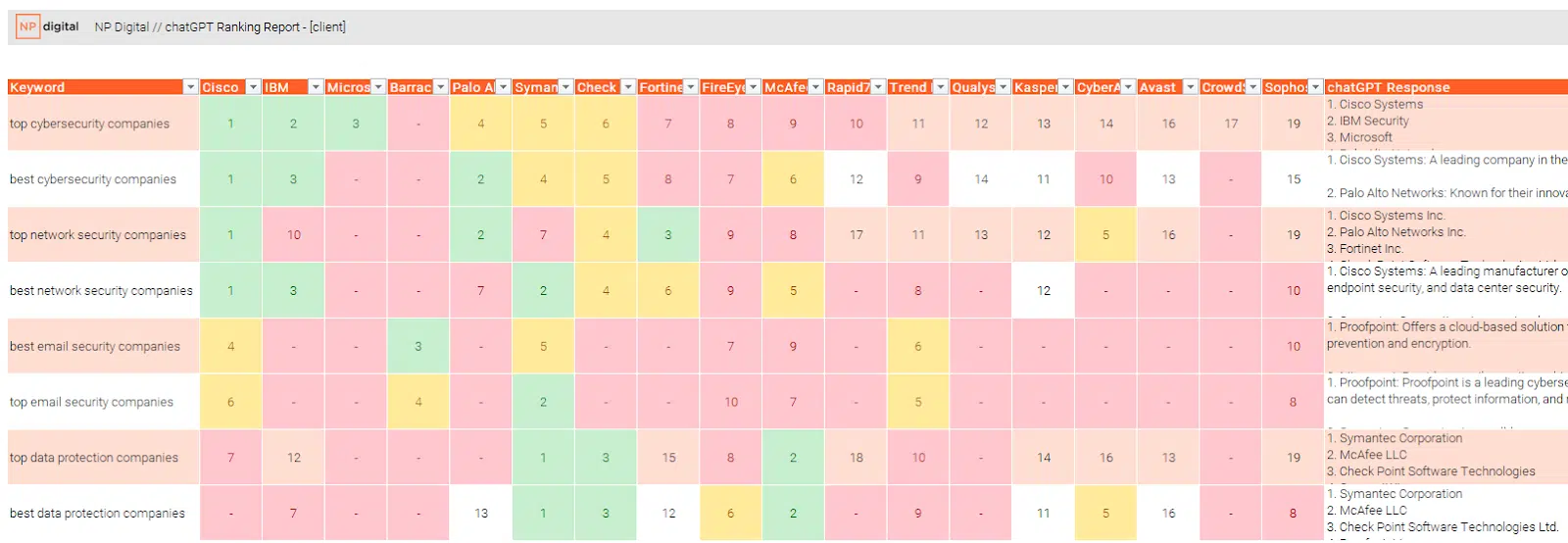
- ChatGPT rank tracking:Thanks to the GPTforSheets integration, you can quickly identify and track your rank for specific prompts within ChatGPT against competitors. With the right Sheets formula and formatting work, you can distill rankings and other important metrics for data-driven decisions like with traditional Google rankings.
- Wikipedia page writing:A Wikipedia page for your brand boosts online authority, search engine rankings and visibility within large language models (LLMs) like ChatGPT. Wikipedia’s credibility and high domain authority elevate trust among your audience. Additionally, Wikipedia is a significant data source for LLMs, and having a page ensures that your brand is accurately and frequently mentioned. Overall, it enhances credibility, visibility and authority.
- Digital PR and brand mention campaigns:If you’ve ever asked ChatGPT to recommend a list of stores or brands, you’ve probably noticed you’re usually presented with well-known brands. Whether you ask for the best toddler pajama brand, the best SEO agency or where to buy a microwave, you’ll likely get a list of criteria, including reputation, recognition, popularity and reliability. Leverage digital PR, an incredibly impactful umbrella of PR tactics, to boost your online authority and strengthen your chances of being favorably recommended for relevant prompts.
- GEO best practices:
- Use structured data and schema markup for clear data organization.
- Leverage relevant statistics, quotations and citations within content.
- Build topical authority through robust, full-funnel content clustering.
- Utilize natural, contextually relevant language and create comprehensive, valuable content.
- Incorporate diverse content formats such as images, videos and GIFs.
- Implement contextual linking using both internal and external linking best practices.
- Update content to keep it fresh and current.
6. App stores
AppTweak’s CMO, Alexandra De Clerck, explains:
- “App stores generate a significant amount of intent-driven traffic. According to Apple, almost 400 million people search in the App Store every week, making ASO crucial for app-first businesses. We’re also seeing a shift where app-supported brands are now prioritizing their apps because it’s easier to engage users within an app than on the web. This shift gives a new dimension to ASO. Slowly, marketers understand ASO and its insights are vital to driving user engagement.”
But I’ve consistently seen ASO treated as more of an afterthought. Too often, companies lack proper budgets and architecture for SEO and ASO synergy.
It’s common for companies to partner with separate agencies for ASO and SEO and operate with siloed teams. Two funnels can be created instead of one congruent search journey when this happens.
- “It’s surprising how many marketing teams still lack ASO expertise. And without dedicated specialists, businesses struggle to implement effective strategies. But by not optimizing their visibility and discoverability in the app store, SEOs miss out on a significant opportunity to reach a highly engaged audience and stay competitive in a mobile-first marketplace,” De Clerck further explains.
To compete in today’s competitive app stores, it is crucial to focus on these areas:
- ASO essentials: Research and target relevant keywords to optimize app metadata. Build a semantic profile with search terms people will likely use to find an app. You can find the optimal metadata structure for your title, subtitle, keywords and descriptions through testing and iteration. This may look different than traditional SEO research since users search differently on mobile than on the web. Mobile searches are often two- to three-word feature-based phrases versus traditional web searches for collecting information on the best solution.
- Compelling creatives: Design compelling screenshots and app icons that showcase value and grab attention. Creative is one of the biggest levers for an ASO campaign, so ensure this is something you’re iterating regularly. I recommend updating creative at least once per quarter or when a split test winner is declared.
- A/B test for success: Utilize custom product pages (App Store) and store listing experiments (Google Play) to find screenshots most likely to convince a viewer to download your app. While visibility and discoverability are important, converting page views to downloads might be even more important. Most users already know the app they intend to download before searching the store. Often, the focus is on users finding you in the search results, but improving CVR is equally important.
- Integrate SEO:SEO and ASO overlap more than most marketers think.Integrate SEO research and practices into your ASO strategy to create a cohesive user journey.
- Paid search integration: Using paid search channels like Apple Search Ads (ASA) will better index keywords and bolster search rank. Combining Custom Product Pages and ASA will ensure viewers see creative that matches their search term, creating a more holistic and impactful user acquisition campaign.
- Native marketing tools: Apple and Google have tools to help users discover more apps. Using in-app events, feature placement submissions, promotional text and custom product pages/ custom store listings will increase brand visibility and learning.
- ASO analytics: A custom ASO dashboard helps brands understand how users find their app. Tracking organic download trends can be used to benchmark for organic performance.
7. Amazon
With its extensive product catalog and sophisticated search algorithms, shoppers often view Amazon as a search engine. Consumers usually turn directly and sometimes solely to Amazon to search for products, compare prices, read reviews and find recommendations.
The platform’s ability to filter results by various criteria, such as price, brand and customer ratings, enhances the search experience. Integrating machine learning and personalized suggestions further tailors search results to individual preferences, solidifying Amazon’s role as a powerful search engine in the retail space.
How do you drive organic success on Amazon?
- Keyword research with nuance: While keywords are still crucial, prioritize relevance over pure search volume. Understand your target audience’s intent behind searches and tailor your product titles, descriptions and backend keywords accordingly. Tools like Amazon PPC can help with research.
- A+ content for the win: Utilize Amazon’s A+ content feature to create enhanced product descriptions with rich media like images, infographics and videos. This can significantly boost product conversions.
- Category matters: Think carefully about the category/department under which you list your product. Best Seller badges are often gained by being a best seller in a category. Those badges aid CVRs. So, rather than being a “small fish” in a big category, maybe there is a more niche category your products will shine in. After all, people tend to search via keywords and not via the category tree on Amazon.
- Mobile-first focus: With the mobile app’s massive share of how people interact, ensure your product listings are optimized for mobile devices. Use high-quality images that load quickly and clear, concise descriptions that are easy to read on smaller screens.
- Video power for Amazon optimization: Create high-quality product videos that showcase features, benefits and use cases to increase product engagement, CVRs and potentially boost search ranking within Amazon.
Embracing the future of SEO
SEO has outgrown search engines.
Brands must incorporate platforms well beyond Google into their search optimization strategy.
Look at your current marketing plan and see where to implement these actionable tips.
Contributing authors are invited to create content for Search Engine Land and are chosen for their expertise and contribution to the search community. Our contributors work under the oversight of the editorial staff and contributions are checked for quality and relevance to our readers. Search Engine Land is owned by Semrush. Contributor was not asked to make any direct or indirect mentions of Semrush. The opinions they express are their own.