Parasitism - Definition and Examples - Biology Online Dictionary (original) (raw)
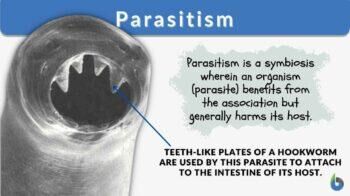
Parasitism
n., plural: parasitisms
[ˈpæɹəs(a)ɪˌtɪzm̩]
Definition: parasite-host interaction
Table of Contents
Toggle
- Parasitism Definition
- Types of Parasitism
- Interesting Facts on Parasitism
- Evolutionary Ecology
- Parasitism Examples
- Quiz
- References
Organisms depend on different sources of food to survive. Larger organisms like plants make their own food (autotrophs) and others consume other organisms to gain an energy source, like herbivores, carnivores and omnivores. These consumptions however are based on the organism obtaining their sources of energy on their own. They put in work to gain the food that they consume.
Other animals like parasites “_steal_” their source of food and energy from other organisms. What is parasitism? Some parasitisms are obligate, others are facultative. However, there are many other types that are explored within this article. Let us find out and define parasitism below.
Parasitism is a kind of symbiosis in which one organism (referred to as the parasite) benefits at the expense of another organism (referred to as the host); the interaction may also cause harm to the host.
What is a parasite? A parasite is a creature that lives on or in the host and obtains its sustenance from or at the cost of the host.
Parasites are commonly associated with what food in human environments? Parasites like to live in the host’s partly digested food. They are usually connected with seafood, wild wildlife, and foodstuff that has been treated with polluted water. This is because parasites and parasites’ eggs can survive intense conditions.

Figure 1. Showing different types of parasites. Image credit: Nisha Rajil, Microbe Online.
During reproduction, all parasitic worms lay eggs. These eggs have a tough shell that protects them from a variety of environmental factors. The eggs could survive in the environment for months or years without the eggs hatching prematurely.
There are different types of parasites plants (parasitic plants) and parasites animals and they all participate in the symbiosis called parasitism. What is parasitism? What does parasitism mean?
Parasitism is a symbiotic relationship in which one organism, the parasite, causes harm to another, the host, on whom the parasite relies for habitat and resource acquisition. Parasitic relationship examples include humans, plants, insects, and fish parasites.
Here are some parasitism facts:
- Parasitism, like predation, is a kind of consumer-resource interaction, but unlike predators, parasites, except for parasitoids, are normally considerably smaller than their hosts, do not kill their hosts, and often remain in or on them for a lengthy period.
- Animal parasites are highly specialized and proliferate quicker than their hosts. Interactions between vertebrate hosts and Plasmodium, flukes, tapeworm species, and fleas are typical examples.
- Parasites lower host fitness by general or specialized parasitic disease, ranging from parasite castration to host behavior change. Parasites improve their fitness by utilizing hosts for resources essential for survival, namely by feeding on them and employing intermediate hosts to aid in transmission from one definitive host tissue to another.
Biology Definition:
Parasitism is a form of symbiosis in which one organism (called parasite) benefits at the expense of another organism usually of different species (called a host); the association may also lead to the injury of the host.
Symbiosis is a close, long-term association between organisms of different species. It may be in the form of mutualism wherein the relationship between the two organisms is interdependent. It may also be in the form of commensalism wherein an organism benefits from the association while the other stays generally unharmed. Symbiosis may also be in the form of parasitism. In parasitism, the organism benefits at the expense of another organism. The organism that benefits from the association is called a parasite whereas the one that does not benefit but is rather harmed is called a host. Thus, in parasitism the symbiotic relationship is non-mutual. However, the parasitic organism does not necessarily kill its host. This makes parasitism different from predation wherein the predator eventually kills the prey. Furthermore, the parasite is generally smaller than the host. Some of the parasites would also need a vector to aid in their transmission to their host.
Examples of parasitism are the helminths (worms) in the intestines of the host, lice (Pediculus humanus capitis) in human head, Plasmodium species transmitted by anopheline mosquito and causing malaria in humans.
Etymology: from the word parasite, “para”, meaning “beside”, and “sītos”, meaning “grain”, “food”**.** Related terms: parasite, parasitology.
Types of Parasitism
Parasitism is a type of symbiosis, which is defined as a tight and lasting biological contact between a parasite and its host. Parasites, unlike saprotrophs, feed on live hosts, however some parasitic fungi, for example, may continue to feed on hosts that have died.
In contrast to commensalism and mutualism, parasitism generally causes harm to the host by either feeding on it or, in the case of intestinal parasites, devouring part of its food. Because parasites interact with different species, they can easily serve as infection vectors, producing illness.
Predation is not a symbiosis by definition because the interaction is brief, but entomologist E. O. Wilson defines parasites as “predators that eat prey in units of less than one.”
There are several possible techniques within that framework. Taxonomic diversity classifies parasites using a range of overlapping methods based on their interactions with their hosts and their frequently complicated life cycles.
Let’s now know the different types of parasitic groups.
Obligate Parasitism
An obligate parasite requires a specific host species. A parasite species like this developed for a unique connection with the host. It will cling to the host and be completely dependent on it.
However, the host is usually not severely injured, ensuring that it is available for the obligatory parasite to feed on. Because obligate parasites do not survive removal from their host, head lice are an example of an obligate parasite. They are also a type of a directly-transmitted parasite.
Facultative Parasitism
This is an uncommon kind of parasitism. They are capable of surviving (free-living) in the absence of a host and can reproduce. Facultative parasites are not discriminating and will infect any accessible host. This group includes several roundworms (such as Strongyloides stercoralis) and amoebae.
Ectoparasitism, Endoparasitism, and Mesoparasitism
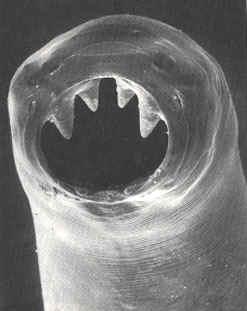
Figure 2: Parasitic hookworms are endoparasites. They inhabit the intestines of their host. Their teeth-like plates are used to “_hook_” themselves to the intestinal tract of a human host. Image Credit: Nemaplex.ucdavis.edu
A mesoparasite lives partially, but not entirely, inside the body of its host. It enters the body via an external entrance, such as the ear. Endoparasites, as opposed to parasites that live on the exterior of a host, dwell within the host’s body. Parasitic copepods and tapeworms, as well as some barnacles on shrimp and clams, are examples. Ectoparasites exist outside of the host’s body. Ticks and head lice are two ectoparasite examples. A tick bite by a black-legged tick harboring bacteria, Borrelia spp. (especially B. burgdorferi) could lead to Lyme disease.
Macroparasitism Versus Microparasitism
A macroparasite is large enough to be seen with the naked eye and hence does not require the use of a microscope. Microparasites, as opposed to macroparasites, must be observed under a microscope. They are invisible to the human eye. These parasites are often unicellular. Protozoa are a kind of microparasitic organism.
Necrotrophic Versus Biotrophic
A necrotrophic parasite will devour a portion of its host until it dies. They keep the host alive long enough for the parasite to take advantage of it. These parasites are also known as parasitoids. Biotrophic parasitism refers to parasites that do not kill their hosts because they rely on them for survival.
Monogenic Versus Digenetic
To complete its life cycle, a monogenic parasite requires only one host. A digenic parasite requires more than one host to complete its complex life cycle. Plasmodium vivax, the protozoa that cause malaria, is an example of this. Humans are its intermediate host whereas mosquitoes are its definitive host.
Epiparasitism
Epiparasitism exists when an epiparasite feeds on the host of another parasite. A protozoan that feeds on a flea that feeds on a mammal is an example.
Social Parasitism
Social parasites prey on the social colonies of some insects, such as bees, ants, and termites as well as some small green insects. Mimicry is sometimes employed to gain entry into a colony. Some related animals even force other species to nurture their young. Tetramorium inquilinum, a kind of ant, rides atop other ant species, gaining food and transport in the process.
Brood Parasitism
Brood parasites, like kleptoparasites, trick hosts into rearing their young instead of the hosts’. Kleptoparasite may be from the same species as the victim. The cuckoo is possibly the best-known example of a species that employs brood parasitism. As a result, the intended children are deprived of energy and nourishment. The activity of the brood parasite frequently kills the host organism’s offspring. A brown-headed cowbird, for example, will take over the nests of other bird species, such as phoebes.
Interesting Facts on Parasitism
- Parasitism is one of the types of symbiosis where only one organism benefits.
- A parasite can infect an animal’s circulatory system, organs, surfaces, and other body components, or it can assault a plant’s system.
- There are many types of parasitism that occur among organisms.
- Both animals and plants can be members of the parasitism relationship.
- Parasitism can lead to the death of the organism that is being “preyed” upon.
Evolutionary Ecology
Parasitism is an important part of evolutionary ecology; for example, practically all free-living animals carry at least one species. The best-studied group, vertebrates, are home to 75,000 to 300,000 helminth species and an uncountable number of parasitic microbes.
A mammal species typically hosts four nematode species, two trematode species, and two cestode species. Humans have 342 helminth parasite species and 70 protozoan parasite species. A parasite population, which is vital in controlling host populations, is present in around three-quarters of the linkages in food webs. Approximately 40% of all known animal species had been described as parasitic species.
Fossil record
Parasitism is difficult to prove from the fossil record, however, perforations in the mandibles of some Tyrannosaurus specimens may have been caused by _Trichomonas_-like parasites.
Coevolution
As hosts and parasites co-evolve, their interactions frequently shift. When a parasite-host interaction is a one-sided connection with a host, selection encourages the interaction to become more benign, even mutualistic, because the parasite may reproduce for a longer time if the host lives a longer period.
When parasites compete, however, selection favors the parasite that reproduces the fastest, resulting in enhanced virulence. As a result, there are several potentials for host-parasite evolution.
Darwinian medicine applies a similar evolutionary theory to non-parasitic illnesses such as cancer and autoimmune problems, whereas evolutionary epidemiology studies how parasites spread and evolve.
Coevolution favoring mutualism
Long-term coevolution can result in a somewhat stable relationship resembling commensalism or mutualism because it is in the parasite’s evolutionary interest that its host prosper. A parasite may develop to become less dangerous to its host, or a host may adapt to live with the parasite’s inevitable presence—to the point where the parasite’s absence causes harm to the host.
Although animals parasitized by worms are frequently plainly affected, such infections may lessen the occurrence and severity of autoimmune diseases in animal hosts, including humans. In a more severe case, certain nematode worms cannot reproduce or even survive unless they are infected with Wolbachia bacteria.
Lynn Margulis and others have suggested, following Peter Kropotkin’s 1902 Mutual Aid: A Factor of Evolution, that when resources are few, natural selection promotes relationships from parasitism to mutualism. This technique may have been involved in the symbiogenesis that resulted in the formation of eukaryotes from an intracellular connection between archaea and bacteria, while the exact sequence of events is unknown.
Competition favoring virulence
Natural selection can be predicted to favor quicker reproducing and hence more virulent parasites in parasite competition. Biologists have long hypothesized that flamingos and ducks shared parasitic lice that were identical in both groups. Cospeciation did occur, however, it resulted in flamingos and grebes, with flamingo lice eventually switching hosts to ducks.
The relative potency of the antimicrobial toxins (bacteriocins) generated by the two strains involved determined pathogenicity among competing for parasitic insect-killing bacteria from the genera Photorhabdus and Xenorhabdus.
When only one bacteria could kill the other one, the competition eliminated the other strain. However, when caterpillars were infected with bacteria that both contained toxins capable of killing the other strain, neither strain was eliminated, and their virulence was lower than when the insect was infected with a single strain.
Cospeciation
A parasite and its host may cospeciate, leading to the pattern described by Fahrenholz’s rule, in which the phylogenies of the host and parasite come to mirror one other. Consider the simian foamy virus (SFV) and its hosts which are primates.
SFV polymerase and mitochondrial cytochrome c oxidase subunit II phylogenies from African and Asian monkeys were found to be nearly congruent in branching order and divergence periods, showing that simian foamy viruses cospeciated with Old World primates for at least 30 million years.
The assumption that parasites and hosts have a common evolutionary history can help explain how host taxa are connected in the animal kingdom. For example, there is debate about whether flamingos are more closely related to storks than ducks.
The fact that flamingos and ducks and geese share parasites was previously seen as proof that these many species were more closely connected than either is to storks. However, evolutionary processes such as parasite species duplication or extinction (in the absence of analogous events on the host phylogeny) frequently erase commonalities between host and parasite phylogenies.
Flamingos have lice that are identical to those seen in grebes. Flamingos and grebes share an ancestor, indicating bird and lice cospeciation in these taxa. Flamingo lice subsequently shifted hosts to ducks, causing researchers to be perplexed.
As demonstrated by digenetic trematodes infecting lake snails, parasites infect sympatric hosts (those in the same geographical region) more successfully. This is consistent with the Red Queen hypothesis, which posits that two or more species interactions result in continual natural selection for coadaptation.
Because parasites mimic the traits of regionally prevalent hosts, they are less infectious to allopatric hosts, or those from other geographical areas.
Modifying host behavior
Some parasites alter host behavior to enhance their transmission between hosts, frequently in connection to predator and prey (parasite increased trophic transmission).
- The fluke Euhaplorchis californiensis, for example, affects the ability of its killifish host to evade predators in the California coastal salt marsh.
This parasite grows in egrets, which are more likely than uninfected fish to feed on infected killifish. - Toxoplasma gondii, a parasite that grows in cats but may be carried by many other animals, is another example. Uninfected rats avoid cat scents, whereas _T. gondii_-infected rats are lured to them, perhaps increasing transmission to feline hosts.
- The malaria parasite alters the skin odor of its human hosts, making them more appealing to mosquitos and so increasing the likelihood that the parasite will be spread.
- Cyclosa argenteoalba spiders frequently have parasitoid wasp larvae attached to them, which alters their web-building activity. When the parasites were connected, they produced simpler webs rather than their regular sticky spiral-shaped webs. This controlled behavior lasted longer and became more noticeable as the parasites remained on the spiders.
Watch this vid about parasites and how they seem to change the behavior of their hosts:
Trait loss
Parasites can use their hosts to do a variety of duties that they would otherwise have to perform for themselves. Parasites that lose certain functions gain a selective advantage by diverting resources to reproduction.
Many insect ectoparasites, such as bedbugs, batbugs, lice, and fleas, have lost their capacity to fly and must instead rely on their hosts for transportation. Trait loss is common in parasites in general. The myxosporean Henneguya zschokkei, a fish ectoparasite and the only animal known to have lost the capacity to breathe aerobically: its cells lack mitochondria.
Host defenses
Hosts have developed a range of defensive mechanisms against their parasites, including physical barriers such as vertebrate skin, mammalian immune systems, insects that actively remove parasites, and plant protective compounds.
W. D. Hamilton, an evolutionary scientist, proposed that sexual reproduction was developed to aid in the defeat of many parasites by permitting genetic material recombination, or the shuffling of genes to generate different combinations.
Hamilton demonstrated that sexual reproduction (sexual parasitism) would be evolutionarily stable in many conditions using mathematical modeling and that the theory’s predictions matched the actual ecology of sexual reproduction.
Immunocompetence and secondary sex features of breeding male vertebrate hosts, such as peacock feathers and lion manes, may, however, be incompatible. This is due to the male hormone testosterone, which promotes the development of secondary sex traits, favoring such guys in sexual selection at the expense of lowering their immunological defenses.
Vertebrates
The physical barrier formed by the thick, generally dry, and waterproof skin of reptiles, other birds, and mammals prevents invading microbes from entering the body. Human skin secretes sebum, which is poisonous to most microbes. Larger parasites, such as the trophically transmitted trematodes, sense compounds released by the skin to identify their victims when they enter the water.
Lysozyme, an enzyme found in vertebrate saliva and tears, breaks down the cell walls of invading bacteria. If the organism passes through the mouth, the stomach with its hydrochloric acid, which is harmful to most germs, is the next line of defense.
Some intestinal parasites have a thick, resistant outer covering that is slowly or not at all digested, allowing the parasite to pass through the stomach alive, where it enters the intestine and begins the next stage of its life.
Once within the body, parasites must overcome the immune system’s serum proteins and intracellular and cellular pattern recognition receptors that activate adaptive immune system lymphocytes such as T cells and antibody-producing B cells. These have parasite-recognition receptors.
Insects
Insects, including biting insects frequently modify their nests to reduce parasitism. For example, one of the main reasons why the wasp Polistes canadensis builds many combs rather than a single comb, like the rest of its genus, is to minimize tineid moth infection.
The tineid moth deposits its eggs in wasp nests, and the larvae develop into larvae that can tunnel from cell to cell and dine on wasp pupae. Adult wasps gnaw down the margins of cells, covering the cells with an oral secretion that gives the nest a dark brownish look, in an attempt to remove and destroy moth eggs and larvae.
Plants
Host plants defend themselves against parasites using a variety of chemical defenses, including polyphenol oxidase, which is controlled by the jasmonic acid-insensitive (JA) and salicylic acid (SA) signaling pathways. Separate assaults stimulate different biochemical pathways, and the two pathways might interact favorably or adversely.
Plants can, in general, elicit either a specific or a non-specific reaction. Specific reactions include the plant’s cellular receptors recognizing a parasite, resulting in a powerful yet localized response: defensive chemicals are created around the area where the parasite was discovered, preventing its spread and avoiding squandering defensive production where it is not needed.
Non-specific defensive reactions are systemic, which means they are disseminated throughout the plant rather than isolated to one location, making them energy-intensive. These work against a wide variety of parasites.
When harmed, such as by lepidopteran caterpillars, the leaves of plants such as maize and cotton emit increasing levels of volatile compounds such as terpenes, which communicate that they are being attacked; one result of this is to attract parasitoid wasps, who then attack the caterpillars.
Parasitism Examples
In humans
Protozoa, helminths, and ectoparasites are the three primary types of human parasites that may infect or parasitize humans. Their presence could even lead to diseases. Parasites in humans can also cause parasitic infections. These can be caused by animals like the botfly, Balantidium coli, blastocystis, Echinococcus, blood fluke, stomach parasites, and intestinal worms in humans like:
- Threadworm
- Taenia saginata
- Trichuris trichiura
- Necator americanus
- Diphyllobothrium latum
- Dientamoeba fragilis
- Ascaris worm
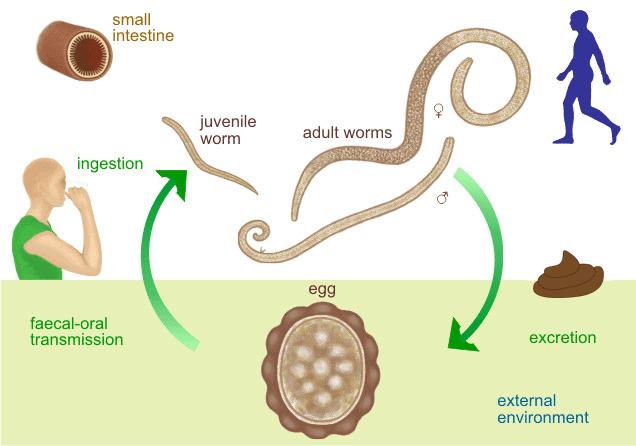
Figure 3 The Climate Resilience Execution Agency for Dominica (CREAD) in Dominica of an Ascaris worm in humans. The diagram shows the parasite life cycle. Image credit: Parasite.org.
In mammals
Babesia, Coccidia, roundworm in dogs, roundworm in cats, Sarcoptes scabiei, Dirofilaria immitis, Cyclospora, rat lungworm, Cyclospora cayetanensis, Acanthocephala, are all parasites that affect different mammals besides and/or including humans.
In plants
Plants act as both the sufferer and perpetrators of parasitism. Aphids are well-known for their sap consumption among the animals that parasitize plants.
There are nearly 4,000 blooming parasitic plant species. Some plants employ modified root systems to drain water and nutrients from the vascular systems of other plants. Others that do not generate chlorophyll adhere to mycorrhizal parasitic fungus to obtain energy and nutrients.
In insects
Insects, like other insects, have parasites of their own. They frequently prey on immature or young insects. Adult wasps will paralyze juvenile cockroaches and then feed them to their larvae. Malaria parasites also live within the mosquito and cause malaria in humans.
In fish
Parasitism affects fish as well. Nematodes, leeches, and tiny crustaceans adhere to the gills of fish. Some infiltrate fish jaws. If fish parasites are not adequately cooked, they might cause disease in humans as well. This is also true for _Ascetosporea_-infected mollusks like oysters.
Answer the quiz below to check what you have learned so far about parasitism.
References
- Berdoy, M., Webster, J. P., & Macdonald, D. W. (2000). Fatal attraction in rats infected with Toxoplasma gondii. Proceedings. Biological Sciences, 267(1452), 1591–1594. https://doi.org/10.1098/rspb.2000.1182
- CDC – Parasites—About Parasites. (2022, March 21). https://www.cdc.gov/parasites/about.html
- Dobson, A., Lafferty, K. D., Kuris, A. M., Hechinger, R. F., & Jetz, W. (2008). Colloquium paper: Homage to Linnaeus: how many parasites? How many hosts? Proceedings of the National Academy of Sciences of the United States of America, 105 Suppl 1, 11482–11489. https://doi.org/10.1073/pnas.0803232105
- Ebert, D., & Hamilton, W. D. (1996). Sex against virulence: The coevolution of parasitic diseases. Trends in Ecology & Evolution, 11(2), 79–82. https://doi.org/10.1016/0169-5347(96)81047-0
- Getz, W. M. (2011). Biomass transformation webs provide a unified approach to consumer–resource modelling. Ecology Letters, 14(2), 113–124. https://doi.org/10.1111/j.1461-0248.2010.01566.x
- Lafferty, K. D., & Morris, A. K. (1996). Altered Behavior of Parasitized Killifish Increases Susceptibility to Predation by Bird Final Hosts. Ecology, 77(5), 1390–1397. https://doi.org/10.2307/2265536
- Maizels, R. M. (2009). Parasite immunomodulation and polymorphisms of the immune system. Journal of Biology, 8(7), 62. https://doi.org/10.1186/jbiol166
- Martin, B. D., Martin, Bradford D., & Schwab, Ernest. (2012). Symbiosis: “Living together” in chaos. Studies in the History of Biology, 4(4), 7-25.
- Massey, R. C., Buckling, A., & French-Constant, R. (2004). Interference competition and parasite virulence. Proceedings. Biological Sciences, 271(1541), 785–788. https://doi.org/10.1098/rspb.2004.2676
- Parasitic worm. (2022). In Wikipedia. https://en.wikipedia.org/w/index.php?title=Parasitic\_worm&oldid=1089638169
- Parasitism. (2022). In Wikipedia. https://en.wikipedia.org/w/index.php?title=Parasitism&oldid=1091419001
- Parasitism: Definition, Types, Facts & Examples. (n.d.). Sciencing. Retrieved June 15, 2022, from https://sciencing.com/parasitism-definition-types-facts-examples-13719236.html
- Parasitism—An overview | ScienceDirect Topics. (n.d.). Retrieved June 15, 2022, from https://www.sciencedirect.com/topics/earth-and-planetary-sciences/parasitism
Pare, null, & Tumlinson, null. (1999). Plant volatiles as a defence against insect herbivores. Plant Physiology, 121(2), 325–332. - Poulin, R. (1995). Evolution of parasite life-history traits: Myths and reality. Parasitology Today (Personal Ed.), 11(9), 342–345. https://doi.org/10.1016/0169-4758(95)80187-1
- Rigaud, T., Perrot-Minnot, M.-J., & Brown, M. J. F. (2010). Parasite and host assemblages: Embracing the reality will improve our knowledge of parasite transmission and virulence. Proceedings. Biological Sciences, 277(1701), 3693–3702. https://doi.org/10.1098/rspb.2010.1163
- Runyon, J. B., Mescher, M. C., & De Moraes, C. M. (2010). Plant defences against parasitic plants show similarities to those induced by herbivores and pathogens. Plant Signaling & Behavior, 5(8), 929–931. https://doi.org/10.4161/psb.5.8.11772
- Sarkar, S., & Plutynski, A. (2008). A Companion to the Philosophy of Biology. John Wiley & Sons.
Sukhdeo, M. V. K. (2012). Where are the parasites in food webs? Parasites & Vectors, 5, 239. https://doi.org/10.1186/1756-3305-5-239 - Takasuka, K. (2019). Evaluation of manipulative effects by an ichneumonid spider-ectoparasitoid larva upon an orb-weaving spider host (Araneidae: Cyclosa argenteoalba) by means of surgical removal and transplantation. The Journal of Arachnology. https://doi.org/10.1636/JoA-S-18-082
- The making of Alien’s chestburster scene. (2009, October 13). The Guardian. https://www.theguardian.com/film/2009/oct/13/making-of-alien-chestburster
©BiologyOnline.com. Content provided and moderated by Biology Online Editors.