Introduction to the Spring Data Framework (original) (raw)
Last Updated : 28 Aug, 2025
Spring Data is a data access framework in the Spring ecosystem that simplifies database interactions for relational (SQL) and non-relational (NoSQL) databases. It eliminates boilerplate code and provides an easy-to-use abstraction layer for developers working with JPA, MongoDB and more.
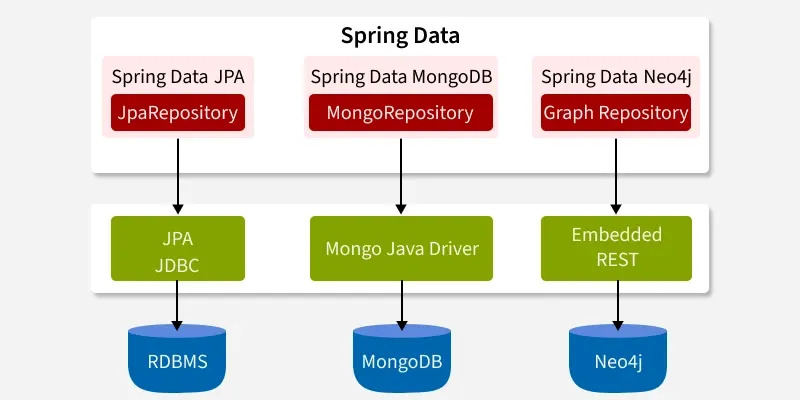
Spring-Data
Need for Spring Data Framework
- **Scalability limitations: Difficult and expensive to scale writes in RDBMS.
- **Performance: Vertical and horizontal scaling require costly infrastructure.
- **Flexibility concerns: The schema of RDBMS does not suit dynamic applications.
**Spring Data Framework was introduced to bridge the gap between traditional and modern data storage solutions. It provides:
- Unified access to SQL, NoSQL and Big Data technologies.
- Simplified CRUD operations via repositories.
- Automatic query generation and optimized database interactions.
- Scalable and flexible architecture for cloud-based and microservices applications.
Spring Data Framework Components
Spring Data is a parent project that consists of multiple submodules, each designed for specific database types.
1. Relational Database Support (SQL-based)
- **Spring Data JPA: Simplifies Hibernate and JPA-based persistence.
- **Spring Data JDBC: Direct JDBC access with minimal overhead.
- **Spring Data R2DBC: Reactive database access for SQL databases.
2. NoSQL Database Support
- **Spring Data MongoDB: Document-oriented database with JSON-based storage.
- **Spring Data Redis: In-memory key-value store with caching support.
- **Spring Data Cassandra: Highly scalable, distributed NoSQL database.
- **Spring Data Elasticsearch: Full-text search and analytics database.
- **Spring Data Neo4j: Graph-based database with complex relationship modeling.
3. Big Data Support
- **Spring Data Hadoop: Integration with Hadoop ecosystem for large-scale data processing.
- **Spring Data Hive, Pig and Cascading: Support for distributed computing.
Popular Spring Data Modules
Spring Data includes several widely used modules:
- **Spring Data JPA: ORM-based persistence layer for SQL databases.
- **Spring Data JDBC: Lightweight alternative to JPA.
- **Spring Data Redis: In-memory caching and messaging.
- **Spring Data MongoDB: NoSQL document storage.
- **Spring Data Elasticsearch: Advanced search and analytics.
- **Spring Data REST: Exposes repository-based data as RESTful APIs.
**Below modules are under development:
Currently, Spring Data R2DBC (Reactive Relational Database Connectivity) is evolving to provide:
- Reactive repository support
- Asynchronous query execution
- Enhanced SQL and NoSQL integration
Key Terms in Spring Data
1. Repositories
A repository is an abstraction layer between domain models and the database. It enables CRUD operations without writing SQL queries manually.
**Steps to Use a Repository:
- Create a POJO entity representing the data model.
- Extend JpaRepository, CrudRepository or MongoRepository.
- Define custom query methods using Spring Data Query Methods.
- Inject the repository into services and use it for database operations.
2. QueryDSL
A type-safe way to build dynamic queries for SQL, JPA, MongoDB and Lucene.
3. NoSQL Data Models
NoSQL databases store data in key-value, document, column-family or graph-based formats:
- **MongoDB: Document database using JSON-like BSON format.
- **Redis: Key-value store supporting Lists, Sets and HashMaps.
- **HBase: Column-oriented NoSQL database.
- **Neo4j: Graph-based database for relationship-driven applications.