Animation in Android with Example (original) (raw)
Last Updated : 23 Jul, 2025
Animation is the process of adding a motion effect to any view, image, or text. With the help of an animation, you can add motion or can change the shape of a specific view. Animation in Android is generally used to give your UI a rich look and feel. The animations are basically of three types as follows:
- **Property Animation
- **View Animation
- **Drawable Animation
**1. Property Animation
Property Animation is one of the robust frameworks which allows animation almost everything. This is one of the powerful and flexible animations which was introduced in Android 3.0. Property animation can be used to add any animation in the CheckBox, RadioButtons, and widgets other than any view.
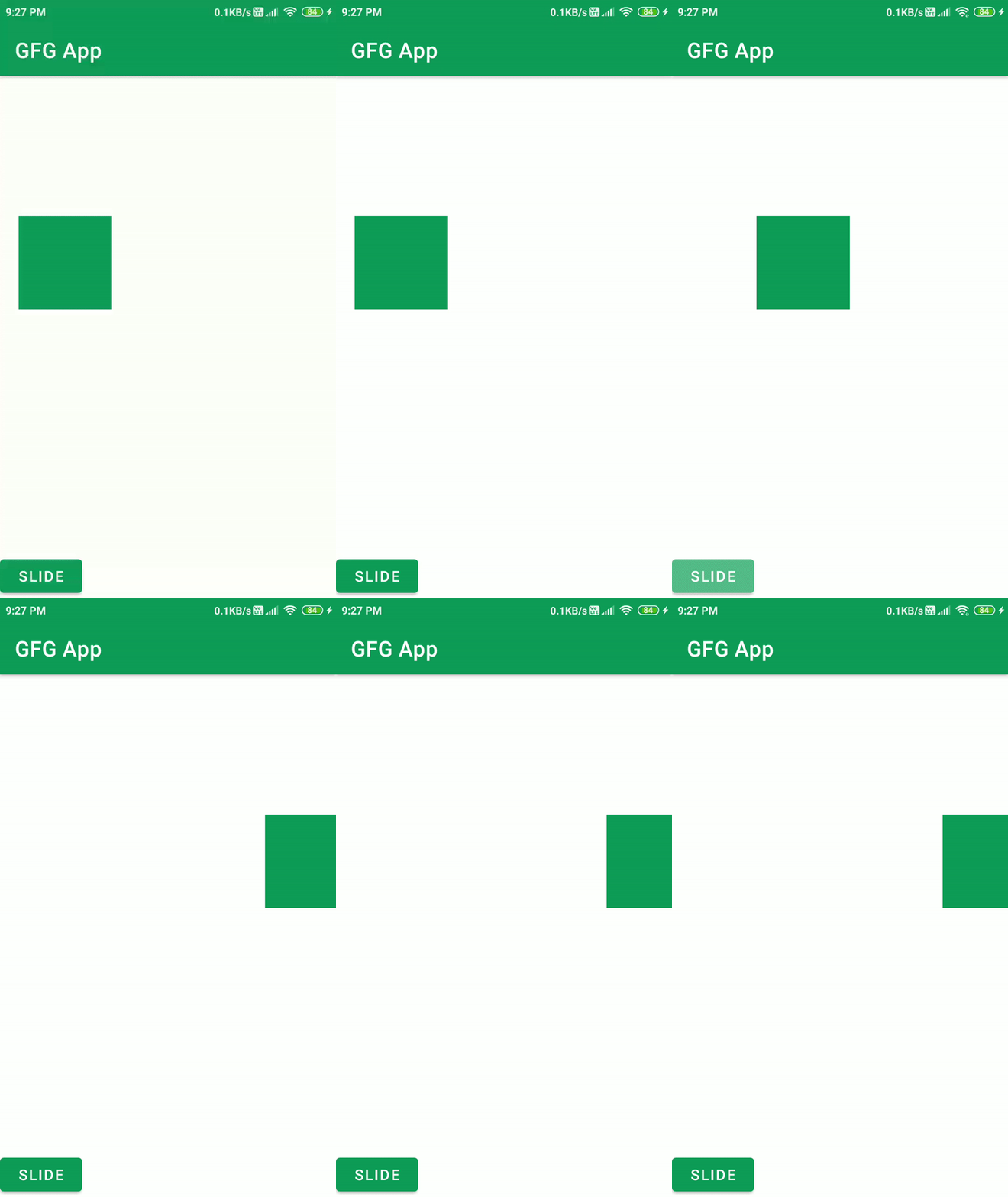
**2. View Animation
View Animation can be used to add animation to a specific view to perform tweened animation on views. Tweened animation calculates animation information such as size, rotation, start point, and endpoint. These animations are slower and less flexible. An example of View animation can be used if we want to expand a specific layout in that place we can use View Animation. The example of View Animation can be seen in Expandable RecyclerView.

**3. Drawable Animation
Drawable Animation is used if you want to animate one image over another. The simple way to understand is to animate drawable is to load the series of drawable one after another to create an animation. A simple example of drawable animation can be seen in many apps Splash screen on apps logo animation.

Important functions for working with Animation
| Methods | Description |
|---|---|
| startAnimation() | This method will start the animation. |
| clearAnimation() | This method will clear the animation running on a specific view. |
Steps of Implementing Android Animation
Now we will see the Simple Example to add animations to ImageView. Note that we are going to implement this project using both **Java and Kotlin language.
**Step 1: Create a New Project
To create a new project in Android Studio please refer to How to Create/Start a New Project in Android Studio.
Select **Java/Kotlin as the programming language.
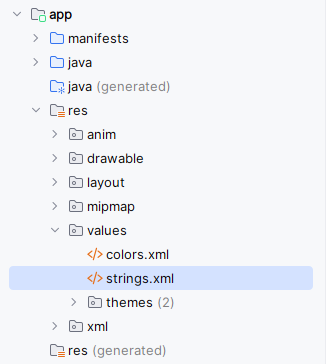
**Step 2: Working with the strings.xml file
Navigate to **app > res > values > strings.xml and the below code into the file. Follow the gate to the file.
**strings.xml:
strings.xml `
GFG App BLINK ROTATE FADE MOVE SLIDE ZOOM STOP ANIMATION Course Rating Course Name`
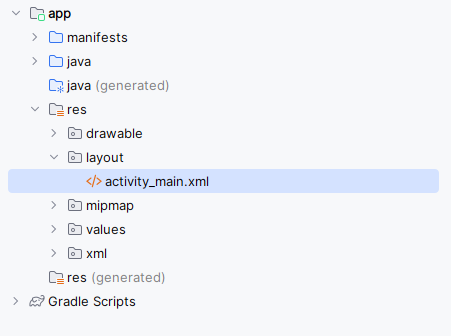
**Step 3: Working with the activity_main.xml file
Navigate to the **app > res > layout > activity_main.xml. Create ImageView in the **activity_main.xml along with buttons that will add animation to the view.
**activity_main.xml:
activity_main.xml `
<ImageView
    android:id="@+id/imageview"
    android:layout_width="200dp"
    android:layout_height="200dp"
    android:layout_marginTop="40dp"
    android:contentDescription="@string/app_name"
    android:src="@drawable/gfg_logo" />

<LinearLayout
    android:id="@+id/linear1"
    android:layout_width="match_parent"
    android:layout_height="wrap_content"
    android:layout_marginTop="30dp"
    android:orientation="horizontal"
    android:weightSum="3">

    <!--To start the blink animation of the image-->
    <Button
        android:id="@+id/blink"
        style="@style/TextAppearance.MaterialComponents.Button"
        android:layout_width="0dp"
        android:layout_height="wrap_content"
        android:layout_margin="10dp"
        android:layout_weight="1"
        android:padding="3dp"
        android:text="@string/blink"
        android:textColor="@color/white" />

    <!--To start the rotate animation of the image-->
    <Button
        android:id="@+id/rotate"
        style="@style/TextAppearance.MaterialComponents.Button"
        android:layout_width="0dp"
        android:layout_height="wrap_content"
        android:layout_margin="10dp"
        android:layout_weight="1"
        android:padding="3dp"
        android:text="@string/clockwise"
        android:textColor="@color/white" />

    <!--To start the fading animation of the image-->
    <Button
        android:id="@+id/fade"
        style="@style/TextAppearance.MaterialComponents.Button"
        android:layout_width="0dp"
        android:layout_height="wrap_content"
        android:layout_margin="10dp"
        android:layout_weight="1"
        android:padding="3dp"
        android:text="@string/fade"
        android:textColor="@color/white" />

</LinearLayout>

<LinearLayout
    android:id="@+id/linear2"
    android:layout_width="match_parent"
    android:layout_height="wrap_content"
    android:layout_marginTop="30dp"
    android:orientation="horizontal"
    android:weightSum="3">

    <!--To start the move animation of the image-->
    <Button
        android:id="@+id/move"
        style="@style/TextAppearance.MaterialComponents.Button"
        android:layout_width="0dp"
        android:layout_height="wrap_content"
        android:layout_margin="10dp"
        android:layout_weight="1"
        android:padding="3dp"
        android:text="@string/move"
        android:textColor="@color/white" />

    <!--To start the slide animation of the image-->
    <Button
        android:id="@+id/slide"
        style="@style/TextAppearance.MaterialComponents.Button"
        android:layout_width="0dp"
        android:layout_height="wrap_content"
        android:layout_margin="10dp"
        android:layout_weight="1"
        android:padding="3dp"
        android:text="@string/slide"
        android:textColor="@color/white" />

    <!--To start the zoom animation of the image-->
    <Button
        android:id="@+id/zoom"
        style="@style/TextAppearance.MaterialComponents.Button"
        android:layout_width="0dp"
        android:layout_height="wrap_content"
        android:layout_margin="10dp"
        android:layout_weight="1"
        android:padding="3dp"
        android:text="@string/zoom"
        android:textColor="@color/white" />

</LinearLayout>

<!--To stop the animation of the image-->
<Button
    android:id="@+id/stop"
    android:layout_width="match_parent"
    android:layout_height="wrap_content"
    android:layout_marginLeft="30dp"
    android:layout_marginTop="30dp"
    android:layout_marginRight="30dp"
    android:text="@string/stop_animation" />
`
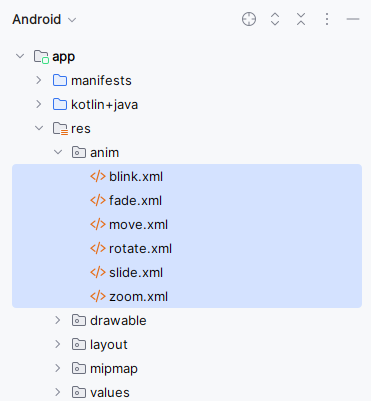
**Step 4: Create 6 different types of animation for ImageView
To create new animations we have to create a new directory for storing all our animations. Navigate to the app > res > Right-Click on res > New > Directory > Name your directory and type as "anim". Inside this directory, we will create our animations. For creating a new anim r**ight click on the anim directory> Animation Resource file and give the name to your file as below. Below is the code snippet for 6 different animations.
blink.xml `
fade.xml
<!-- duration is the time for which animation will work-->
<alpha
    android:duration="1000"
    android:fromAlpha="0"
    android:toAlpha="1" />

<alpha
    android:duration="1000"
    android:fromAlpha="1"
    android:startOffset="2000"
    android:toAlpha="0" />
move.xml
<translate
    android:fromXDelta="0%p"
    android:toXDelta="75%p"
    android:duration="700" />
rotate.xml
<rotate
    android:duration="6000"
    android:fromDegrees="360"
    android:pivotX="50%"
    android:pivotY="50%"
    android:startOffset="5000"
    android:toDegrees="0" />
slide.xml
zoom.xml
<scale
    android:interpolator="@android:anim/linear_interpolator"
    android:duration = "1000"
    android:fromXScale = "1"
    android:fromYScale = "1"
    android:pivotX = "50%"
    android:pivotY = "50%"
    android:toXScale = "2"
    android:toYScale = "2"/>
`
Below is how the file structure should look like:
**Step 5: Working with the MainActivity file
Add animation to the ImageView by clicking a specific Button. Navigate to the **app > java > your apps package name >> MainActivity. Code is provided in both Java and Kotlin.
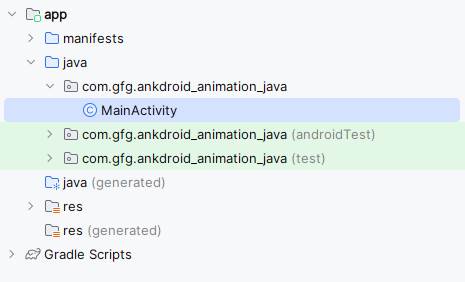
MainActivity file:
MainActivity.java `
package org.geeksforgeeks.demo;
import android.os.Bundle; import android.view.View; import android.view.animation.Animation; import android.view.animation.AnimationUtils; import android.widget.Button; import android.widget.ImageView; import androidx.appcompat.app.AppCompatActivity;
public class MainActivity extends AppCompatActivity {
// Declare variables for ImageView and Buttons
private ImageView imageView;
private Button blink, rotate, fade, move, slide, zoom, stop;

@Override
protected void onCreate(Bundle savedInstanceState) {
    super.onCreate(savedInstanceState);
    setContentView(R.layout.activity_main);

    // Initialize ImageView and Buttons using their IDs
    imageView = findViewById(R.id.imageview);
    blink = findViewById(R.id.blink);
    rotate = findViewById(R.id.rotate);
    fade = findViewById(R.id.fade);
    move = findViewById(R.id.move);
    slide = findViewById(R.id.slide);
    zoom = findViewById(R.id.zoom);
    stop = findViewById(R.id.stop);

    // Set up click listeners for each button to start corresponding animations
    createAnimation(blink, R.anim.blink);
    createAnimation(rotate, R.anim.rotate);
    createAnimation(fade, R.anim.fade);
    createAnimation(move, R.anim.move);
    createAnimation(slide, R.anim.slide);
    createAnimation(zoom, R.anim.zoom);

    // Set up click listener for stop button to clear any ongoing animation
    stop.setOnClickListener(v -> imageView.clearAnimation());
}

// Function to set up an animation for a given view and animation resource ID
private void createAnimation(View view, int animResId) {
    view.setOnClickListener(v -> {
        // Load the animation from the specified resource ID
        Animation animation = AnimationUtils.loadAnimation(MainActivity.this, animResId);
        // Start the animation on the ImageView
        imageView.startAnimation(animation);
    });
}
}
MainActivity.kt
package org.geeksforgeeks.demo
import android.os.Bundle import android.view.View import android.widget.Button import android.widget.ImageView import android.view.animation.AnimationUtils import androidx.appcompat.app.AppCompatActivity
class MainActivity : AppCompatActivity() {
// Declare variables for ImageView and Buttons
private lateinit var imageView: ImageView
private lateinit var blink: Button
private lateinit var rotate: Button
private lateinit var fade: Button
private lateinit var move: Button
private lateinit var slide: Button
private lateinit var zoom: Button
private lateinit var stop: Button

override fun onCreate(savedInstanceState: Bundle?) {
    super.onCreate(savedInstanceState)
    setContentView(R.layout.activity_main)

    // Initialize the ImageView and Buttons using their IDs
    imageView = findViewById(R.id.imageview)
    blink = findViewById(R.id.blink)
    rotate = findViewById(R.id.rotate)
    fade = findViewById(R.id.fade)
    move = findViewById(R.id.move)
    slide = findViewById(R.id.slide)
    zoom = findViewById(R.id.zoom)
    stop = findViewById(R.id.stop)

    // Set up click listeners for each button to start corresponding animations
    createAnimation(blink, R.anim.blink)
    createAnimation(rotate, R.anim.rotate)
    createAnimation(fade, R.anim.fade)
    createAnimation(move, R.anim.move)
    createAnimation(slide, R.anim.slide)
    createAnimation(zoom, R.anim.zoom)

    // Set up click listener for stop button to clear any ongoing animation
    stop.setOnClickListener {
        imageView.clearAnimation()
    }
}

// Function to set up an animation for a given view and animation resource ID
private fun createAnimation(view: View, animResId: Int) {
    view.setOnClickListener {
        // Load the animation from the specified resource ID
        val animation = AnimationUtils.loadAnimation(this, animResId)
        // Start the animation on the ImageView
        imageView.startAnimation(animation)
    }
}
}
`
**Note: Drawables and strings can be found in the drawable folder and strings.xml file. Drawables can be found from the **app > res > drawable.
**Output:
**Note : To access the full android application code check this github repository: Animation in Android Application