Aerobic Respiration (original) (raw)
Last Updated : 24 Mar, 2026
Aerobic respiration is a type of cellular respiration in which cells use oxygen to break down food, especially glucose, to release energy. This energy is stored in the form of adenosine triphosphate (ATP), which supports various life processes. The process begins with glycolysis in the cytoplasm and continues in the mitochondria through the Krebs cycle and the electron transport chain. Because it uses oxygen and produces a large amount of energy, aerobic respiration is considered an efficient way for cells to meet their energy needs.
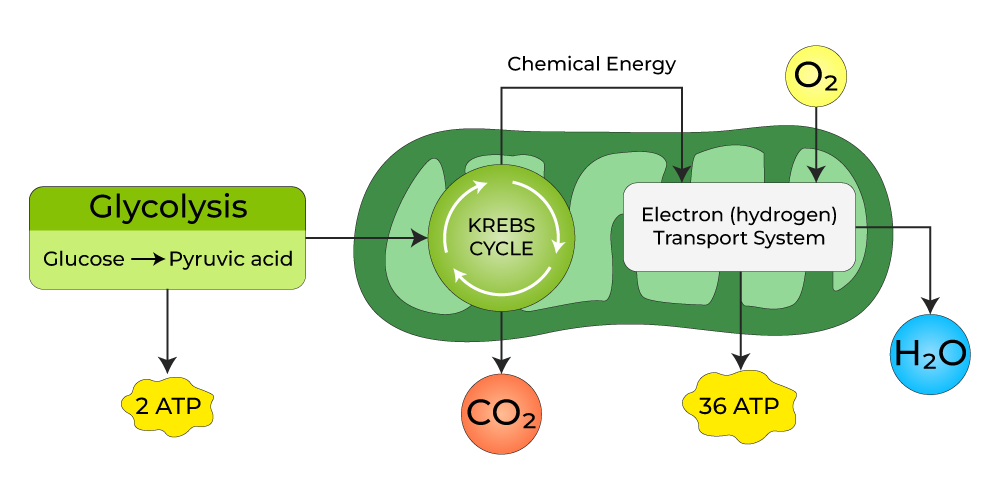
Characteristics of Aerobic Respiration
Aerobic Respiration can be defined as a set of metabolic reactions and processes that occur in the cells of organisms to convert chemical energy from nutrients into ATP, and then release carbon dioxide, water and other waste products.
- It produces a large number of ATP compared to anaerobic respiration, making it the main energy-producing process in living organisms that utilise oxygen.
- It helps in carrying out various cellular functions such as muscle contractions, cell division, and maintaining body temperature.
- The overall chemical equation for aerobic respiration is:
C6H12O6 + 6O2 → 6CO2 + 6H2O + energy (ATP)
- The above chemical reaction shows that the glucose is broken down to release energy, which is captured in ATP in the presence of oxygen, which is used by the cell for various cell functions.
- The end products of the aerobic respiration equation are Carbon dioxide, Water, and ATP. Around 2,900 kJ/mol of energy is released during aerobic respiration.
- In aerobic respiration, different metabolic processes are involved, i.e., glycolysis, the TCA cycle, and the Electron Transport Chain.
Steps of Aerobic Respiration
Aerobic Respiration is a multistep enzymatic process that is carried out in four stages:
1. Glycolysis
The name “glycolysis” originates from the Greek words “glycose,” which means “sugar,” and “lysis,” which means “dissolution.” The glycolysis process is the first phase in the aerobic respiration process that takes place in the cytosol. Glycolysis is the metabolic pathway that converts glucose into pyruvate and produces ATP and NADH. Both end products are further used in different aerobic respiration steps.
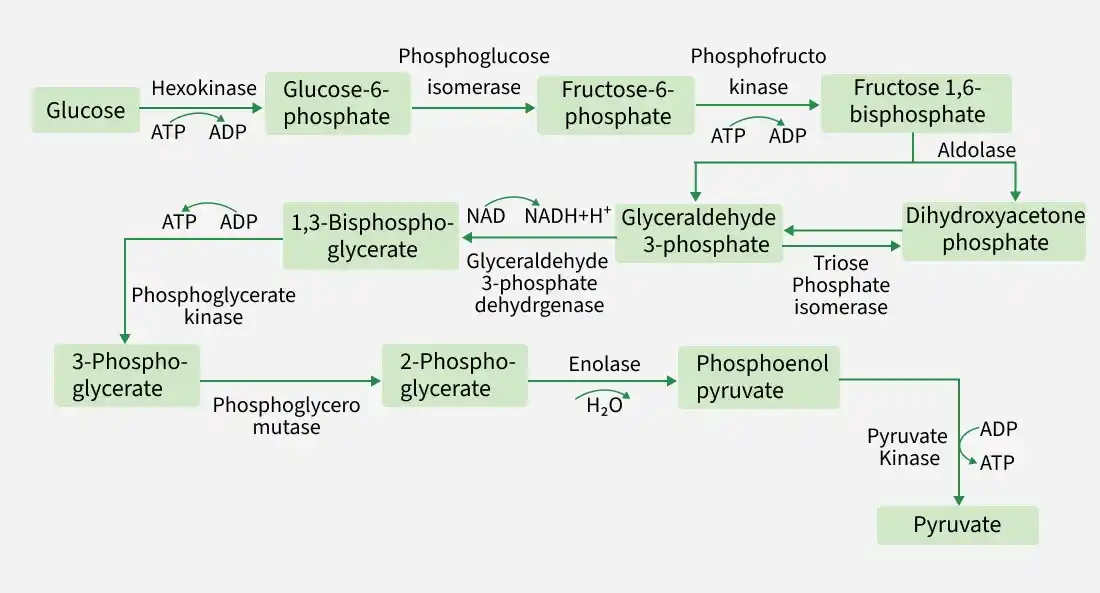
The steps of the Glycolysis process are as follows:
- **Step 1 (Hexokinase): Hexokinase is an enzyme that phosphorylates or adds a phosphate group to glucose in the cytoplasm of a cell. A phosphate group from ATP is transferred to glucose, resulting in glucose 6-phosphate, or G6P. During this phase, one molecule of ATP is consumed.
- **Step 2 (Phosphoglucoisomerase): Phosphoglucoisomerase is an enzyme that converts G6P to its isomer fructose 6-phosphate or F6P. Isomers have the same chemical formula but differ in their atomic configurations.
- **Step 3 (Phosphofructokinase): The kinase phosphofructokinase transfers a phosphate group to F6P to create fructose 1,6-bisphosphate or FBP. So far, two ATP molecules have been used.
- **Step 4 (Aldolase): Aldolase is an enzyme that converts fructose 1,6-bisphosphate into a ketone and an aldehyde molecule. These sugars are isomers of each other, dihydroxyacetone phosphate (**DHAP) and glyceraldehyde 3-phosphate (GAP).
- **Step 5 (Triose-phosphate isomerase): The enzyme triose-phosphate isomerase transforms DHAP to GAP quickly (these isomers can interconvert). GAP is the substrate required for the next step.
- **Step 6 (Glyceraldehyde 3-phosphate dehydrogenase): It dehydrogenates GAP first by transferring one of its hydrogen (H+) molecules to the oxidising agent nicotinamide adenine dinucleotide (NAD+), resulting in NADH + H+.GAPDH combines oxidised GAP with cytosolic phosphate to generate 1,3-bisphosphoglycerate (BPG). Both molecules of GAP generated in the previous step are dehydrogenated and phosphorylated.
- **Step 7 (Phosphoglycerokinase): To form ATP, the enzyme phosphoglycerokinase transfers a phosphate from BPG to an ADP molecule. This occurs for each BPG molecule. This process produces two molecules of 3-phosphoglycerate (3 PGA) and two molecules of ATP.
- **Step 8 (Phosphoglycerate): To generate two 2-phosphoglycerate (2 PGA) molecules, the enzyme phosphoglyceromutase moves the P of the two 3 PGA molecules from the third to the second carbon.
- **Step 9 (Enolase): Enolase is an enzyme that removes a molecule of water from 2-phosphoglycerate to produce phosphoenolpyruvate (PEP). This occurs for each of the two PGA molecules from Step 8.
- **Step 10 (Pyruvate Kinase): Pyruvate and ATP are formed when the enzyme pyruvate kinase transfers a P from PEP to ADP. This occurs for each PEP molecule. This process produces two pyruvate molecules and two ATP molecules
2. Pyruvate Decarboxylation (Transition Reaction)
It is the 2nd step of aerobic respiration. The pyruvate molecule formed in glycolysis is then transported into the mitochondria. In the mitochondrial matrix, pyruvate is converted into Acetyl-CoA through decarboxylation (removal of a carbon dioxide molecule). Two molecules of NADH are produced.
2 Pyruvate + 2NAD+ + 2CoA⇢ 2 Acetyl-CoA+ 2NADH +2H+ +2Co2
3. Krebs Cycle
Krebs cycle, also known as the Citric Acid cycle or the Tricarboxylic Cycle (TCA). It is the third stage of aerobic respiration. Citric acid is produced when the oxaloacetate is combined with the acetyl-CoA. The citric acid cycle undergoes a chain of reactions. The end products of the Citric Acid cycle are 2CO2 + 1ATP + 3NADH and 1FADH. The end products are further used in the last step of aerobic respiration.
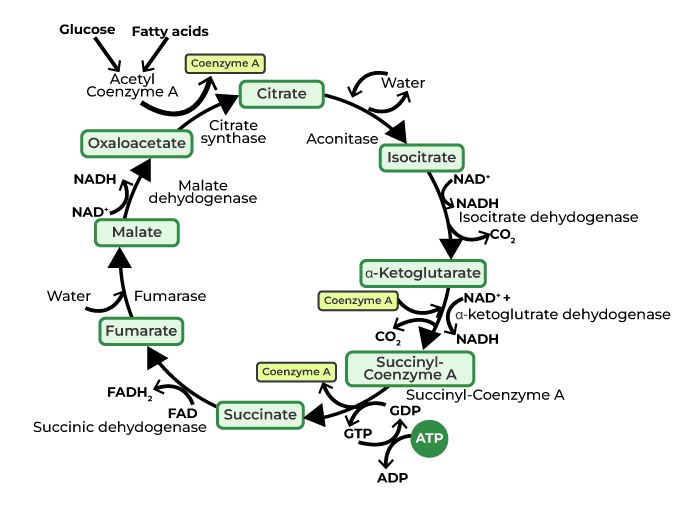
The Krebs cycle is a series of chemical reactions that occur in the mitochondria of cells. The steps of the Krebs cycle are as follows:
- **Step 1: The cycle starts with the entry of a two-carbon acetyl group derived from acetyl-CoA, combined with a four-carbon compound, oxaloacetate. A six-carbon molecule known as citrate is formed. The reaction is catalysed by the enzyme citrate synthase.
- **Step 2: Isocitrate, the isomer of Citrate is formed. It is a hydration reaction and is catalysed by the enzyme aconitase.
- **Step 3: Isocitrate undergoes an oxidative decarboxylation reaction, releasing a molecule of carbon dioxide (CO2) and producing NADH. This step is catalysed by the enzyme isocitrate dehydrogenase.
- **Step 4: Isocitrate is oxidised to alpha-ketoglutarate. Carbon dioxide and NADH are produced in this step, which is catalysed by the enzyme alpha-ketoglutarate dehydrogenase complex.
- **Step 5: Alpha-ketoglutarate is oxidised. Carbon dioxide and NADH are produced. Guanosine diphosphate (GDP) is phosphorylated to form guanosine triphosphate (GTP), which gets converted into ATP. The reaction is catalysed by the enzyme alpha-ketoglutarate dehydrogenase complex.
- **Step 6: Alpha-ketoglutarate is converted to succinyl-CoA, and one molecule of NADH is produced. The reaction is catalysed by the alpha-ketoglutarate dehydrogenase complex.
- **Step 7: Succinyl-CoA reacts with a molecule of guanosine diphosphate (GDP) and forms one molecule of guanosine triphosphate (GTP) and succinate. The reaction is catalysed by the enzyme succinyl-CoA synthetase.
- **Step 8: Succinate is oxidised to fumarate, and FADH2 (Flavin adenine dinucleotide) is produced. The reaction is catalysed by the enzyme succinate dehydrogenase, which is also a part of the electron transport chain.
- **Step 9: Fumarate is hydrated to malate. The reaction is catalysed by the enzyme fumarase.
- **Step 10: Malate is oxidised to oxaloacetate, and one molecule of NADH is produced. The reaction is catalysed by the enzyme malate dehydrogenase.
4. Electron Transport Chain (ETC) and Oxidative Phosphorylation
The electron transport chain is the fourth and last step of aerobic respiration. Electrons carried by NADH and FADH2 from glycolysis, pyruvate decarboxylation, and the Krebs cycle are transported in the inner mitochondrial membrane.

The main components of the ETC include:
- **Complex I (NADH dehydrogenase): Removes electrons from NADH and transfers them to a mobile electron carrier called ubiquinone (coenzyme Q).
- **Complex II (Succinate dehydrogenase): Removes electrons from succinate and transfers them to ubiquinone.
- **Complex III (Cytochrome bc₁ complex): Transfers electrons from ubiquinone to cytochrome c. During this process, protons are pumped across the inner mitochondrial membrane.
- **Cytochrome c: A small mobile electron carrier that shuttles electrons between Complex III and Complex IV.
- **Complex IV (Cytochrome oxidase): The terminal complex of the ETC that accepts electrons from cytochrome c and transfers them to oxygen, the final electron acceptor. Protons are also pumped across the membrane during this process.
- **Complex V (ATP synthase): Utilises the proton gradient generated by the ETC to phosphorylate ADP to ATP.
**Oxidative Phosphorylation
The synthesis of ATP from ADP and inorganic phosphate takes place through a process called oxidative phosphorylation. Oxygen acts as the final electron acceptor in the ETC and forms water. This process generates a large amount of ATP (approximately 28-34 ATP molecules) for each molecule of glucose.
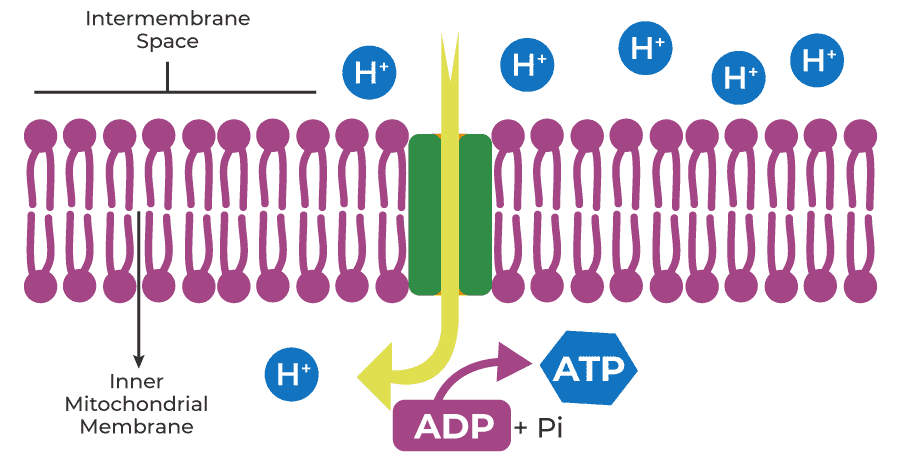
Oxidative Phosphorylation steps are:
- **Electron Delivery: NADH and FADH2 are reduced, and they transfer their electrons to the molecules that are at the beginning of the transfer chain.
- **Electron Transport and Proton Pumping: Electrons move from a high-energy level to a low-energy level and release energy. Some of that energy will be used to generate an electric charge when electrons are pushed from one end of the membrane to the other. An electrochemical gradient is created due to pumping.
- **Oxygen Splitting: An electron reacts with a half-split oxygen molecule at the end of ETC. H+ is taken up to form water.
- **ATP Synthesis: Through an ATP synthase enzyme, **H + ions are sent back up to the mitochondria. It helps in ATP synthesis by controlling the flow of protons.
Importance of Aerobic Respiration
- Aerobic respiration is a highly efficient process that produces a large amount of ATP, which is the energy currency of cells.
- It enables the complete oxidation of glucose and other organic molecules, minimising waste products.
- Compared to anaerobic processes, aerobic respiration maximises ATP production per glucose molecule.
- Aerobic respiration is important for multicellular organisms as they complete their high-energy demands.
- It helps in the removal of carbon dioxide from the body.
- The heat generated during aerobic respiration contributes to maintaining body temperature in warm-blooded animals.
- Aerobic respiration provides oxygen for various metabolic processes, such as lipid metabolism and detoxification.