Angiosperms (original) (raw)
Last Updated : 16 Feb, 2026
Angiosperms are the most advanced and diverse group of plants in the plant kingdom. They are commonly known as flowering plants because they produce flowers and seeds enclosed within fruits. The term angiosperm comes from two words, Angio meaning covered and Sperma meaning seed. Angiosperms dominate most terrestrial ecosystems and play an important ecological and economic role.
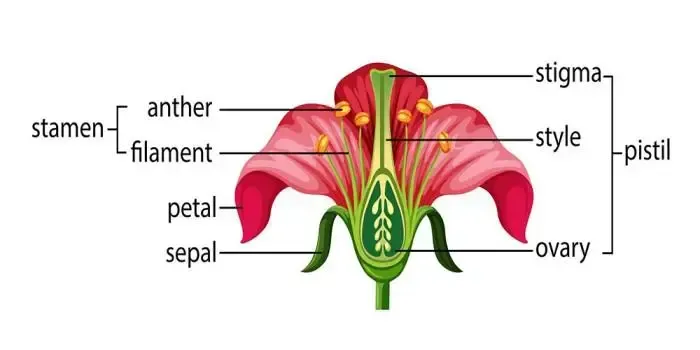
In angiosperms, the developing seeds are enclosed within the fruit, so they are known as flowering plants. Their seeds contain embryos with specialized structures. The flower, which is the reproductive structure of the plant, is composed of stamens that produce pollen and carpels that bear ovules.
Characteristics of Angiosperms
Characteristics of Angiosperms are given below:
- The blooms serve as the plant's reproductive organs and a route of genetic information exchange.
- The stems, roots, and leaves of the sporophyte are distinct.
- The vascular system consists of companion cells in the phloem and true vessels in the xylem.
- At the base of the megasporophyll, the ovary contains the ovules.
- Angiosperms produce both microspores (pollen grains) and megaspores, making them heterosporous.
- The nucellus retains a single functional megaspore indefinitely.
- A triploid endosperm and a diploid zygote are produced as a result of the flowers' double and triple fusion.
- Marine habitats are just one of the many habitats that angiosperms can survive in.
- Angiosperms have a quicker fertilisation process. Due to the smaller female reproductive components, the seeds are also generated swiftly.
- Stamens, the reproductive organs of flowers, are a component of every angiosperm. They create pollen grains that contain genetic material.
- The carpels contain developing seeds with the potential to become fruit.
- One of the biggest benefits of angiosperms is their ability to produce endosperm. After fertilisation, the endosperm develops and provides sustenance for the growing seed and seedling.
Pollination Process of Angiosperms
Pollination is a process that angiosperms must go through to reproduce. Stamens, or male sex organs, are found in angiosperms. The anther is located at the stamen's tip. Pollen is produced here. It is necessary to transport the pollen to the pistil, or the female portion of the flower. At the tip of the pistil, the stigma still has pollen on it.
- Pollen is transported to the ovary by the stigma through a tube known as the style.
- Pollinators might include birds and insects. While moving from blossom to flower in search of nectar, insects and birds may pick up some pollen and also leave some behind.
- Pollen can be moved from one flower to another with the aid of the wind.
Classification of Angiosperms
Angiosperms are flowering plants in which seeds are enclosed within fruits. They are the most advanced and diverse group of plants. Angiosperms are mainly classified based on the number of cotyledons in the seed.

Angiosperms are classified into two categories, which are given below:
1. Monocotyledons
One cotyledon makes up each seed. Simple leaves with parallel veins are present. This group includes accidental roots. There are three people in each floral whorl. It has numerous closed vascular bundles.
Examples of monocots: Bananas, sugarcane, flowers, etc.
2. Dicotyledons
These plants produce seeds with two cotyledons. Instead of adventitious roots, they have tap roots. The venation on the leaves is reticulate. The vascular bundles are arranged in rings, and the flowers are either tetramerous or pentamerous.
Examples: Grapes, sunflowers, tomatoes, etc.
Life Cycle of Angiosperms
The alternation of generations is a technique used by angiosperms to develop and reproduce. They alternate between asexual and sexual phases. Within the plant bloom, gametes for both sexes develop. Angiosperms are pollinated by insects, animals, and the wind.
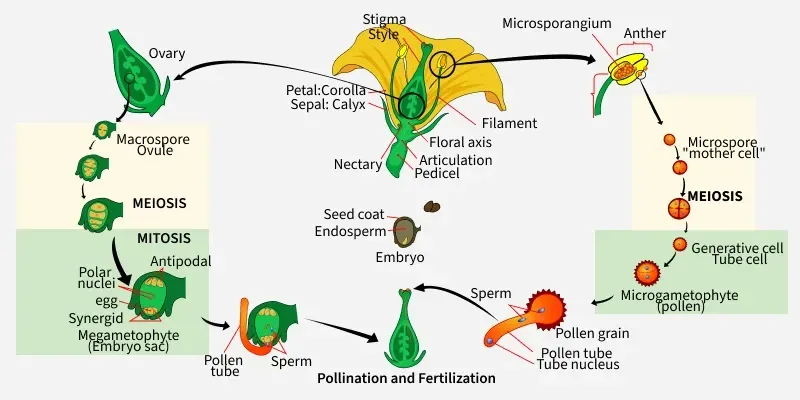
The features of the Life cycle of Angiosperms are given below:
- As spores are produced during the asexual phase, it is known as the sporophyte generation.
- The gametophyte generation, which occurs during the sexual phase, involves the manufacture of gametes.
- Pollen contains the male microspores, which mature into sperm. In the plant ovary, female megaspores transform into egg cells.
- Fertilised eggs mature into seeds, and the fruit of the plant grows from the ovary around them.
- Angiosperms can be distinguished from other flowering plants, known as gymnosperms, by their fruit development.
- Woody and herbaceous plants are two different forms of angiosperms. Trees and certain shrubs are examples of woody plants. Beans and corn are examples of herbaceous plants.