Seed (original) (raw)
Last Updated : 20 May, 2026
A seed is the reproductive structure of a flowering plant that contains the embryo and stored food necessary for germination and growth. Cotyledons are the embryonic seed leaves present in the embryo of a seed. If one seed leaf is present, the plant will be classified as a monocot, and if two seed leaves are present, it is a dicot.
Structure of Monocotyledonous Seed
Monocotyledon seeds have well-developed endosperms that can store starch and proteins that are essential for the early growth of the plant.
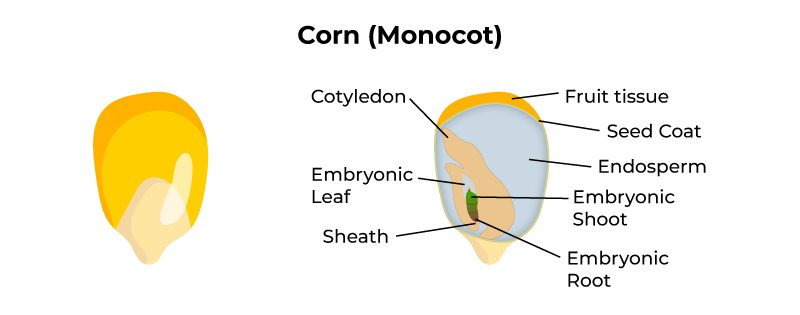
- The maize seed has a membranous covering framed by the seed cover, combined with the natural product wall (Pericarp). It is the defensive layer of the seed.
- In a longitudinal section of a maize grain, two distinct regions are visible: the large endosperm and the smaller embryo, separated by an epithelial layer.
- The embryo is situated on one side of the endosperm and comprises the accompanying parts a solitary cotyledon, radicle, and plumule.
- The radicle is present at the lower end of the embryo, while the plumule is present at the upper end.
- The radicle is protected by a sheath called coleorhiza, while the plumule is enclosed by a sheath called coleoptile.
- After germination, the radicle develops into the root, and the plumule develops into the shoot.
- In maize, the single cotyledon is called the scutellum, which is shield-shaped. The scutellum is joined to the endosperm by an epithelial layer.
- Its function is to absorb nutrients from the endosperm and supply them to the developing embryo.
Structure of Dicot Seed
The embryo present in a dicotyledonous seed consists of an embryonal axis and two cotyledons. The cotyledons are often fleshy and store food that nourishes the developing embryo during germination. In some dicot plants, the cotyledons may also become green and photosynthetic after emerging above the soil.
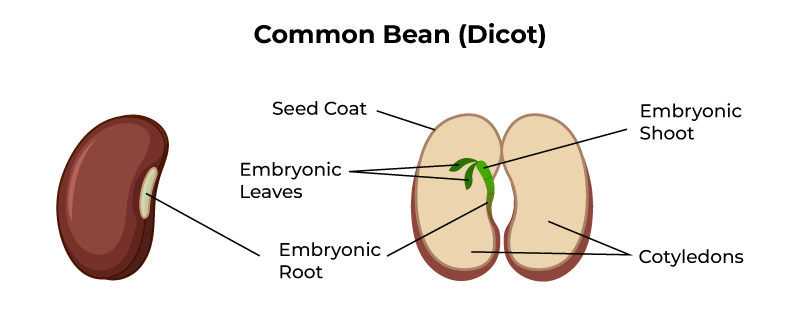
- The outer layer of the dicot seed is called a seed coat. The seed coat has two layers: the outer layer is known as the testa, and the internal layer is the tegmen.
- The scar present on the seed coat is called the hilum through which the developing seeds are connected to the fruit.
- The small pore present above the hilum is called the micropyle.
- The embryo is enclosed by the seed coat, which consists of two cotyledons attached to the primary axis. The embryo consists of an embryonal axis with two cotyledons attached to it.
- The plumule is present at the upper end of the embryonal axis, while the radicle is present at the lower end.
- The root is formed from the radicle, and the plumule forms the shoot. The region between the plumule and the micropyle is known as the epicotyl, and the region above the cotyledons is called the epicotyl. The region below the cotyledons and above the radicle is called the hypocotyl.
Types of Seeds
They serve as units of dispersal, reproduction, and survival during unfavourable conditions. Seeds can be classified in various ways based on biological, structural, and ecological criteria.
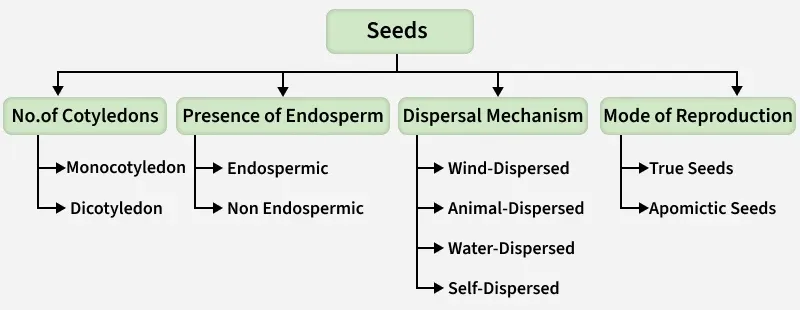
Based on the Number of Cotyledons
- **Monocotyledon Seed: Monocotyledon seeds are found in the class of flowering plants known as Liliopsida.They're mainly herbaceous, and their name derives from the seed structure, which shows a single cotyledon in its terminal position. Examples: Wheat, lilies, bananas, onions, garlic, daffodils, etc.
- **Dicotyledon Seed: Dicotyledon seeds comprise a group of over 175,000 plant varieties, ranging from flowers to trees, and are classified under the species Magnoliopsida. Dicotyledonous seeds contain two cotyledons. Examples include oak, carrots, radishes, almonds, bell peppers, peas, etc.
Based on the presence of Endosperm
- Endospermic seeds(Albuminous Seeds): These are seeds in which the endosperm does not get consumed completely. The endosperm remains present and provides nourishment to the developing embryo. Examples include Maize, Wheat, Rice, Coconut, etc.
- Non-endospermic seeds(Ex-Albuminous Seeds): These are seeds in which the endosperm is completely consumed during seed development. The growing embryo is nourished by the cotyledon. Examples include Peas, Beans, Groundnuts, Mustard, Orchid family, etc.
Based on the Dispersal Mechanism
- Wind Dispersed Seeds(Anemochory ): These seeds are carried by air currents. Lightweight wings and hairs are the adaptations of wind-dispersed seeds.Examples**:** dandelion, cotton, maple, pine, and orchid****.**
- **Animal Dispersed Seeds (Zoochory): Epizoochory **(**Seeds attach to animal skin or fur through hooks, spines, or sticky surfaces)and Endozoochory (Animals eat fruits and disperse seeds through droppings). Examples of Epizoochory include burdock and cocklebur, while mango, fig, berry, and apple are examples of Endozoochory.
- **Water Dispersed Seeds (Hydrochory): These seeds float on water and travel through rivers or seas. Waterproof seed coat, air-filled tissues are the adaptation of water-dispersed seeds.Examples: coconut, lotus, and mangrove.
- **Self Dispersed Seeds (Autochory): These seeds burst out from the fruit due to mechanical pressure. Explosive capsules or pods are an adaptation of self-dispersed seeds.Examples: balsam, pea, bean, and castor.
Based on the Mode of Reproduction
- **True Seeds: These types of seeds are made by the fusion of gametes, show genetic variability, developed from a fertilised ovule. Examples: Paddy, wheat, maize, mustard, mango, and pea.
- **Apomictic Seeds: These types of seeds are made by the process called apomixis. No genetic variation. Useful in maintaining hybrid vigour. Examples: Some grasses (e.g., Poa), Citrus, Mango (nucellar embryos), and Dandelion.
Importance of Seeds
- The seed has a hard seed coat that protects the embryo.
- Seed is better adapted for dispersal.
- Out of all the stages of the plant, like pollination, embryo development, etc. Water is essential for seed germination and early growth of the plant. Seeds remain dormant until favourable conditions such as water, oxygen, and suitable temperature are available.
- A seed is a product of sexual reproduction and thus helps in producing variation.
- Due to dormancy and dehydration, seeds can be transported. Also, farmers can store seeds for the next season.