Ascomycetes (original) (raw)
Last Updated : 9 Jun, 2026
Ascomycetes, commonly known as sac fungi, are a large and diverse group of fungi belonging to the phylum Ascomycota. They are characterised by the production of sexual spores called ascospores inside specialised sac-like structures known as asci. This group includes both unicellular forms, such as yeasts and multicellular filamentous fungi that occur in a wide range of habitats.
General Characteristics of Ascomycetes
- Ascomycetes exhibit a wide range of morphological and physiological characteristics that distinguish them from other fungal groups.
- Despite their diversity, all members share the common feature of producing sexual spores inside specialised sac-like structures known as asci.
- The vegetative body of multicellular Ascomycetes consists of a well-developed mycelium made up of branched, thread-like structures called hyphae.
- Unlike the aseptate hyphae found in Phycomycetes, the hyphae of Ascomycetes are septate, meaning they are divided by cross walls called septa.
- These septa contain pores that allow the movement of cytoplasm, nutrients, organelles, and sometimes nuclei between adjacent cells.
- This arrangement ensures physiological continuity throughout the fungal mycelium while maintaining cellular organisation.
- The cell wall of Ascomycetes is primarily composed of chitin and β-glucans. These structural polysaccharides provide strength, rigidity, and protection to the fungal cells.
- The cell wall also contains glycoproteins that contribute to cellular functions and interactions with the environment.
Habitat and Distribution
- Ascomycetes are cosmopolitan in distribution and occur in almost every type of habitat on Earth. They are particularly abundant in terrestrial ecosystems, where they play a crucial role in the decomposition of organic matter.
- They can be found growing on dead wood, fallen leaves, fruits, seeds, animal remains, and other organic substrates.
- Many species inhabit agricultural fields and forests, where they contribute to nutrient recycling and soil fertility. Some species grow on living plants and animals as parasites, while others establish mutually beneficial relationships with their hosts.
- Several Ascomycetes have adapted to extreme environmental conditions, including deserts, polar regions, high-altitude ecosystems, and highly saline environments.
- Their remarkable adaptability has contributed to their evolutionary success and widespread distribution.
Reproduction in Ascomycetes
Ascomycetes reproduce through both asexual and sexual methods. These reproductive strategies enable them to survive, spread, and adapt to changing environmental conditions.
Asexual Reproduction in Ascomycetes
- Asexual reproduction is the most common mode of reproduction in Ascomycetes and allows rapid multiplication under favourable conditions.
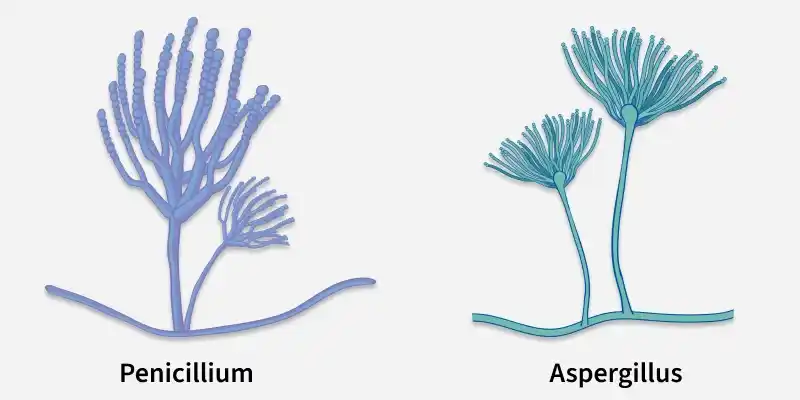
- The most common asexual spores are known as conidia. These spores are produced externally on specialised hyphae called conidiophores. Conidia are usually lightweight and easily dispersed by wind, water, insects, and other agents.
- In unicellular yeasts, asexual reproduction occurs primarily through budding. During this process, a small outgrowth develops on the parent cell, enlarges gradually, and eventually separates as a new individual.
- Certain species may also reproduce through fragmentation of the mycelium, where portions of the hyphae break off and develop into new fungal colonies.
Sexual Reproduction in Ascomycetes
- Sexual reproduction in Ascomycetes is a complex process involving the fusion of compatible mating types and the formation of specialised reproductive structures. The process begins when two compatible hyphae of different mating types come into contact.
- The male reproductive structure, known as the antheridium, and the female reproductive structure, known as the ascogonium, participate in sexual reproduction.
- The first stage is plasmogamy, during which the cytoplasm of the two mating cells fuses. However, nuclear fusion does not occur immediately. As a result, cells containing two genetically distinct haploid nuclei are formed. This condition is known as the dikaryotic stage.
- Following plasmogamy, specialised dikaryotic hyphae called ascogenous hyphae develop within the fruiting body. At the tips of these hyphae, structures known as asci begin to form.
- Within each ascus, the two haploid nuclei finally fuse in a process called karyogamy, resulting in the formation of a diploid nucleus. This diploid stage is usually very brief.
- The diploid nucleus undergoes meiosis to produce four haploid nuclei. These nuclei then undergo mitotic division, resulting in the formation of eight haploid nuclei. Each nucleus becomes enclosed within cytoplasm and a protective wall, forming eight ascospores.
- When the ascospores mature, they are released into the environment. They are dispersed by wind, water, insects, or other agents. Upon reaching a suitable substrate, the ascospores germinate and develop into new fungal mycelia, thereby completing the life cycle.
Importance of Ascomycetes
- Yeasts, particularly _Saccharomyces cerevisiae, are extensively used in baking, brewing, and wine production.
- Species of _Aspergillus are used in the production of soy sauce, sake, miso, and various traditional Asian fermented foods and beverages.
- Morels (_Morchella) and truffles (_Tuber) are highly prized edible fungi that are considered delicacies throughout the world. Their unique flavour and rarity make them economically valuable food items.
- One of the most significant contributions of Ascomycetes to medicine is the production of the antibiotic penicillin from _Penicillium chrysogenum. Penicillin revolutionised modern medicine and has saved millions of lives since its discovery.
- The immunosuppressive drug ciclosporin, obtained from _Tolypocladium inflatum, is widely used during organ transplantation to prevent rejection and in the treatment of autoimmune disorders.
- Ascomycetes produce numerous commercially valuable enzymes and organic acids.
- Species such as _Neurospora crassa and _Saccharomyces cerevisiae have served as important model organisms in genetics, molecular biology, and biotechnology.
- Several species cause economically important plant diseases such as apple scab, rice blast disease, Dutch elm disease, powdery mildew, black knot disease, and ergot disease. These diseases reduce crop yield and cause substantial agricultural losses worldwide.