Kingdom Fungi (original) (raw)
Last Updated : 28 Jan, 2026
Kingdom Fungi, part of the five-kingdom classification system proposed by R.H. Whittaker, includes organisms with a chitin-based cell wall, heterotrophic nutrition, and a filamentous body structure called mycelium. These eukaryotic organisms thrive by absorbing nutrients from external sources. Fungi play important ecological roles, including decomposition and symbiosis.
Structure of Fungi
Fungi are eukaryotic organisms that have a well-defined nucleus and other cell organelles. It includes yeasts, moulds, and mushrooms, all classified under the Kingdom Fungi. These organisms possess a cell wall and are found in nearly every environment on Earth.

The structure of fungi can be explained in the following points:
- Fungi have a simple body called a thallus (plural: thalli), which is a multicellular structure without specialised conducting tissues.
- The cell wall surrounds a protoplast, which contains various cell parts like the cell membrane, cytoplasm, cell organelles, and nuclei.
- The nucleus is dense, clear, and contains chromatin threads, surrounded by a nuclear membrane.
- In baker's yeast (Saccharomyces cerevisiae), the parent cell forms a bud, which is cut off when it reaches the size of the parent cell, and this process repeats each time the cell doubles in size.
- The simplest fungi, like yeasts, lack mycelium and live as microscopic, rounded cells.
- Most fungi grow a mycelium, which is made of slender, branching tubes called hyphae (singular: hypha).
- Hyphae grow by sensing chemicals released from a food source, a process called chemotropism, and they grow towards the source.
- As the hyphae lengthen, small bumps form at the tip, which later become branch hyphae, allowing the mycelium to spread quickly.
- The mycelium may form cross-bridges by fusing hyphae, creating a network or web.
- Hyphal growth begins when a spore absorbs water, swells, and starts to germinate. The spore wall softens, allowing the cell to expand.
- When reproduction starts, coloured spores may cover the surface of the hyphae.
- Individual hyphae are very thin and almost colourless, making them difficult to see with the naked eye.
Characteristics of Fungi
Below are a few of the important characteristics of Kingdom Fungi:
- Fungi are eukaryotic organisms that are non-vascular, non-motile, and heterotrophic.
- They can be either unicellular (like yeasts) or multicellular, typically forming filamentous structures.
- Reproduction in fungi occurs through the production of spores, either sexually or asexually.
- Fungi undergo alternation of generations in their life cycle.
- Lacking chlorophyll, fungi are incapable of photosynthesis and must absorb nutrients from other sources.
- They store energy in the form of starch.
- Fungi are capable of synthesising chitin, a key component of their cell walls.
- The nuclei in fungi are relatively small in size.
- Fungi do not have an embryonic stage; instead, they develop directly from spores.
- Some fungi are parasitic, capable of infecting and feeding on host organisms.
- Common examples of fungi include mushrooms, moulds, and yeast.
Classification of Fungi
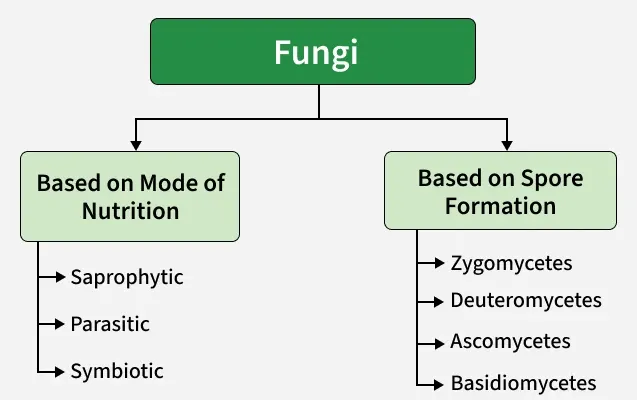
Kingdom Fungi is categorised based on various characteristics and reproductive modes.
Based on Spore Formation
Kingdom Fungi are classified into the following based on the formation of spores:
**1. Zygomycetes
Zygomycetes are a class of fungi distinguished by their unique reproductive structures, known as zygosporangia. Some key characteristics of Zygomycetes are:
- Zygomycetes are commonly referred to as "conjugation fungi."
- They are primarily multicellular, with a simple mycelium structure that is non-septate.
- Zygomycetes can be saprophytic, parasitic, or symbiotic.
- They reproduce sexually through the formation of zygospores and asexually by sporangia that produce sporangiospores.
- The mycelium of zygomycetes is coenocytic (lacking cell division between nuclei).
- Examples of Zygomycetes include _Rhizopus (commonly found in bread mould), _Mucor, and _Pilobolus.
**2. Ascomycetes
Ascomycetes are considered a separate class of fungi based on their unique reproductive structure, known as asci. Some of its characteristics are:
- Ascomycetes are often referred to as sac-fungi.
- They are typically seen in multicellular form; unicellular form is uncommon.
- The mycelium of ascomycetes is branched and septate.
- They may be saprophytic, parasitic, decomposers, coprophilous, or any of these.
- Ascospore is the name for sexual spores. Conidiospores are used in asexual reproduction.
- Aspergillus, Claviceps, and Neurospora are a few examples.
**3. Basidiomycetes
Basidiomycetes are often considered the most advanced and commonly encountered fungi due to their large and conspicuous fruiting bodies. Some of its characteristics are:
- These include mushrooms (gill fungi), toadstools, puffballs, and bracket fungi, among others.
- Mycelium is branched and septate.
- Vegetative reproduction via fragmentation occurs frequently.
- Plasmogamy occurs as a result of the fusion of vegetative or somatic cells of two different strains. This results in the production of basidium.
- Four basidiospores are produced inside the basidium as a result of Karyogamy and Meiosis.
- The basidia get arranged in fruiting bodies called basidiocarps.
- Among the best wood decomposers are basidiomycetes. Basidiomycetes can outcompete most insects in the decay of hardwoods and woody tree parts. Basidiomycetes have the capacity to break down cellulose and lignin.
**4. Deuteromycetes
This class of fungus, called Deuteromycetes,encompasses all those fungi whose sexual stage is either unknown or nonexistent. Some of its characteristics are:
- The majority of deuteromycete members may actually be ascomycetes, in which sexual reproduction is either absent or has not yet been identified.
- Some Deuteromycetes resemble yeast-like unicellular organisms.
- Conidia and other forms of spore**s frequently serve as the means of asexual reproduction.
- Typically, the mycelium is septate and branched.
- Most of the members are decomposers, and some of them are parasites.
- There are no clamp connections, which are present in basidiomycetes.
**Based on the Mode of Nutrition
Fungi are classified into three types based on their mode of nutrition:
**1. Saprophytic Fungi
- These fungi live and feed on dead organic matter.
- E.g. Penicillium, Rhizopus, Mucor.
**2. **Parasitic Fungi
- They feed on hosts, which are either living or dead organisms.
- By spreading disease, they cause harm to the hosts.
- The parasite-host relationship is referred to as parasitism.
**3. Symbiotic Fungi
- Symbiotic fungi live in an interdependent relationship with other species that benefits both parties.
- Lichens andmycorrhiza are two examples. Lichens are the result of a mutualistic relationship between algae and fungi.
- In this case, algae and fungi benefit from each other because fungi provide shelter for algae, and algae provide carbohydrates for fungi.
- Mycorrhiza is a symbiotic relationship that exists between fungi and plants.
Reproduction in Fungi
Fungi reproduce through both sexual and asexual methods. The sexual mode of reproduction is known as teleomorph, while the asexual mode is referred to as anamorph.

**Vegetative Reproduction in Fungi
- Fungi can reproduce vegetatively through methods like budding, fission, or fragmentation.
- In this process, new individuals are formed from parts of the parent organism, allowing fungi to rapidly spread and grow in favourable environments.
**Asexual Reproduction in Fungi
- Asexual reproduction in fungi occurs through the production of spores.
- These spores can be conidia, zoospores, or sporangiospores, which are released into the environment to grow into new individuals.
- Asexual reproduction allows fungi to quickly reproduce and colonise new areas.
**Sexual Reproduction in Fungi
- Fungi also reproduce sexually by producing specialised spores such as ascospores, basidiospores, and oospores. This process introduces genetic diversity, which helps fungi adapt to changing environments and survive various challenges.
- In certain species, the fusion of two haploid hyphae does not immediately result in a diploid cell. Instead, an intermediate stage called the _dikaryophase occurs, where two nuclei remain separate within the same cell.
- This stage eventually leads to the formation of diploid cells, which then continue through the sexual reproduction process. This unique feature of fungal reproduction adds complexity to their life cycle and contributes to their adaptability and survival.
**Uses of Fungi
The uses of Fungi are listed as follows:
- Fungi help in maintaining the ecological balance as they act as decomposers and return the nutrients to the soil and atmosphere.
- These form symbiotic relationships with organisms like algae and help them with shelter in return for food.
- Fungi like Penicillium are used in making antibiotics, which are used to treat diseases in humans.
- Fungal spores are sprayed across the crops, and they help in killing pests and other insects.
- Fungi are used in producing food products such as bread, cheese, beer, etc.