Phycomycetes (original) (raw)
Last Updated : 8 Jun, 2026
Phycomycetes are a group of simple and primitive fungi commonly known as lower fungi. They are found in moist habitats such as soil, decaying organic matter, water, and as parasites on plants and animals. Their body consists of aseptate, coenocytic hyphae that form a well-developed mycelium. Phycomycetes may be saprophytic or parasitic and play important roles in decomposition and nutrient recycling.
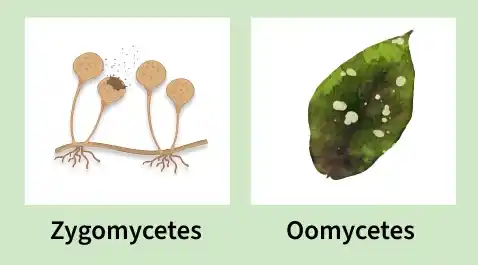
Characteristics of Phycomycetes
- They are among the simplest and most primitive groups of fungi.
- They are commonly found in moist and humid habitats.
- The mycelium is well developed, branched, aseptate, and coenocytic.
- The hyphae contain numerous nuclei within a continuous cytoplasm.
- They lack chlorophyll and are heterotrophic in nutrition.
- They may be saprophytic, parasitic, or occasionally symbiotic.
- Asexual reproduction occurs through zoospores or aplanospores produced in sporangia.
- Sexual reproduction may occur through isogamy, anisogamy, or oogamy.
- Thick-walled resting spores are often formed during sexual reproduction.
- They play important ecological roles in decomposition and nutrient recycling.
Examples of Phycomycetes
Some common examples of phycomycetes include:
- _Mucor
- _Rhizopus (bread mould)
- _Albugo
- _Pythium
- _Saprolegnia
Habitat of Phycomycetes
- Phycomycetes are widely distributed in nature and occur in a variety of habitats. Most species grow in moist terrestrial environments where organic matter is abundant.
- They are commonly found on decaying leaves, fruits, vegetables, bread, and other organic substances undergoing decomposition.
- Some species inhabit aquatic environments and are found in freshwater bodies such as ponds, lakes, streams, and marshes.
- Certain phycomycetes are parasitic and obtain nutrients from living plants or animals, causing various diseases.
- The abundance of moisture is one of the most important environmental factors influencing their growth and reproduction.
Structure of Phycomycetes
- The vegetative body of phycomycetes consists of a mycelium composed of long, branched hyphae.
- The hyphae are usually aseptate, which means that they do not possess septa or cross walls dividing them into separate cells.
- Because septa are absent, the cytoplasm forms a continuous mass containing many nuclei. This condition is known as coenocytic organisation.
- The coenocytic mycelium enables efficient transport of nutrients and contributes to rapid growth.
- The cell wall is primarily composed of chitin and other polysaccharides that provide structural support and protection.
- The fungal body lacks chlorophyll and therefore cannot synthesise its own food through photosynthesis.

Nutrition in Phycomycetes
Phycomycetes exhibit heterotrophic nutrition and depend on external sources for obtaining food.
- **Saprophytic Nutrition: Many phycomycetes are saprophytes and derive nourishment from dead and decaying organic matter. They secrete digestive enzymes onto the substrate, break down complex organic substances into simpler forms, and absorb the resulting nutrients.
- **Parasitic Nutrition: Certain species are parasitic and obtain nutrients from living hosts. These fungi may infect plants and cause diseases that result in significant agricultural losses.
- **Symbiotic Association: Some phycomycetes may also participate in symbiotic relationships with other organisms, although saprophytic and parasitic modes are more common.
Reproduction in Phycomycetes
Reproduction in phycomycetes occurs through both asexual and sexual methods. These fungi are capable of producing large numbers of spores, ensuring effective dispersal and survival.
Asexual Reproduction
It is the most common mode of reproduction in phycomycetes. It occurs through the formation of spores known as zoospores or aplanospores.
- **Zoospores: Zoospores are motile spores that possess one or more flagella. They are produced inside specialised structures called sporangia. Because zoospores can swim in water, they are particularly common in aquatic and moist environments.
- **Aplanospores: Aplanospores are non-motile spores produced within sporangia. These spores are dispersed by wind, water, or other agents and germinate under favourable conditions to form new mycelia.
Sexual Reproduction
Sexual reproduction in phycomycetes occurs through the fusion of compatible gametes and may take place in different ways. Following fertilisation, a thick-walled resting spore known as a zygospore or oospore may be formed, depending on the group. These structures help the fungus survive unfavourable environmental conditions.
- **Isogamy: In isogamy, the fusing gametes are morphologically similar in size and shape.
- **Anisogamy: In anisogamy, the two gametes differ in size but are both motile.
- **Oogamy: In oogamy, a large non-motile female gamete fuses with a smaller motile male gamete.
Economic Importance of Phycomycetes
- Phycomycetes have both beneficial and harmful effects on human activities and ecosystems.
- Many saprophytic phycomycetes decompose dead organic matter and contribute to nutrient cycling in nature. Through decomposition, they release essential minerals back into the environment, making them available for plant growth.
- They also help maintain ecological balance by breaking down plant and animal remains.
- Certain phycomycetes are plant pathogens and cause serious diseases in crops.
- For example, species of _Albugo cause white rust disease in cruciferous plants, while some species of _Pythium cause damping-off disease in seedlings. These diseases can reduce crop yield and lead to significant agricultural losses.