C4 Cycle of Photosynthesis (original) (raw)
Last Updated : 12 May, 2026
The C4 cycle, also known as the Hatch–Slack pathway, is a special type of photosynthetic process found in certain plants. It is an adaptation that helps plants survive in hot, dry environments by increasing the efficiency of carbon fixation and reducing photorespiration. The C4 cycle is a photosynthetic pathway found in certain plants where the first stable product formed is a 4-carbon compound. It is an adaptation to reduce photorespiration and increase photosynthetic efficiency.

Steps of the C4 cycle
**1. Carboxylation
- Six molecules of carbon dioxide are accepted by six molecules of a primary carbon acceptor called 'phosphoenol pyruvic acid` (PEP) to form six molecules of oxaloacetic acid (OAA), which is a four-carbon dicarboxylic acid; hence, this is called the C4 pathway.
- This reaction occurs in the cytosol of the mesophyll cell and is catalysed by the enzyme PEP carboxylase (PEPcase).
- OAA, thus formed in the cytosol, enters the chloroplast of the mesophyll cell.
- Mg+2 is an activator of enzymes RUBISCO and PEP case enzymes.

**2. Reduction
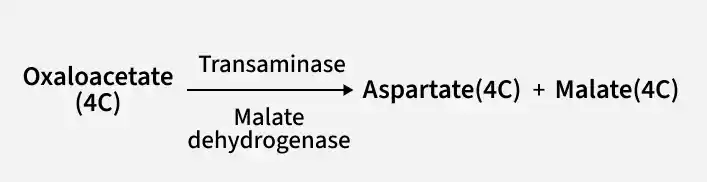
- Six molecules of oxaloacetic acid are reduced to six molecules of malic acid by using the light-generated NADPH.
- This reaction is catalysed by the enzyme malic dehydrogenase.
- In some C4 plants, oxaloacetic acid is converted into aspartic acid by transamination.
**3. Oxidative Decarboxylation
- Six molecules of malic acid formed in the chloroplast of mesophyll cells are transported to the chloroplast of bundle sheath cells and undergo oxidative decarboxylation to form six molecules of pyruvic acid (three-carbon organic acid) and six molecules of CO2.
- This reaction is catalysed by the malic enzyme.
- The oxidation of malic acid during this reaction is associated with the reduction of6NADP+ into 6NADPH + 6H+.
- This molecule of CO2 generated in the above reaction is utilised in the Calvin cycle (PCR cycle) to synthesise sugars.
- The bundle sheath may form several layers around the vascular bundles. They are deep-seated and impervious to gaseous exchange due to the presence of Casparian thickenings.
- As a result, oxygen reaching bundle sheath cells is less, but CO2 released is more (by decarboxylation of malic acid). As a result, RuBP undergoes carboxylation only, thereby reducing the chance of photorespiration.

**4. Phosphorylation
- Six molecules of pyruvic acid produced in bundle sheath cells move to the chloroplasts of mesophyll cells. Here it is phosphorylated to six molecules of phosphoenol pyruvate (PEP).
- The enzyme pyruvate dikinase catalyses the reaction. Twelve molecules of extra ATP are used to transport 6 CO2 from the mesophyll cell into the bundle sheath cell.
- PEP enters the cytosol of the mesophyll cell. During this process, there are two carboxylations ( one each in mesophyll and bundle sheath) and one decarboxylation (bundle sheath cell).
- To synthesise one molecule of glucose, C4 plants utilise 30 ATP and 12 NADPH (energetics of C4 Cycle).

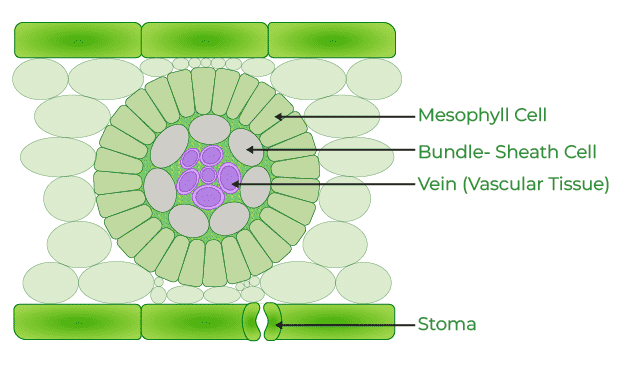
**Structure of C4 Leaf (Kranz Anatomy)
The most distinctive anatomical feature of a C4 leaf is the presence of a bundle sheath surrounding the vascular bundles. This anatomical specialization is called Kranz anatomy. The bundle sheath cells contain large, agranal chloroplasts, whereas the mesophyll cells possess chloroplasts with well-developed grana. This difference in chloroplast structure is known as chloroplast dimorphism. Chloroplasts are more numerous in the bundle sheath cells than in the mesophyll cells. The C4 pathway operates in two types of photosynthetic cells the mesophyll cells and the bundle sheath cells, thus showing a clear division of labour.
**Why do Plants Evolve into the C4 Cycle?
- C4 plants are more proficient than C3 plants because of their high rate of photosynthesis and decreased rate of photorespiration. The fundamental catalyst of carbon fixation (Calvin cycle) is RuBisCO, for example, ribulose bisphosphate carboxylase oxygenase. It has a affinity for both CO2 and O2.
- At the point when carbon dioxide fixation is low, RuBisCO takes up oxygen to perform photorespiration. In C4 plants, photorespiration is profoundly diminished in light of the fact that carbon dioxide fixation is high at the RuBisCO site.
- C4 plants have extraordinary leaf life structures called 'Kranz anatomy' and go through the C4 pathway of photosynthesis. Here, CO2 is first acknowledged by phosphoenolpyruvate (PEP) in the mesophyll cells to create 4-carbon organic acids, for example, oxaloacetic acid (OAA).
- OAA is then switched over completely to malic acid and shipped to package sheath cells. In the bundle sheath cells, CO2 is delivered, and it enters the Calvin cycle and is followed up on by RuBisCO. Because of the greater centralisation of carbon dioxide in the group sheath cells, photorespiration is limited.