Photosynthesis (original) (raw)
Last Updated : 29 Apr, 2026
Photosynthesis is the process by which green plants, algae, and some bacteria make their own food using sunlight. Plants use sunlight, carbon dioxide, and water to make glucose (food) and oxygen.
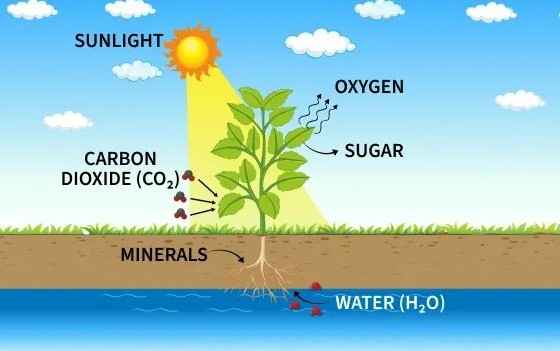
The word photosynthesis is taken from the Greek words photo (light) and synthesis (to merge), which means ‘merging with the aid of light’. Light is the most important factor in the photosynthesis process.
Characteristics of Photosynthesis
Here are the main characteristics of photosynthesis:
**1) Occurs in green parts of plants: Photosynthesis mainly takes place in the leaves, as they contain chlorophyll, the green pigment needed to trap sunlight.
**2) Requires sunlight, carbon dioxide, and water:
- Sunlight provides the energy for the process.
- Plants absorb carbon dioxide (CO₂) from the air and water (H₂O) from the soil.

**3) Produces glucose (food) and oxygen:
- The main product of photosynthesis is glucose, which the plant uses for energy and growth.
- Oxygen (O₂) is released as a by-product into the air.
**4) Takes place in chloroplasts: Photosynthesis occurs inside the chloroplasts present in the cells of green plants.
**5) Occurs during daytime: Since sunlight is essential, photosynthesis mostly takes place during the day.
**6) Endothermic process: It is an endothermic process because it absorbs energy from sunlight.
Where Does Photosynthesis take place?
Chloroplasts, a type of plastid (an organelle with a membrane), are organelle that contains chlorophyll.
- They are typically found in plant leaves and perform photosynthesis.
- Chlorophyll pigments in plants absorb light energy.
- When a chlorophyll pigment releases an electron, it can then go on to an appropriate recipient, converting the energy into chemical energy.
- Reaction centres are the pigments and proteins that transform light energy into chemical energy and start the process of electron transfer.
Factors Affecting Photosynthesis
There are some factors that affect the rate of photosynthesis.
- **Temperature: The optimum temperature for the most efficient photosynthesis is 25° to 35° C.
- **Light: Light intensity directly affects the rate of photosynthesis
- **Carbon Dioxide (CO2) directly affects the rate of photosynthesis. If the concentration of CO2 is low, then the photosynthesis rate also decreases.
- **Pollution: Pollutants settle on the upper surface of the leaf, which prevents gas exchange from occurring properly, and it affects the rate of photosynthesis.
- **Water: Water is an important factor, and if it is below the optimum level, it decreases the rate of photosynthesis. A low level of water does not let the stomata open, and CO2 does not come inside.
Equation of Photosynthesis
Despite the fact that both types of photosynthesis are complex, multistep processes, the entire procedure can be neatly condensed into a chemical equation.
- The oxygenic (with oxygen usage) photosynthesis equation is:
6CO2 + 12H2O + Light Energy → C6H12O6 + 6O2 + 6H2O
- Light energy is used to mix 12 molecules of water (H2O) with six molecules of carbon dioxide (CO2). As a result, six molecules each of oxygen and water are formed, as well as one molecule of a carbohydrate (C6H12O6, or glucose).
- A single generalised formula can be used to express all anoxygenic (without oxygen usage) photosynthesis reactions:
CO2 + 2H2A + Light Energy → [CH2O] + 2A + H2O
- Through tiny holes on their leaves known as stomata, plants take in CO2 from the atmosphere and release it along with water and oxygen. The guardians of gas exchange between a plant's interior and the outside world are stomata.
- Stomata release oxygen and allow water vapour to escape while they are open, allowing CO2 to enter the system. Stomata close in an effort to lessen the amount of water lost, but doing so prevents the plant from absorbing CO2 for photosynthesis.
- For plants that grow in hot, dry climates, this trade-off between CO2 intake and water loss presents a unique challenge.
Photosynthetic Pigments
Pigments are present in the leaves, and they provide the colour to the leaves. In plants, 4 types of photosynthetic pigments are:
- **Chlorophyll A: It is the main pigment, which is used in the photosynthesis process, and it has a bright or blue-green colour in the chromatogram.
- **Chlorophyll B: It is a yellow-green colour in the chromatogram.
- **Xanthophylls: They are yellow in colour in the chromatogram.
- **Carotenoids: They are yellow to yellow-orange in colour in the chromatogram.
Process of Photosynthesis
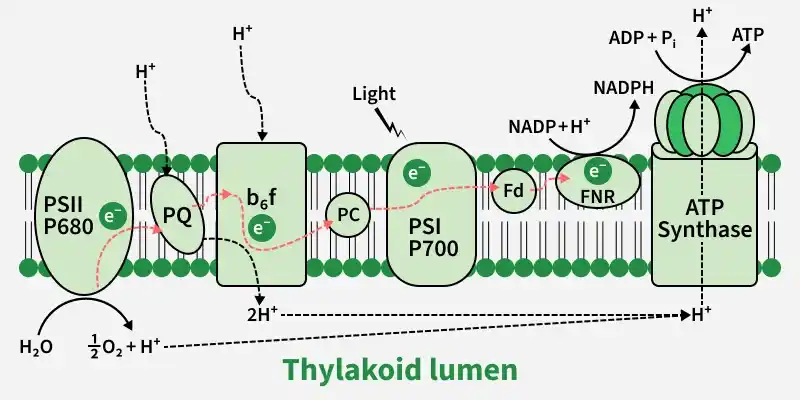
Photosynthesis takes place in the special cell organelles known as chloroplasts at the cellular level. The lamina of the leaf helps in absorbing CO2 and sunlight. The process of photosynthesis is classified into two stages based on light, i.e., Light-dependent and light-independent reactions.
Light-Dependent Reactions
Photosynthesis occurs during the day in the presence of sun rays, called the Light-Dependent Reaction.
1. This reaction takes place in the thylakoid membrane.
2. On the membrane, different protein complexes known as photosystems are present, which are of 2 types :
- Photosystem-I
- Photosystem-II
3. In light-dependent photosynthesis, solar energy is converted into chemical energy in the form of ATP and NADPH.
2H2O + 2NADP+ +3 ADP + 3Pi ⇢ O2+ 2NADPH + 3ATP
Light-Independent Reactions
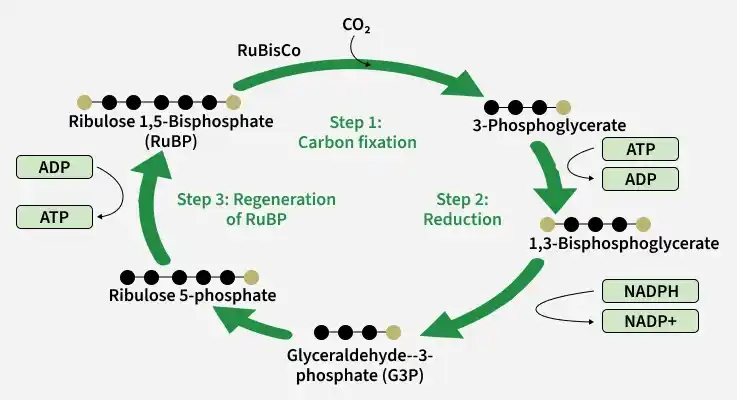
Light-independent reaction is also known as the Dark reaction or Carbon-fixing reaction.
- In this reaction, monosaccharides are formed with the utilisation of CO2 and H2O
- A dark reaction takes place in the stroma.
- Plants take the CO2 from the stomata and start the Calvin cycle.
- In the Calvin cycle, 6 molecules of CO2 are used to form one molecule of sugar (monosaccharide)
3Co2 + 6 NADPH + 5H2O + 9ATP ⇢ G3P + 2H+ + 6NADP+ + 9ADP + 8Pi
Types of Photosynthesis
The C3, C4, and CAM pathways are the three basic categories of photosynthetic pathways. They all use the Calvin cycle to convert CO2 into sugars, but each pathway does so in a somewhat different way.
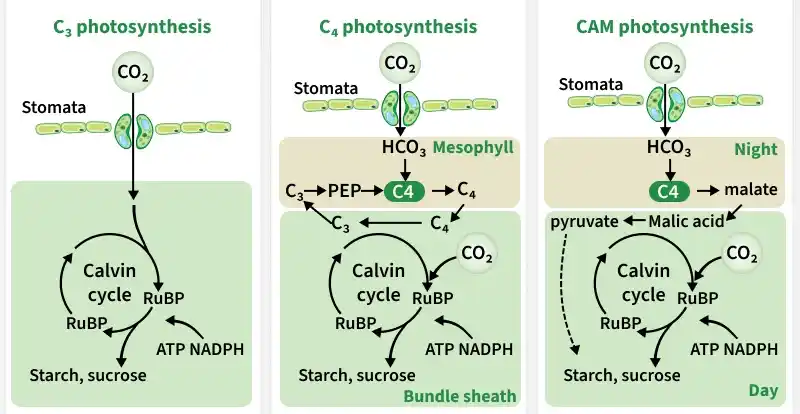
**C3 photosynthesis: The Majority of plants, including cereals (wheat and c rice), cotton, potatoes, and soybeans, utilise C3 photosynthesis. The three-carbon molecule 3-phosphoglyceric acid (3-PGA), which is a byproduct of C3 photosynthesis, gives the process its name. When Rubisco fixes CO2, a three-carbon molecule called 3-PGA is created.
**C4 photosynthesis: C4 photosynthesis is used by plants like sugarcane and maize. A four-carbon chemical intermediate called oxaloacetate, which is transformed into malate, is used in this process. C4 plants can continue to fix carbon even while their stomata are closed, which lowers their risk of photorespiration, and they are also better adapted to hot, dry settings.
**CAM photosynthesis: Plants accustomed to extremely hot and dry settings, like cacti and pineapples, have a process called Crassulacean Acid Metabolism (CAM). CAM is one modification where plants open their stomata at night (when temperatures are lower and water loss is less of a risk). Stomata close, lowering the likelihood of water loss, and the CO2 is then available for light-dependent processes during the day.
Importance of Photosynthesis
The following are the important aspects of photosynthesis are given below:
- Because of the process of photosynthesis, the oxygen level of the environment is maintained.
- Food is generated from solar energy, which plays a significant role in the food chain.
- Photosynthesis provides food to other living organisms.