Chemiosmotic Hypothesis (original) (raw)
Last Updated : 11 May, 2026
The chemiosmotic hypothesis is a fundamental concept that explains how cells produce energy in the form of ATP. According to this hypothesis, ATP synthesis is driven by the movement of protons (H⁺ ions) across a biological membrane, creating an electrochemical gradient known as the proton motive force. This gradient is generated during processes like cellular respiration in mitochondria and photosynthesis in chloroplasts. The chemiosmotic hypothesis provides a clear explanation of how energy released during electron transport is used to form ATP, making it essential for understanding energy production in living cells.

**Chemiosmosis
- Chemiosmosis refers to the process by which ions move over a semipermeable membrane, such as the membrane within mitochondria.
- Molecules containing a net electric charge are called ions.
- Examples include the specialised usage of Na+, Cl-, and H+ in chemiosmosis to generate energy.
- During chemiosmosis, ions move along an electrochemical gradient or a gradient of electrochemical potential (a form of potential energy).
- Chemiosmosis is a type of diffusion that causes ions to move from areas of high concentration to areas of low concentration across a membrane. Ions also move to balance the electric charge across a membrane.
**Key Features of the Chemiosmotic Hypothesis
- The biological process by which ATP synthase produces ATP molecules is known chemiosmotic hypothesis.
- An explanation of how energy molecules (ATP: Adenosine triphosphate) are produced during photosynthesis is provided by the Chemiosmotic theory, which was put forth by a British biochemist, Peter Dennis Mitchell, in 1961.
- The chemiosmotic hypothesis is a theory that explains how cells produce energy.
- It suggests that energy is generated through the movement of ions across a membrane, creating an electrochemical gradient.
- This gradient powers the production of ATP, the cell's energy currency. In simpler terms, it's like a battery powering the cell's activities by moving ions across a membrane.
- This process is important for cellular functions, including metabolism and cell signalling.
- Nicotinamide adenine dinucleotide phosphate, often known as NADP or NADP+, is created with ATP during the light reaction or photochemical phase.
- These constitute the essential components of photosynthesis. They are used to produce sugar molecules throughout the dark reaction, or Calvin cycle.
**Process of Chemiosmotic Hypothesis
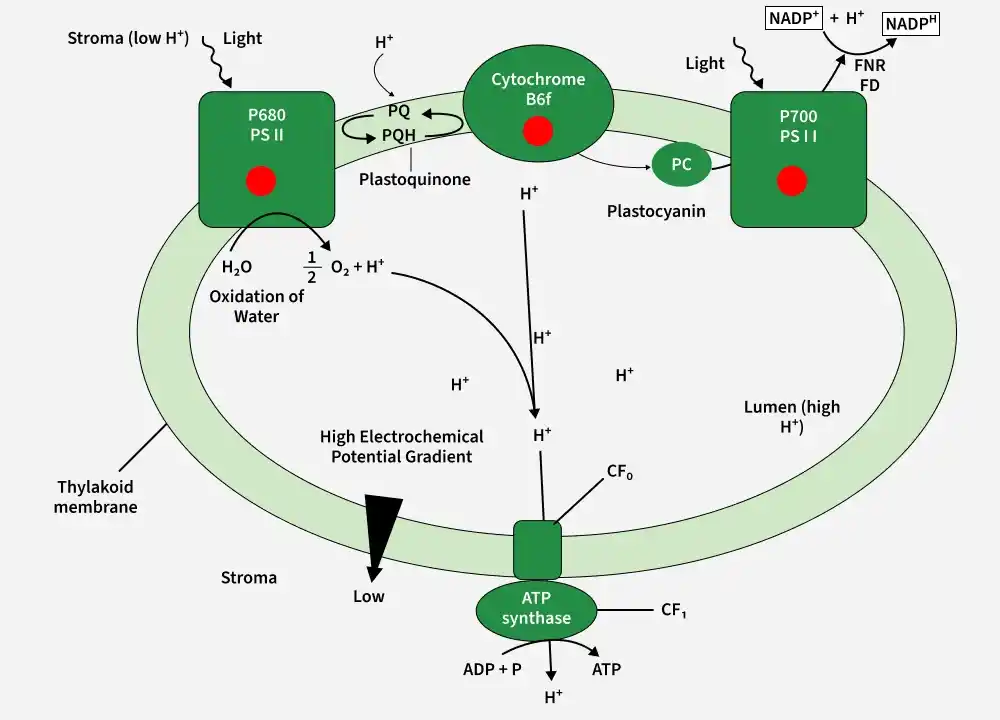
- The proton gradient that exists across the thylakoid membrane is what causes the ATP- Adenosine Triphosphates to be created in this process.
- The proton gradient, ATP synthase, and proton pump are important elements required for the chemiosmosis process.
- ATP synthase is the name of the enzyme that is necessary for the synthesis of ATP molecules. Two subunits, designated F0 and F1, make up the enzyme ATP synthase. To move protons across the membrane, the F0 subunit is necessary. This alters the F1 subunit's conformation, which activates enzymes.
- By adding a phosphate group to ADP, the enzyme phosphorylates it, turning it into ATP. Across the membrane, there is a proton gradient, which acts as ATP synthase's main propulsion source.
- Chlorophyll absorbs light with the aid of photosystems during the light response stage of photosynthesis. As a result, the water molecules split, releasing protons and electrons in the process. This is known as hydrolysis. The electron transport system carries the liberated electrons as they become energised and proceed to a higher energy level.
- In the meantime, the stroma's released protons start assembling inside the membrane. As a result, a proton gradient is produced, which is a by-product of the electron transport chain.
- Photosystem I use the few remaining protons to convert NADP+ to NADPH using electrons from the photolysis of water. The proton gradient eventually collapses, releasing energy and protons that are then transported back to the stroma by ATP synthase F0. ADP is converted to ATP by the ATP synthase when the F1 conformation is altered by the resulting energy.
Function of the Chemiosmotic Hypothesis
- The chemiosmotic hypothesis explains how cells produce energy.
- It describes the process of ATP synthesis through the movement of ions across a membrane.
- This hypothesis is essential for understanding cellular respiration and photosynthesis.
- It provides a framework for studying the role of ion gradients in various cellular processes.
- Understanding the chemiosmotic hypothesis helps in developing treatments for diseases related to energy metabolism