Animal Kingdom: Basis of Classification (original) (raw)
Last Updated : 9 Jun, 2026
The Animal Kingdom (Kingdom Animalia) encompasses a diverse array of multicellular, eukaryotic, and heterotrophic organisms that exhibit remarkable diversity in their structure, organisation, and mode of life. To study this vast diversity systematically, animals are classified into different groups based on specific fundamental characteristics. Such classification helps in understanding the similarities, differences, and evolutionary relationships among various animal groups.
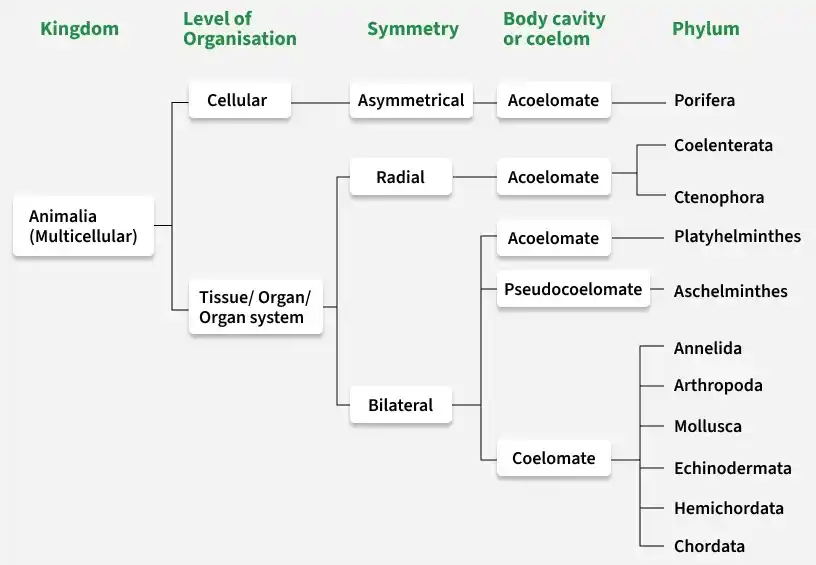
Important criteria used for animal classification include the level of organisation, body symmetry, germ layers, coelom, segmentation, and the presence or absence of a notochord.
Levels of Organisation
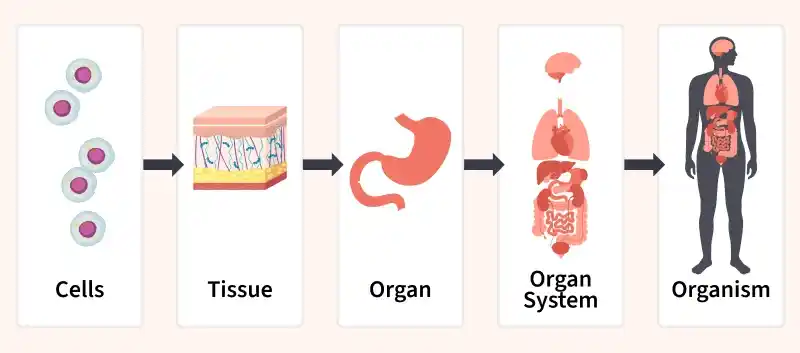
One of the most important criteria used in classifying animals is the level of organisation present in the body. During evolution, animals developed increasing structural complexity, resulting in different levels of organisation.
- **Cellular Level of Organisation: The cellular level of organisation is the simplest level found in animals. In this level, the body consists of loosely arranged cells that perform all vital functions independently. There are no true tissues or organs. Examples are Sponges (Phylum Porifera)
- **Tissue Level of Organisation: In tissue-level organisation, similar cells are grouped to form tissues that perform specific functions. However, true organs are absent. Examples are Cnidarians and Ctenophores
- **Organ Level of Organisation: In this level, different tissues combine to form organs, and each organ performs a specific function. Examples arePlatyhelminthes (Flatworms)
- **Organ System Level of Organisation: This is the highest level of organisation found in animals. Different organs work together to form organ systems, and each system performs a particular physiological function.Examples are Annelids, Arthropods, Molluscs, Echinoderms, and Chordates
Symmetry
Symmetry refers to the arrangement of body parts in relation to a central axis. It is an important characteristic used for classifying animals.
- **Asymmetrical Animals: Animals that cannot be divided into equal halves by any plane passing through the body are called asymmetrical animals. Examples are Sponges
- **Radial Symmetry: In radial symmetry, the body can be divided into similar halves by any plane passing through the central **axis. Examples are Hydra, Jellyfish, Sea Anemones, and Ctenophores
- **Bilateral Symmetry: In bilateral symmetry, only one plane passing through the body divides it into two equal and mirror-image halves. Examples are Annelids, Arthropods, Molluscs, and Chordates

Diploblastic and Triploblastic Organisation
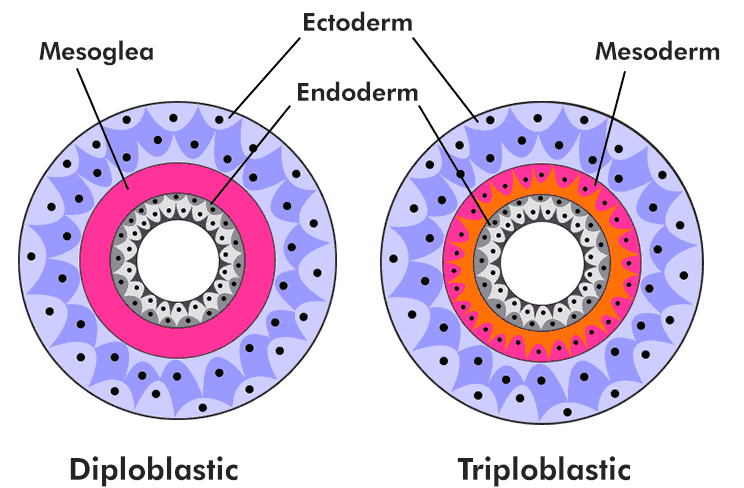
Animals are also classified based on the number of embryonic germ layers formed during development.
- **Diploblastic Animals: Diploblastic animals possess two primary germ layers, Ectoderm (outer layer) and Endoderm (inner layer). Between these layers lies a non-cellular gelatinous layer called mesoglea.Examples areCnidarians and Ctenophores
- **Triploblastic Animals: Triploblastic animals possess three germ layers: Ectoderm, Mesoderm, and Endoderm. The mesoderm gives rise to muscles, connective tissues, circulatory organs, and other complex structures. Examples are Platyhelminthes, Annelids, Arthropods, Molluscs, Echinoderms, and Chordates
Coelom (Body Cavity)
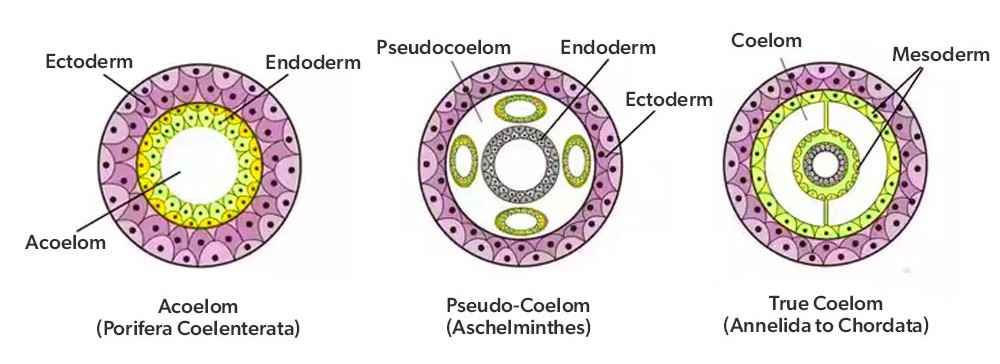
The coelom is a fluid-filled body cavity located between the body wall and the digestive tract. It is lined by mesoderm and provides space for the development of internal organs.
- **Acoelomates: Animals in which the body cavity is completely absent are called acoelomates. Examples arePlatyhelminthes
- **Pseudocoelomates: Animals possessing a false body cavity that is not completely lined by mesoderm are known as pseudocoelomates. Examples are Aschelminthes (Nematodes)
- **Coelomates: Animals possessing a true coelom completely lined by mesoderm are called coelomates. Examples are Annelids, Molluscs, Arthropods, Echinoderms, and Chordates
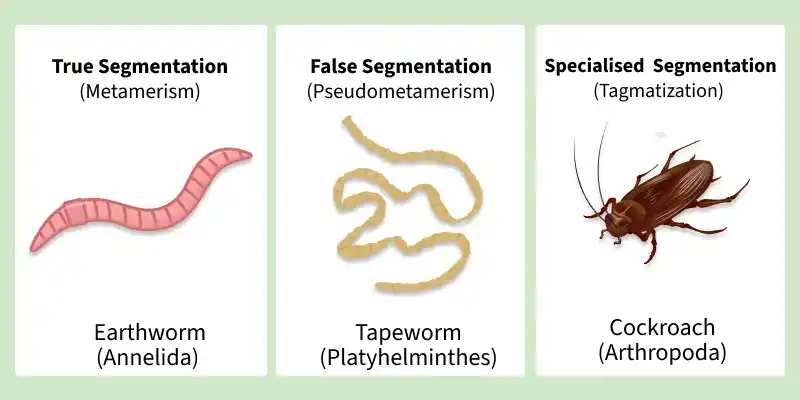
Segmentation of the Body
Segmentation refers to the division of the body into a series of repeated segments.
- **True Segmentation (Metamerism): In true segmentation, the body is divided externally and internally into similar repeated segments arranged in a linear sequence. Examples areEarthworms, Leeches, and Chordates
- **False Segmentation (Pseudometamerism): In false segmentation, the body appears segmented externally, but internal segmentation is absent.Example areTapeworm
- **Tagmatization: In some animals, body segments become specialised and grouped to form functional units called tagmata. Examples are Arthropods (Head, Thorax, and Abdomen)
Presence or Absence of Notochord
The notochord is a flexible rod-like structure derived from mesoderm that provides support during embryonic development.
- **Non-Chordates: Animals that lack a notochord throughout their life cycle are known as non-chordates.Examples are Porifera, Cnidaria, Platyhelminthes, Nematoda, Annelida, Arthropoda, Mollusca, Echinodermata
- **Chordates: Animals possessing a notochord at least during some stage of their life cycle are called chordates.Examples are Fishes, Amphibians, Reptiles, Birds, and Mammals
Significance of Classification in the Animal Kingdom
- The classification of animals based on these fundamental characteristics provides a systematic framework for studying the enormous diversity present in the animal kingdom.
- It helps scientists identify organisms, understand their evolutionary relationships, compare structural and functional adaptations, and trace the gradual progression from simple to highly complex forms of life.
- The basis of classification also provides important insights into the evolutionary history of animals and helps in understanding biodiversity, ecological relationships, and conservation strategies.