Difference between Prokaryotic and Eukaryotic Cells (original) (raw)
Last Updated : 19 Dec, 2025
Prokaryotic and eukaryotic cells are the two primary types of cells. Prokaryotic cells lack a defined nucleus and membrane-bound organelles, while eukaryotic cells have a true nucleus and membrane-bound organelles. Prokaryotes are smaller and simpler, found in bacteria and archaea, while eukaryotes are larger and more complex, found in animals, plants, fungi, and protists.
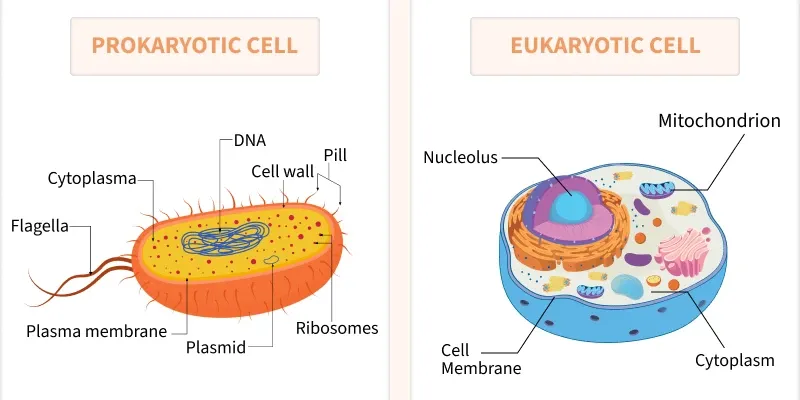
The difference between prokaryotes and eukaryotes is as follows:
| **Prokaryotes Cell | **Eukaryotes Cell |
|---|---|
| Lack membrane-bound organelles, though they may have simpler structures like ribosomes. | Contain membrane-bound organelles such as mitochondria, endoplasmic reticulum, Golgi apparatus, lysosomes, and more. |
| Lacks a true nucleus. Genetic material is present in the nucleoid, not enclosed by a membrane. | Have a true nucleus enclosed by a nuclear membrane, containing genetic material (DNA). |
| The size of the cell is smaller (0.1–5 μm). | In comparison, the cell size is bigger (10-100 μm). |
| Single, circular chromosome (DNA). It may also contain plasmids. | Multiple linear chromosomes (DNA) are found in the nucleus. |
| This cell has a unicellular structure | Multicellular eukaryotic cells predominate. Nevertheless, some are monocellular. |
| Lysosomes and Peroxisomes are absent | Lysosomes and Peroxisomes present |
| Microtubules are absent | Microtubules are present |
| The endoplasmic reticulum is absent | The endoplasmic reticulum is present |
| Mitochondria are absent | Mitochondria are present |
| The cytoskeleton is absent | Cytoskeleton is present |
| Ribosomes are smaller | Ribosomes are larger |
| Vesicles are present | Vesicles are present |
| The cell wall is present | Cell wall not present |
| PK cell divides by binary fission | Ek cell divides by a process known as mitosis. |
| Reproduce primarily through binary fission, a form of asexual reproduction. | Reproduce through mitosis (asexual) and meiosis (sexual) processes. |
| Present but smaller in size. | Large flagella. |
| Generally simpler in structure and function. | More complex structurally and functionally due to organelles and cellular compartmentalisation. |
| Archaea, Bacteria | Plant, Fungi, Animal Cell |