Cell Organelles (original) (raw)
Last Updated : 24 Apr, 2026
Cell organelles are the small structures inside a cell that perform specific jobs, just like organs in our body do. Each organelle has a unique function that helps the cell survive, grow, and function properly. Each cell organelle is unique in structure, function, and composition.
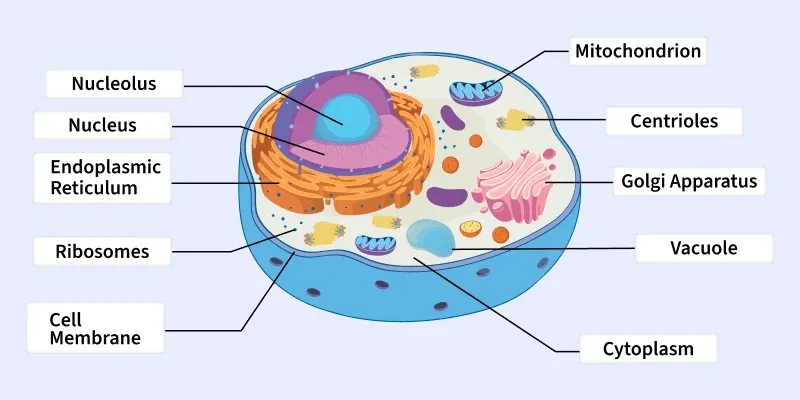
Several types of organelles are present, which are differentiated into three types based on their membranes.
- **Organelles Without Membrane: Include Ribosomes, Centrioles, and Cytoskeleton.
- **Single-layer membrane organelles: All those membranes that are covered by one layer are included in this category in eukaryotic cells. Organelles included are vacuoles, Golgi apparatus, lysosomes, and endoplasmic reticulum.
- **Twofold-layer membrane organelles: These organelles are covered by 2 layers, including the nucleus, mitochondria, and chloroplasts.
**Cell Organelles Functions
Different types of cell organelles and their functions are present in the cell, which are:
| Cell Organelles | Functions |
|---|---|
| Plasma Membrane | Allows selective entry of substances, hence maintains cell homeostasis |
| Cytoplasm | Site where cellular processes occur |
| Nucleus | DNA storage and transfer of genetic materials |
| Endoplasmic Reticulum | Helps in the transport of substances within the cell |
| Mitochondria | Energy Production |
| Plastids | Responsible for photosynthesis and the storage of starch |
| Ribosomes | Protein synthesis |
| Golgi Complex | Protein modification and export |
| Microbodies | Breakdown of fatty acids |
| Cilia & Flagella | Facilitate movement |
| **Centrosomes and Centrioles | Organise the microtubule network during cell division |
| Vacuoles | Store water, nutrients, and maintain cell turgor pressure |
**1. Plasma Membrane
The plasma membrane is also known as the cell membrane or cytoplasmic membrane. It's a selectively porous membrane of the cell, which is made of a lipid bilayer and proteins, present in both plant and animal cells.

Structure of the plasma membrane
Characteristics of the Plasma membrane are listed below:
- It allows only certain molecules to pass through the cell membrane, which makes it selectively permeable.
- In animal cells, they also perform one function, i.e., provide shape to the cell; in plant cells, it is done via the cell wall.
- It protects the cell from the external environment, governs interactions with surroundings, and supports essential cellular functions.
**2. Cytoplasm
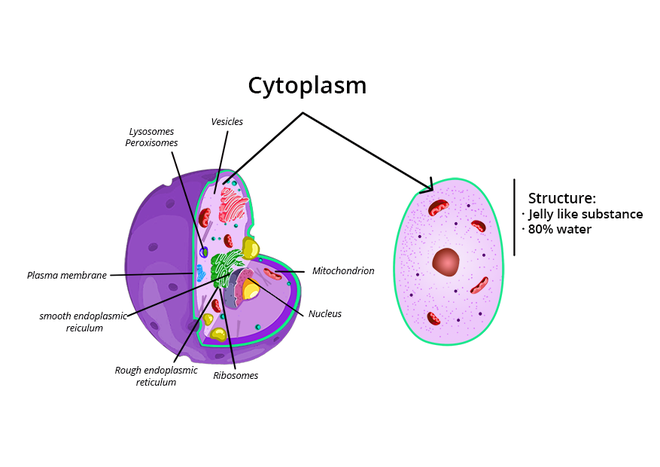
Cytoplasm is a jelly-like substance present in both plant and animal cells.
Characteristics of Cytoplasm are listed below:
- It is present between the nucleus and the plasma membrane.
- Cytoplasm is composed of water, organic, and inorganic compounds.
- It is the site for many metabolic chemical reactions as it contains many cell enzymes.
- All the cell organelles are embedded in the cytoplasm.
**3. Nucleus
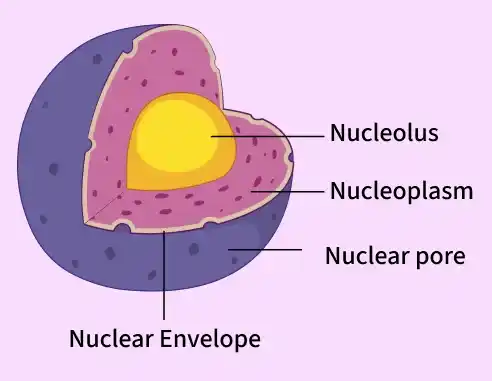
The nucleus is a double-membrane structure present in all eukaryotic cells. It contains the maximum molecular weight of the cell.
Characteristics of the nucleus are given below:
- It is circular in shape and dark in colour, having a double membrane.
- Nuclear membranes are also selectively permeable. They help in cellular transport. Nuclear pores are present over the nuclear membrane, which help in the transport of proteins and transcription factors. The nuclear membrane differentiates the nucleoplasm from the cytoplasm.
- Within the nucleus, a small spherical body is presently known as the nucleolus. They are the thin, thread-like structure that contains the **gene.
- A gene is the hereditary unit, i.e., all the information from the parent to the offspring is transferred via a gene.
- The key function of the nucleus is to maintain the cell and its metabolic activities.
**4. Endoplasmic Reticulum
The Endoplasmic Reticulum is the membranous structure containing cisternae, which are attached to the tubules filled with some fluid. Endoplasmic Reticulum is the cell transport system, i.e., it helps to transport various proteins and enzymes in the cell or outside the cell.

There are two distinct types of Endoplasmic Reticulum:
- **Rough Endoplasmic Reticulum: they're created out of cisternae, tubules, and vesicles, and are where the protein is synthesised.
- **Smooth Endoplasmic Reticulum: They primarily work as a storage organelle. They also synthesise steroids and lipids. It also helps in detoxification.
**5. Mitochondria
Mitochondria are a semiautonomous organelle****,** i.e., they have some genes that form their proteins, but not all. For some proteins, mitochondria are still dependent on the nucleus.

Characteristics of mitochondria are given below:
- Mitochondria are known as the powerhouse of the cell.
- It is a double membrane structure present in all eukaryotic cells.
- Mitochondria vary in size and can be either circular or oval. It is the site for aerobic respiration.
**6. Plastids
The large membrane-bound organelles containing pigments are known as a plastid. Types of plastids are shown below:
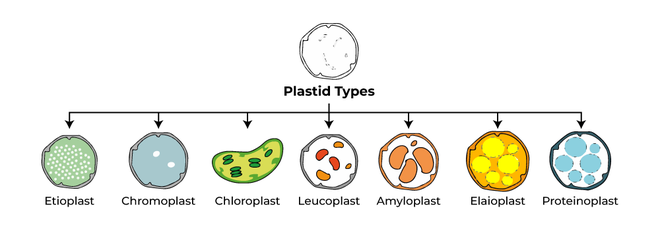
Depending on the type of pigments, plastids are differentiated into 3 types:
- **Chloroplasts: These are double-membrane organelles. Chloroplasts are present in the leaf mesophyll cell. Chlorophyll is the main pigment that helps in storing light energy, which helps in photosynthesis.
- **Chromoplasts: The chromoplasts incorporate fat-solvent, antioxidant shades like xanthophylls, and carotene, which provide the plants with their colour - yellow, orange, red, and so on.
- **Leucoplasts: Leucoplasts are colourless plastids that store nutrients in them. Amyloplasts store carbs (like starch in potatoes), aleuroplasts store proteins, and elaioplasts store oils and fats.
**7. Ribosomes
Ribosomes are non-membrane-bound structuresThe made up of RNA and protein and are mainly attached to the endoplasmic reticulum.
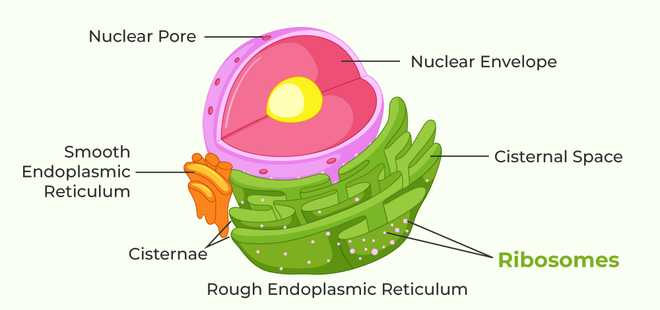
Characteristics of ribosomes are given below:
- They are composed of RNA and ribosomal proteins.
- Ribosomes can be of 2 types, i.e. 70s present in prokaryotic cells and 80s in eukaryotic cells. Where s stands for Svedbergs Unit.
- Both ribosomes are composed of 2 subunits large and a small subunit.
- Ribosomes can be present in both forms, either they are attached to the ER or present freely in the cytoplasm.
**8. Golgi Complex
Golgi complex is also known as the Golgi Apparatus.
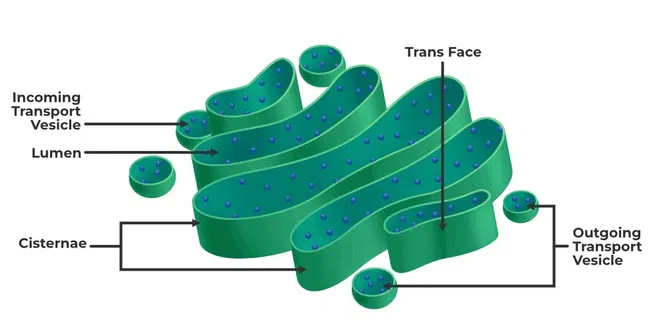
Characteristics of the Golgi complex are listed below:
- The Golgi complex is a membrane-bound organelle that forms flattened, stacked pouches known as cisternae, present in both plant and animal cells.
- The Golgi apparatus helps in transporting the cargo, modifications, targeting, and packaging of proteins and lipids to the target site.
**9. Microbodies
Microbodies are single-membrane structures, minute, sac-like organelles, present in both plant and animal cells. Microbodies contain various enzymes that can be seen via an electron microscope.

Characteristics of Microbodies are listed below:
- Microbodies primarily focus on tasks such as breaking down fats, detoxifying harmful substances, and managing cellular energy.
- Among some microbodies are Woronin bodies, peroxisomes, glycosomes, and glyoxysomes.
- A microbody is typically a spherical vesicle with a diameter of between 0.2 and 1.5 micrometres.
- They lack any genetic material that would allow them to self-replicate.
**10. Cytoskeleton
The cytoskeleton is a proteinaceous structure that is present from the cell membrane to the nucleus. It is present everywhere in the cell.
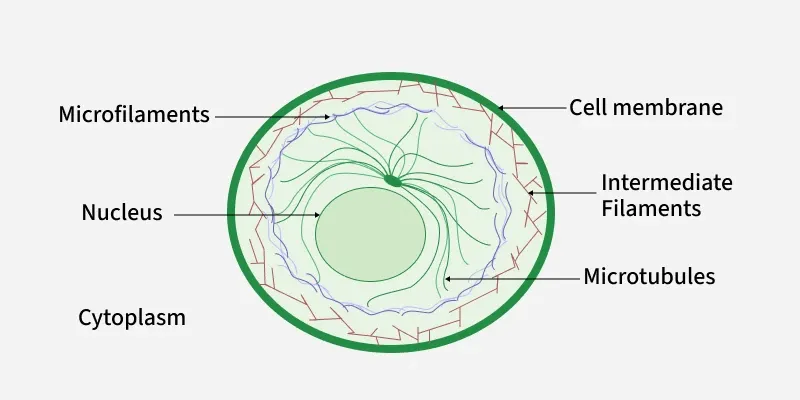
Characteristics of the Cytoskeleton are:
- It provides shape to the cell and helps in the movement of the cargo
- Cell matrix is a form of different types of proteins that assemble in a few minutes and disassemble depending on the cell's requirement.
- They provide mechanical resistance to the cell, and the contractile nature of the filament helps the cell in movement.
**11. Cilia and Flagella
Cilia and flagella are present on the cell surface. They both help in the movement of the cell.
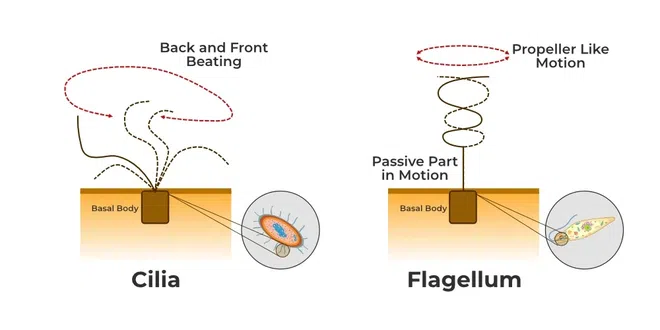
Characteristics of Cilia and Flagella are:
- Cilia are hair-like projections present on the cell membrane that help in the movement of cells or extracellular fluid.
- Flagella are a bit bigger than the cilia.
- Axoneme is the core of both cilia and flagella, which contain 9 microtubules and a set of central microtubules.
- The centriole is the basal body of both cilia and flagella.
**12. Centrosomes and Centrioles
A centrosome is made when 2 perpendicular centrioles come together and form a centrosome.
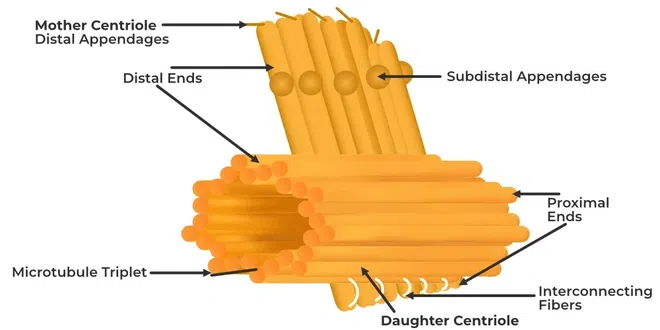
Characteristics of Centrosomes are:
- Each centriole is made of nine microtubule triplets arranged in a cylinder.
- Centrioles connect the peripheral fibril with the radial spoke. Cilia and flagella basal bodies are composed of centrioles.
**13. Vacuoles
Vacuoles are the cell organelles with a single membrane.

Characteristics of vacuoles are listed below:
- In plant cells, vacuoles have the maximum area of the cells.
- Vacuoles help in storing various compounds. Normally, they store nutrients and food that are required for the survival of a cell. Vacuoles also store waste products.
- The no and shape of vacuoles vary depending on the cell.