Prokaryotic Cells (original) (raw)
Last Updated : 23 Apr, 2026
Prokaryotic cells are simple, microscopic cells that do not have a true nucleus or membrane-bound organelles. Their genetic material is present in a nucleoid region.
- They are normally smaller than eukaryotic cells, with a size range of 0.1 to 5 μm in diameter.
- They are evolutionarily older than eukaryotic cells and live in nearly all environments on Earth.
- They can adapt to diverse environments.
Characteristics of Prokaryotic Cells
The following are characteristics of prokaryotic cells:
- The prokaryotic cells are represented by bacteria, blue-green algae, mycoplasma and PPLO (Pleuro Pneumonia Like Organisms).
- Prokaryotic cells don't have membrane-bound organelles.
- They are significantly smaller than eukaryotic cells.
- Most prokaryotic cells have a cell wall made of peptidoglycan, but some (e.g., Mycoplasma) lack it.
- Many additionally include a polysaccharide-based capsule or slime layer.
- Prokaryotes frequently have protrusions on their surface.
- They usually possess a single circular chromosome located in the nucleoid region due to their simple cellular organisation, and they are structurally simpler organisms.
Structure of Prokaryotic Cells
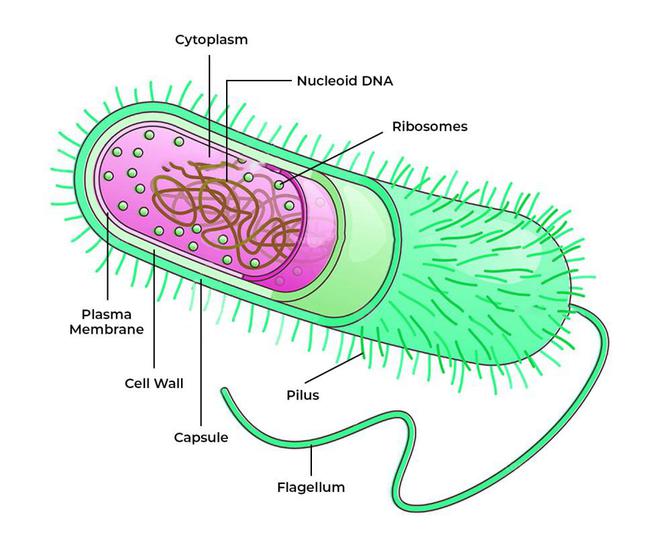
Prokaryotes are unicellular organisms, such as bacteria and archaea. They vary in shape and can be spherical, rod-shaped, or spiral. A prokaryotic cell structure is as follows:
- Prokaryotic cells lack a true nucleus, and their genetic material is present in a nucleoid region.
- They lack a well-developed cytoskeleton like eukaryotes.
- They have a single, circular DNA that contains the genetic instructions for the functioning of the cell.
- Most prokaryotic cells have a rigid cell wall that provides structural support and protection.
- They have a plasma membrane, the semipermeable barrier that separates the cell's interior from its external environment.
- The cytoplasm is the gel-like substance within the cell membrane where various metabolic processes occur
- The prokaryotic cells have ribosomes, which are structures that produce proteins.
- Pili are short, hair-like appendages on the surface of some prokaryotic cells that serve various functions, such as attachment to surfaces and conjugation.
- Some prokaryotic cells possess flagella, whip-like structures that allow for motility. Flagella help bacteria move through their environment.
**Reproduction in Prokaryotes
Prokaryotes reproduce asexually (binary fission), while genetic recombination (conjugation, transformation, transduction) is not true sexual reproduction.
**Binary Fission (Asexually)
Binary fission is the process in which one cell divides into two identical daughter cells. When an organism divides into two halves (cytokinesis) through binary fission, it doubles its genetic material, or deoxyribonucleic acid (DNA), with each new organism receiving one copy of DNA.
Genetic Recombination (Not a true Sexual Reproduction)
It is a type of Gene transfer mechanism in which the genetic material of one bacterium is inserted into the genetic material of another bacterium. This happens via 3 processes:
| Types of Genetic Recombination | Characteristics |
|---|---|
| **1. Conjugation | One bacterium can exchange genetic material with another directly through the process of conjugation. One bacterium acts as the genetic material giver during conjugation, and another bacterium acts as the recipient. The fertility factor, or F-factor, is a DNA sequence that is carried by the donor bacterium |
| **2. Transformation | Bacteria take up foreign DNA from the environment and incorporate it into their genome. |
| **3. Transduction | In this process, DNA is transferred to the bacteria with the help of a virus. Example Bacteriophage. |
Examples of Prokaryotic Cells
Examples of prokaryotic cells are primitive Bacterial cells and archaea bacteria.
- **Bacteria: Bacteria are unicellular, simple cells. Bacteria are present everywhere on Earth. The size and shape of bacteria vary. Flagella help in locomotion, while pili are mainly for attachment and conjugation. DNA is circular, and they also have plasmid (extrachromosomal DNA).
- **Archaea Cells: These are similar to normal bacteria, but they can survive or be found in harsh conditions because of the composition of the surface layer. The cell wall of archaea doesn't have peptidoglycan; they have different types of lipids with different features.
- **Cyanobacteria: These are the Photosynthetic prokaryotes. They contain chlorophyll and can perform photosynthesis and make their own food. In the aquatic environment, they are the primary producers.
Gram Staining
Gram staining is a laboratory technique used in microbiology to classify bacteria into two main groups based on the structure of their cell wall.
In simple words, it’s a dye test that tells us what type of bacteria we’re looking at.