Gibberellins (original) (raw)
Last Updated : 3 Jun, 2026
Gibberellins are important plant hormones that regulate various growth and developmental processes in plants. They mainly promote stem elongation, seed germination, flowering, and fruit development by stimulating cell division and cell elongation. These hormones are produced in young and actively growing regions such as shoot tips, developing seeds, roots, and leaves. Gibberellins play a significant role in plant growth and are widely used in agriculture and horticulture to improve crop yield and quality.
Historical Discovery of Gibberellins
- Gibberellins were first discovered in the early twentieth century during studies on a disease affecting rice plants in Japan.
- In the 1920s, a Japanese scientist named Eiichi Kurosawa observed a peculiar disease in rice plants known as the “bakanae” disease, which means “foolish seedling disease.”
- Rice plants affected by this disease showed excessive stem elongation, became abnormally tall, weak, and pale, and eventually died without producing grains.
- Kurosawa discovered that the disease was caused by a fungus called Gibberella fujikuroi.
- This fungus produced certain chemical substances that stimulated abnormal growth in rice seedlings. Later, scientists isolated these substances and named them gibberellins after the fungus from which they were first obtained.
- Further research led to the identification of many different types of gibberellins in plants and fungi. Among them, gibberellic acid, commonly known as GA₃, became one of the most extensively studied and commercially important gibberellins.
Nature and Production of Gibberellins
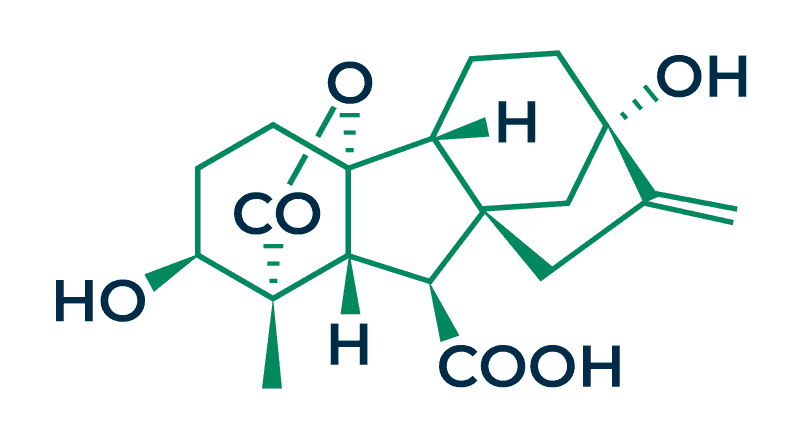
- Gibberellins are diterpenoid acids that function as plant growth regulators.
- They are synthesised naturally in various parts of plants, especially in actively growing tissues such as young leaves, root tips, stem apices, developing seeds, embryos, and fruits
- The biosynthesis of gibberellins begins in plastids and continues in the endoplasmic reticulum and cytoplasm of plant cells.
- More than 130 different gibberellins have been identified in plants, fungi, and bacteria. However, only a few of them are biologically active.
- Among all gibberellins, GA₃ or gibberellic acid is one of the most important and widely used forms in agriculture because of its strong growth-promoting effects.
Characteristics of Gibberellins
Gibberellins possess several important characteristics that distinguish them from other plant hormones:
- They are growth-promoting phytohormones.
- They stimulate stem elongation and cell division.
- They are produced mainly in young and actively growing tissues.
- They help break seed and bud dormancy.
- They influence flowering and fruit development.
- They are effective even in very small concentrations.
- They are widely used in agricultural and horticultural practices.
Functions of Gibberellins
Gibberellins perform a wide range of physiological functions in plants. These hormones regulate several growth and developmental processes essential for plant survival and reproduction.
**1. Promotion of Seed Germination
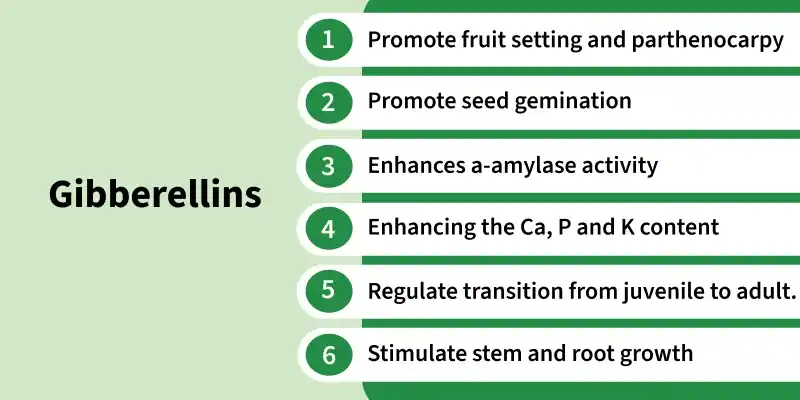
- One of the most important functions of gibberellins is the stimulation of seed germination.
- During germination, gibberellins activate the production of hydrolytic enzymes such as amylase in the aleurone layer of seeds.
- These enzymes break down stored starch into simple sugars that provide energy for the growing embryo.
- As a result, seeds germinate more effectively, and seedlings develop rapidly.
- Gibberellins are especially important in cereal grains such as barley, wheat, and rice.
**2. Breaking Seed and Bud Dormancy:
- Many seeds and buds remain dormant under unfavourable environmental conditions.
- Gibberellins help overcome dormancy by stimulating metabolic activities and growth processes.
- Application of gibberellins can induce germination in dormant seeds and promote sprouting in dormant buds.
- This property is useful in agriculture for ensuring uniform germination and growth.
**3. Stem Elongation
- Gibberellins strongly promote stem elongation by stimulating both cell division and cell elongation.
- Plants treated with gibberellins often become taller because their internodes increase in length.
- This effect is particularly evident in dwarf plants, where gibberellin application can restore normal height.
- Gibberellins therefore play a major role in determining plant stature.
**4. Delay of Senescence
- Gibberellins help delay senescence or ageing in leaves, fruits, and other plant organs.
- They maintain chlorophyll content and prolong the functional life of plant tissues.
- As a result, leaves remain green for a longer time, and fruits maintain freshness and quality for extended periods.
**5. Induction of Flowering
- Gibberellins induce flowering in certain plants, especially long-day plants and biennial plants.
- In some species, gibberellins can replace the requirement for specific environmental conditions such as long photoperiods or cold treatment.
- This property is highly useful in horticulture and commercial flower production.
**6. Fruit Development
- Gibberellins promote fruit growth and increase fruit size by stimulating cell division and elongation.
- They also help improve fruit quality and appearance.
- In some plants, gibberellins can induce parthenocarpy, which is the development of seedless fruits without fertilisation.
- Seedless grapes, tomatoes, and cucumbers are examples of fruits that can be produced using gibberellins.
**7. Promotion of Bolting
- Bolting refers to the rapid elongation of the flowering stem before flowering occurs.
- Gibberellins stimulate bolting in rosette plants such as cabbage, beetroot, and lettuce.
- This process is important for reproductive development in many plants.
**8. Enzyme Production
- Gibberellins stimulate the synthesis of several enzymes involved in metabolism and growth.
- One important enzyme activated by gibberellins is alpha-amylase, which helps convert stored starch into sugars during seed germination.
Commercial Uses of Gibberellins
Gibberellins have numerous commercial applications in agriculture, horticulture, and the food industries due to their growth-promoting properties.
- **Increase in Crop Yield: Gibberellins are used to promote plant growth and increase crop yield. By stimulating stem elongation and overall growth, these hormones help improve agricultural productivity.
- **Malting Process in Brewing Industry: In the brewing industry, gibberellins are used during the malting process of barley. They stimulate the production of enzymes that convert stored starch into sugars required for fermentation. This process improves the efficiency of beer production.
- **Production of Larger Fruits: Gibberellins are applied to fruits such as grapes, apples, and pears to increase fruit size and improve market quality. In grapes, gibberellins produce larger and elongated fruits with better appearance and higher commercial value.
- **Breaking Seed Dormancy: Application of gibberellins helps break dormancy in seeds and ensures uniform germination. This is especially useful in crops with hard or dormant seeds.
- **Production of Seedless Fruits: Gibberellins are used to induce parthenocarpy and produce seedless fruits in several horticultural crops. Seedless fruits are often preferred in the market because of better taste and convenience.
- **Delay of Fruit Ageing: Gibberellins help delay ripening and ageing of fruits, thereby increasing shelf life during storage and transportation.
Advantages of Gibberellins
- Gibberellins promote rapid growth and increase plant height through stem elongation.
- By stimulating growth and flowering, gibberellins contribute to higher crop yields and better agricultural output.
- Application of gibberellins results in larger, healthier, and more attractive fruits.
- Gibberellins are widely used in horticulture for seed germination, flowering control, and fruit production.
- These hormones ensure faster and more uniform seed germination in agricultural crops.
Disadvantages of Gibberellins
- Overuse of gibberellins may lead to abnormal elongation and excessive vegetative growth.
- Excessive stem elongation may result in weak and slender stems that are unable to support the plant properly. This condition may lead to lodging, where crops bend or fall over.
- Gibberellins must be applied in appropriate concentrations because excessive amounts can negatively affect plant balance and development.
- Plants with excessive growth may become more vulnerable to wind damage and environmental stress.