Coordination in Plants (original) (raw)
Last Updated : 1 May, 2026
Different plant tissues work together to respond to a particular stimulus, and this process is known as coordination. In plants, coordination is carried out through various chemicals in their chemical signalling system. Different plant hormones, also known as phytohormones, play a major role in this coordination process. Plant coordination involves the integration of signals from both internal and external sources, enabling plants to optimise their survival and reproduction.
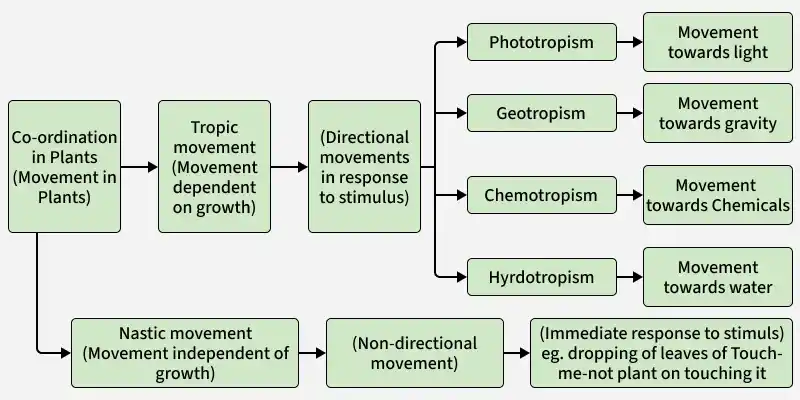
**Plants normally show 2 types of movement:
- Growth-Dependent movement (**Trophic Movement**):** Such Movement away from and towards a stimulus.
- **Non-Growth Dependent Movement (Nastic Movement): All those movements occur without a stimulus. Such movement is also known as Nastic Movement.
**Trophic Movement
Development of a plant that decides to head with the upgrade.
**Example: Phototropism.
- **Function: Tropisms are developments that are prompted toward the path connected with the development course. Being firmly connected with the sessile way of life of plants, they are utilised to lay out body design and to arrange body parts to additional appropriate conditions.
- **Characteristics: A tropism is a development toward or away from an upgrade. Normal upgrades that impact plant development include light, gravity, water, and contact. Plant tropisms vary from other upgrade, created developments, for example, nastic developments, in that the direction of the reaction relies upon the direction of the boost.
**1. Phototropism
These types of plants give responses to light for growth and development, and for maximum photosynthesis, the plant shoot bends towards the side where more sunlight falls. Movement of plants towards a light.
**Example: Sunflower.

**2. Geotropism
Geotropism, also known as Gravitropism, is the response to gravity for the growth and development of the plant. For survival, it causes the orientation of the shoot and roots of the plant. Movement of plants towards the gravity of the Earth.
**Example: Plants that develop on steep slopes.

**3. Chemotropism
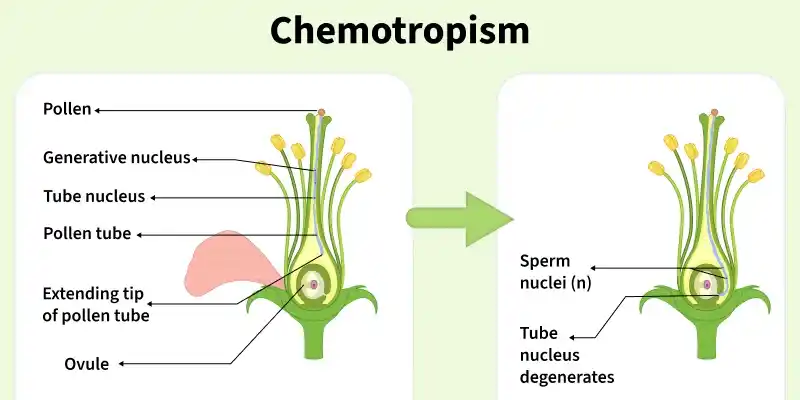
Chemotropism is the response to chemicals for the directional growth and development of the plant. This process is generally responsible for reproduction and nutrient acquisition. Movement of plants towards synthetic compounds.
**Example: The development of the dust tube down to the ovule in the ovary through the stigma and style during preparation to determine the presence of sugars in the style.
**4. Hydrotropism
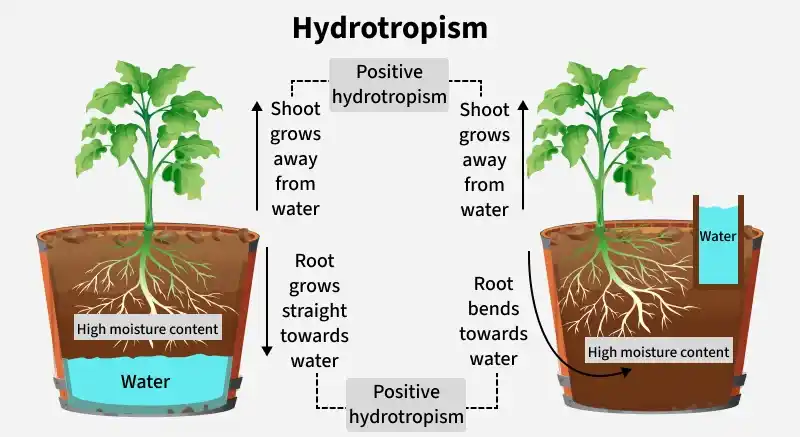
These types of plants give responses to water for directional growth and development. Since water is essential for plant survival, roots naturally grow in the direction where more water is present in the soil. Movement of plants towards the water.
**Examples: Tomato roots, radish roots, or even carrots.
**Nastic Movement
All the non-directional movements are classified in the Nastic Moments. Such a movement occurred because change of water content of the leaf. On this basis, they either shrink or swell.
**Example: Touch Me Not plant (Mimosa pudica), when we touch the plant, it immediately fold their leaves.

Plant Hormones
Plant hormones, commonly known as phytohormones, are chemical substances that oversee and coordinate a variety of growth and developmental functions in plants.
**It is divided into two categories based on functions:
- Plant Growth Promoter
- Plant Growth Inhibitor
**1. Auxin
It is a plant chemical that advances cell extension and development in plants.
**Examples: indole-3-acetic acid (IAA) and indole butyric acid (IBA).
- **Function:Auxin promotes cell growth and elongation of the plant. In the elongation process, auxin alters the plant wall plasticity, making it easier for the plant to grow upwards. Auxin also influences rooting formations.
- **Characteristics: Auxin is a plant chemical delivered in the stem tip that advances cell division. Auxin moves to the darker side of the plant, making the cells there become bigger than those on the lighter side of the plant.
**2. Gibberellins
A plant chemical that advances cell separation and breaks the dormancy of seeds and buds.
**Example: Bacillus licheniformis, B. pumilus, Rhizobium meliloti.
- **Function: Gibberellins are plant development regulators that work with cell stretching and assist the plants in becoming taller. They likewise assume significant parts in germination, an extension of the stem, fruit development and flowering.
- **Characteristics: There are three normal primary qualities between these GAs: a hydroxyl group on C-3β, a carboxyl group on C-6, and a lactone between C-4 and C-10.
**3. Cytokinin
A plant chemical that advances cell division and the kickoff of stomata.
**Example: Benzyl adenine.
- **Function: Cytokinins are a group of plant development controllers that are fundamentally engaged in performing cell division in the plant root and shoot system. This chemical aids in advancing the cell's development, improvement, and separation, influencing apical predominance and deferring leaf senescence.
- **Characteristics: Cytokinin are fundamental plant chemical. By invigorating cell division, they direct shoot meristem size, leaf primordia number, and leaf and shoot development. They can animate both the separation and the outgrowth of axillary buds. The cytokinin can interfere with axillary bud discharge from apical dominance.
4. Ethylene
Ethylene acts as a plant hormone that is gaseous in nature. It is the first known gas found to be a natural hormone.
**Example: Ethylene gas (C₂H₄).
- **Function: Promoting the ripening of fruits and ageing (senescence) are the main functions of this hormone. To affect growth at high concentrations, stimulating flowering in pineapple, inducing leaf and flower senescence, and promoting fruit ripening in banana, mango, and tomato.
- **Characteristics: It is the only gaseous plant hormone and is produced in ripening fruits, ageing leaves, and nodes of stems.
**5. Abscisic Acid
It helps in hindering the development of the plant and advances shrivelling and falling of leaves and food.
**Example: Jasmonate, Phytohormone, Protein, Cytokinin.
- **Function: Abscisic acid (ABA) is a significant phytohormone directing plant development, improvement, and stress reactions.
- **Characteristics: Abscisic acid is a sesquiterpene, which plays a significant part in seed improvement and development, in the combination of proteins and viable osmolytes, which empower plants to endure stresses because of natural or biotic variables, and as an overall inhibitor of development and metabolic activities.