Overview of Grazing Food Chain (original) (raw)
Last Updated : 23 Jul, 2025
**A grazing food chain is a type of food chain that involves the transfer of energy between autotrophic plants and herbivores. In a food chain, nutrients and energy flow from one organism to another at different trophic levels. The grazing food chain starts with producers. Green plants (producers) use solar energy in the grazing food chain to fix the abiotic carbon dioxide into glucose by photosynthesis. Grazing food chains are important for maintaining the balance of energy flow in ecosystems.
Table of Content
- What is the Grazing Food Chain?
- Grazing Food Chain Diagram
- Features of Grazing Food Chain
- Types of Grazing Food Chain
- What is the Flow of Energy Through a Grazing Food Chain?
- What are Some Examples of Grazing Food Chain?
- Grazing Food Chain Significance
- Difference Between the Grazing Food Chain and the Detritus Food Chain
What is the Grazing Food Chain?
**Grazing Food Chain Definition: The Grazing Food Chain is a sequence of transfer of nutrients and energy from green plants to higher trophic levels.
Grazing food chain starts from producers. The green plants are the primary producers that convert sunlight into energy and trap it within glucose through photosynthesis. Herbivores, such as rabbits or cows, eat these plants and acquire energy from the producers. These herbivores are then eaten by consumers and thus energy flows from herbivores to consumers, and so on. The grazing food chain plays a crucial role in the ecosystem by driving a **unidirectional energy flow from one trophic level to another which is essential for the survival of diverse organisms.
**Also Read: Difference Between Respiration And Photosynthesis
Grazing Food Chain Diagram
The grazing food chain diagram is shown below:

Grazing Food Chain Diagram
Features of Grazing Food Chain
The important features of grazing food chain are discussed below.
- **Solar energy: It depends on solar energy as the initial source of energy. Photosynthetic organisms, such as green plants, utilize sunlight and convert it into chemical energy through photosynthesis.
- **Energy flow: It maintains a continuous flow of energy within the ecosystem. The flow of energy occurs from the producers (plants) to the herbivores and then to the carnivores.
- **Nutrient fixation:It plays an important role in nitrogen fixation in the soil. In the process of decomposition and nutrient cycling, organic matter and nutrients are released in the soil, which are then available for the plant to uptake.
- **Macroscopic organisms: All the macroscopic organisms including plants, herbivores, carnivores, and decomposers are the participants of this food chain.
- **Factors affecting the food chain: Various factors that affect the grazing food chain include plant oxidation, virus attacks on plants, and plant decay.
**Also Read: Difference Between Food Chain and Food Web
Types of Grazing Food Chain
There are mainly two types of grazing food chains.
- **Predator Chain: The animal which is consumed by another animal, is called **prey. The animal that consumes prey is called a **predator. The flow of energy occurs as the predator feeds on the prey, and then this predator becomes the prey of another predator of a higher trophic level. The predator chain **represents the energy flow through predation from one trophic level to another.
- **Parasitic Chain: The parasites such as fungi, bacteria, or small insects infect plants and animals within the food chain and live on or within the host organisms. The parasites extract nutrients and energy from the host organisms at the cost of their health. The parasitic chain demonstrates a unique interaction between parasites and their hosts and energy flows through parasitic relationships.
**Also Read: Difference Between Bacteria And Fungi
What is the Flow of Energy Through a Grazing Food Chain?
The energy flows in the grazing food chain in the following manners.
- **Trophic Levels: The flow of energy in an ecosystem occurs from one trophic level to another. The energy flow starts from the lowest trophic level i.e. producers (plants) and then progresses through primary consumers (herbivores), secondary consumers (carnivores), and so on.
- **Unidirectional Energy Flow: Energy always flows in a **one-way direction in the grazing food chain starting from the producers to herbivores and then to carnivores.
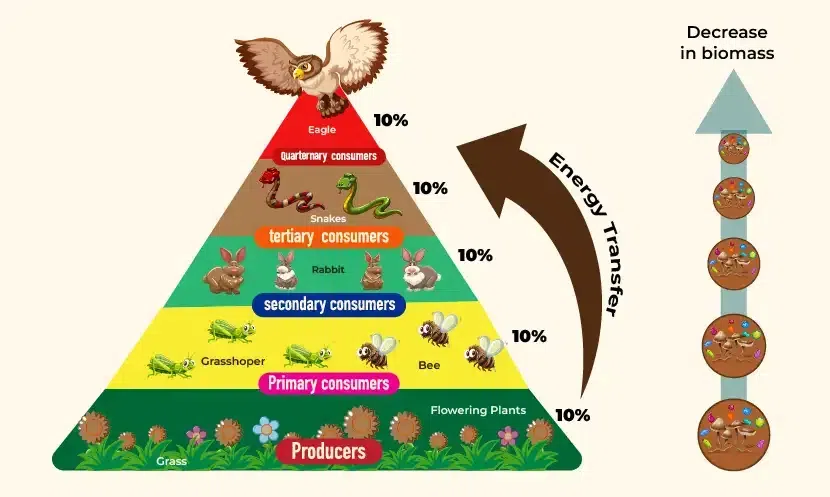
- **Energy Loss: As energy moves to the upper trophic levels, there is a **loss of energy in the form of heat at each level due to metabolic processes, and physical activities of the organisms. Therefore, there is a decrease in energy available to the next upper trophic level.
- **10% Rule: According to the 10% rule, **only approximately 10% of the energy accumulated as biomass is transferred from one trophic level to another per unit of time. Therefore, the net productivity of each level is only 10% of the net productivity of the previous level.
**Also Read: Diagram of Trophic Level - Ecological Pyramids
What are Some Examples of Grazing Food Chain?
Some examples of grazing food chains are given below.
**Aquatic Grazing Food Chain Example
Phytoplankton → Zooplankton → Small Fish → Larger Fish → Humans.
**Terrestrial Grazing Food Chain Examples
Grass → Rabbit → Fox
Leaf → Caterpillar → Chameleon → Mongoose → Snake.
Grazing Food Chain Significance
The grazing food chain plays many significant roles in an ecosystem which are as follows.
- It helps in the recycling of nutrients in the ecosystem.
- It helps to control the plant populations.
- It helps to create an ecosystem having diverse species of plants and animals.
- It provides an important source of food for many animals.
**Also Read: Types Of Ecosystem
Difference Between the Grazing Food Chain and the Detritus Food Chain
The grazing food chain differs from the detritus food chain in several ways which are stated below.
| Features | Grazing Food Chain | Detritus Food Chain |
|---|---|---|
| Primary energy source | Solar energy | Dead and decaying organic matter (detritus) |
| Primary producers | Plants | Detritus serves as the initial energy source |
| Primary consumers | Herbivores | Detritivores |
| Energy flow | Energy transfers from plants (producers) to herbivores (primary consumers) to carnivores (secondary consumers) | Energy transfers from detritus to detritivores to decomposers |
| Trophic levels | Consist of primary producers, herbivores, and carnivores | Consist of detritivores and decomposers |
| Efficiency in the transfer of energy | Less efficient in the transfer of energy due to energy loss at each trophic level | More efficient in the transfer of energy as detritus provides direct energy |
| Nutrient cycle | Contribution to nutrient cycle is limited | Contribution to nutrient cycle is very significant |
| Dependency on sunlight | Highly dependent on sunlight and photosynthesis | Less dependent on sunlight; can occur in dark environments |
| Examples | Grass → Grasshopper → Frog → Snake | Dead leaves → Detritivores → Decomposers |
**Also Read: Difference Between Grazing and Detritus Food Chain
The grazing food chain begins with the autotrophic plants and sunlight is the primary source of energy. It begins with producers, like green plants, that create their own food through photosynthesis. The grazing food chain then moves from herbivores to carnivores. The energy is transferred in a unidirectional manner in a food chain. Only 10% in the form of biomass is transferred to the next trophic level. The grazing food chain mainly differs from the detritus food chain in terms of energy source which is dead organic matter in the detritus food chain. The grazing food chain is dependent on the amount of solar radiation.
**Also Read: