Common Diseases In Humans (original) (raw)
Last Updated : 5 Jan, 2026
A disease is a physiological condition in which the human body fights against the external or internal causes of infection. Based on externally caused diseases, various examples are present, ranging from bacteria, viruses, protozoans, helminths, and many more. The pathogen is an organism that causes a disease in another organism (Host) to complete its life cycle or survival.
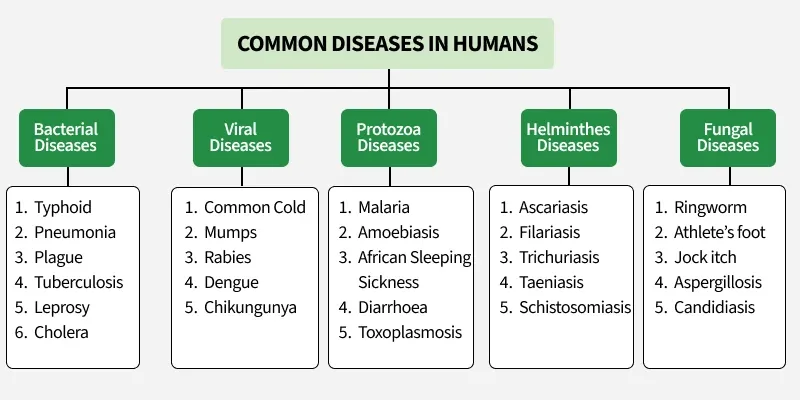
Diseases Caused by Bacteria
Bacteria are microscopic, single-celled organisms found everywhere in the environment. While many bacteria are harmless or even beneficial, some can cause infectious diseases in humans, animals, and plants. These diseases occur when pathogenic bacteria enter the body and multiply, releasing toxins or damaging tissues.
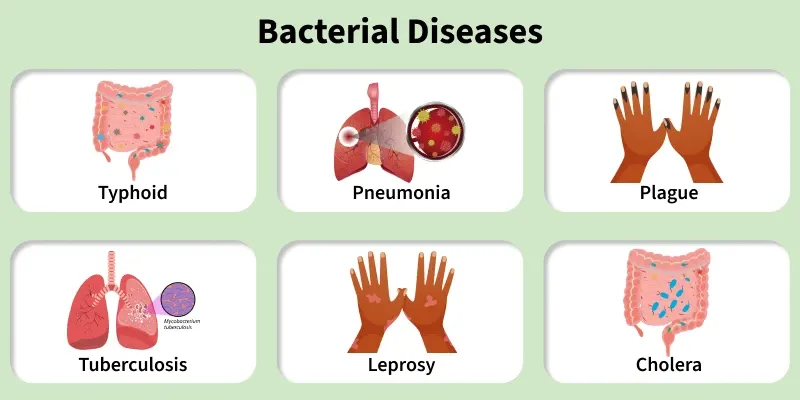
The following are some diseases caused by the bacteria:
**Typhoid
- Caused by a bacterium called _Salmonella typhi
- **Symptoms: High fever, weakness, stomach pain, constipation, headache, and loss of appetite. Furthermore, Intestinal perforation and death can also be reported in some cases.
- It generally enters the body through contaminated food and water and migrates to other organs through the blood.
- Mary Mallon, also known as Typhoid Mary, was a cook and a carrier of typhoid. She spread typhoid for many years, unknowingly that she was suffering from typhoid.
- **Diagnostic Test: - WIDAL Test
**Pneumonia
- Caused by two bacteria called __Streptococcus pneumoniae_and _Haemophilus influenzae ****.**
- **Symptoms: Fever, chills, cough, and headache.
- The infection is acquired by inhaling the droplets and aerosols released by an infected person or even by sharing glasses and utensils with an infected person.
- The infected organ in the human body: alveoli (air-filled sacs) of the lungs. The alveoli get filled with fluid, leading to several respiratory problems.
- In some severe cases, it has been seen that the lips and fingernails turn grey to bluish in colour.
Disease Caused by Viruses
Viral diseases are illnesses caused by viruses, which are microscopic infectious agents that can reproduce only inside the living cells of a host. Viruses affect humans, animals, and plants, and they spread through air, water, food, physical contact, or vectors like mosquitoes.
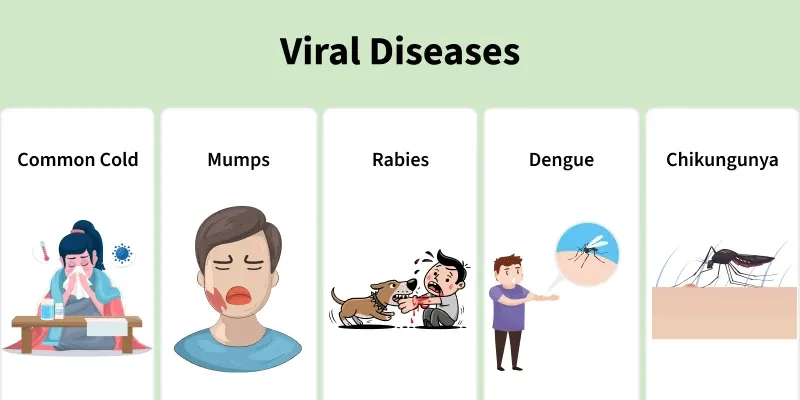
The following are the diseases caused by viruses:
**Common Cold
- Caused by Rhinoviruses (It is a group of the most infectious human ailment viruses).
- **Symptoms: Nasal congestion and discharge, sore throat, hoarseness, cough, headache, tiredness, etc., usually lasting for 3-7 days.
- The infection is acquired by inhaling Droplets from the cough/sneezing of an infected person or through contaminated objects, e.g. computer keyboard or mouse, pen, etc.
- The infected organ in the human body: -nose and respiratory passage, but not the lungs.
Dengue
- Spread by the bite of an infected _Aedes mosquito
- Not spread directly from person to person
- **Symptoms: High fever, Severe headache and pain behind the eyes, Muscle and joint pain (breakbone fever), Nausea, and vomiting
- No specific antiviral treatment available
- Supportive care such as rest, hydration, and fever management
Disease Caused by a Protozoan
Protozoan diseases are illnesses caused by protozoa, which are single-celled, microscopic organisms. These diseases commonly spread through contaminated food or water, insect bites, or direct contact with infected individuals.
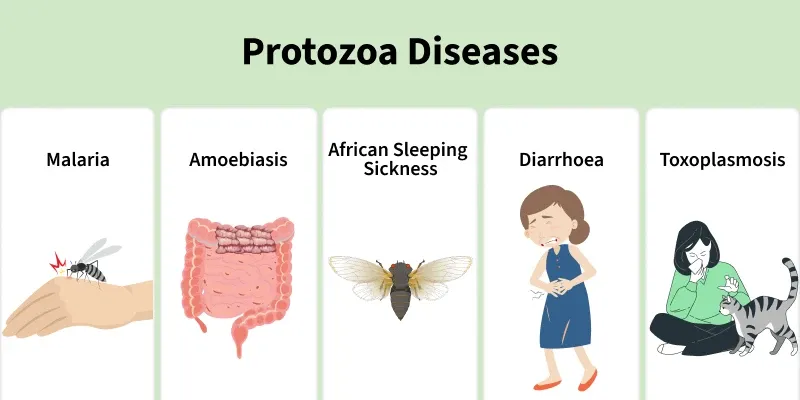
The following are the diseases caused by protozoa:
**Malaria
- Caused by _Plasmodium (_P. vivax, P. malaria, and P. falciparum)
- **Symptoms: Recurring fever, chills and anaemia.
- Furthermore, malaria caused by P. falciparum is the most serious and can even be fatal.
- The primary host of _Plasmodium is the female _Anopheles mosquito, whereas the secondary host is Humans.
**Amoebiasis
- Caused by _Entamoeba histolytica, a parasite of the large intestine of humans.
- **Symptoms: Constipation, abdominal pain, cramps, stools with excess mucous, and blood clots.
- **Vector: Houseflies (acts as carriers and spreads to transmit the parasite from the faeces of an infected person to food and food products.)
- **Sources of infection: Drinking water and food contaminated by faecal matter.
Diseases Caused by Helminthes
Helminths are parasitic worms that live in the human body and cause a variety of diseases known as helminthic diseases. These worms mainly belong to three groups: Platyhelminthes (flatworms), Nematodes (roundworms), and Annelids (segmented worms – rarely parasitic). Helminthic infections are common in areas with poor sanitation and hygiene.
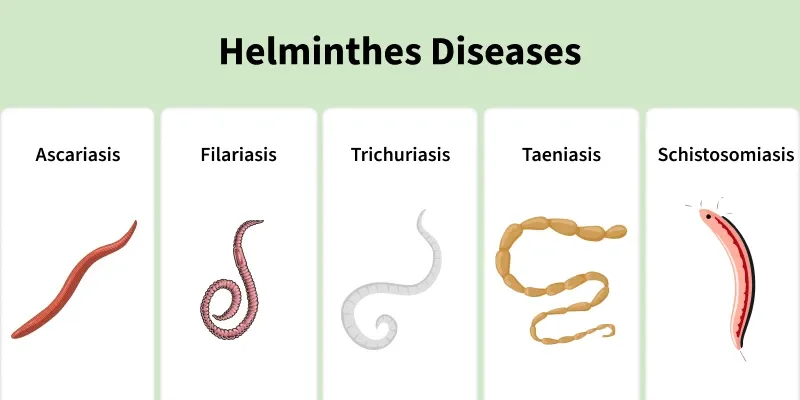
The following are the diseases caused by Nematodes:
Elephantiasis or Filariasis
- Caused by__Wuchereria_(W. bancrofti and__W. malayi), commonly known as filarial worms.
- **Symptoms: recurrent fever, lymph node swelling, inflammation of lymph vessels.
- **Vector: Female mosquito vectors (Infection transmitted to the healthy person through the bite of female mosquito vectors).
- The chronic inflammation of the organs develops due to the long-term residence of filarial worms there.
**Ascariasis
- Caused by __Ascaris,_commonly known as roundworms (intestinal parasites).
- **Symptoms: Internal bleeding, muscular pain, fever, anaemia, and blockage of the intestinal passage.
- The eggs of the parasite are excreted along with the faeces, which ultimately contaminate water, plants, etc.
- A healthy person acquires the infection by consuming contaminated water, vegetables, fruits, etc.
Diseases caused by Fungi
Fungi can cause a variety of diseases in humans, plants, and animals. These diseases are called fungal infections or mycoses. Fungal diseases usually affect the skin, hair, nails, lungs, and sometimes internal organs.
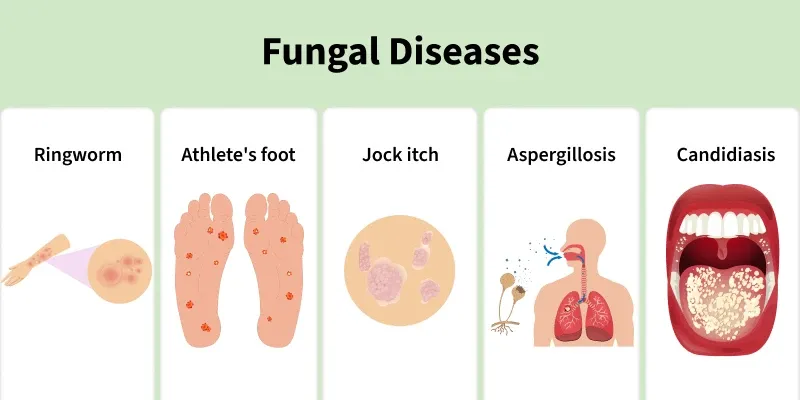
The following are the diseases caused byfungi:
**Ringworm
- Caused by fungi belonging to the genera _Microsporum, Trichophyton ****,** and _Epidermophyton ****.**
- **Symptoms: Appearance of dry, scaly lesions (accompanied by intense itching) on various parts of the body, such as skin, nails, and scalp.
- Infection is acquired by: Using towels, clothes, or even the comb of infected individuals. Heat and moisture help these fungi to grow, and most commonly infections thrive in skin folds such as those in the groin or between the toes.
Athlete’s Foot
- Caused by fungi like _Trichophyton.
- Spreads through direct contact or by walking barefoot on contaminated floors.
- **Symptoms: Itching and burning sensation between toes, Redness and cracked or peeling skin, and Blisters in severe cases.
- **Treatment: Antifungal creams, powders, or sprays, and Maintaining proper foot hygiene.