Virus in Biology (original) (raw)
Last Updated : 20 Nov, 2025
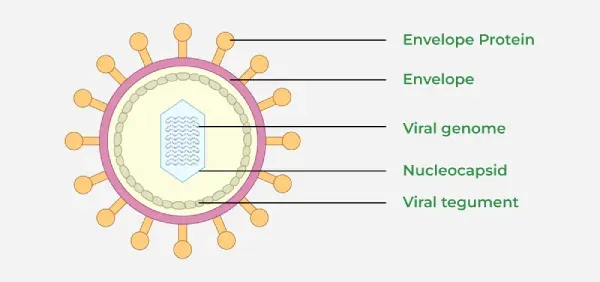
A virus is an extremely small infectious particle that is not truly living but can reproduce inside a host cell. It contains genetic material (DNA or RNA) wrapped in a protein coat. The study of viruses is called virology.
Characteristics of Virus
The following are a few of its characteristics :
- Viruses are submicroscopic organisms. They are even smaller than bacteria.
- They are non-cellular and lack cell organelles.
- Viruses are obligate parasites that act as connecting links between the living and the non-living organisms.
- Viruses contain protein and genetic material that can be either DNA or RNA, but can never be both.
- Their genetic material is protected by a protein covering called the capsid.
- The capsid is made up of small subunits called Capsomeres. These capsomeres are arranged in a geometric form (helical or polyhedral).
- Some viruses have an external lipid membrane called an Envelope.
Classification of Virus
Viruses can be classified based on various phenotypic characteristics, including nucleic acid type, morphology, mode of replication, chemical composition, host organisms, size, shape, and the kind of disease they cause.
1. Classification of viruses based on the type of nucleic acid
The following are the different virus types based on the type of nucleic acid, each given with some examples.
| DNA virus | RNA virus |
|---|---|
| When the genetic material in a virus is DNA, it is referred to as a DNA virus. | When the genetic material in a virus is RNA, it is referred to as an RNA virus. |
| It can be categorised into Single-stranded (ss) and Double-stranded (ds) DNA | It can be categorised into Single-stranded (ss) and Double-stranded (ds) RNA. |
| Single-stranded(ss): Parvovirus, Picornaviruses**Double-stranded(ds)**: Herpesvirus, Adenovirus | Double-stranded(ds): Reovirus**Single-stranded(ss)**: Poliovirus, Hepatitis A, Rabies virus, Influenza. |
2. Classification of Viruses Based on Host
The following are the different types of viruses based on host, with examples.
| Plant Viruses | Animal Viruses | Bacterial Viruses |
|---|---|---|
| This type of virus infects plants | This type of virus infects animals, including humans | This type of virus infects bacteria |
| Mostly, they have RNA as genetic material | They have both DNA and RNA as genetic material | Mostly, they have DNA as genetic material |
| Example: TMV (Tobacco Mosaic Virus), CMV (Cucumber Mosaic Virus), Potato Virus Y | Examples: HIV → AIDS****,** Influenza virus, Coronavirus, Rabies virus, Dengue virus | Examples: T4 bacteriophage, Lambda phage, T2, T6 phages. |
3. Classification of Viruses Based on Structure
The following are the different virus types based on the structure, each given with some examples.
| Type of Virus | Example |
|---|---|
| Cubical virus (also known as icosahedral symmetry virus) | Picorna virus, Reovirus |
| Radial symmetry virus | Bacteriophage |
| Spiral virus (also known as helical symmetry virus) | Orthomyxovirus, Paramyxovirus |
| Complex virus | Pox virus |
Reproduction in a Virus
Viruses reproduce only inside a living host by taking over the host's metabolic system, and this process is known as viral replication. Steps of reproduction in a virus are as follows:
- **Attachment: also known as adsorption and Initially, the virus starts the attack by attaching itself to the host cell.
- **Penetration: The genetic material is injected into the host cell by the virus.
- Uncoating
- **Replication: The host cell's metabolism gets under the control of the virus. Thus, the host cell's organelles start producing new proteins and nucleic acids.
- **Assembly: In this stage, nucleic acid and protein are assembled to form a new virus.
- **Release: The attacked cell bursts due to viral enzymes, and the replicas of the virus are released to other surrounding cells to make them infected as well.
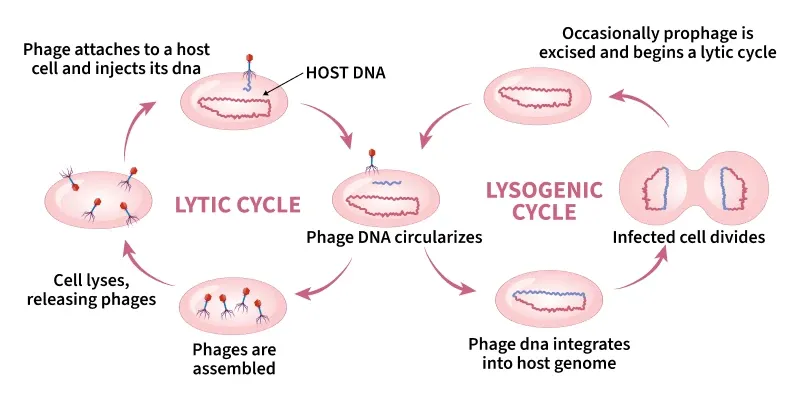
A virus can reproduce in two ways- the Lysogenic Cycle and the Lytic Cycle.
- **Lytic Cycle: During Lytic infection, the virus penetrates the host cell, multiplies, and causes the cell to lyse or burst. The majority of viruses are reproduced by this cycle. The Lytic Cycle is a fast, destructive method of viral reproduction
- **Lysogenic cycle: the virus stays in a dormant phase and does not immediately attack the body. It keeps replicating silently within the body. Only in case of triggers like stress or temperature change, the cells burst and the virus particles spread throughout the body. The lysogenic cycle is a silent or dormant phase.
Diseases caused by a Virus
When a virus enters the human body, it spreads via replication, which results in a viral disease. The virus will initiate the body's immune response, which, in case it is weak, will result in the body getting ill. A typical viral infection is a cold. The following are some other viral diseases:
| Diseases | Description |
|---|---|
| 1. AIDS( Acquired Immunodeficiency Syndrome) | Caused by HIV viruses which infects immune system and slows down the body function and It makes the body unable to fight common infections. |
| 2. Chickenpox | Caused by the Varicella-zoster virus, producing itchy blisters and fever. It spreads easily through air and contact. |
| 3. Measles | Caused by the Measles virus (Paramyxovirus) and It leads to high fever, cough, runny nose, red eyes****.** |
| 4. Mumps | Caused by the Mumps virus (Paramyxovirus) and It leads to painful swelling of the salivary (parotid) glands, along with **fever, headache, and difficulty chewing or swallowing. |
| 5. Herpes | Caused by the Herpes Simplex Virus (HSV-1 and HSV-2) and It leads to painful fluid-filled blisters on the skin, usually around the mouth (cold sores) or genitals. |
| 6. Small Pox | Caused by the Variola virus, characterized by high fever and pus-filled blisters all over the body. |
| 7. Influenza | Caused by Influenza viruses (Types A, B, and C****)** that affect the respiratory system and spreads through air droplets from coughing or sneezing. |
| 8. Viral hepatitis | Caused by hepatitis viruses (A, B, C, D, E) and spreads through contaminated food/water or blood and body fluids . |
Importance of Virus
Viruses are known to cause fatal diseases in humans, but they also have significant roles in our daily lives. The importance of the virus is outlined as follows:
- Viruses are utilised to create vaccines, which can be injected during the infant phase in humans to prevent diseases.
- Viruses do not belong to either the living world or the non-living world. Hence, they act as connecting links.
- Viruses are studied extensively as they help in understanding various processes that occur in molecular biology, such as transcription, replication, immune mechanisms, etc.
- Viruses can be used as vectors that help in the targeted delivery of drugs.
- Viruses are these days, being used in the process of pest management.
- In nanotechnology, viruses can be utilised as carriers for genetically altered genomes.