Immunity (original) (raw)
Last Updated : 19 Dec, 2025
Immunity is a defence mechanism of the body provided by the immune system that helps fight disease-causing organisms. It allows the body to recognize and eliminate pathogens, preventing their harmful effects and promoting overall health.
In simple words, it is the body’s defence system that fights germs like bacteria, viruses, and other harmful substances.
Types of Immunity
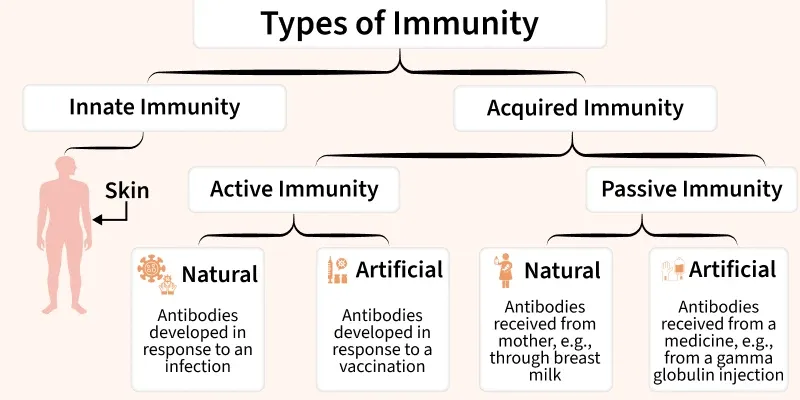
There are two immunity types: innate immunity, providing immediate but nonspecific protection, and acquired immunity****,** offering targeted and memory-based responses.
Innate Immunity
Innate immunity refers to the body's natural defence system that provides immediate protection against pathogens. This type of immunity is present in an organism at birth. It is non-specific, which means it is common to all pathogens.

The cells involved in innate immunity are:
- **Macrophages: Engulf and digest pathogens; act as antigen-presenting cells to activate other immune cells.
- **Neutrophils: Phagocytic cells that rapidly respond to infections, eliminating pathogens through engulfment and destruction.
- **Natural Killer (NK) Cells: Target and destroy virus-infected cells and cancer cells; part of the early immune response.
- **Dendritic Cells: Capture and present antigens to T cells, initiating adaptive immune responses.
- **Mast Cells: Release histamines and other inflammatory mediators in response to injury or infection, contributing to the inflammatory response.
- **Basophils and Eosinophils: Involved in the immune response against parasites and play a role in allergic reactions.
- **Complementary System: Consists of proteins that enhance the immune response by promoting phagocytosis, inflammation, and cell lysis.
- **Epithelial Cells: Form physical barriers and secrete antimicrobial substances, contributing to the defence against pathogens.
Levels of Defence
Two levels of defence come under Innate Immunity:
- First level of defence
- Second level of defence
**First Level of Defence
The first level of defence is provided by the body's physical and chemical barriers, such as the skin and mucous membranes. It acts as a protective shield against pathogens, preventing their entry into the body. The first level of defence includes two types of barriers-
- **Physical Barriers: Skin acts as a physical barrier for incoming pathogens. Mucus epithelium in the nose and gut in the small intestine traps pathogens and prevents their entry into the body.
- **Chemical Barriers: HCl in the stomach creates a strong acidic environment that kills pathogens. Saliva in the mouth and tears in the eyes have anti-biotic properties.
**Second Level of Defence
The second level of defence involves the innate immune system's cellular response, where white blood cells like macrophages and neutrophils recognise and engulf pathogens. The second level of defence includes:
**1. Cellular Barriers
- Cellular barriers involve immune cells like macrophages and neutrophils, which actively protect tissues, engulfing and digesting pathogens to prevent infection.
- These include two types of cells: Phagocytic Cells and Non-Phagocytic Cells
**2. Inflammation
- Inflammation is the body's natural and protective response to injury or infection, characterised by redness, swelling, heat, and pain at the affected site.
**3. Fever
- A condition in which body temperature increases more than normal.
- Pathogens release toxins or pyrogens, and WBCs release Interleukins (a type of c) or pyrogens.
- These pyrogens stimulate the Hypothalamus, which increases body temperature to decrease the growth of pathogens.
- Antipyretic drugs like paracetamol can be used to decrease body temperature.
**4. Cytokines Barriers
- Virus-infected cells release interferons.
- Interferons are small proteins containing 270 amino acids that stimulate non-infected cells to release an antiviral protein known as T.I.P. (Translation Inhibition Protein) that inhibits the translation of viral protein in non-infected cells.
Acquired Immunity
Acquired immunity refers to the immune response that develops after exposure to specific pathogens. Also known as adaptive immunity. It is a learned and adaptive defence mechanism that targets and eliminates specific pathogens.

Cells Involved in Acquired Immunity
Acquired immunity is broadly classified into two types of cells:
**1. B Lymphocytes mediated immunity, or Antibody-mediated immunity, or Humoral immunity: The antibodies produced by B-lymphocytes are present in the blood and are transported all over the body. It has the following features:
- Stem cells in the bone marrow produce immature B lymphocytes that, on maturation in the bone marrow itself, form mature B lymphocytes.
- B cells recognise specific antigens through their B cell receptor.
- The activated B cells produce plasma cells and memory cells.
- The plasma cells release antibodies into the blood.
- The memory B cells remember the information about the pathogen to prevent any disease caused by that pathogen in the future.
**2. T lymphocytes mediated immunity, or cell-mediated immunity, has the following features:
- It involves Helper T cells, Killer T cells, Suppressor T cells and Memory T cells.
- T helper cells initiate Cell-mediated immunity.
- The active T killer cells eliminate the infected cells from the body by releasing perforin protein against cancerous cells and virus-infected cells, thereby promoting apoptosis or programmed cell death.
- The T helper cells also activate other immune cells.
- T lymphocytes are also involved in tissue grafting or organ transplantation.
Types of Acquired Immunity
**1. Active Immunity
- It produces long-lasting responses, and memory cells are also involved in preventing future infestations. Active Immunity is of two types.
- **Natural immunity: It involves all-natural infections. Natural Infections induce the formation of antibodies from plasma cells. Memory cells help in the defence against future infestations.
- **Artificial immunity: It involves all vaccinations. Vaccines help in the formation of memory cells and antibodies artificially
**2. Passive Immunity
- In this type of immunity, prepared antibodies are provided to the host for the treatment of diseases. It is short-lived immunity, and memory cells are not formed.
- **Natural immunity: Passive immunity through natural modes. Example: IgG antibodies through the placenta to the foetus and IgA antibodies through Colostrum (First milk) to infants.
- **Artificial immunity: Passive immunity through artificial modes. Example: Serum and Antivenom.
Types of Immune Response
There are two types of immunity response:
- **First Immune Response: TheFirst immune response is generated when a pathogen encounters the body for the first time. Antigen interacts with the antibody present on B lymphocytes and stimulates cell division of B lymphocytes into plasma cells and memory cells.
- **Second Immune Response: When the same pathogen enters the body next time, the antigens interact this time with antibodies on memory cells. Antibodies IgG are formed in high intensity after antigen-antibody interaction.
Acquired Immunity vs Innate Immunity
The difference between acquired and innate immunity is as follows:
| Innate Immunity | Acquired Immunity |
|---|---|
| Nonspecific, providing general defence | Specific, targeting particular pathogens |
| Immediate, providing a rapid but generic defence | Delayed, taking time to mount a specific response |
| Lacks immunological memory | Possesses immunological memory for future encounters |
| Includes physical barriers, phagocytes, natural killer cells, and complement proteins | Comprises B cells, T cells, and antigen-presenting cells |
| Present from birth and remains unchanged | Develops over time in response to exposure to pathogens |
| Skin, mucous membranes, phagocytes | Antibody-mediated and cell-mediated immune responses |
Autoimmunity
Autoimmunity evolved in higher vertebrates. It is based on the ability to differentiate non-self cells from self-cells. In autoimmunity, the body attacks its own cells. This results in damage to the body. These diseases, in which the body attacks its own cells, are called autoimmune diseases.
- Myasthenia Gravis and Rheumatoid Arthritis are examples of autoimmune diseases.
- Both genetic tendency and environmental triggers, such as infections or certain medications, can contribute to the development of autoimmune disorders.
- Autoimmunity leads to inflammation and tissue damage, impacting the proper functioning of affected organs or systems.
Vaccination
The technique of giving a vaccine to boost the immune system and protect the body from particular infectious diseases is known as vaccination. There are five types of vaccines given below:
| Types of Vaccines | Description | Examples |
|---|---|---|
| **1. Live Attenuated Vaccines | It contains pathogens in a weakened form that, although still capable of replicating, do not infect healthy people. | Varicella (chickenpox), measles, and mumps vaccine. |
| **2. Inactivated (Killed) Vaccines | It includes pathogens that have been rendered inactive or dead to prevent them from replicating. | Hepatitis A vaccination and Inactivated polio vaccine (IPV) |
| **3. Conjugate Vaccines | It includes fragments of the pathogen, as opposed to the whole microbe (such as sugar, protein, or capsid). | Hepatitis B vaccination and the Human Papillomavirus (HPV) vaccine |
| **4. Messenger RNA (mRNA) Vaccines | It contains mRNA responsible for encoding a viral protein. This mRNA is used by cells to make the protein, which in turn sets off an immunological reaction. | COVID-19 vaccines (Pfizer-BioNTech, Moderna) |
| **5. Toxoid Vaccines | It includes toxins that have been rendered inactive by the infection. The immune system defeats the natural toxin. | Diphtheria and Tetanus. |