Improvement in Crop Yields (original) (raw)
Last Updated : 8 Apr, 2026
Improvement in crop yield refers to increasing the quantity and quality of crops produced per unit area of land. It involves utilizing more effective farming methods, improved seeds, and proper management practices to enhance agricultural productivity and ensure food security. Different crops grow best under specific climatic conditions, temperature, and light duration, such as Rabi crops in winter and Kharif crops in the rainy season.
Crop yield can be improved through the following approaches:
- **Crop Variety Improvement: Developing and selecting high-yielding, disease-resistant, and climate-adaptable crop varieties.
- **Crop Production Management: Providing proper nutrients, irrigation, and suitable farming practices to support healthy plant growth.
- **Crop Protection Management: Protecting crops from pests, diseases, and weeds, and ensuring proper storage after harvest.
**Crop Variety Improvement
Improving crop yields depends on finding crop varieties with desirable traits, such as disease resistance, fertiliser response, product quality, and high yield. This can be achieved through hybridisation and genetic modification.
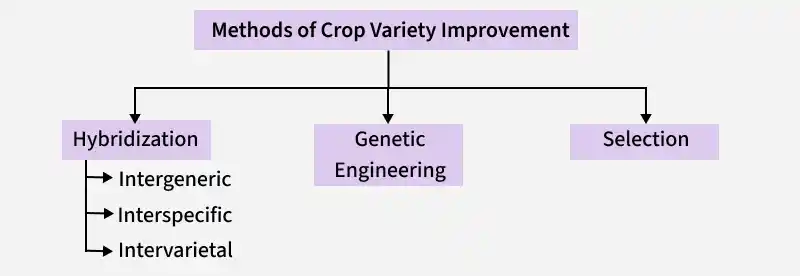
Methods of Crop Variety **Improvement
**1. Hybridisation: Hybridisation involves crossing genetically different parents to create improved crops. There are three types:
- **Interspecific hybridisation: Crossing different species within the same genus.
- **Intergeneric hybridisation: Crossing plants from different genera.
- **Intervarietal hybridisation: Between different variations
**2. Genetic Engineering: This confers the desired traits and produces genetically modified crops.
**3. Selection: Selection involves choosing plants with desirable traits from a mixed population and growing them over generations to develop improved varieties.
**Benefits of Improved Varieties of Crop
Improved crop varieties offer several advantages that enhance agricultural productivity and efficiency. Some key benefits include:
- **Higher Yield: They produce greater output, increasing overall productivity.
- **Better Quality: They provide improved characteristics such as enhanced baking quality in wheat, higher protein in pulses, increased oil content in oilseeds, and longer shelf life in fruits and vegetables.
- **Shorter Growth Duration: Uniform and faster maturity allows timely and cost-effective harvesting.
- **Wider Adaptability: They can grow successfully under different climatic and regional conditions.
- **Desirable Agronomic Traits: Traits such as suitable plant height, bushiness, or dwarfness improve crop management and resistance to lodging.
By selecting and improving crop varieties through these methods, farmers can achieve better yields and quality, ensuring more efficient and sustainable agriculture.
**Crop Production Management
Crop management is the process used to efficiently grow and harvest crops. The methods used for crop production depend on the farmer's budget and can be categorised as 'no cost', 'low cost', and 'high cost' practices.
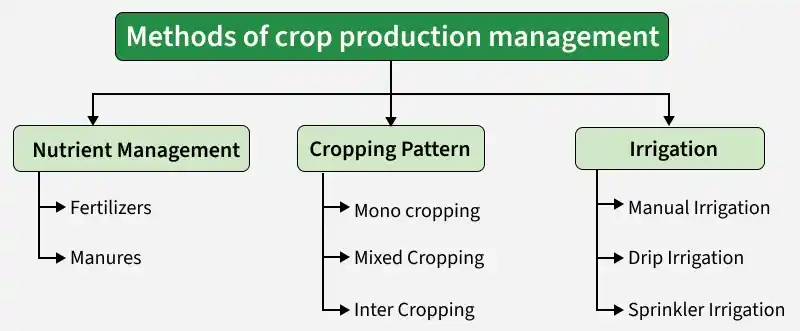
Methods of Crop Production Management
**1. Nutrient management
Plants get their nutrients from the air, water, and soil. There are sixteen essential nutrients for plants. Air provides carbon and oxygen, water provides hydrogen, and soil provides the other thirteen nutrients. Nutrient management involves supplying the soil with these necessary nutrients by adding compost and fertilisers.
- **Fertilisers: Fertilisers are commercially made nutrients for plants, mainly providing nitrogen, phosphorus, and potassium to the soil. Continuous use of fertilisers can reduce soil fertility by not replenishing organic matter and harming soil microorganisms. Sustainable farming can be achieved through organic farming.
- **Manure: Manure is organic matter derived from plant and animal waste, decayed plants, and agricultural waste like dry leaves and twigs. It contains many nutrients, improves soil quality, and increases healthy crop yields.
**2. Cropping Patterns
A cropping system is the type and sequence of crops farmed, and the procedures employed to grow them. The common types of crop patterns include the following:
- Monocropping: Monocropping is the cultivation of only one agricultural species on a piece of land. Continuous monocropping may reduce soil fertility over time and structure.
- **Mixed Cropping: Mixed cropping occurs when two or more crops are planted on the same area of land at the same time. When you plant wheat and gram on the same area of ground at the same time, this is known as mixed cropping.
- **Inter Cropping: Intercropping is the practice of simultaneously producing multiple crops in the same row pattern on the same piece of land. Three rows of intercrops are commonly planted after one row of the main crop. This boosts per square foot productivity. For Example, crops like maize and soybean can be grown together in alternate rows.
**3. Irrigation
Crop irrigation is the process of artificially supplying water to crops to ensure their growth and productivity, especially in areas where rainfall is insufficient or irregular. Sources of irrigation include ponds, canals, tube wells, and Reservoirs. Irrigation can also provide nutrients to crops. There are different types of irrigation systems, including:
- **Manual irrigation: This is a labour-intensive and time-consuming irrigation method. Manual labour is used to distribute water using watering cans.
- **Drip irrigation: Drip irrigation is the most effective way to supply water and nutrients to crops. It provides water and nutrients directly to the root zone of the plant in the proper amounts and at the right time. Horticulture crops are mostly irrigated with drip irrigation.
- **Sprinkler Irrigation: Sprinkler irrigation is a technique for distributing irrigation water through pipes and spray heads to irrigate the whole soil surface.
Importance of Crop Production Management
- Helps farmers obtain higher and better-quality crop yield.
- Ensures proper use of resources such as soil, water, seeds, and fertilisers.
- Promotes healthy plant growth through timely sowing, irrigation, and nutrient supply.
- Reduces crop loss due to weeds, pests, and diseases.
- Maintains soil fertility and productivity for future cultivation.
- Supports safe harvesting and proper storage, preventing post-harvest losses.
- Contributes to sustainable agriculture and food security.
Crop Protection Improvement
Crop protection involves safeguarding crops from pests, weeds, diseases, and other harmful organisms. To ensure high crop yields, farmers must protect their crops before, during, and after growth. Fields often face threats from weeds, rodents, fungi, insects, and disease-causing microbes, all of which can damage crops.
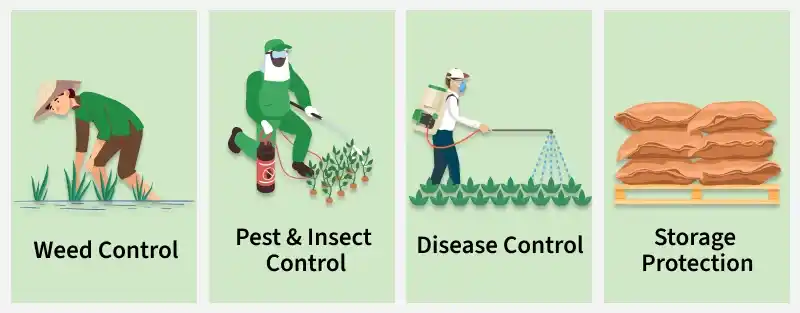
Methods of Crop Protection Methods
- **Weed Control: Weeds are the unwanted plants that grow with the crops. These plants also collect the essential nutrients, sunlight, and water from the same resources that are essential for the crops.
- **Pest and Insect Control: Insects and pests are the main cause of crop damage and loss of yield. These agents ruin the entire crop by eating the major portion of the grains
- **Disease Control: Pathogenic diseases harm crops. They are caused by bacteria, fungi, and viruses. These diseases affect different parts of the crops in different ways.
- **Storage Control: Harvested crops may be damaged by insects, rodents, and microorganisms during storage.
Importance of Crop Protection in Agriculture
- Helps prevent loss of crop yield caused by pests, diseases, and environmental stress.
- Enables farmers to increase production even on limited land areas.
- Preserves soil nutrients and supports biodiversity.
- Improves the quality of food and helps reduce overall food costs.
- Protects the environment by promoting safe and balanced farming practices.