Integumentary system (original) (raw)
Last Updated : 18 Dec, 2025
An integument is a layer or coating on the surface of an organism. It may cover the whole organism or parts of it, depending upon its nature and need. Integuments can include skin, hair, membrane, cuticle, etc., based on their function. The integument** serves as the primary layer that separates the underlying tissues from the external environment. The absence of this layer hinders the organism's capacity to survive and operate.
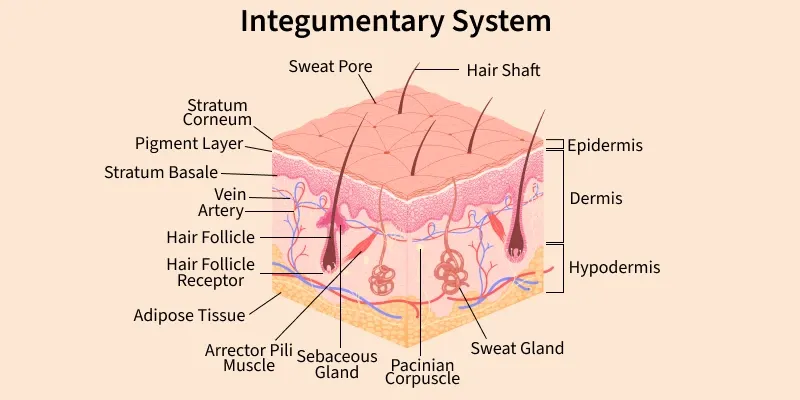
Organs of the Human Integumentary System
In humans, the integumentary system includes the outermost covering of the body, i.e. the skin, along with its components, including hair, nails, and various glands. The skin acts as a defence barrier against various external factors like infectious microorganisms, UV radiation, and bodily damage. Let’s discuss these integumentary components in detail.
**Skin
- The skin is a multiple-layered, composite organ that protects the body against numerous external damages.
- It also regulates body temperature, produces excreta in the form of sweat, and acts as a receptor for touch, temperature, and pain.
- The skin consists of three main layers Epidermis, the Dermis, and the Subcutaneous layer.
**Nails
- Nails are composed of a protein called keratin.
- Being derived from the epidermis, nails have various functions, including protection of fingers and toes, providing sensation in the tips of fingers and toes, and performing motor tasks like picking up objects, typing, etc.
**Hair
- Hair is also composed of keratin protein.
- It acts as a protective cover for various parts of the body, including the eyes and scalp.
- Hair also has functions in sensation and thermoregulation.
**Apocrine Sweat Glands
- This is a kind of sweat gland found in the underarms and anogenital areas.
- The exact function of apocrine sweat glands is still to be explored; various research studies suggest that apocrine glands may play a role in scent production and possibly other physiological processes.
**Eccrine Sweat Glands
- These glands are present throughout the skin, but mostly these glands are present on the palms, soles, forehead, and armpits.
- This gland produces sweat that helps regulate body temperature.
**Sebaceous Glands
- These glands produce an oily secretion called **sebum.
- lubricates and protects the skin and hair.
**Ceruminous Glands
- Located in the external auditory canal
- These glands secrete a substance called cerumen, commonly known as earwax.
- Cerumen acts as a protective barrier, stopping dust, debris, and foreign particles from entering the ear canal and thus protecting the eardrum from damage or infection.
**Mammary Glands
- These glands are present in both females and males, but they typically develop and function fully in females.
- These glands produce milk for the newborn, which is rich in essential nutrients, antibodies, and other bioactive compounds required for growth, development, and immune system support.
Functions of the Integumentary System
The primary functions of integuments include:
- **Protection: Integument protects against external strains, infectious pathogens, UV radiation, etc.
- **Regulation: Regulation of body temperature is an important aspect of the integument. It maintains body temperature by **sweat production, **blood flow regulation, and **insulation.
- **Sensation: Integuments also function as sensory receptors. They help in detecting touch, temperature, and pain, allowing organisms to interact with their environment.
- **Excretion: Integuments facilitate the excretion of waste products via sweat glands. It helps the body maintain homeostasis.
- **Respiration: In various organisms, the integument helps in gas exchange, i.e. allowing oxygen uptake and carbon dioxide release, especially in aquatic environments.
How does the Integumentary System Work with Other Systems?
To regulate bodily functions, the integumentary system works in coordination with other systems present in the body. These interactions with other systems include:
- **Nervous System: The sensory receptors present in the skin help detect environmental cues such as touch, pressure, temperature, and pain. The receptor transmits those cues as chemical signals to the nervous system, enabling the nervous system to take the appropriate response.
- **Immune System: The skin acts as the first and foremost barrier to organisms of a pathogenic nature. Also, as the glands on the skin produce sweat and sebum, these substances prevent the growth of bacteria and other harmful organisms, contributing to the body's defence against infections.
- **Circulatory System: The skin contains numerous blood vessels that help in regulating body temperature. It dilates or constricts the blood vessels, according to need, to regulate heat loss or retention. Additionally, these blood vessels also transport nutrients and oxygen to skin cells.
- **Digestive System: The skin produces sweat that helps in the elimination of various waste products, such as small amounts of water, salts, and urea. Additionally, the skin helps the digestive system acquire vitamin D through sunlight, which is required by the body for the absorption of calcium.
Integuments in Invertebrates
Similar to the human integumentary system, invertebrates also possess an integumentary system that acts as a protective barrier against external stresses. Let’s discuss integuments in various invertebrate phyla.
- **Arthropods: Including insects, arachnids, crustaceans, and myriapods, the integument system in arthropods is made up of a rigid exoskeleton- mostly **chitin, a polysaccharide, and proteins. Here, the integument acts as a shield against physical injuries, pathogens, and desiccation.
- **Molluscs: Various molluscs have a calcareous shell or exoskeleton that provides protection and support. This phylum includes animals like snails, clams, squids, and octopuses.
- **Annelids: Including earthworms, leeches, and marine worms, the annelid integumentary system serves various functions, including protection, movement, respiration, and sensory perception.
- **Cnidarians: The integumentary system in cnidarians is composed of an external epidermal layer and an internal gastrodermal layer separated by a gelatinous mesoglea. It provides protection and support and includes organisms such as jellyfish, corals, and sea anemones.
Common Integumentary Disorders
Some common integumentary disorders include:
- **Acne: In this condition, the skin develops pimples, blackheads, whiteheads, and cysts, on the skin. This is due to excessive oil production, clogged hair sacs, or hormonal imbalance.
- **Eczema (Dermatitis): In this condition, due to inflammation in the skin, it becomes red and itchy. Eczema can be caused due to genetics, immune system dysfunction, environmental factors, and allergens.
- **Psoriasis: This is a chronic autoimmune condition of the skin. It causes a rapid increase in the number of skin cells, causing thick, silvery scales and red patches to appear on the skin. This can be either hereditary or caused by immune system dysfunction, and environmental factors.
- **Impetigo: This condition is caused by bacterial infection and is highly contagious. It causes red sores or blisters on the face, hands, and other parts of the body. This is caused by the gram-positive bacteria: S. aureus or S. pyogenes.
- **Vitiligo: In this skin condition, the skin loses its pigment, causing white patches on the skin. This condition is caused due to the autoimmune destruction of melanocytes.