Meristematic Tissues (original) (raw)
Last Updated : 24 Apr, 2026
Meristematic tissues are a type of plant tissue that plays an important role in the growth and development of plants. These tissues consist of undifferentiated cells that can divide and differentiate into various types of specialised cells. The term "meristem" was given by Carl Wilhelm von Nägeli. Meristematic tissues are mainly found in that part of the plant where active growth occurs, such as at the tips of roots and shoots.
**Characteristics of Meristematic Tissue
The characteristics of the meristematic tissues are as follows:
- Meristematic tissues consist of cells that have not yet differentiated into specific cell types.
- These tissues undergo rapid and frequent cell division, contributing to the growth of the plant.
- Meristematic tissues are responsible for primary growth, which leads to an increase in the length of plant structures.
- These tissues are commonly found at the tips of roots, shoots, and other growing regions of the plant.
- Meristematic tissueexhibits totipotency.
- Secondary meristems such as vascular cambium and cork cambium are responsible for secondary growth.
**Classification of Meristematic Tissue
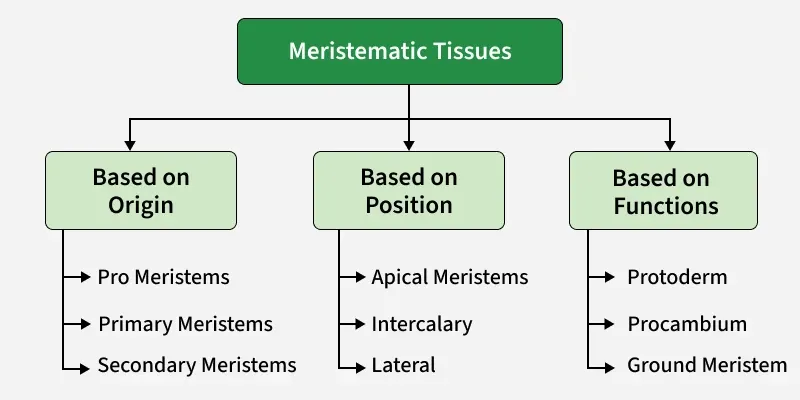
Meristematic tissue is classified based on its origin, position, and functions. The classification of meristematic tissue is as follows:
**Classification Based on Origin
The meristematic tissue is divided based on origin as follows:
1. **Pro Meristems
- Pro meristems are the earliest stage of undifferentiated cells in plant development and are the precursors to specialised meristematic tissues.
- Found in growing regions, such as root and shoot tips, it contributes to primary and secondary growth in plants.
- It is responsible for the growth and development of apical, lateral, and intercalary meristems.
**2. Primary Meristems
- Derived from pro meristems, they are the first set of differentiating meristematic cells.
- Primary meristems are of three types: protoderm, ground meristem, and procambium.
- Protoderm forms the outer layer, ground meristem produces internal tissues, and procambium differentiates into vascular tissues.
- Primary meristem gives rise to specific plant tissues—epidermis, ground tissues, and vascular tissues (xylem and phloem).
- Primary meristems contribute to primary growth, which is elongation in plants.
**3. Secondary Meristems
- Secondary meristems develop in the later stages of a plant's life from primary meristems or cambium cells.
- It is of two main types—vascular cambium and cork cambium (phellogen).
- Vascular cambium gives rise to secondary xylem and secondary phloem, leading to an increase in girth in woody plants(secondary growth).
- Cork cambium produces protective outer bark, helping in plant protection and growth.
- Vascular cambium is present between the primary xylem and the primary phloem in stems and roots. Cork cambium is found in the outer bark.
**Classification Based on Position
The meristematic tissue is divided based on position as follows:

**1. Apical Meristems
- Apical meristems are present at the tips of roots and shoots in plants.
- It is responsible for primary growth, which leads to the elongation of plant structures.
- It is of two main types—root apical meristem (at root tips) and shoot apical meristem (at shoot tips).
- Apical meristems ensure continuous growth and renewal throughout a plant's life.
**2. Intercalary Meristems
- Intercalary meristems are present at the base of leaves or internodes at the intercalary position.
- Intercalary meristems enable rapid growth and regeneration in response to injury.
- It helps in regrowing plant parts like leaves and stems after they have been removed.
- It helps in the elongation of stems and leaves.
- More commonly found in monocot plants, such as grasses and bamboo.
**3. Lateral Meristems
- Lateral meristems form in mature plants from primary meristems.
- It is of two main types—vascular cambium and cork cambium (phellogen).
- It is responsible for secondary growth, adding girth by producing secondary xylem and phloem.
- Vascular cambium is present between the primary xylem and phloem in both stems and roots. Cork cambium is present in the outer bark.
- Lateral meristems help plants to adapt to changing conditions.
**Classification Based on Functions
The meristematic tissue is divided based on function as follows:
**1. Protoderm
- Protoderm is a primary meristem that forms the epidermis, the outermost layer of plant tissues.
- It acts as a barrier against physical damage, pathogens, and water loss.
- Protoderm is important as it forms the epidermal layer in both root and shoot tissues.
**2. Procambium
- Procambium is a primary meristem that produces vascular tissues (xylem and phloem).
- Procambium differentiates into primary xylem and primary phloem, which are essential for fluid and nutrient transport.
**3. Ground Meristem
- Ground meristem is a primary meristem that produces ground tissues.
- It differentiates into various types of ground tissues like parenchyma, collenchyma, and sclerenchyma.
- Parenchyma stores nutrients, collenchyma gives support, and sclerenchyma provides structural strength.
**Functions of Meristematic Tissue
Meristematic tissues are important for plants as they contribute to growth, development, and adaptation. Some of the important functions of meristematic tissue are as follows:
- Meristematic tissues for both primary and secondary growth in plants, allowing them to increase in both length and girth.
- It produces various types of specialised cells, which then differentiate into different plant tissues such as epidermal, vascular, and ground tissues.
- Meristematic tissues start the formation of new leaves, stems, roots, and other plant structures.
- Vascular tissues that originate from meristematic tissues are responsible for the movement of water, nutrients, and minerals throughout the plant.
- Meristematic tissues allow plants to adapt to changing environmental conditions by forming new tissues and structures.
- Intercalary meristems result in the repair and regrowth of the injured plants, especially after grazing or cutting off plants.