Permanent Tissues (original) (raw)
Last Updated : 24 Apr, 2026
Permanent tissues are a type of plant tissue that has completed its growth and differentiation. These tissues perform specific functions and are responsible for the overall structural growth and function of the plant. Permanent tissues consist of mature, differentiated cells that have lost the ability to divide. These mature cells perform specific functions essential for the plant's growth, survival, adaptability, and overall functionality.
There are three main types of permanent tissues: Simple, Complex, and Special Permanent Tissues.
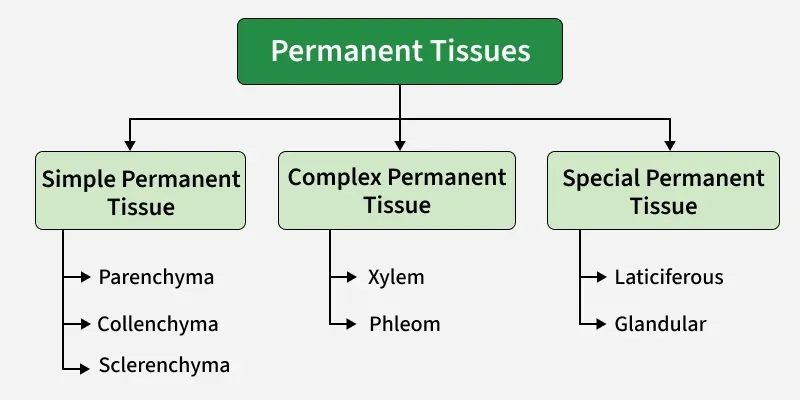
Simple Permanent Tissue
These tissues consist of a single type of cell, mainly originating from the same source and having similar structure and functions. They are also calledhomogeneous tissues. Simple permanent tissue is classified into three types, which are as follows:
**1. Parenchyma
Parenchyma cells have a thin cell wall composed of hemicellulose or cellulose and a large central vacuole. These cells are involved in photosynthesis, gas exchange and nutrient storage.
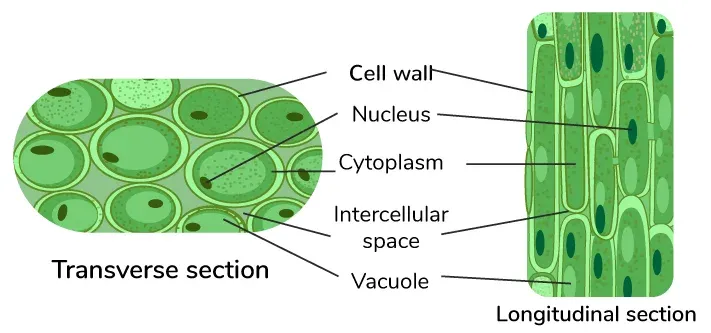
The parenchyma is divided into two types as follows:
- **Chlorenchyma: It contains chlorophyll and helps in photosynthesis.
- **Aerenchyma: It contains air cavities and is present in aquatic plants, known as aerenchyma. It provides buoyancy to aquatic plants. They help in the formation of the anaerobic rhizosphere in anaerobic soil.
**2. Collenchyma
These tissues consist of living, elongated cells that are unevenly thickened at the corners due to deposition of cellulose and pectin. They are found under the epidermis and in the vascular bundle of a dicot leaf. They lack intercellular spaces. Collenchyma contains cellulose, hemicellulose, and pectic materials. It may or may not contain chloroplasts and perform photosynthesis and store food.
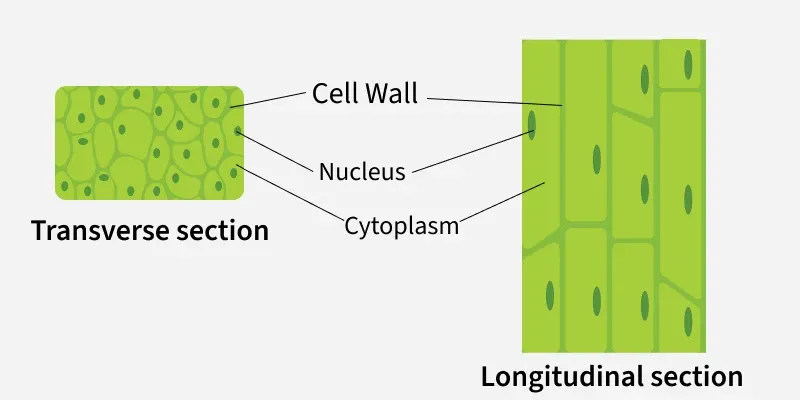
The collenchyma is divided into four types as follows:
- **Tangential Collenchyma: In this collenchyma, cells are thickened at the tangential part of the cell wall and are arranged into lined-up rows.
- **Lacunar Collenchyma: In this collenchyma, there is space within the cells.
- **Angular Collenchyma: In this collenchyma, the intercellular contact points are thickened.
- **Annular Collenchyma: In this collenchyma, cell walls are thickened uniformly.
**3. Sclerenchyma
These tissues are made up of long and narrow dead cells and lack intercellular space. They have thick, lignified cell walls, thereby providing strength and durability to the plant structure. Sclerenchyma cells offer rigidity, structural support and protection. These are present in the stem, around the vascular bundle, in the veins of leaves, and in the hard covering of seeds and nuts.
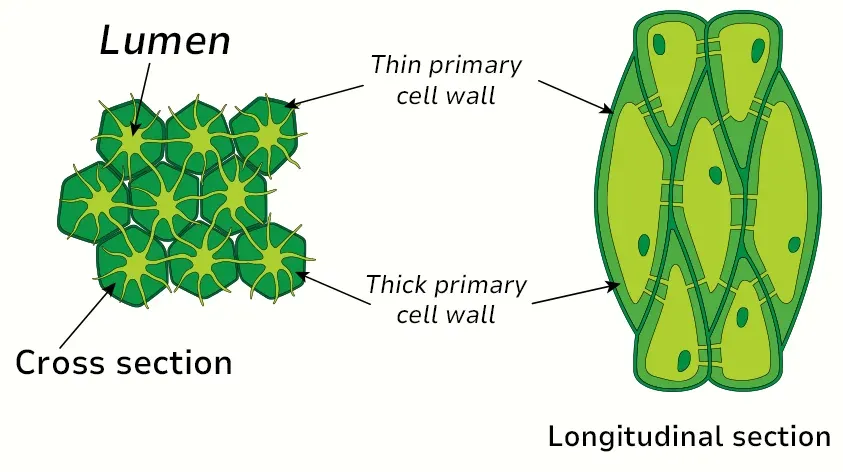
The sclerenchyma is divided into two types as follows:
- **Fibre: They have long cells, which provide strength to the plant. They are often found in bundles or strands and present in the stem, the roots, and the vascular bundles of leaves. They are mainly found in clusters, clumps, or patches.
- **Sclereids: They are present in different shapes and are found in tissues such as the periderm, cortex, pith, xylem, and phloem. They are present in various parts of the plants, such as the outer covering of nuts and seeds. Example: The grainy texture of pears and guavas.
Parenchyma vs Collenchyma vs Sclerenchyma
The difference between parenchyma, collenchyma, and sclerenchyma is as follows:
| **Parenchyma | **Collenchyma | **Sclerenchyma |
|---|---|---|
| The cells are living and thin-walled. | The cells are living and thick at the corners. | Due to lignin deposition, the cells are dead and thick-walled. |
| The shape of the cells is oval, spherical, or polygonal. | The cells are elongated and thickened at the corners. | The cells are narrow and long. |
| A large intercellular space is present between the cells. | Intercellular space is very small | No intercellular space. |
Complex Permanent Tissue
Complex permanent tissues are made up of different kinds of specialised cells that work together to perform specific functions within a plant. It helps in the transportation of food, water, and minerals throughout the plant.
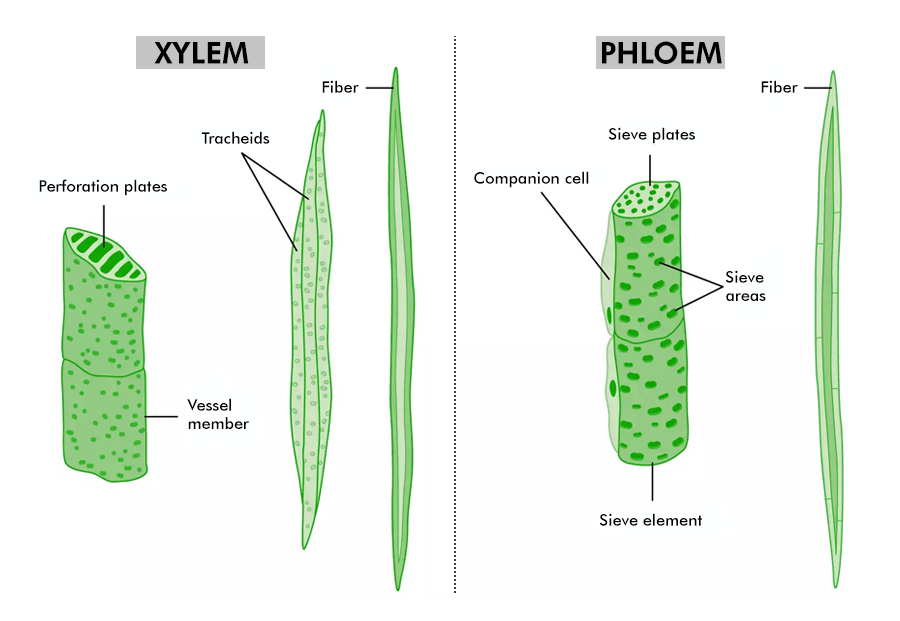
**1. Xylem
- It is mostly made up of dead cells and is used to transport water and minerals from the root to leaves and other parts of the plant.
- It consists of various cell types, including tracheids and vessel elements for water conduction, fibres for support, and xylem parenchyma cells for storage.
- Only the Xylem parenchyma is made up of living cells and contains food.
- The tracheids and vessels are long, elongated, and hollow.
**2. Phloem
- Phloem is composed of living cells and helps in the transportation of food from leaves to other parts of plants.
- It is made up of sieve tube elements, which are responsible for transporting nutrients, and companion cells that support sieve tube elements, phloem fibre, and phloem parenchyma.
- Only the phloem fibre is made up of dead cells.
- They are also responsible for the transportation of proteins and mRNAs.
**Secretory Tissues
As the name indicates, these tissues are related to the secretion of substances such as gums, resins, latex, nectar, etc.The secretory tissues are of two types, which are as follows:
- **Laticiferous Tissues: They are long, elongated, thickened, and multinucleated cells and contain a yellowish substance called latex. When laticifers are damaged, they release latex, which can have protective, defensive, or healing functions for the plant. Its function ranges from deterring herbivores to healing wounds. They are spread over the parenchyma cells of plants.
- **Glandular Tissues: These tissues contain glands that secrete various essential products like essential oils, mucilage (in betel leaf), gum, resin, tannin, digestive enzymes, etc. Glandular tissues are commonly found in structures such as flower petals, leaves, and stems. The secretions they produce can serve various purposes, including attracting pollinators, deterring herbivores, or aiding in wound healing.